

The clearest signs you’re being pushed out of your job include sudden loss of responsibilities, exclusion from key meetings, vague negative feedback after previously strong reviews, unrealistic goals, HR appearing in routine conversations, and direct or indirect pressure to resign. When several of these signals appear together within weeks of each other, the pattern almost always means deliberate action — not coincidence. The right response is calm, strategic documentation — not panic.
You usually feel it before you can prove it. Your manager becomes colder. Meetings happen without you. Work you used to own quietly moves to someone else. Then, without warning, every small mistake becomes “a concern” — while your actual contributions go unacknowledged.
These are often signs you’re being pushed out of your job — not through a direct firing, but through a slow, deliberate process of making your role uncomfortable, irrelevant, or impossible to succeed in. I’ve studied this dynamic across hundreds of workplace situations, and I can tell you: the pattern is more common than most people realize, and it almost always has a recognizable fingerprint.
Not every awkward workplace change means you’re being targeted. Companies reorganize. Managers get stretched. Priorities shift without explanation. But when multiple warning signals appear together — especially after a specific trigger event — you need to stop hoping it will fix itself and start protecting your career.
This guide breaks down 17 signs you’re being pushed out, how to tell the difference between normal change and deliberate targeting, and exactly what to do before you resign, get terminated, or accept a bad severance deal.
What Does “Being Pushed Out of a Job” Actually Mean?
Being pushed out means your employer — whether it’s your direct manager, HR, or senior leadership — is trying to engineer your departure without directly firing you. The goal is to make you uncomfortable enough, or unsuccessful enough, that you either resign voluntarily or give them clean documentation to terminate you for “performance.”
This is sometimes called quiet firing. In more serious cases — particularly where contract breaches, discrimination, retaliation, or a forced resignation are involved — it can carry real legal weight. In the UK, for example, ACAS defines constructive dismissal as a situation where an employee resigns because the employer seriously breached the employment contract — including scenarios involving bullying, ignored grievances, or unreasonable changes to working conditions. In the US, the EEOC treats retaliation as unlawful when an employer punishes an employee for protected activity, such as reporting harassment or discrimination.
That doesn’t mean every hostile manager is breaking the law. Most push-outs are painful but technically legal. The point is: you need to understand what’s happening, document it carefully, and make smart moves — not emotional ones.
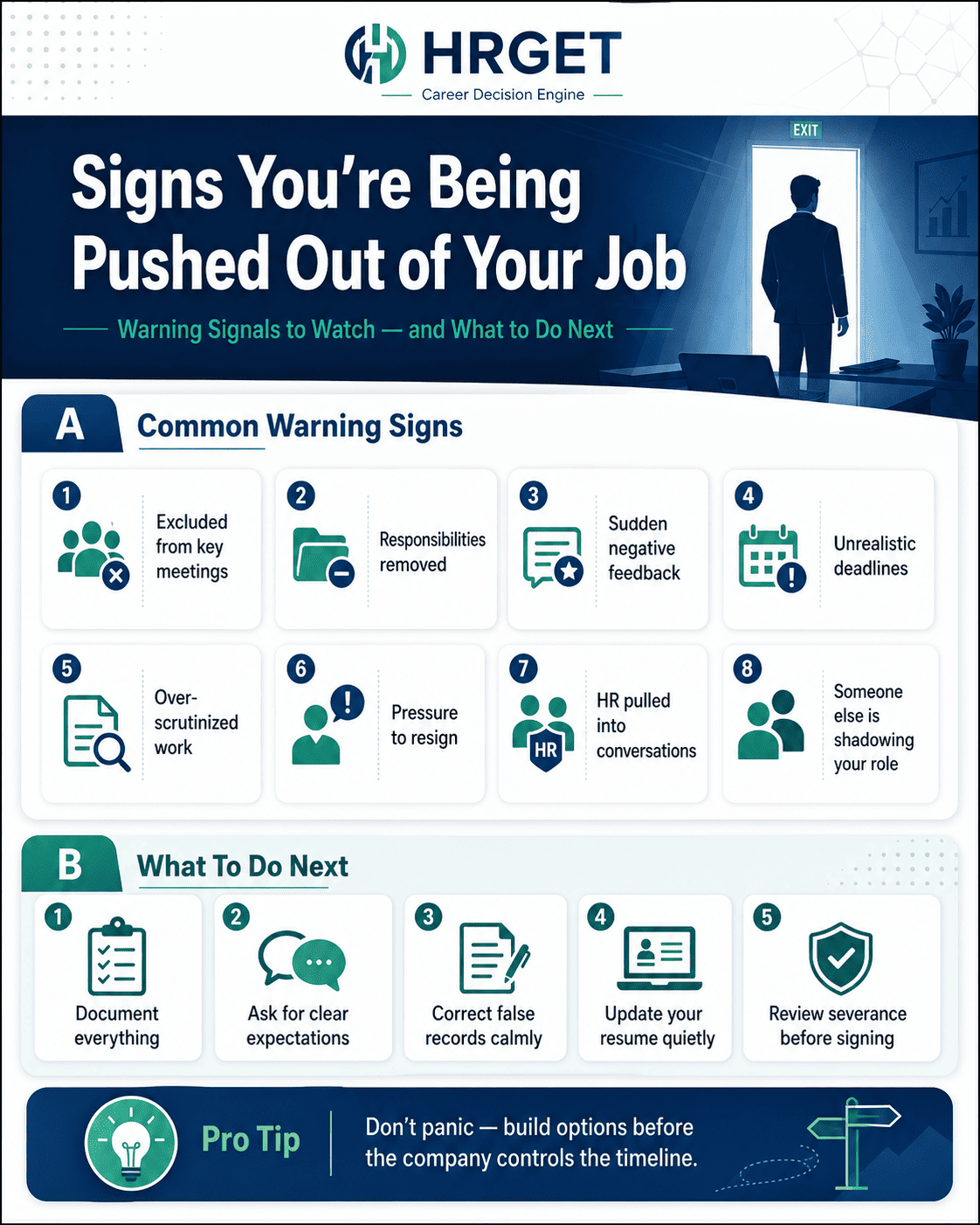
17 Signs You’re Being Pushed Out of Your Job
1. Your Responsibilities Are Quietly Taken Away
This is the most common early signal. You’re still employed, still attending some meetings — but the meaningful work starts disappearing. Important projects, client relationships, and strategic decisions migrate to someone else, often without any explanation.
The dangerous part isn’t the change itself. It’s the silence around it.
Example: You used to run the monthly leadership review. Then one week your manager says, “Let’s have Priya handle it this time.” After that, it never comes back to you.
When this happens, don’t react with frustration. Ask directly but professionally — and push for a written answer:
“I noticed the ownership of [project] has shifted. Could you help me understand whether this is a temporary change or a longer-term adjustment to my role?”
2. You’re Excluded From Meetings You Used to Attend
One missed invite is noise. A pattern is signal. If you’re suddenly dropped from leadership updates, planning calls, client conversations, or roadmap sessions — especially without explanation — that’s workplace exclusion in motion. It reduces your organizational visibility and makes it easier for others to say, eventually, that your role isn’t essential.
The tell? People say, “Oh, we didn’t think you needed to be in that one,” even when the meeting directly affects your work. Respond in writing:
“I saw there was a planning discussion on [topic]. Since my work depends on that decision, should I be included going forward?”
3. Your Manager Stops Investing in You
Silence can be worse than criticism. If your manager used to coach you, discuss your career, give substantive feedback — and now barely engages — that disengagement often means they’ve mentally moved on. One-on-ones get cancelled repeatedly, or shrink to five-minute status updates. Your growth is never discussed.
I’ve seen this dozens of times. A manager who wants to retain someone actively invests in them. A manager building an exit case becomes distant, transactional, and strategically vague.
Pro Tip
Ask for feedback before the company claims you ignored it. Send your manager a message: “I want to make sure I’m aligned with expectations. What are the top two things you’d like me to improve this quarter?” If the answer is vague, follow up: “Could we define what success looks like in measurable terms?” You either get clarity — or evidence that expectations were deliberately kept ambiguous.
4. Negative Feedback Appears Out of Nowhere After Strong Reviews
You had solid performance reviews. Your work was consistently appreciated. Then suddenly your communication, ownership, “executive presence,” or attitude is called into question. Sometimes this feedback is valid — but when it appears without specific examples, after a leadership change or a conflict, and for the first time after years of positive signals, it’s a risk sign, not a development conversation.
Red flags: feedback with no concrete examples, criticism framed as “perception,” complaints you’ve never heard before, or old incidents being resurfaced months later. Ask directly:
“Can you share two specific examples so I can understand the behavior and work on it?”
If they can’t answer that, the issue is political — not performance.
5. You’re Given Unrealistic Goals or Impossible Deadlines
A classic push-out tactic: set the bar somewhere no one could realistically clear, then use the resulting gap as evidence of underperformance. Watch for goals that are vague, unmeasurable, dependent on teams you don’t control, or significantly harder than what your peers are expected to deliver — assigned with no additional support.
Don’t accept impossible goals verbally. Respond in writing:
“I’m committed to this. The main dependencies are A, B, and C. If those aren’t available by [date], the delivery timeline will need to be adjusted accordingly.”
You’re not refusing. You’re creating a contemporaneous record of the constraints that existed.
6. Your Work Is Suddenly Over-Scrutinized
Your manager starts demanding daily status reports when others report weekly. Minor errors become “serious concerns.” Emails you used to send independently now require approval. You’re asked to document decisions you’ve been making autonomously for two years. This isn’t higher standards — when it applies only to you, it’s targeted monitoring, and it often precedes a documented termination process.
Stay professional. Respond to every scrutiny with clean, factual communication. Don’t get frustrated in writing. The goal is to be undeniably professional while the paper trail being built around you collapses under its own selectivity.
7. A Paper Trail Starts Building — Fast
Normal documentation exists in all companies. What’s abnormal is a sudden escalation: written warnings appearing after months of only verbal conversations, HR copied on emails, formal meeting summaries sent after calls that were previously casual, or sudden references to specific company policies you’ve never heard cited before.
Warning
When HR appears unexpectedly in performance conversations, do not panic — but do not ignore it either. From that point, every communication you send and receive is potentially part of a legal or HR record. Respond to inaccurate summaries with calm corrections: “I want to clarify one point for accuracy: the delay was caused by the vendor dependency resolved on April 12. I delivered the revised version on April 15.” Never leave a false record unchallenged.
8. You’re Placed on a Performance Improvement Plan
A PIP isn’t automatically a death sentence — some employees do successfully complete them. But in a significant number of organizations, a PIP is a pre-termination documentation step, not a genuine development tool. The question that matters isn’t whether you received one. It’s whether it was actually designed for you to succeed.
| A Fair PIP | A PIP Designed for Exit |
|---|---|
| Clear, measurable success criteria | Vague phrases like “improve attitude” |
| Reasonable timeline (60–90 days) | Unrealistically short deadlines |
| Regular coaching and manager support | Manager absent or hostile |
| Objective, observable goals | Subjective judgment calls |
| Goals within your direct control | Dependencies on teams you don’t manage |
| Tone of genuine improvement focus | Tone that feels pre-decided |
If you receive a PIP, ask: “What specific evidence would show that I’ve successfully completed this plan?” If they can’t answer clearly, you have your answer.
9. You’re Left Out of Future Planning
When your manager stops discussing your promotion path, your role in next quarter’s plans, or which projects you’ll lead in the coming months — that absence of future talk is its own signal. You’re being treated as present today but not expected to be around tomorrow. Ask directly: “How do you see my role evolving over the next six months?” The answer — or the deliberate avoidance — will tell you more than any performance review.
10. Someone Is Being Trained to Replace You
Cross-training is normal. What’s not normal: a colleague being asked to shadow you unexpectedly, learn your specific systems, join your client calls, or take over your documentation — without a clear organizational reason. The distinction matters.
Normal backup: “We want coverage while you’re on parental leave.”
Replacement signal: “Please document everything you do” — followed by your work being quietly transferred.
Cooperate professionally. But update your resume, document your achievements, and start exploring external options quietly. Don’t wait for confirmation.
11. Your Access, Budget, or Authority Is Reduced Without Explanation
You lose access to systems you rely on. Budget you controlled gets reallocated. Stakeholders are told to route around you. Your direct reports start attending meetings with your manager instead of you. This manufactured dependency — stripping the tools you need to succeed, then citing your reduced output — is one of the most deliberate forms of a push-out.
Push back in writing: “I noticed my access to [system] was removed. Since I need it for [responsibility], should I assume that responsibility has changed?” This forces clarity and creates a record that the constraint came from above — not from you.
12. Your Manager Communicates Through HR Instead of Directly
HR involvement in routine people matters isn’t automatically ominous. But when ordinary management conversations suddenly become HR-led — when HR is present in meetings your manager used to handle alone — the situation has changed. This typically signals that a termination is being prepared, there’s legal sensitivity in the situation, or a formal separation is being considered. In the US, large-scale layoffs may also trigger WARN Act notice obligations for covered employers — worth understanding even if your situation is individual. When HR joins, slow down. Don’t sign anything immediately. Ask for documents. Take notes. Request time to review.
13. You’re Pressured to Resign
This is a major escalation. If your manager or HR says things like “maybe this role isn’t the right fit,” “it might be better if you left voluntarily,” or “we can keep this clean if you resign” — do not resign on the spot. Depending on your contract, country, and circumstances, resignation can affect severance eligibility, unemployment benefits, legal options, and bonus or equity timing.
Warning
The company wants you to make an emotional decision that benefits them, not you. One sentence protects you: “I’m not resigning today. If the company is proposing a separation, please share the details in writing so I can review them.” That single response — said calmly — can be worth tens of thousands of dollars in preserved options.
14. Your Reputation Is Being Reframed
People who previously respected you become cautious around you. Normal professional pushback is reframed as “resistance.” Asking about project scope becomes “lack of ownership.” This is often how an exit narrative gets constructed — not through your actual performance, but through the language chosen to describe it.
Common labels deployed before a push-out: “not a team player,” “poor communication,” “not aligned with culture,” “low energy,” “doesn’t take feedback well.” Some may be genuine feedback. But if these labels appear suddenly, without examples, challenge them constructively. Ask for specifics. Without examples, the label is political, not factual.
15. Your Achievements Are Minimized or Erased
When a company wants to retain you, they remember your wins. When they want you out, your contributions become “team success” and your mistakes become yours alone. A performance review that focuses more on style complaints than measurable outcomes — while ignoring a successful delivery you own — is a deliberate narrative strategy, not a balanced assessment.
Build and maintain a personal achievement file. Include project deliverables, revenue or cost impact, customer outcomes, metrics improved, positive emails, stakeholder recognition, and awards. You may need this for severance negotiation, internal escalation, legal advice, or your next job interview. Don’t wait until you’re desperate to gather it.
16. Your Role Is Being Reorganized Around You
Sometimes being pushed out isn’t personal — it’s structural. Your company is eliminating your function, merging teams, outsourcing, or shifting strategy. The warning sign isn’t the reorganization itself. It’s the lack of transparency about where you fit in it. Your role isn’t mentioned in the new org chart. Your manager avoids the question directly. Others know about the changes before you do. Ask early: “With the new structure, what role do you see me playing and what responsibilities will remain with me?” Vague answers mean you should start preparing your exit strategy.
17. You Feel Like You’re Being Set Up to Fail
This is the overarching pattern. One signal in isolation might mean nothing. But when responsibilities are reduced, goals become unrealistic, your manager documents every issue, HR starts appearing, your replacement is being quietly trained, and you’re encouraged to resign — that combination is no longer workplace stress. That’s a coordinated exit process.
Insider View
Here’s what most HR professionals won’t tell you publicly: once a senior leader has decided they want someone out, the formal process — PIPs, documentation, escalating feedback — is often built retroactively to justify the decision that’s already been made. The time to act is when the pattern begins, not when the final meeting is scheduled. By then, the narrative has already been written.
How to Tell the Difference: Normal Change vs. Being Targeted
Not every uncomfortable workplace shift means you’re being pushed out. Companies change. Managers have bad quarters. Priorities get reshuffled. Here’s a practical framework to separate noise from signal:
| Normal Workplace Change | Possible Push-Out Situation |
|---|---|
| Changes are explained — even briefly | Changes happen without explanation |
| Multiple people are affected | Only you are affected |
| Feedback is specific and actionable | Feedback is vague, untimely, or untraceable |
| Your manager still discusses your growth | Your future at the company is never mentioned |
| You’re included in planning for next quarter | You’re absent from forward-looking conversations |
| HR involvement is standard process | HR appears unexpectedly in routine discussions |
| Expectations are documented clearly | Expectations shift and are never written down |
The key variables are pattern, timing, and selectivity. If the negative shift started right after you filed a complaint, took FMLA leave, reported harassment, disclosed a health issue, or asserted a legally protected right — pay close attention. Retaliation protections exist precisely because those triggers are well-documented risk scenarios for employers.
What to Do If You Think You’re Being Pushed Out: 8 Steps
Stop reacting emotionally
Start documenting everything — on personal devices
Ask for clear expectations in writing
Correct false records professionally
Update your resume and LinkedIn quietly
Understand your financial runway
Explore internal transfer options before leaving
Do not sign severance immediately
Common Mistakes That Make Things Worse
Resigning too quickly. Resignation may feel like taking control — but it often eliminates severance eligibility, unemployment benefits, and negotiation leverage in one move. Emotional resignation is rarely your best exit. Planned resignation is.
Trying to win the argument instead of protecting the outcome. Your goal isn’t to prove your manager wrong. It’s to protect your career, your income, and your story. That might mean repairing the relationship, transferring teams, negotiating a settlement, or leaving with a clean narrative. Don’t confuse personal justice with strategic positioning — they’re different games.
Ignoring the early signals. Most people explain away the first few warning signs because they don’t want to believe what’s happening. “Maybe I’m overthinking.” “Maybe my manager’s just busy.” Meanwhile, the company is documenting. Hope is not a strategy. A documented, factual record is.
Using work devices for private planning. Never use your work laptop, company email, or corporate Slack to apply for jobs, contact lawyers, save personal evidence, or plan your exit. Use personal devices and personal accounts only. And do not take confidential information, trade secrets, or internal documents you don’t have the right to keep — that creates a legal risk that sits entirely with you.
Burning relationships on the way out. Even when you’re angry, leave as cleanly as you can. Your future references, professional network, and industry reputation extend well beyond this company. You can be firm without being reckless.
Should You Resign or Wait to Be Fired?
This is the question almost everyone asks, and the honest answer is: it depends on your specific situation. But here’s how to think through it.
| Resigning May Make Sense When… | Waiting May Make Sense When… |
|---|---|
| You already have another offer secured | Severance is possible and you haven’t been offered it yet |
| The environment is damaging your mental health | You may qualify for unemployment benefits |
| You’ve negotiated a mutual exit and clean reference | You’re close to a bonus or equity vesting date |
| You can genuinely afford the financial gap | You need more time to complete your job search |
| Staying creates reputational risk for you | You want the company to make the documented first move |
In most cases, the smartest path sits in the middle: stay professional, document everything, start interviewing quietly, explore internal options, understand what severance could look like, and avoid resigning under pressure. Leave when you have leverage — not when the company’s timeline forces your hand.
Real Scenario
A senior analyst — let’s call her Maya — had been with her firm four years with consistently strong reviews. A new manager arrived. Month one: removed from a client meeting with no explanation. Month two: told she needed to “communicate better” but given no examples. Month three: a junior colleague starts shadowing her daily. Month four: a written warning for missed deadlines caused by a dependency on another team. Month five: HR suggests she “think about whether this role is the right fit.”
Maya had two paths. She could panic, resign, and leave with nothing. Or she could document the timeline, correct inaccurate claims in writing, update her resume, speak with an employment lawyer, interview quietly, and negotiate from a stronger position. The second path was harder emotionally. It was significantly smarter financially.
Email Templates You Can Use Right Now
Template 1: Asking for Role Clarity
Subject: Clarification on Role Priorities
Hi [Manager Name],
I wanted to make sure I’m staying aligned with current expectations.
I noticed that [responsibility/project] has shifted to [person/team]. Could you confirm whether this is a temporary change or a longer-term adjustment to my role?
For the next 60–90 days, what are the top outcomes you’d like me to focus on?
Thanks,
[Your Name]
Template 2: Responding to Vague Negative Feedback
Subject: Follow-Up on Feedback
Hi [Manager Name],
Thank you for sharing the feedback today. I want to make sure I understand it clearly so I can act on it effectively.
Could you share 2–3 specific examples of the behavior or outcome you’d like me to improve, along with what success would look like? That will help me focus on the right changes.
Thanks,
[Your Name]
Template 3: Responding If You’re Pressured to Resign
Subject: Follow-Up on Today’s Conversation
Hi [Manager Name],
Thank you for speaking with me today. I understand there was a discussion about whether I should consider resigning.
I’m not resigning at this stage. If the company is proposing a separation or change to my employment, please share the details in writing so I can review them carefully.
Thanks,
[Your Name]
Frequently Asked Questions
What are the biggest signs you’re being pushed out of your job?
The clearest signs include sudden loss of responsibilities, exclusion from key meetings, vague negative feedback after strong reviews, unrealistic goals, HR appearing unexpectedly in routine conversations, pressure to resign, and a performance improvement plan with no genuine support structure. The more of these appear together — especially within a short window — the more seriously you should take the pattern.
Is being pushed out the same as being fired?
Not exactly. A firing is a direct, documented termination. Being pushed out is a managed process — your employer creates conditions that make your role uncomfortable, unstable, or impossible so that you resign voluntarily or they accumulate documentation for a termination. This distinction matters because it affects severance eligibility, unemployment claims, and legal options differently depending on your jurisdiction.
Should I resign if I think my employer is pushing me out?
Don’t resign emotionally. Depending on your contract, location, and timing, resignation can forfeit severance, unemployment benefits, bonus eligibility, and legal leverage. Document the situation thoroughly, understand your financial runway, review your employment contract, and consider professional legal advice before making any formal move. The company benefits from your resignation — not you.
Can I negotiate severance if I’m being pushed out?
Yes, often. Severance is frequently negotiable when you have significant tenure, strong performance history, or a situation carrying legal sensitivity for the employer. You may be able to negotiate additional pay, extended healthcare coverage, neutral reference language, improved equity treatment, and removal of overly broad non-compete clauses. Don’t sign the first offer without understanding what’s in it.
Is a PIP always a sign I’ll be fired?
No. Some employees do recover from a PIP and go on to strong careers at the same company. The question is whether the plan was genuinely designed for your success or to document an exit. A fair PIP has measurable goals, a reasonable timeline, manager support, and objective success criteria. If those elements are absent, treat it as a serious warning and begin preparing your options.
What should I document if I think I’m being pushed out?
Keep factual, time-stamped records of changed responsibilities, feedback received, meetings you were excluded from, goals assigned, HR interactions, and any pressure to resign. Capture positive performance evidence too — emails, metrics, stakeholder recognition. Store everything on personal devices only. Factual documentation, not emotional notes, is what protects you.
Can pushing someone out of a job be illegal?
Depending on the facts and jurisdiction, yes. Potential legal issues include retaliation for protected activity, discrimination based on a protected characteristic, constructive dismissal in the UK and EU, breach of contract, or violations of WARN Act notice requirements in the US for mass layoffs. If the push-out follows a complaint, a protected leave, or a disclosure of a protected characteristic, consult an employment attorney before taking any action.
What’s the smartest move if my manager wants me gone?
Stay calm and professional in all communications. Document everything factually on personal devices. Ask for measurable expectations in writing. Correct inaccurate records promptly but without hostility. Update your resume and start interviewing before you’re forced to. And avoid resigning under pressure — your leverage disappears the moment you do. The goal is to create external options before the company controls the timeline.
Verdict
If you see one or two of these signals, don’t overreact. If you see five or six appearing together — especially within weeks of each other — act. The biggest risk isn’t being pushed out. It’s being pushed out while completely unprepared. Protect your documentation, your income, and your options. Start building them before the company decides the timeline for you.
A company can control your role. It shouldn’t control your entire career.
Related reading on HRGet.com
How to Deal With a Toxic Manager Without Blowing Up Your Career →

Organizational Psychologist & Workplace Behavior Advisor (Former consultant with Boston Consulting Group, research contributor aligned with Harvard Business Review)
Dr. Amelia Grant is an organizational psychologist specializing in burnout, toxic workplaces, leadership behavior, and employee mental resilience. She writes practical, research-backed workplace guidance for modern professionals.