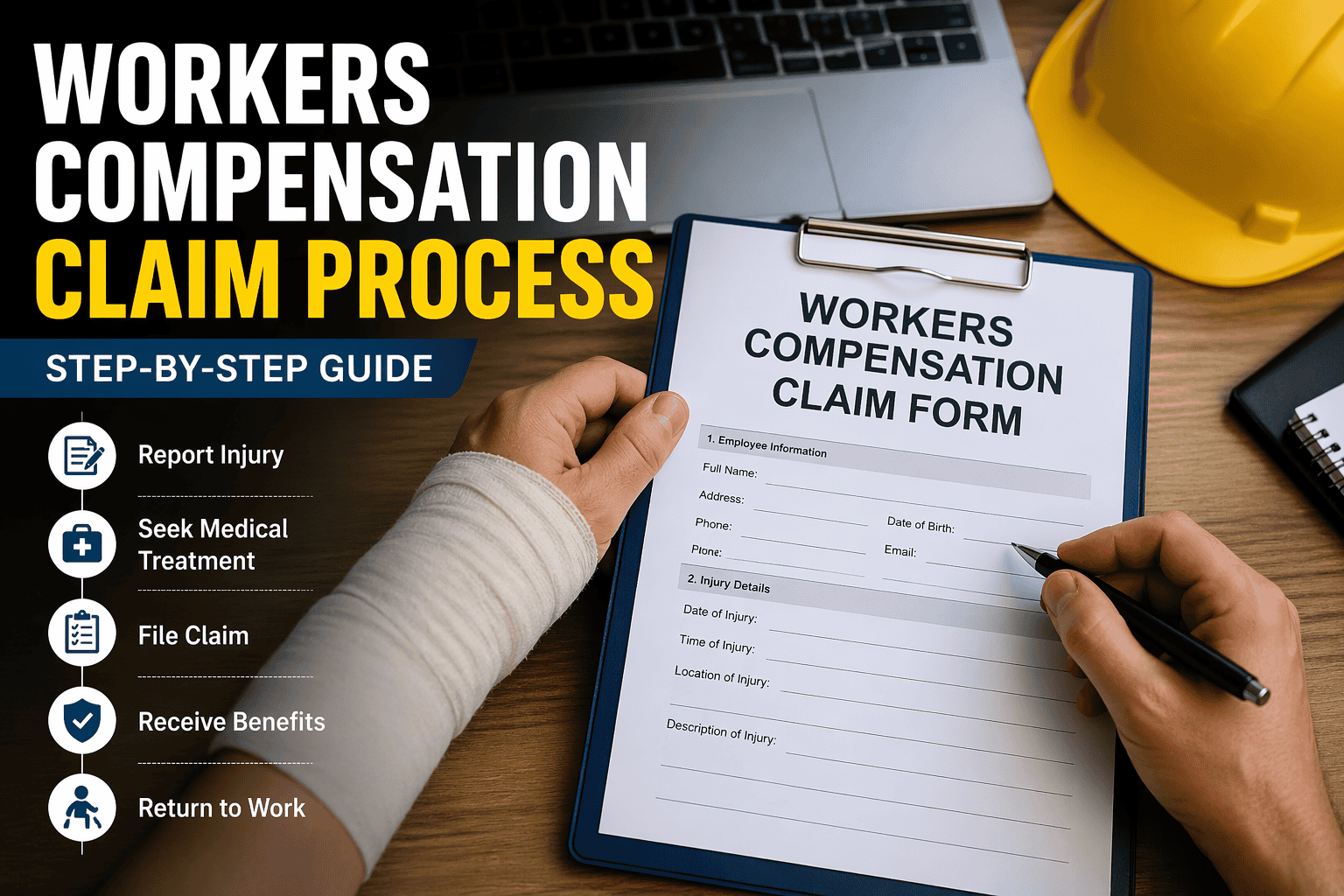
The workers compensation claim process has seven steps: report the injury immediately → seek medical treatment → employer files the claim → insurer reviews → benefits approved → ongoing treatment → return to work or settlement. The most common reason valid claims get denied? Delayed reporting and failure to document the injury as work-related within the first 48 hours.
Here’s something I’ve watched happen dozens of times in my 20 years advising on employment law: a worker gets hurt on the job, does everything “the right way” by being honest and cooperative — and still ends up with a denied workers compensation claim. Not because they were dishonest. Because they didn’t understand how the process actually works.
The workers compensation claim process is not designed around your wellbeing. It’s designed around documentation, timelines, and legal thresholds. Miss one step — even by a day — and the insurer has grounds to dispute your case.
This guide covers every step of the workers comp claim process in plain terms, with the insider knowledge that most legal-sounding articles skip. Whether you’re in the US, UK, or India, the core logic is the same: paper trail wins.
What Is Workers Compensation?
Workers compensation is a state-mandated insurance program that provides benefits to employees who suffer a work-related injury or occupational illness. Employers pay premiums into the system; in return, injured employees receive guaranteed benefits without having to prove negligence — but they also generally waive the right to sue their employer in civil court.
That trade-off matters enormously. You get a faster, more predictable path to medical coverage and wage replacement — but you’re locked into a structured process. Step outside that process, and you lose leverage fast.
Workers comp typically covers:
| Benefit Type | What It Covers | Typical Limit |
|---|---|---|
| Medical Benefits | Doctor visits, surgery, medication, therapy | No cap in most states |
| Wage Replacement | Lost income while unable to work | 60%–70% of average weekly wage |
| Disability Benefits | Temporary or permanent impairment payments | Varies by state and severity |
| Vocational Rehab | Job retraining if you can’t return to prior role | State-determined |
In the US, workers comp law is governed at the state level, so rules differ between, say, California and Texas. In the UK, it operates under the Employers’ Liability (Compulsory Insurance) Act 1969 and the statutory sick pay framework. In India, it falls under the Employees’ Compensation Act 1923. The underlying claim mechanics, though, follow a broadly similar logic everywhere.
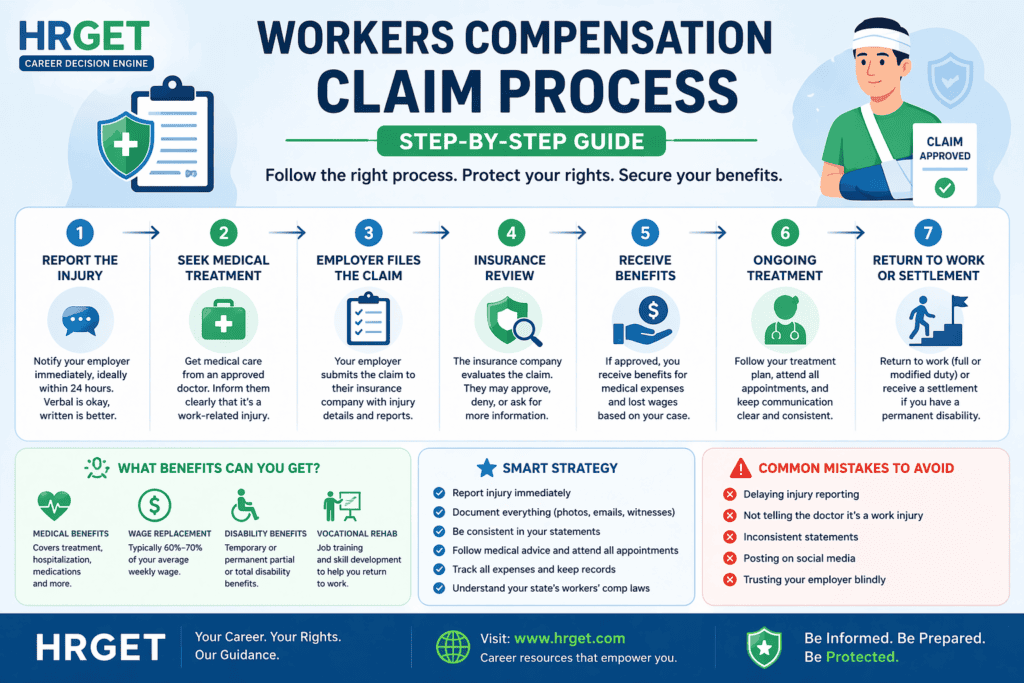
Step-by-Step Workers Compensation Claim Process
Follow this exactly. The order isn’t arbitrary — each step builds the evidentiary record the insurer will scrutinize.
Step 1: Report the Injury to Your Employer — Immediately
Notify your employer as soon as possible — ideally within 24 hours, never beyond 72. Most US states have a strict reporting window of 30 days, but waiting even a few days gives insurers the ammunition they need to question whether the injury is genuine or work-related.
A verbal report is a legal starting point. A written one is vastly better. Send an email, a WhatsApp message, or fill out an incident report form. The timestamp on that message could be the single most important piece of evidence in your file.
Pro Tip: If your manager brushes it off verbally, follow up with an email that begins: “This is to confirm I reported my injury to you today, [date], at approximately [time].” That paper trail is yours — not theirs.
Step 2: Seek Medical Treatment — And Say the Right Thing
Go to a doctor. Depending on your state, your employer may direct you to a panel physician, or you may have the right to choose your own. Either way, the single most critical thing you do at this appointment is clearly state: “This injury happened at work.”
I’ve seen valid claims collapse entirely because the doctor’s notes read “patient presents with back pain” — no mention of workplace causation. The insurer then classifies it as a personal health issue, not a compensable workplace injury. Your medical records are your claim’s foundation. Make sure they say the right things from day one.
Keep copies of every medical record, every prescription, every imaging report. Ask for them at every appointment.
Step 3: Employer Files the Claim with Their Insurer
Once you’ve reported the injury, your employer is legally obligated to file a First Report of Injury (FROI) with their workers comp insurer. This document triggers the formal claims process. It should include the incident report, initial medical records, and your employment details.
Warning: Some employers deliberately delay filing or downplay the severity of injuries to protect their premium rates. If you haven’t received confirmation that a claim has been filed within 5 business days of your report, follow up in writing — and consider contacting your state workers comp board directly.
Step 4: Insurance Company Investigates and Decides
The insurer has a defined window — typically 14 to 21 days in most US states — to accept or deny the claim. During this period, a claims adjuster reviews whether the injury is work-related, whether medical evidence supports the claim, and whether your statements are consistent across all sources.
This is where your documentation becomes your weapon. Inconsistencies between what you told your employer, what your doctor recorded, and what you tell the adjuster are the primary basis for denial. Be consistent, factual, and specific about when, where, and how the injury occurred.
Step 5: Benefits Begin (If Approved)
Approval triggers medical expense coverage and — if your injury prevents you from working — temporary disability wage replacement. In most states, there’s a waiting period (typically 3–7 days) before wage replacement kicks in. If you’re off work longer than that waiting period threshold, you may also receive retroactive payment for those initial days.
Medical benefits start immediately upon approval. Wage replacement is typically 60%–70% of your pre-injury average weekly wage, subject to your state’s maximum weekly benefit cap.
Step 6: Ongoing Treatment — Stay Compliant
Once benefits start, you’re monitored. Insurance companies conduct routine surveillance on active claims — yes, that includes your social media accounts, and in some cases, physical surveillance. This isn’t paranoia; it’s standard claims management practice in 2026.
Attend every medical appointment. Follow the prescribed treatment plan exactly. If you miss appointments or engage in activities inconsistent with your stated injury, the insurer can use this to modify or terminate your benefits. Straightforward compliance is your best protection.
Step 7: Return to Work, or Reach a Settlement
Most claims end in one of four ways: full recovery and return to your previous role; modified duty return under a light-work arrangement; permanent disability with ongoing long-term benefits; or a negotiated lump-sum settlement that closes the claim permanently.
A settlement can be attractive — but it’s irreversible. Before signing any settlement agreement, have an attorney review the terms. I’ve seen workers accept a lump sum that covered 18 months of expenses, not realizing their injury would require treatment for years beyond that.
Real Scenario: Where Most Claims Fail
Real Scenario
Marcus, a warehouse supervisor in Ohio, injured his shoulder lifting a heavy pallet. He kept working through the pain for four days — didn’t want to seem like he was making a big deal of it. When the pain became unbearable, he went to his personal doctor, describing it as general shoulder discomfort. His doctor ordered an MRI. Three weeks later, Marcus reported it to his employer.
The insurer denied the claim on two grounds: delayed reporting raised questions about work-relatedness, and his initial medical records contained no mention of a workplace incident.
The lesson isn’t that Marcus was dishonest. It’s that the workers comp system doesn’t evaluate intent — it evaluates evidence. Documentation and timing are the only currencies that count. Marcus eventually won on appeal, but it took nine months and legal fees he hadn’t budgeted for.
This pattern repeats constantly. The injury is real, the claim is valid — but the process wasn’t followed correctly in those first critical 48 hours. Don’t let that be your story.
What Benefits Can You Get From Workers Comp?
What you’re entitled to depends on the severity and permanence of your injury, your state’s benefit caps, and your pre-injury earnings. Here’s a practical breakdown:
| Benefit | What It Covers | Typical Amount / Duration |
|---|---|---|
| Medical Benefits | All reasonable, necessary treatment | Unlimited in most states |
| Temporary Total Disability (TTD) | Can’t work at all due to injury | 60–70% of average weekly wage |
| Temporary Partial Disability (TPD) | Can work reduced hours or light duty | Difference between old and current wage |
| Permanent Partial Disability (PPD) | Lasting impairment, can still work | Lump sum or weekly payments by impairment rating |
| Permanent Total Disability (PTD) | Unable to return to any work | Lifetime payments in some states |
| Vocational Rehabilitation | Retraining for a new occupation | State-determined; varies widely |
One thing most guides don’t mention: workers comp wage replacement is generally tax-free at the federal level in the US. That 60–70% is closer to your actual take-home pay than it sounds. Check your state’s rules, but this is often the case.
Common Mistakes That Kill Workers Comp Claims
I’ll be direct — these aren’t “tips to keep in mind.” These are active claim-killers I’ve watched destroy cases that should have succeeded.
❌ Delaying Your Injury Report
Even a 48-hour delay creates a credibility gap the insurer will exploit. “If it was that serious, why didn’t you report it immediately?” That’s the question an adjuster will ask — and it’s hard to answer convincingly.
❌ Not Explicitly Stating “Work Injury” to Your Doctor
Your doctor’s notes are a legal document. If they don’t record a work-related mechanism of injury, the claim has no medical anchor. This one omission alone can close your case.
❌ Inconsistent Statements Across Parties
What you tell your employer, your doctor, and the insurance adjuster must be factually identical. Adjusters are trained to find discrepancies — and they compare all three accounts. A minor inconsistency in how you describe the injury mechanism is enough to flag fraud concerns.
❌ Social Media Activity That Contradicts Your Injury
If you’re claiming a back injury that limits mobility and you post a photo of yourself hiking two weeks later, your claim is effectively dead. Insurers assign investigators to larger claims. Assume you’re being watched online and offline.
❌ Assuming Your Employer Is On Your Side
Your employer’s HR department and their insurer have aligned interests — minimizing payouts and protecting premium rates. They are not your advocates. Be cooperative and professional, but remember: everything you say to them is part of the claims record.
Smart Strategy to Maximize Your Workers Comp Claim
Playing this strategically doesn’t mean gaming the system. It means being as rigorous about your rights as the insurer is about finding reasons to deny them.
1. Build Your Documentation File From Day One
Create a physical or digital folder the day you’re injured. Include: the time and exact location of injury, names of any witnesses, photos of the scene or your injury, all communications with your employer, all medical records, and all receipts for out-of-pocket expenses. This file is your case.
2. Maintain One Consistent Narrative
Write down exactly what happened within 24 hours of the injury — before memory fades and before anyone questions you. Use that written account as your reference. Consistency isn’t just smart; it signals credibility to everyone evaluating your claim.
3. Track Every Expense, No Matter How Small
Mileage to medical appointments, over-the-counter medications, home care equipment, physical therapy co-pays — these are potentially reimbursable. Keep a log with dates, amounts, and what each expense was for. Many workers leave hundreds or thousands on the table simply because they didn’t track these costs.
4. Know Your State’s Specific Rules
Workers comp law varies enormously by state. California has pre-designation rights and a more employee-friendly framework. Texas allows employers to opt out of the state system entirely. Florida has specific exceptions for agricultural workers. Before you assume what you’re entitled to, look up your state’s workers compensation board website and understand the timeline requirements that apply to you.
5. Don’t Accept the First Settlement Offer Without Scrutiny
Insurers often make early settlement offers that seem reasonable in the moment but significantly undervalue long-term medical costs and lost earning capacity. A Compromise and Release (C&R) settlement in most states is final — you can’t reopen the claim. Get an independent medical evaluation of your long-term prognosis before signing anything.
When to Hire a Workers Comp Lawyer
Not every claim requires legal representation. A straightforward soft tissue injury, approved quickly and resolved in a few weeks, is manageable without an attorney. But there are clear situations where going without one puts you at a serious disadvantage.
| Situation | Hire a Lawyer? | Why |
|---|---|---|
| Claim denied | Yes | Appeals have strict deadlines and procedural requirements |
| Permanent or serious injury | Yes | Long-term benefits and disability ratings require expert negotiation |
| Benefits delayed or cut off | Yes | Insurers are less likely to delay when an attorney is involved |
| Employer retaliates after you file | Yes | Separate wrongful termination claim may be warranted |
| Third party caused the injury | Yes | You may have both a comp claim and a civil lawsuit simultaneously |
| Simple, approved minor injury | Likely not needed | Straightforward claims resolve without legal complexity |
Most workers comp attorneys work on a contingency basis — meaning they charge a percentage of your settlement or award, only if you win. That percentage is often capped by state law (commonly 15–25%). There’s no upfront cost, which removes the financial barrier to getting proper representation when you need it.
Insider View: What Insurance Adjusters Are Really Looking For
The Insider View
Having worked across both the claimant and defense sides in my career, here’s what I can tell you about how adjusters actually evaluate claims: they’re not trying to find reasons to help you. They’re running a risk model. Every data point in your file gets scored against the probability of fraud, exaggeration, or non-work causation.
The red flags that trigger enhanced scrutiny are predictable: delayed reporting, prior injury history at the same body part, inconsistencies in injury description, a treating physician who frequently appears on high-value claims (yes, they track this), and lifestyle activity that doesn’t match your stated limitations.
The green flags that accelerate approval are equally predictable: immediate reporting, contemporaneous documentation, a consistent medical record from day one, and a clean statement to the adjuster that matches everything in the file.
The workers comp system isn’t built to be unfair. It just operates with bureaucratic precision, and it rewards people who understand that precision. Now you do.
Bottom Line
The workers compensation claim process is not employee-friendly — it’s evidence-driven. The first 48 hours after your injury determine whether your claim succeeds or fails. Report immediately, get medical documentation that explicitly links your injury to work, and build a paper trail from day one.
If your claim is denied or you’re facing a complex permanent injury, get an attorney. The contingency fee structure means you have nothing to lose — and potentially years of benefits to gain.
Related Reading on HRGet.com
If your employer retaliates against you for filing a workers comp claim, you may have additional legal recourse. Read our guide on wrongful termination rights to understand your options.
Frequently Asked Questions
How long do I have to file a workers compensation claim?
Deadlines vary by state, but most US states require you to report a workplace injury within 30 to 90 days. The formal claim filing deadline is typically one to two years from the date of injury. Missing either deadline can result in automatic denial, so report immediately and confirm your state’s specific statute of limitations before assuming you have time.
Can I get fired for filing a workers compensation claim?
No. Retaliating against an employee for filing a workers comp claim is illegal under most state laws and federal anti-retaliation provisions. If you are demoted, disciplined, or terminated after filing, you may have a separate wrongful termination or retaliation claim. Document every adverse action taken after you file — dates, what was said, who was present.
What happens if my workers compensation claim is denied?
You have the right to appeal. Most states require you to file a formal appeal with the state workers compensation board within 30 to 90 days of the denial. You can submit additional medical evidence and request a hearing before a workers comp judge. This is where hiring an experienced attorney significantly improves your outcome — appeal success rates with legal representation are substantially higher.
Do I get my full salary under workers compensation?
No. Workers compensation wage replacement typically covers 60% to 70% of your pre-injury average weekly wage, subject to a state-imposed maximum. In California, the maximum weekly benefit in 2026 is approximately $1,619. Importantly, workers comp wage replacement is generally tax-free at the federal level, which partially offsets the reduction compared to your regular take-home pay.
Can I choose my own doctor for a workers compensation claim?
It depends on your state. In California and New Jersey, you can pre-designate your personal physician before an injury occurs. In many other states, your employer directs you to a panel doctor for the initial treatment period. After that window, you often gain more freedom to switch treating physicians. Know your state’s rules before you assume you have a choice — or before you assume you don’t.
How long does it take to receive workers comp benefits after approval?
Once approved, most states require the insurer to begin wage replacement payments within 14 to 21 days of claim acceptance. Medical benefits typically start immediately. Delays beyond 30 days may entitle you to penalty interest under certain state laws. If your payments are unreasonably late, contact your state’s workers compensation board and consult an attorney.
Can I work while receiving workers compensation benefits?
Yes, but only under specific conditions. If your doctor clears you for light duty or modified work, you can return in a limited capacity. If your employer offers suitable modified duty and you refuse without a valid medical reason, your wage replacement benefits may be reduced or suspended. Always get medical clearance in writing before returning — verbal approval isn’t sufficient protection if your employer later disputes the arrangement.
Victoria Hale: Employment Law Partner | Former Partner, Freshfields Bruckhaus Deringer
Victoria has spent 20+ years advising employees and corporations on employment law across the US and UK, with deep expertise in workplace injury rights, FLSA, wrongful termination, and executive exits. She has handled workers compensation matters across multiple jurisdictions and advises on employment rights strategy for HRGet.com.

Victoria Hale | Former Partner, Freshfields Bruckhaus Deringer | Employment Law Specialist | 20+ Years Advising Multinationals & Executives
Author: Victoria Hale spent over two decades as an Employment Law Partner at Freshfields Bruckhaus Deringer — one of the world’s most prestigious Magic Circle law firms — advising multinational corporations and senior executives on some of the most complex employment disputes in the US and Europe. Her practice covered wrongful termination litigation, executive exits, non-compete enforcement, FLSA compliance, and cross-border workforce restructuring under EU labour law. Now based between London and New York, Victoria writes for HRGet.com to close the gap between legal theory and how employment law actually plays out in the real world — for employees who need to know their rights before it’s too late.