
The salary you should ask for is your target salary — calculated as your current total compensation, adjusted upward by the market rate for the role and a premium for its scope. Always quote a narrow range from your target to your stretch ask, never from your minimum. Your minimum is private. Your market data is your leverage.
“How much salary should I ask for?” — I’ve heard this question from fresh graduates in Bengaluru, senior product leads in London, and VP-level candidates in New York. It is, without question, the salary negotiation question that makes smart people freeze.
Ask too low and you leave thousands on the table — permanently, because every future raise compounds from that anchor. Ask too high without backing, and you worry the offer evaporates. Stay vague, and the recruiter fills the silence with their budget, not your value.
Here’s the truth I’ve learned after two decades in global compensation: your salary ask is not a wish. It is a business case. And like any business case, it needs data, logic, and structure. This guide gives you exactly that — a practical, multi-region framework for deciding how much salary to ask for at any stage of your career.
What “How Much Salary Should I Ask For?” Really Means
When you’re staring at a salary expectation field or a recruiter’s expectant pause, you’re actually trying to answer three overlapping questions simultaneously:
- What am I worth in the current market?
- What is this specific role worth to this specific company?
- What can I ask without weakening my position?
Those are not the same question. Your market value is what the labour market pays for your skills. The role’s value is what the company will pay based on budget, urgency, and business impact. Your negotiation number is where those two converge — with enough confidence and flexibility to close.
A strong salary ask is always built on three private numbers. Every professional should walk into any compensation discussion knowing all three:
| Salary Number | What It Means | Use In Negotiation? |
|---|---|---|
| Minimum acceptable | Lowest you can accept without regret or financial stress | Never disclose this |
| Target salary | The number you realistically want — supported by data | The floor of your public range |
| Stretch ask | Ambitious but justifiable opening position | The ceiling of your public range |
Never go into a salary conversation with only one number. One number makes you rigid. A range built from target to stretch makes you strategic.
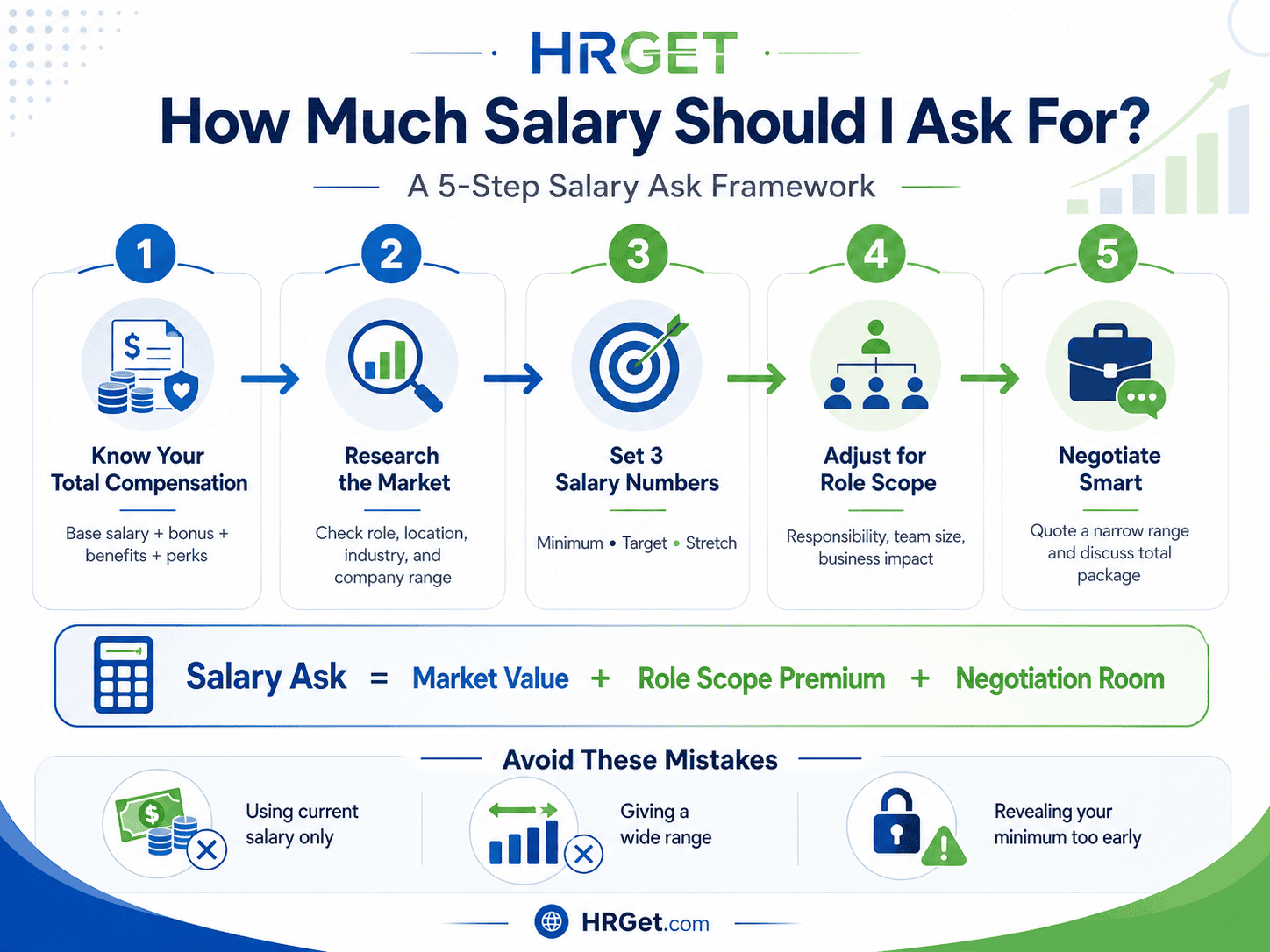
The 6-Step Salary Ask Framework
Use this framework before every interview or salary negotiation. It takes about 30 minutes and pays returns for years.
Step 1: Define Your Current Total Compensation Properly
Most people only count their base salary. That’s a costly mistake. Your real compensation includes base salary, annual bonus or variable pay, stock options, RSUs or ESOPs (at their current value), employer retirement contributions, health insurance, paid time off, allowances, joining or retention bonuses, relocation support, and learning budget. In some tech roles, remote flexibility has genuine market value too.
If your base salary is ₹20 LPA but you also receive a ₹3 Lakh annual bonus and ₹2 LPA in employer-funded benefits, your actual total compensation is closer to ₹25 LPA. If you negotiate solely against ₹20 LPA, you risk accepting an offer that looks like a raise but is structurally weaker than where you started.
Pro Tip
Always compare offers at the level of annual total compensation, not monthly or base salary alone. An offer of $110K with a 15% target bonus and full healthcare is better than $120K base with no bonus and expensive medical premiums.
Step 2: Research the Market Salary Range
Your salary ask must be grounded in external reality. Pull data from at least four sources: job postings with posted ranges, salary platforms (Levels.fyi for tech, LinkedIn Salary, Glassdoor, AmbitionBox for India, Payscale for the UK), conversations with recruiters, and trusted peers in similar roles. Industry salary surveys — published annually by Mercer, Korn Ferry, and Aon — are gold if you can access them.
Don’t rely on a single source. Salary data can be outdated, skewed toward high-paying companies, or self-reported with optimistic bias. Build a realistic range by triangulating.
Say you’re applying for a Product Manager role in Bengaluru or San Francisco in 2026:
| Data Source | Indicated Range |
|---|---|
| Job postings (3–5 listings) | ₹30–45 LPA |
| Peer conversations | ₹35–50 LPA |
| AmbitionBox / Glassdoor | ₹28–42 LPA |
| Recruiter input | ₹32–48 LPA |
The overlapping consensus points to roughly ₹32–48 LPA. A strong candidate should be targeting the upper-middle to top of that band — and we’ll talk about exactly why shortly.
Step 3: Understand the Role Scope
Two identical job titles can sit at opposite ends of the pay spectrum. A “Marketing Manager” at a 40-person startup managing campaigns hands-on is not the same role as a “Marketing Manager” at a 10,000-person enterprise owning a $50M budget and leading a cross-functional team of 12. Same title. Very different market value.
Before deciding how much salary to ask for, dig into: team size, revenue or cost accountability, reporting level, decision-making authority, technical complexity, geographic scope, and whether the company genuinely needs this hire urgently. The bigger the scope, the higher your defensible ask.
Real Scenario
Two candidates both interview for “HR Manager.” Candidate A is joining a 60-person company to run recruiting and employee records. Candidate B is joining a 3,000-person company to lead compensation design, HR technology, and workforce planning for three geographies. Both roles say “HR Manager.” Candidate B should be asking for significantly more — not because of title, but because of scope, risk, and business impact. Negotiate the role, not the label.
Step 4: Calculate Your Minimum Acceptable Salary
Your minimum is not what you hope to earn. It’s the lowest number you can accept without feeling underpaid, financially stressed, or quietly resentful six months in.
Factor in: your current total compensation, monthly fixed expenses, savings goals, loan or mortgage payments, family responsibilities, cost of living in the new location, commuting or relocation costs, and tax changes if crossing state or country lines. A ₹22 LPA offer in Mumbai may look like a raise from ₹18 LPA in Hyderabad — but after Mumbai rents and daily costs, you may actually be worse off.
This number is private. It never leaves your head. It’s purely your decision filter.
Step 5: Set Your Target Salary
Your target is the number you actually want — realistic, data-backed, and defensible in conversation. A simple formula that works across markets:
Target Salary = Current Total Compensation + Market Adjustment + Role Upgrade Premium
If you currently earn ₹18 LPA in total compensation, similar roles pay ₹24–32 LPA, and the new role has materially broader scope, your target salary is probably around ₹28 LPA. That’s not a hope — that’s a reasoned number you can defend clearly.
Step 6: Decide Your Stretch Ask
Your stretch ask is the number you put forward first, or position as the upper end of your range. It should be ambitious but not detached from reality. Here’s a practical calibration:
| Market Range | Minimum (Private) | Target | Stretch Ask |
|---|---|---|---|
| ₹25–35 LPA | ₹27 LPA | ₹32 LPA | ₹36–38 LPA |
| $90K–$120K | $95K | $112K | $125K–$130K |
| £55K–£75K | £58K | £70K | £78K–£80K |
| AED 180K–240K/yr | AED 190K | AED 225K | AED 250K–260K |
Your stretch ask creates anchoring room. When the company counters down, you still land near your target — which is exactly where you wanted to be all along.
How Much Salary Hike to Ask for When Changing Jobs
There’s no universal percentage, but these ranges reflect real hiring market patterns across India, the US, UK, and UAE in 2026:
| Situation | Reasonable Increase |
|---|---|
| Same role, same industry (lateral move) | 15%–25% |
| Strong performer with scarce or in-demand skills | 25%–50% |
| Promotion-level move (IC to manager, or manager to director) | 30%–70% |
| Startup to large tech or high-paying sector (BFSI, consulting) | 40%–100%+ |
| Career switch into a new domain | 0%–25%, depending on transferable skills |
| Relocation to expensive city (Mumbai, London, NYC, Dubai) | Cost-of-living premium + role premium |
Here’s the catch, and I see this trap constantly: percentage hikes can mislead you if your starting point is already wrong. If you’re underpaid today, a 30% hike may leave you underpaid tomorrow. If you’re at market or above, a 15% hike can be genuinely strong.
Person A earns ₹8 LPA but the real market for their skills is ₹14–18 LPA. Asking for ₹10.5 LPA (a 30% hike) is undervaluing themselves badly — they should target ₹15–16 LPA and anchor with market data.
Person B earns ₹40 LPA and the market range for the new role is ₹38–50 LPA. Asking for ₹60 LPA without exceptional justification will raise eyebrows. The right stretch ask might be ₹52–54 LPA if the scope is genuinely senior.
The lesson: don’t negotiate from your current number. Negotiate from the market.
Should You Give a Range or a Single Number?
Almost always, give a range — but make it a smart one. A wide range signals uncertainty and hands the recruiter a discount. A narrow range signals preparation and signals confidence.
A bad range:
“I’m looking for somewhere between $80,000 and $120,000.”
That $40,000 spread tells the recruiter nothing except that you’ll accept $80K. They’ll hear the low number.
A better range:
“Based on the role scope and my experience, I’m targeting $115,000 to $130,000, depending on total compensation and benefits.”
That’s tight, confident, and leaves natural room for discussion. The formula:
Your public range = Target Salary → Stretch Ask
Not: Minimum → Target
If your minimum is ₹25 LPA and your target is ₹32 LPA, don’t say ₹25–32 LPA. Say ₹32–38 LPA. Companies negotiate toward the bottom of your range — so make sure the bottom is where you actually want to land.
Insider View
Recruiters are trained to ask for salary expectations before sharing the company’s budget. The first number anchors the entire conversation. If you say ₹20 LPA and the budget was ₹28 LPA, congratulations — you just left ₹8 LPA on the table. This is why preparing your range before any screening call is non-negotiable.
What to Say When a Recruiter Asks Your Expected Salary
This is where most professionals give away value — and they don’t even realise it. Recruiters often surface salary expectations in the first screen call because they need to check budget alignment quickly. That’s fair. But answering before you understand the full role scope often means anchoring too low.
Best Response Early in the Process
“I’d like to understand the role scope and total compensation structure first. That said, based on my experience and what similar roles pay in the market, I’m likely looking in the range of [X to Y], depending on the overall package.”
That answer shows you’re serious, gives enough information to pass a budget check, and keeps negotiation room intact.
If They Push for a Specific Number
“For roles with this level of responsibility, I’m targeting around [target to stretch range]. I’m flexible depending on bonus, equity, benefits, and growth scope.”
What you should never say:
“Whatever is your company standard.”
That hands full pricing power to the recruiter.
“I just want a fair offer.”
Fair according to whom? You need your own anchor, or the recruiter provides one for you.
What If the Job Posting Already Has a Salary Range?
Don’t automatically default to the bottom of a posted range. That’s not what posted ranges are for. Companies post a range that typically runs from the floor for a minimally qualified candidate to what they’d pay for an exceptional one.
Ask yourself honestly: Do I meet most of the requirements? Do I exceed any of them? Do I have scarce skills relevant to this role? If the posting says $100K–$130K and you’re a strong fit, your ask should target $125K–$130K, not $100K–$110K.
“Given my background and the scope of this role, I’d be targeting the upper part of the posted range — around $125,000 to $130,000 — depending on the full package.”
Also worth knowing: posted ranges are not always final. In competitive markets — especially in tech, finance, and consulting — companies will stretch for truly strong candidates. Your job is to ask intelligently and let them respond.
Warning
In the US, several states now require salary range transparency in job postings (California, New York, Colorado, Washington). In the UK, while not yet mandated by law, many employers voluntarily disclose ranges. If you’re applying in these markets, use the posted range as a negotiation floor, not a ceiling.
Salary Ask Framework by Career Stage
Entry-Level Candidates (0–3 Years)
The most common mistake at this stage is treating salary as something you’re grateful to receive rather than something you negotiate. You still have leverage — strong internships, technical skills in demand, competing offers from campus, or certifications that fill an immediate need. Use them.
Base your ask on market data for the role and company, not on what your friends got or what “feels right.”
“Based on similar entry-level analyst roles in this market and my internship experience, I’m targeting ₹8–10 LPA.”
Don’t say: “Anything is fine, I just need a job.” Even if emotionally true, this weakens every negotiation you’ll have for the next five years.
Mid-Career Professionals (4–12 Years)
This is where negotiation leverage peaks. You can connect your experience directly to business outcomes — revenue generated, costs reduced, teams built, systems launched. Your salary ask should sound like a business case, not a personal request.
“Given my seven years of experience and direct ownership of similar projects at [comparable company], I’m targeting ₹35–40 LPA for this scope of role.”
At this stage, you should also be tracking market data actively — not just when you’re job hunting. Knowing your market rate year-round puts you in a much stronger position whenever an opportunity appears.
Senior Professionals and Managers (12+ Years)
At senior levels, salary negotiation becomes a total compensation conversation. The base salary is just one line in the offer. You need to evaluate: annual and long-term bonus structure, equity (RSUs, stock options, LTIP), signing bonus, severance terms, notice period buyout, relocation support, and the scope of decision authority and reporting line.
A senior candidate should not ask “What is the base salary?” They should open with:
“Can we discuss the total compensation structure, including base, target bonus, equity, joining bonus, and any performance-linked components?”
At this level, lower base salary may sometimes be acceptable if equity upside is meaningful and the company has credible growth prospects. Be careful, though: uncertain upside should not replace guaranteed compensation unless you genuinely understand and accept the risk profile.
If You’re Underpaid — or Overpaid — Right Now
If You’re Currently Underpaid
This is one of the most common income traps I’ve seen in 20 years of compensation work. Someone earning ₹10 LPA gets excited about a ₹13 LPA offer because it’s a 30% hike — without realising the market for their role is ₹18–22 LPA. The company called it generous. It wasn’t.
The solution is to shift the conversation away from your current salary entirely.
“My current compensation doesn’t fully reflect the market value of the work I’m doing or the role I’m interviewing for. Based on comparable roles and the scope here, I’m targeting ₹18–22 LPA.”
You don’t owe anyone an apology for wanting market compensation. Your current employer’s failure to pay you fairly is not a data point the next employer should benefit from.
If You’re Currently Overpaid Relative to Market
This happens more than people admit — especially after a few years at a high-paying company, after a strong equity run, or if you’ve been in a niche role that temporarily commanded a premium.
In this case, demanding a large hike on top of an already above-market salary can make you look misaligned or disconnected from reality. Shift your framing toward the opportunity itself:
“My current compensation is on the higher side, so I’m evaluating the overall opportunity — role quality, growth trajectory, leadership scope, and equity upside — rather than just a salary jump. I’d want the package to be competitive and close to what I’m currently earning.”
That’s honest, mature, and keeps the door open without underselling yourself.
6 Common Mistakes That Cost You Money
Mistake 1: Anchoring to Current Salary Instead of Market Value
Your current salary may be outdated, unfair, or below market by design. Use it as one input, not the anchor. Negotiate from what the role pays externally.
Mistake 2: Quoting a Wide Range
A range like ₹20–40 LPA tells the employer you’re uncertain and will likely accept the low end. Keep your range tight — within ₹5–8 LPA or 10–15% — and anchored high.
Mistake 3: Revealing Your Minimum Too Early
Your minimum acceptable salary is your private decision filter. The moment you say it out loud, it becomes the company’s ceiling. Never volunteer it.
Mistake 4: Ignoring Benefits and Variable Pay
A ₹30 LPA offer with no bonus, poor health insurance, and no flexibility may be structurally weaker than a ₹27 LPA offer with a 15% bonus target, strong benefits, and remote-work flexibility. Always compare packages holistically.
Mistake 5: Sounding Apologetic
You’re not asking for charity. You’re negotiating compensation for business value you’ll deliver. Avoid: “Sorry, but I was hoping for…”, “I don’t know if this is too much…”, “Maybe around…”, “I’m okay with whatever.” Use calm, professional language. Confidence is not aggression.
Mistake 6: Accepting Too Quickly
If you receive an offer, it’s entirely appropriate to say:
“Thank you for the offer — I’m genuinely excited about the role. I’d like to take a day or two to review the full compensation details and come back with a thoughtful response.”
That pause gives you the space to negotiate, compare, and respond with intention rather than relief.
Salary Negotiation Scripts You Can Use Today
Opening your ask in an interview:
“I’m very interested in the role, and based on our conversation, the scope aligns well with my experience. Considering the responsibilities, market compensation for similar positions, and the value I can bring, I’m targeting a salary in the range of [X to Y]. I’m open to discussing the full package, including bonus, equity, and growth opportunities.”
After receiving a written offer:
“Thank you for the offer — I’m excited about the opportunity. After reviewing the role scope and current market compensation for comparable positions, I was expecting something closer to [X]. Is there flexibility to improve the base or overall package?”
If they say the budget is fixed:
“I understand. If the base is fixed, could we explore flexibility in the joining bonus, performance bonus, equity, relocation support, or scheduling an earlier compensation review at the six-month mark?”
Never negotiate only one component. Total compensation gives you multiple levers — and companies that can’t move on base can often move on bonus, equity, or a review timeline.
How to Ask for Salary During an Internal Promotion
Internal negotiations are different because companies use salary bands and internal equity rules. But “we have a band” is not a ceiling — it’s a starting position. I’ve seen internal promotions move salary by 35–50% when the candidate came prepared.
Before the conversation, build a short business case with four elements: your new responsibilities and accountability level, the quantified business impact you’ve already delivered, the market salary for the promoted role externally, and the replacement cost if the company had to hire someone externally into this role.
“I’m proud of what I’ve delivered this year — [specific outcomes]. Given the new scope, I’ve benchmarked the market rate for this role externally and found it ranges from ₹X to ₹Y. I’d like to discuss landing in the upper half of the new salary band, at [target].”
If the company cites band constraints, ask which band level the new role sits in, where you’d be placed within that band, and what the path is to reach the top of the band. A transparent conversation about band positioning is entirely appropriate and shows you’re thinking long-term.
Verdict
The answer to “how much salary should I ask for” is never a random number, never your current salary plus a vague percentage, and never whatever the recruiter hints at first. It’s a structured calculation: your total compensation today, calibrated against the market rate for the specific role and location, adjusted for scope, and delivered as a narrow, confident range. That’s not bold — that’s just professional. And in 2026, candidates who bring that clarity to the table close offers faster and earn more for longer.
📋
Ready to put this into practice? Read our full guide: Salary Negotiation Tips That Actually Work in 2026 — covers counter-offer tactics, email scripts, and how to handle lowball offers without burning the relationship.
Frequently Asked Questions
How much salary should I ask for when changing jobs?
Base your ask on market salary data for that specific role and location — not just a percentage hike on your current number. For a lateral move, aim for 15–30% above your current total compensation. For a promotion-level move or jump into a higher-paying sector, 40–70% more is defensible when anchored in external benchmarks. Platforms like Levels.fyi, LinkedIn Salary, AmbitionBox, and Glassdoor are your starting points.
Should I give a salary range or a specific number?
Give a narrow, confident range — not a single number and not a wide band. Your range should run from your target salary to your stretch ask. If the market is ₹30–40 LPA and you’re a strong fit, say ₹36–42 LPA rather than ₹25–40 LPA. A wide range tells recruiters you’re unsure; a narrow one tells them you’ve done your homework.
What is a reasonable salary hike when changing jobs in India in 2026?
A 20–30% hike is typical for a lateral move. Strong performers with scarce skills — cloud architects, ML engineers, senior product managers — routinely negotiate 40–60% or more. If you’re underpaid relative to market, ignore the percentage game entirely and negotiate against external benchmarks. Don’t accept a “big hike” that still leaves you below market rate.
How do I answer “What are your salary expectations?” in an interview?
Don’t anchor low and don’t deflect entirely. Say: “Based on the role scope and market compensation for similar positions, I’m targeting [X to Y], depending on the full package.” If pressed early before you know the role scope, acknowledge you’d like to understand the full expectations first, then provide your range. Never say “whatever is standard” — that hands the recruiter full pricing power.
What should I ask for if I’m currently underpaid?
Shift the conversation from your current salary to market value entirely. Say: “My current compensation doesn’t reflect the market rate for this scope of work. Based on similar roles, I’m targeting ₹X–Y.” You have no obligation to accept a modest hike on top of an already-low base. Market data is your strongest and most credible argument.
How do I negotiate salary for an internal promotion?
Come prepared with the market rate for the promoted title, your quantified achievements, and the cost the company would pay to hire externally. A promotion-level jump typically warrants a 20–40% raise. If the company cites internal salary bands, ask where you’d sit in the new band and negotiate to land in the upper half — not the floor.
Is it bad to ask for a very high salary?
Not if you can justify it. A well-anchored high ask backed by market data, role scope, and specific value rarely disqualifies a strong candidate — most recruiters will simply counter. An unjustified high number with no logic behind it can signal poor self-awareness. Always be ready to explain exactly why your number makes sense, and the conversation stays professional.
When should I disclose my current salary?
In most US states, several EU jurisdictions, and the UK, you’re not legally required to disclose current salary. In India, disclosure is common practice but not mandatory. If asked, you can say: “I’d prefer to focus on the role’s market value rather than my current package.” If pressed, share total compensation rather than base salary — and anchor your ask separately from current earnings.

Eleanor Whitmore | Former Partner, Mercer | Advisor, World Economic Forum | 20+ Years in Global Compensation
Author bio: Eleanor Whitmore has spent over two decades shaping how the world’s leading organisations pay, retain, and reward talent. As a former Partner at Mercer and an advisor to World Economic Forum working groups on the Future of Work, she has designed compensation frameworks for Fortune 500 companies across the US, UK, Europe, and emerging markets. Based between London and New York, Eleanor writes for HRGet.com to translate boardroom-level pay strategy into actionable guidance for working professionals navigating real compensation decisions.