You got the offer. And for about 30 seconds, it felt great.
Then you did the math. The salary is decent — but it’s not what you were hoping for. Maybe it’s ₹3–4 LPA below your target. Maybe it’s $10K short of what the market says you’re worth. Either way, you’re sitting there wondering: Do I push back? What if they pull the offer?
Here’s what 15 years of sitting on the hiring side of the table has taught me — almost nobody gives their best number first. There’s almost always room. The problem isn’t the offer. It’s that most people don’t know how to ask without sounding desperate or demanding.
This guide gives you a salary negotiation email template that actually works, plus the psychology and strategy behind it so you’re not just copy-pasting blindly.
Why Most People Leave Money on the Table
Studies on compensation negotiation consistently show that professionals who negotiate their first offer earn significantly more over their career than those who don’t — not just at that job, but compounding forward through every raise, promotion, and future offer that anchors off that base.
And yet, most people accept the first number they’re given.
Why? Three reasons that I’ve watched play out over and over:
Fear of seeming greedy. They’ve worked hard to get this offer and don’t want to appear ungrateful. So they stay quiet and sign.
They think the offer is final. Recruiters are trained to present offers with confidence. That confidence gets mistaken for firmness. It usually isn’t.
They don’t know what to say. They know they want more but have no script. So they freeze.
The uncomfortable reality? If you don’t negotiate, you’re not being polite — you’re just being underpaid. Companies budget for negotiation. That buffer exists whether you use it or not.
When You Should (and Shouldn’t) Negotiate
Let me be direct: you should negotiate almost every offer. But not every situation is identical.
Negotiate confidently when:
- You have a competing offer (even a weaker one gives you leverage)
- The offer is below market rate for your role and city
- You’re joining at a senior level with clear scope and deliverables
- The company is mid-size or larger (they have comp bands with room to move)
- You’ve done your research on platforms like Glassdoor, Levels.fyi, or LinkedIn Salary
Tread carefully when:
- It’s a genuine early-stage startup with a tight cash runway (equity conversation makes more sense)
- The recruiter has used the phrase “this is our best offer” more than once
- You’ve already pushed back informally during interviews
- The role is significantly above your current level (don’t negotiate yourself out of a stretch opportunity)
Even in the cautious cases, there’s a way to negotiate softly — more on that below. The goal isn’t to be aggressive. It’s to be strategic.
The Psychology Behind a Winning Negotiation Email
Here’s the thing most salary negotiation advice gets completely wrong — it focuses on tactics when it should focus on tone.
Hiring managers aren’t against paying more. They’re against hiring people who seem difficult, entitled, or unsure of themselves. Your email needs to do one job: make them feel good about revising the offer upward.
That means your email can’t read like a complaint or a threat. It needs to read like a conversation from someone who’s confident, collaborative, and genuinely excited about the role.
The sequence that works, every time:
1. Gratitude — Acknowledge the offer warmly. Don’t be performative, but be genuine.
2. Excitement — Confirm you want the role. This lowers the recruiter’s anxiety immediately.
3. Justification — Give a reason that’s market-based, not personal. “My expenses are high” doesn’t help them. “Market benchmarks for this role in this city” does.
4. The Ask — Make it specific, non-confrontational, and framed as a question, not a demand.
That’s it. Four elements. The order matters as much as the content.
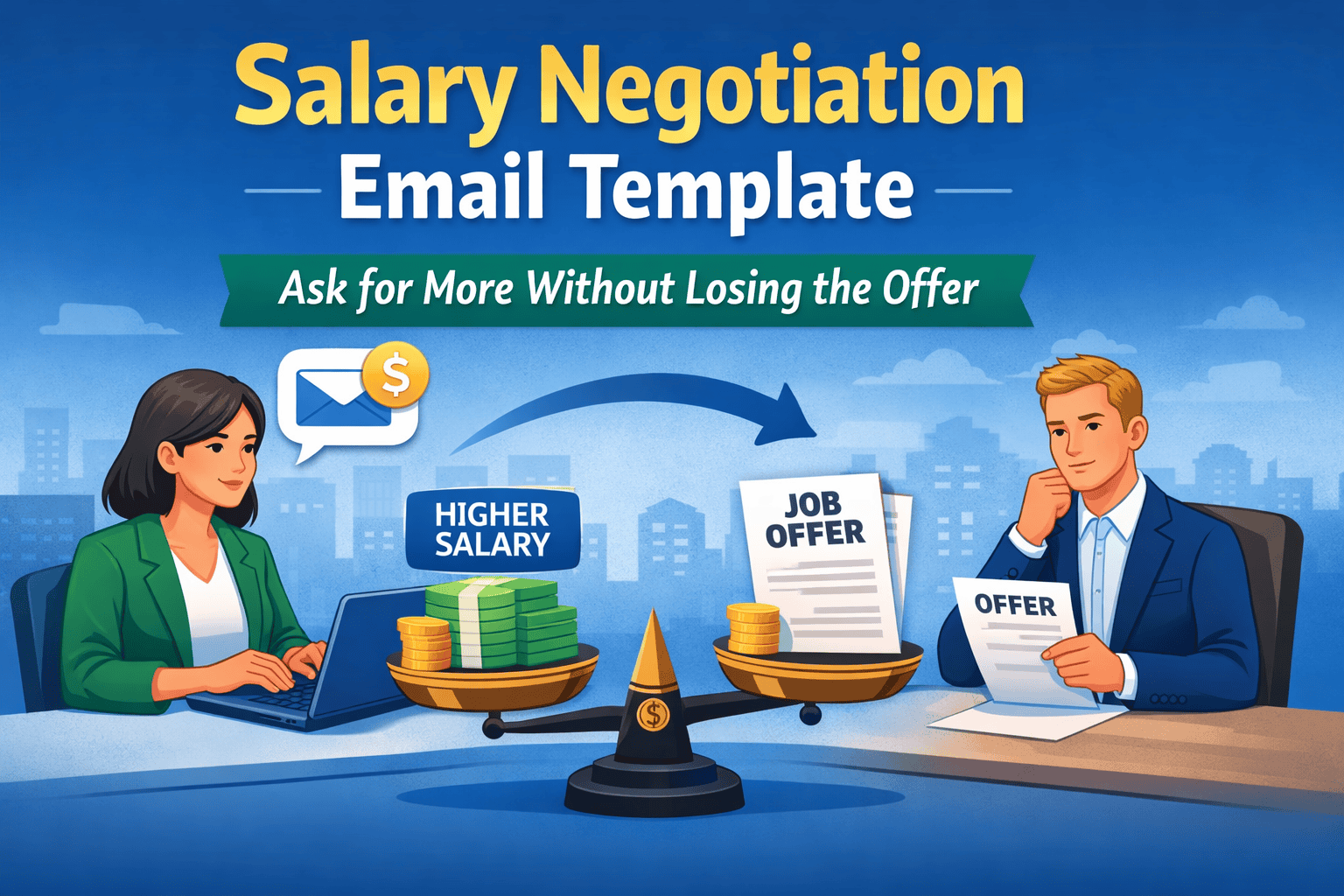
Salary Negotiation Email Template (Copy-Paste Ready)
Here’s the core salary negotiation email template. Customize the bracketed fields — don’t change the structure.
Subject: Re: [Job Title] Offer — Quick Follow-Up
Hi [Hiring Manager’s Name],
Thank you so much for the offer — I genuinely appreciate it, and I’m really excited about the opportunity to join [Company Name]. After speaking with the team, I can see myself doing meaningful work here, and that matters to me.
I did want to follow up on the compensation. Based on my [X years of experience in specific skill/domain], the scope of this role, and current market benchmarks for [Job Title] roles in [City/Region], I was expecting something closer to [your target range].
Is there flexibility to bring the base salary to [specific number]?
I’m genuinely enthusiastic about making this work and would love to find a package that reflects the value I’ll bring. Looking forward to your thoughts.
Best, [Your Name]
Why This Works (Breaking It Down)
The subject line signals professionalism, not confrontation. “Quick follow-up” feels collaborative, not adversarial.
“I’m really excited” — this reassures the recruiter before you ask for anything. They’re not worried you’ll decline. They’re relaxed.
“Based on my experience and market benchmarks” — this is the magic phrase. You’ve moved the conversation from emotion to logic. They can now go back to their manager with a rational business case.
“Is there flexibility” — a question is softer than a statement. It invites a dialogue rather than a yes/no standoff.
“Reflects the value I’ll bring” — you’re not asking for a favor. You’re framing this as a fair exchange.
Real Scenario: Weak vs Strong Negotiation
Let me show you what this looks like in the real world.
The situation: Priya, a 4-year product manager at a Bangalore startup, gets an offer from a Series B company for ₹24 LPA. She was targeting ₹28 LPA. Market rate for her profile in Bangalore in 2026: ₹26–30 LPA.
Weak version (what most people write):
“Thanks for the offer. I was hoping for something higher — around 28 LPA. Can you do that?”
The recruiter reads this and thinks: She’s just asking for more without a reason. If I push back, she’ll fold or walk. Likely outcome: a token ₹0.5–1 LPA bump, or silence.
Strong version (using the template):
“Thank you for the offer — I’m genuinely excited about this role. Based on my 4 years in B2C product, the scope of this position, and current Bangalore benchmarks for senior PMs, I was expecting something in the ₹28–30 LPA range. Is there flexibility to move the base closer to ₹28 LPA?”
What the recruiter hears: She’s done her homework. She knows her market. She wants this role. This is a reasonable ask with a clear rationale. Likely outcome: ₹27–28 LPA, or a conversation about joining bonus + ESOPs.
Same candidate. Same ask. Completely different result.
Smart Strategy: How to Maximize Your Offer
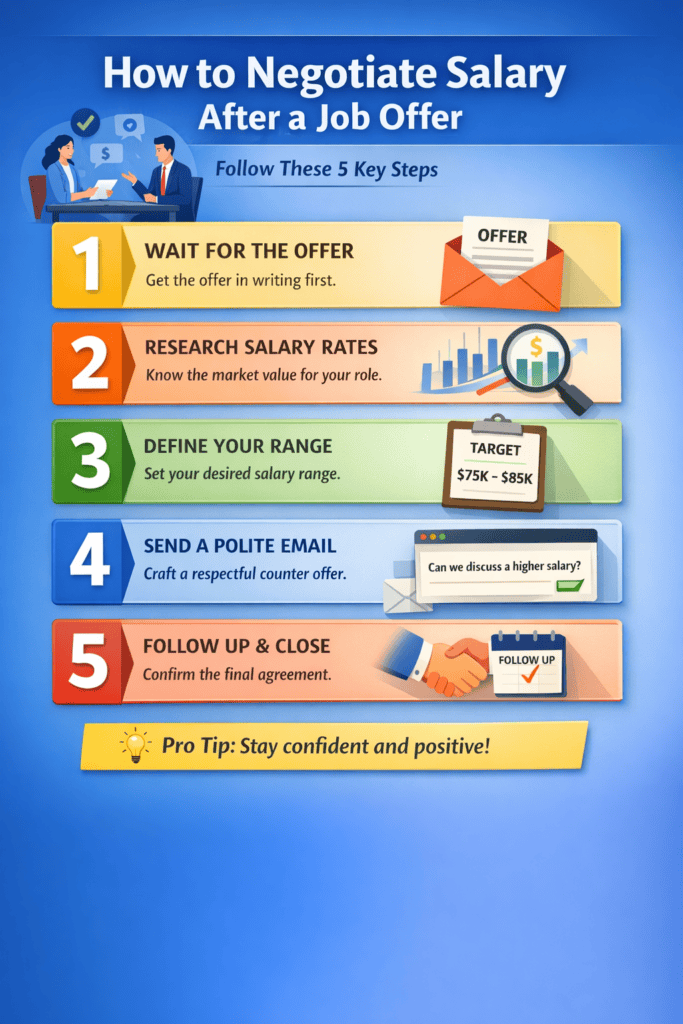
The template gets you in the room. The strategy determines how much you walk out with.
1. Anchor higher than your actual target. If you want ₹28 LPA, ask for ₹30–32 LPA. If you want $120K, ask for $130–135K. Salary negotiations almost always land somewhere in the middle. Set your anchor high enough that the middle is still a win.
2. Always give a range, not a single number. “I was expecting something in the ₹28–30 LPA range” is better than “I want ₹28 LPA.” The range signals flexibility while anchoring high. It’s also psychologically easier for the hiring manager to say yes to — they feel like they have a choice.
3. Use market data, not personal needs. The moment you say “my rent is high” or “I have EMIs,” you’ve made this about your problem, not their decision. Market benchmarks keep the conversation rational and easy to escalate internally.
4. Negotiate the full package, not just base salary. Especially in India, companies often have rigid salary bands but flexible budgets for everything around it. If they can’t move the base, ask about:
- Joining bonus (often comes from a different budget line)
- Performance bonus structure
- ESOPs or RSUs
- Remote work days (has real financial value — saves commute cost and time)
- Learning & development budget
A $5,000 joining bonus or an extra 0.1% equity stake can matter more than a $2,000 base increase over 12 months.
Common Mistakes That Actually Kill Offers
I’ve seen good candidates lose offers — not because they negotiated, but because they negotiated badly. Avoid these.
Sounding entitled, not confident. “I deserve more than this” doesn’t work. It puts the recruiter on the defensive immediately. Confident is: “Based on what I bring to this role…” Entitled is: “I expected better.”
Negotiating before you have the offer. This is one I see constantly. Someone’s in the second interview and starts dropping salary expectations like negotiating tactics. You have zero leverage before they want you. Wait for the written offer.
Writing an essay. Your negotiation email should be 100–150 words. Not 400. Not a bullet-pointed breakdown of your skills. Long emails signal anxiety, not confidence. Say what you need to say, then stop.
Giving an ultimatum without backup. “Match this or I’m moving on” only works if you have a real competing offer and are genuinely prepared to walk. Empty threats destroy trust fast — and recruiting circles are smaller than you think.
Following up the same day. After you send the email, give them at least 48 hours. Silence isn’t rejection. They’re having internal conversations you’re not part of. Rushing them signals desperation.
The Insider View: What Hiring Managers Really Think
Here’s what nobody tells you — because it makes companies look strategic in a way they’d rather not advertise.
The first offer almost never exhausts the budget. When a hiring manager gets approval to hire at ₹28 LPA, they often start the conversation at ₹24–25 LPA. This isn’t malicious — it’s how comp planning works. They need room to “win” the negotiation internally and show they managed costs.
Recruiters expect you to push back. When you don’t, it sometimes raises a flag. Experienced candidates know their value. A senior professional who accepts the first offer without question occasionally makes recruiters wonder why. (I know that sounds backwards — but I’ve heard this from more than a few TA leads.)
The “non-negotiable” signal is often a tactic. When a recruiter says “this is our best offer,” they mean it’s the best offer they’re authorized to give right now — not necessarily the best offer the company can give with a quick internal conversation. A respectful, well-reasoned email changes the conversation.
Your ask helps them make a case internally. When you give a market-based rationale, you’re not just asking for more money. You’re giving the recruiter a script to use with their hiring manager. “The candidate has 6 years of experience, market benchmarks are X–Y, and they’re asking for Z” is a conversation the recruiter can have. “The candidate just wants more” is not.
Advanced Template: When You Have a Competing Offer
Use this only if the competing offer is real. Making one up is a short-term tactic that can permanently damage your professional reputation in a small industry.
Subject: Re: [Job Title] Offer — Wanted to Be Transparent
Hi [Hiring Manager’s Name],
Thank you again for the offer — I want to be upfront that I’m genuinely excited about this role and [Company Name].
I’m currently evaluating another offer in the [₹X–Y LPA / $X–Y] range. That said, I’m more interested in this opportunity because of [specific reason — the team, the product, the growth trajectory].
Would it be possible to revisit the compensation and move closer to that range? I’d really like to make this work.
Best, [Your Name]
This version creates urgency without aggression. You’re being transparent, not threatening. The key is that line about why you prefer their role — it reassures them this isn’t purely transactional, and it gives them a reason to fight for you internally.
What Happens After You Send the Email?
There are three realistic outcomes:
They revise the offer upward. This happens more often than people expect. Say thank you, evaluate whether you want to push slightly again (a second counter is possible but requires careful judgment), and make your decision.
They hold firm on base but offer alternatives. This is actually a green flag — it means they want you and are trying to make it work. Evaluate the full package honestly. A ₹2 LPA joining bonus and one additional WFH day per week can be genuinely worth more than a ₹1 LPA base increase depending on your situation.
They come back with justification. Sometimes they’ll explain the band, the team structure, the comp philosophy. This is an invitation to a real conversation — not a rejection. Ask thoughtful questions. You might learn something that changes your view of the offer.
What almost never happens? They pull the offer because you politely asked for more. In 15 years, I’ve seen this once — and that company had other red flags the candidate probably should have noticed.
FAQ
Can negotiating salary cause a company to rescind an offer?
Almost never, if done respectfully. Companies don’t rescind offers because candidates asked for more — they might rescind if a candidate becomes aggressive, gives ultimatums, or makes demands after already accepting. A polite, well-worded email carries essentially zero risk.
How much more should I ask for in a salary negotiation?
The standard range is 10–20% above the initial offer, adjusted for your leverage. If you have a competing offer or are significantly under market, you can push toward the higher end. If you’re a fresher or the offer is already generous, a 5–10% ask is more appropriate.
Should I negotiate salary over email or phone?
Start with email. It gives you time to craft your words precisely, and it gives the recruiter time to respond thoughtfully without feeling put on the spot. Phone calls can work but require sharper real-time judgment and are harder to control.
What if the recruiter says the offer is non-negotiable?
Ask about other components of the package — joining bonus, performance review timeline, learning budget, or remote flexibility. These often come from separate budget pools. “Non-negotiable” usually applies to the base salary band, not the full compensation package.
How long do I have to respond to a job offer before negotiating?
Respond within 24–48 hours to acknowledge the offer and signal your interest. You can ask for 2–3 business days to review, which gives you time to research benchmarks and prepare your email. Most companies will accommodate a reasonable request for time.
Can freshers or entry-level candidates negotiate salary?
Yes, but the approach is different. Focus less on market benchmarks (the data is thinner for entry-level roles) and more on any specific skills, certifications, or competing opportunities. Even a small negotiation — asking for a signing bonus, a faster first review, or a higher performance bonus — is better than accepting passively.
What’s the best market data source for salary benchmarks in India?
Glassdoor India, LinkedIn Salary Insights, AmbitionBox, and Levels.fyi (for tech roles) are the most reliable sources as of 2026. For US roles, use Glassdoor, Levels.fyi, Payscale, and the Bureau of Labor Statistics for broader industry benchmarks.
One Email Can Change the Trajectory
Here’s what I want you to take away from this.
The salary negotiation email template above isn’t magic. It won’t turn a lowball offer into a generous one overnight. But it gives you something most candidates don’t have: a framework that’s confident without being confrontational, specific without being demanding, and logical enough to give the hiring manager something to work with internally.
The math is simple. Spending 20 minutes writing a thoughtful salary negotiation email that wins you ₹3 LPA extra is worth more than any productivity hack you’ll read this year. Compounded over 5 years, with annual raises on top of that higher base, you’re talking about a difference that runs into lakhs — or tens of thousands of dollars in US markets.
Offers are starting points. Use the template. Make the ask. And don’t leave that money sitting on the table.
Want to go deeper? Read our guide on [How to Evaluate a Job Offer Beyond the Salary Number] on HRGet.com — because getting a higher salary is only half the decision.

Michael Reeves | Former Senior Counsel, Littler Mendelson | Severance & Restructuring Specialist | 18+ Years in Employment Law
Author bio: Michael Reeves spent nearly two decades as Senior Counsel at Littler Mendelson — one of the world’s largest employment law firms — advising on mass layoffs, corporate restructurings, and severance negotiations for Fortune 500 companies across the US and Europe. He has worked both sides of the table: structuring cost-efficient separation packages for employers and, more recently, helping employees understand exactly where their leverage lies. Based between Chicago and London, Michael writes for HRGet.com to demystify the legal and financial dimensions of layoffs — so employees stop leaving money on the table.