
Most people don’t get fired. They get managed out — quietly, deliberately, and often months before anyone says a word officially. If you’re reading this, you’ve probably already felt something shift at work. The meetings you used to lead now happen without you. The feedback that was once positive has turned vague or critical. Your manager seems to be avoiding you.
You’re not imagining it. These are real signs you are being pushed out of your job — and I’ve seen this pattern play out dozens of times across large tech firms, consulting practices, and corporate environments in the US, UK, and India.
The question isn’t whether it’s happening. The question is: what do you do about it before it’s too late?
Below are the 10 clearest warning signals — what each one actually means, what’s driving it behind the scenes, and the moves that protect you professionally.
1. Reduced Responsibilities Without Explanation
This is almost always the first signal — and the most overlooked. You go from leading a product launch to “supporting” it. Your key accounts quietly transfer to a colleague. You’re asked to “focus on execution” when you used to be in strategic conversations. Nobody announces it. Nobody explains it.
Here’s what’s actually happening: the organization is de-risking its dependency on you. Before a company can exit someone cleanly, it needs to make sure critical processes don’t collapse when that person leaves. So work gets redistributed — quietly, gradually — weeks or months before any formal conversation happens.
I’ve seen this in large consulting firms, mid-size tech companies, and FMCG orgs equally. A senior marketing director at a consumer goods firm in Mumbai noticed her brand P&L responsibility handed off “for team development purposes.” Six weeks later, she was on a PIP. The responsibility shift wasn’t random — it was prep.
Insider tip: If your scope shrinks without any feedback conversation, don’t assume it’s a bandwidth adjustment. Ask directly: “Can you help me understand the thinking behind these changes to my responsibilities?” The answer — or the avoidance — will tell you everything.
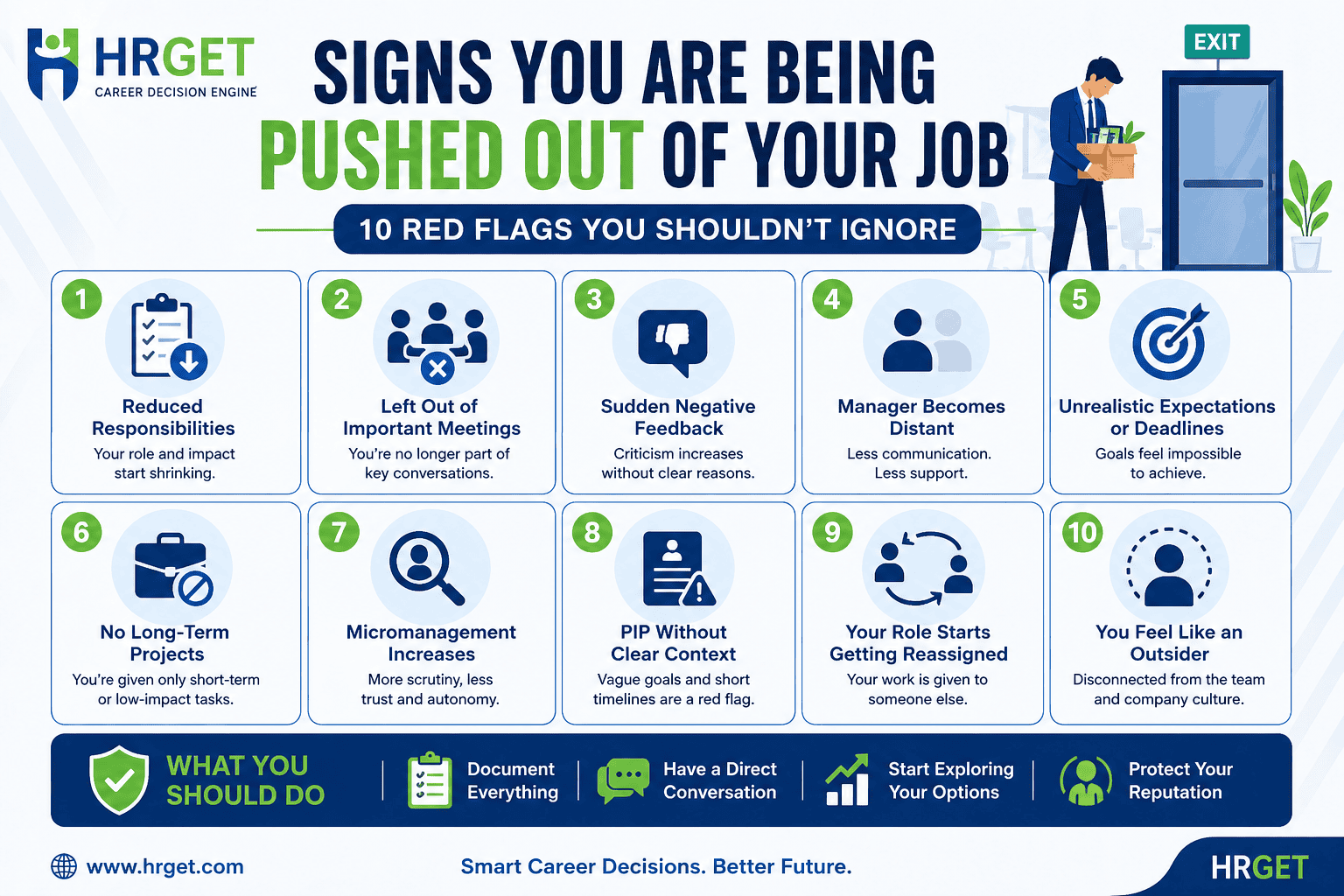
2. You’re Left Out of Important Meetings
One missed invite is noise. Three in a month is a pattern. When you stop appearing on the calendar for strategy sessions, budget reviews, or cross-functional planning calls that you previously attended — you’re being gradually disconnected from influence and visibility.
This matters more than most people realize. In corporate settings, visibility is leverage. When you’re not in the room, decisions get made without your input, which means your name gets associated with less and less over time. You become peripheral. And peripheral roles are the easiest to eliminate.
The tell-tale sign? You hear about decisions second-hand. A peer casually mentions something that happened in a meeting you weren’t invited to — a meeting that directly affects your work.
No company accidentally excludes critical employees from relevant meetings. If it’s happening consistently, it’s intentional.
3. Sudden Negative Feedback After Being Fine Before
This one destabilizes people the most — because it feels so disorienting. You had solid performance reviews. Your manager seemed pleased. And then, seemingly overnight, everything you do gets critiqued. Feedback becomes vague (“your communication style needs work”). Standards you easily met six months ago are now being questioned.
What’s really happening here is deliberate: the organization is building a paper trail. Before an employer can exit someone cleanly — especially in markets with strong employee protections like the UK, Germany, or India — they need documented performance concerns. The sudden shift in feedback is that documentation process beginning.
This is especially common in organizations with legal or HR teams that know employment law. They won’t fire you without a paper trail. So they start creating one.
Your immediate move: Ask for feedback in writing. Request specific examples. Say: “I want to make sure I fully understand the concern — can you share a concrete example of what you’re referring to?” This forces specificity, creates your own record, and often slows the process down.
4. Your Manager Becomes Distant or Avoidant
Watch for this shift carefully. Your 1:1s get cancelled — or rescheduled perpetually. Your manager responds to messages with unusual brevity. The warm, collaborative tone that used to characterize your interactions has gone flat or formal. They stop advocating for you in conversations with leadership.
This behaviour usually means one of two things. Either your manager already knows what’s being planned and is distancing themselves to avoid a difficult dynamic — or they’ve been instructed by HR or leadership to limit engagement as part of the exit process.
I’ll be honest — this is the hardest signal to sit with emotionally, because it feels personal. It often isn’t. Managers in this position are frequently in an uncomfortable middle-ground: they know something you don’t, but they can’t tell you yet. Their avoidance is self-protective, not malicious.
That doesn’t make it less meaningful as a signal. It makes it more so.
5. Unrealistic Expectations or Impossible Deadlines
There’s a specific kind of impossible that only happens when someone is being set up to fail. Targets that were never previously expected of you. Deadlines with no buffer. Goals that require resources or access you don’t have — and when you flag it, you’re told to “figure it out.”
This tactic is used precisely because it creates objective-looking failure. The organization can then say: “We gave them clear targets and they didn’t deliver.” It’s a cleaner narrative than admitting the exit was a management decision.
The tell: the goalposts keep moving. You hit one target and rather than acknowledgment, a new more demanding standard appears. Or the requirements were vague enough that success could never be clearly defined — which means failure always can be.
Smart lens: If you find yourself constantly working at full capacity and still falling short by management’s standards — while nothing has changed about your actual performance — the problem isn’t you. The structure has been designed for you to fail. Recognize it, document it, and start planning accordingly.
6. No Long-Term Projects Assigned
Look at your workload over the last 30 to 60 days. Are you working on things that will matter in six months? Or are you finishing up loose ends, clearing backlogs, and doing work with a short shelf life?
Companies don’t invest in people they’re planning to exit. If you’re no longer being included in planning cycles, not being assigned to initiatives with 6–12 month horizons, or finding yourself doing cleanup work rather than strategic work — the organization has already mentally moved on from you.
This signal is subtle because the short-term work still feels productive. You’re busy. You’re delivering. But you’re delivering on things that don’t require a future version of you to exist at the company.
Pay attention to what you’re being assigned — not just how much.
7. Micromanagement Suddenly Increases
You used to have autonomy. Now everything needs approval. Your work gets reviewed in unusual detail. You’re cc’d into conversations you used to own. Your manager wants daily check-ins where there used to be weekly ones.
Sudden micromanagement, when it hasn’t existed before, serves two purposes. First, it’s a control mechanism — if things go wrong, there’s oversight evidence. Second, it creates a kind of psychological pressure that many people can’t sustain without either breaking or quitting. Some organizations deliberately use this to prompt a voluntary resignation, which is legally and financially cleaner for them than a termination.
Don’t take the bait. Maintain professional composure, deliver consistently, and document the shift in management style. That documentation matters if there’s ever a wrongful termination or constructive dismissal claim.
8. Performance Improvement Plan (PIP) Without Prior Warnings
Let me be direct about this one: a Performance Improvement Plan, in theory, is supposed to be a developmental tool. A structured, time-bound plan to address specific performance gaps with clear support and defined success criteria. In practice? In many organizations, a PIP is an exit mechanism with a 30–90 day runway.
The red flag combination is: no prior documented warnings, vague or subjective improvement goals, a timeline so short it’s functionally impossible to demonstrate meaningful change, and no real support offered to help you succeed. That’s not a development plan — that’s paperwork being processed.
If you’re placed on a PIP without context, the first thing to do is get legal counsel — or at minimum, consult an employment rights resource. In the UK, employees have strong rights under the Employment Rights Act 1996. In India, the Industrial Disputes Act provides protections for certain categories of workers. In the US, the landscape varies by state, but at-will employment doesn’t mean the employer is immune from wrongful termination claims if protected classes are involved.
Don’t sign anything immediately. You often have time to review a PIP. Request 24–48 hours to read it carefully. Note whether the goals are specific, measurable, and achievable. Then decide whether to engage with it seriously or treat it as the exit notice it likely is.
9. Your Role Starts Getting Reassigned Around You
This one is almost painfully obvious once you know to look for it. Someone else starts picking up your core responsibilities. You’re asked to “document processes” or “handover notes” without a clear reason. A junior colleague is suddenly shadowing your work. Or — and this happens more than people admit — you see an internal job posting that looks remarkably similar to your current role description.
Knowledge transfer requests are particularly telling. When an organization asks you to write detailed documentation of your workflows, systems, and client relationships without a business reason being offered — they’re building a transition plan for after you leave.
This is the point at which the exit is no longer theoretical. It’s operational. If you’re seeing this, the timeline to a formal conversation is likely weeks, not months.
10. You Feel Like an Outsider in Your Own Team
This is the most underrated signal — and the one most likely to be dismissed as paranoia. The team dynamic shifts. Colleagues who used to engage warmly now seem guarded. You’re left out of casual Slack threads or lunch conversations. The social glue that made your work feel connected has quietly dissolved.
Culture doesn’t shift randomly. When it does, it’s almost always because information has been shared selectively. Your colleagues may know — or strongly suspect — something about your situation before you do. They’re not unkind; they’re uncomfortable. And that discomfort shows up as distance.
Trust your instincts here. The combination of feeling excluded professionally and socially is one of the clearest combined signals that you’re being pushed out. It’s also one of the most psychologically damaging — which is why it’s important to act on it practically rather than letting it erode your confidence.
Real Scenario: When the Signals Come Together
A senior product manager at a mid-size fintech company in London — let’s call her Priya — noticed three things in the space of six weeks in early 2025. She was removed from the quarterly roadmap planning sessions (“we’re keeping the group smaller this cycle”). Her main product area was quietly transferred to a newly promoted director. And her 1:1s with her VP started being postponed regularly.
She rationalized each one individually. Together, they were unmistakable. Within ten weeks, she was placed on a PIP with a 30-day improvement plan and goals that were, frankly, impossible to meet in that timeframe.
The outcome? Because she had started documenting, updated her CV, and had a quiet conversation with a recruiter two weeks before the PIP landed — she had a competing offer by the time the PIP period ended. She left on her own terms with a negotiated severance. The signals were there early. The response came on time.
Smart Strategy: What To Do If You’re Seeing These Signs
Don’t panic — and don’t quit immediately. Here’s the strategic sequence that gives you the most leverage.
1
Validate the pattern, not individual events
One cancelled 1:1 is noise. Three of these signals appearing simultaneously over 4–6 weeks is a pattern. List them out — write them down — and evaluate the whole, not the parts.
2
Document everything in writing
Save feedback emails. Note dates when responsibilities shifted. Keep meeting summaries. This documentation protects you legally and strengthens any severance negotiation. Email yourself a brief log from a personal account weekly.
3
Have a direct, professional conversation
Ask your manager clearly: “What does success look like for me in the next 60–90 days?” and “Is there any concern about my role or performance I should be aware of?” Their answer — or avoidance — will clarify your situation without triggering a defensive reaction.
4
Quietly prepare your exit options
Update your CV. Reach out to two or three recruiters. Activate your network through LinkedIn or direct messages — not publicly. Explore whether internal transfers are possible. Do this before any formal conversation begins; having options is the single greatest source of leverage.
5
Protect your professional reputation — fiercely
This phase feels unfair — because it often is. Stay professional regardless. Deliver consistently. Avoid venting to colleagues. Your next role’s reference check starts now. The employer you’re leaving will have opinions about how you handled this. Make sure those opinions work in your favour.
Common Mistakes People Make (And What to Do Instead)
I’ve watched smart, capable professionals handle this situation badly — and it cost them time, money, and in some cases, their professional reputation. Here’s what not to do.
| The Mistake | Why It Backfires | Do This Instead |
|---|---|---|
| Ignoring early signals | By the time a PIP lands, your leverage is minimal | Act at the pattern stage, not the crisis stage |
| Overworking to compensate | Working harder doesn’t reverse a strategic decision | Use that energy to job search and document |
| Confronting emotionally | Anger reduces leverage and damages your reference | Stay calm, ask precise questions, document responses |
| Relying on HR to fix it | HR’s mandate is to protect the company, not you | Engage HR only if there’s a legal issue; otherwise stay strategic |
| Quitting without a plan | Voluntary resignation often forfeits severance rights | Stay until you have an offer or negotiate an exit package |
The Pro Tip Most People Get Wrong
If you’re being pushed out, your goal is not to “win internally.” You won’t reverse a strategic decision by performing better or having a heart-to-heart with leadership. Your goal is to exit on your own terms — with a better opportunity, a clean professional record, and ideally a negotiated severance. That’s a win. That’s the play.
FAQ: Signs You Are Being Pushed Out of Your Job
Can I be mistaken about being pushed out?
Yes — a single signal can have an innocent explanation. A cancelled meeting isn’t a conspiracy. But three to five of these patterns appearing simultaneously over 30–60 days is statistically difficult to explain away. Trust the pattern, not isolated incidents. And remember: even if you’re wrong, the protective steps (documenting, networking, updating your CV) cost you nothing.
Is being put on a PIP always a sign you’re being pushed out?
Not always — but context matters enormously. A well-structured PIP with specific, measurable goals, genuine support, and a realistic timeline can be a real development tool. A PIP issued suddenly with vague goals, short timelines, and no prior documented warnings is almost always a formalized exit process. Understand which one you’re dealing with before deciding how to respond.
Should I quit immediately if I think I’m being pushed out?
No — not unless the environment is genuinely harmful to your mental health. Quitting voluntarily typically forfeits severance entitlements and, in many jurisdictions, affects unemployment benefit eligibility. Stay strategic: use the remaining time to line up your next role, negotiate an exit package if possible, and leave on your terms rather than theirs.
Can I recover my position once I notice these signs?
Occasionally — but only if the decision isn’t yet finalized and there’s genuine goodwill from leadership. This usually requires a candid conversation at the right level, a demonstrable change in the specific concern, and organizational flexibility. It happens, but it’s the exception. Don’t stake your financial security on the possibility.
How long does the “being pushed out” process typically take?
In most corporate settings, from the first visible signals to a formal exit conversation: one to three months. In organizations with strong legal or HR oversight (common in large UK and EU employers), the timeline may stretch to four to six months due to documentation requirements. In fast-moving US tech companies, it can move much faster — sometimes within weeks.
Should I escalate to HR if I think I’m being pushed out?
Only if you have a specific legal concern — discrimination on protected grounds, harassment, or a clear breach of employment law. Otherwise, escalating to HR rarely changes the outcome and can accelerate the process. HR’s primary role is to manage legal and organizational risk, not to advocate for your interests as an employee.
What is the single biggest early warning sign to watch for?
The combination of reduced responsibility and exclusion from decisions. Individually, each can be rationalized. Together, they signal that the organization is beginning the process of making itself less dependent on you — which is almost always the first operational step in a managed exit. If these two appear together, treat it as a clear signal, not noise.
The Bottom Line
Companies rarely push people out suddenly or randomly. The process is usually planned, gradual, and quiet. And the signs — if you know what to look for — are visible weeks or months before the formal conversation happens.
If you’re seeing multiple signs you are being pushed out of your job, the most powerful thing you can do is respond strategically rather than emotionally. Document what’s happening. Have direct conversations. Prepare your exit options while you still have leverage. And when the time comes — negotiate, don’t just accept whatever’s offered.
The professionals who come out of these situations well aren’t the ones who fought hardest to stay. They’re the ones who saw it clearly, moved early, and left strong.
Related reading: If you’ve been placed on a PIP or expect a formal exit conversation soon, read our guide on how to negotiate your severance package — including what to ask for, what you can push back on, and the specific language that gets results.
By Dr. Amelia Grant — Organizational Psychologist & Workplace Behavior Advisor | 15+ years | London / Boston
Updated: June 2026 | HRGet.com — Career Decision Engine

Organizational Psychologist & Workplace Behavior Advisor (Former consultant with Boston Consulting Group, research contributor aligned with Harvard Business Review)
Dr. Amelia Grant is an organizational psychologist specializing in burnout, toxic workplaces, leadership behavior, and employee mental resilience. She writes practical, research-backed workplace guidance for modern professionals.