Short answer: yes — but not the way most people assume.
Here’s what 18 years of severance and employment law work has taught me: more people lose their unemployment benefits while freelancing through honest mistakes than through deliberate fraud. They don’t report income correctly. They don’t understand the difference between “earned” and “paid.” They scale up their gig work just a little too fast — and suddenly, the state deems them self-employed. Benefits gone.
The truth is that the system does allow freelancing. It even anticipates it. But there’s a narrow corridor you have to stay inside — and this guide will walk you through exactly where those walls are.
By the time you finish reading, you’ll know how partial unemployment benefits work, what triggers disqualification, how to build a hybrid income strategy that maximizes what you take home, and what the IRS expects from you on the tax side.
What Counts as Freelancing While Unemployed?
Before anything else, let’s define what the system is actually watching for. In the context of unemployment insurance, “freelancing” gets lumped under a broader category: self-employment income. And that bucket is wider than you’d think.
It includes:
- Contract work that generates 1099 income
- Gig economy platforms — Uber, Lyft, Fiverr, Upwork, TaskRabbit
- Consulting work (even a single paid project)
- Remote project-based work for former or new clients
- Any side business income, including digital products or online courses
- Informal paid work — tutoring, handyman jobs, photography gigs
Here’s where it gets counterintuitive: it doesn’t matter whether you’ve “officially” set up a business. If money changes hands for your work, your state’s unemployment agency sees it as self-employment activity — even if it’s a one-off $75 Fiverr logo job.
I’ve seen people argue that because they hadn’t formed an LLC yet, they didn’t need to report it. That reasoning doesn’t hold up. Report the income or risk penalties — it’s that simple.
Can You Collect Unemployment While Freelancing?
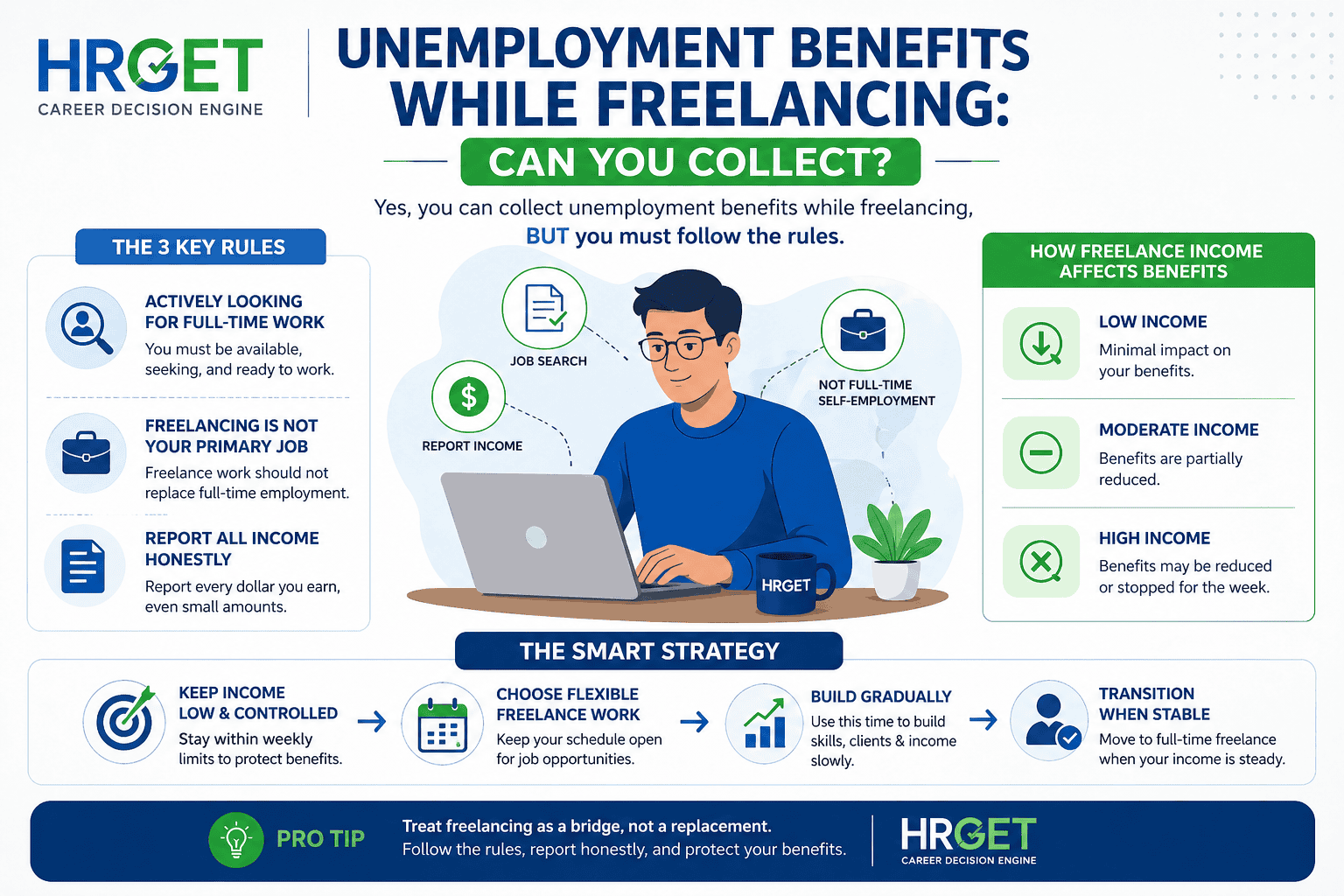
Yes — but three conditions must hold simultaneously. Miss any one of them, and your eligibility falls apart.
1. You’re still actively looking for full-time work
Unemployment Insurance (UI) exists to bridge people to their next full-time job — not to subsidize a freelance career pivot. Every week you certify benefits, you’re attesting that you’re available and actively seeking employment. That means applying to jobs, attending interviews, and not turning down reasonable offers. If freelancing crowds that out, you’re in violation.
2. Freelancing is supplemental — not your primary occupation
The moment the state determines that freelancing has become your main economic activity, they reclassify you as self-employed. Benefits stop. This isn’t a judgment call you make — it’s a determination your state makes based on hours worked, income earned, and whether you’re holding yourself out as a business.
3. You report all income honestly and on time
Every dollar earned from freelance work — no matter how small — must be reported during the certification week in which you earned it, not when it hits your bank account. This distinction trips up more people than any other rule. We’ll come back to it.
These rules flow from the broader framework set by the U.S. Department of Labor’s Unemployment Insurance program, with administration delegated to each state’s workforce agency.
How States Actually Evaluate Freelance Income
This is where things get genuinely confusing, because there’s no single national standard. Unemployment is a federal-state partnership — the Department of Labor sets broad guidelines, and each state runs its own UI program with its own formulas.
That said, most states follow a similar weekly reporting structure:
What you report each week:
- Total hours worked (for any paid activity)
- Gross income earned that week (not received — earned)
- Type of work performed
- Whether you were available and seeking full-time work
From there, your benefit for that week gets calculated. Most states use a formula like this:
| Your Freelance Earnings That Week | What Typically Happens to Your Benefits |
|---|---|
| Below the “earnings disregard” threshold (e.g., $50–$100) | Full benefits paid — state ignores small earnings |
| Moderate (e.g., $100–$400) | Benefits reduced dollar-for-dollar (after disregard) |
| At or above your weekly benefit amount (WBA) | No benefits paid for that week |
| Consistently high — sustained over multiple weeks | State may reclassify you as self-employed; benefits end |
The “earnings disregard” is a small buffer your state gives you before they start reducing benefits. California’s, for instance, is 25% of your weekly benefit amount. Some states use a flat dollar figure. A few states are more generous; a few are stricter. Check your state’s UI agency website for the exact formula.
Partial Unemployment Benefits Explained
The concept of partial unemployment benefits is the key to making this work. Most people think of unemployment as an on/off switch — either you get it or you don’t. That’s wrong.
Partial UI is a feature, not a bug. It’s designed specifically for situations where someone has limited earnings but hasn’t yet returned to full employment. The state is essentially saying: “We won’t punish you for earning a little — but we won’t double-pay you either.”
Here’s the logic in plain terms:
“You can earn — but not enough to replace your need for unemployment. The moment your earnings substitute for a paycheck, benefits stop.”
This framework is intentionally designed to encourage gradual re-entry into the workforce — whether that’s through a part-time role, a freelance contract, or testing out a business idea. The system accommodates all of those, within limits.
What it’s not designed to accommodate is someone who has effectively become a full-time freelancer but wants to keep collecting benefits while building that business. That’s the line — and crossing it, even accidentally, is where things break down.
Real Scenario: What the Numbers Actually Look Like
📋 Real Scenario
Marcus is a laid-off project manager in Texas. His weekly benefit amount (WBA) is $480. Texas has an earnings disregard of 25% of WBA = $120.
Week 1: Marcus earns $90 on Upwork.
Week 2: He earns $250 from a consulting call.
Week 3: He lands a $600 project.
Notice what happened in Week 2: Marcus earned more total income ($600) than he would have on benefits alone ($480). This is the hybrid income sweet spot — freelance earnings that supplement rather than replace.
Week 3 isn’t a disaster. He still earned $600. But if week 3 becomes his new normal — if every week he’s billing $500–$700 from freelancing — the state starts asking questions. A claims examiner may review his file, ask for documentation, and potentially flag him as self-employed.
Smart Strategy: Freelance Without Losing Benefits
Most people get this backwards. They either don’t freelance at all — leaving real income on the table — or they go all-in too fast and lose their safety net. Here’s the play that actually works.
Step 1: Know your state’s exact formula before you take any gig
Go to your state’s unemployment agency website and look up the partial benefits calculation. Find your WBA, your earnings disregard, and the income ceiling beyond which benefits zero out. These three numbers define your playing field. In Texas, for example, your benefit reduces dollar-for-dollar above 25% of your WBA. In New York, any earnings over $504 per week eliminate benefits for that week. Know your numbers.
Step 2: Target income just below your disregard — especially early on
If your disregard is $100 and your WBA is $450, a $95 freelance project is pure addition — you get $450 in benefits plus $95 in earnings. That’s $545 total. As you rebuild, gradually scale up. Don’t max out in week one.
Step 3: Keep work flexible and availability real
Avoid gigs that require fixed daytime hours, long commitments, or exclusivity clauses. If your freelance schedule makes you genuinely unavailable for full-time interviews, you’ve crossed into “not available for work” territory — and that triggers disqualification regardless of income. Take async work: writing, editing, virtual consulting, code reviews, creative projects.
Step 4: Keep documenting your job search in parallel
Most states require you to log a minimum number of job search activities per week — typically two to three contacts. Keep doing this. Save your applications, emails, and LinkedIn messages. If your account ever gets flagged for review, this documentation is your defense.
Step 5: Report income when earned, not when paid
You complete a project on Tuesday. You invoice the client. They pay 30 days later. You still report that income during the week you completed the work — not the week the money arrives. This catches people off guard constantly. If you’re on a net-30 payment cycle and you forget this rule, you can accidentally misrepresent your weekly earnings in ways that look like fraud.
💡 Pro Tip
Keep a simple weekly spreadsheet: date, client, project description, hours worked, amount earned. Takes five minutes. Saves you from audits, miscalculations, and the panic of reconstructing three months of gig income if your state opens a review.
Common Mistakes That Get People Disqualified
Let me be direct: these aren’t edge cases. I’ve seen each of these cost real people real money.
❌ Mistake 1: Not reporting freelance income at all
People assume small amounts don’t count. They do. Unreported income is classified as an overpayment — and states have cross-matching systems that catch 1099 income at tax time. You can face repayment demands plus a 15–30% penalty. In some states, intentional non-reporting is prosecuted as fraud.
❌ Mistake 2: Reporting income in the week you’re paid instead of when you earned it
Unemployment tracks when work is performed. If you finish a project in week 3 but get paid in week 6, that income belongs to week 3’s certification. Misreporting this — even innocently — creates a paper trail that looks suspicious during audits.
❌ Mistake 3: Describing yourself as “full-time freelancer” anywhere public
LinkedIn profile, Upwork bio, personal website — if any of these describe you as a full-time freelancer or self-employed professional, and a state auditor finds it, that’s evidence against you. Keep your profile accurate: describe your situation as “open to full-time roles” or “available for employment.”
❌ Mistake 4: Turning down a suitable full-time job offer
If you reject a job offer that matches your experience and pay expectations because freelancing is going well, your benefits can be immediately terminated. “Suitable work” doesn’t have to be your dream job — it just has to be reasonably comparable to your prior role.
❌ Mistake 5: Scaling too fast, too visibly
Going from $50/week in freelance income to $800/week within a few weeks raises red flags. It signals a transition to self-employment — which is fine, but it means your UI benefits should stop. The problem is people often don’t self-report this transition, which then becomes a retroactive overpayment issue.
Taxes: What You Must Report (And When)
Freelancing while on unemployment creates a double tax situation that most people don’t plan for. Here’s what you’re dealing with.
Your unemployment benefits are federally taxable income. The state pays them, but you still owe federal income tax on them at the end of the year — unless you opted into withholding (which you can do via Form W-4V). Many people skip this and then get hit with a surprise tax bill in April.
Your freelance income adds another layer:
- Self-employment tax: 15.3% on net self-employment earnings (covering Social Security + Medicare — both employer and employee portions)
- Federal income tax: Based on your total income for the year, including UI benefits + freelance earnings
- Quarterly estimated taxes: If your total annual tax liability exceeds $1,000, the IRS expects estimated payments in April, June, September, and January
Practically speaking: if you’re collecting $450/week in benefits and earning $200/week freelancing, you’re looking at roughly $33,800/year in gross income. After self-employment tax and a standard deduction, you might owe $3,000–$5,000 at tax time — more if you’re in a higher bracket from prior income.
The smart move is to set aside 25–30% of all freelance earnings in a separate savings account from day one. It feels painful, but it’s far less painful than a tax bill you weren’t expecting.
When Freelancing Crosses the Line
There isn’t always a flashing warning light. But these are the signals — in order of severity — that you’ve moved from “supplemental freelancer” to “self-employed person who shouldn’t be on UI.”
🚩 You consistently earn more than your weekly benefit amount
For occasional high-earnings weeks, this is fine. But if week after week your freelance income meets or exceeds your WBA, the state will likely stop your benefits for those weeks — and may conduct a broader eligibility review.
🚩 You’re working full-time hours on freelance
States typically view 40+ hours per week of self-employment as equivalent to being fully employed. Even if the income is variable, the activity level disqualifies you. Some states use a threshold as low as 32 hours.
🚩 You’ve stopped applying for full-time jobs
This is a disqualifier on its own, separate from income. If your job search activities have dropped to zero because freelancing is keeping you busy, your weekly certification is no longer accurate — and that creates legal exposure.
🚩 You’ve taken on an ongoing client relationship that resembles employment
A retainer client who pays you $3,000/month for consistent, structured work is functionally an employer in the eyes of many state UI programs. The state may reclassify this as employment — and if so, they’ll ask why you weren’t reporting it as wages.
The honest answer to “when does freelancing become a problem” is: when it stops looking like a bridge and starts looking like a destination. Use it as the former, and the system works with you.
Frequently Asked Questions
Can I freelance full-time and still collect unemployment benefits?
No. Once freelancing becomes your primary work — whether measured by hours, income level, or the absence of active job searching — your state will typically classify you as self-employed and terminate benefits. The system is designed to bridge you to employment, not to fund a permanent freelance career. Self-report this transition rather than risk a retroactive overpayment demand.
Do I have to report small freelance income under $100?
Yes, unambiguously. There is no earnings amount too small to report on your weekly certification — even a $20 gig job must be disclosed. Your state may have an earnings disregard that means small amounts don’t reduce your benefit, but you still have to report them. Failure to report any earned income is the most common trigger for fraud investigations and overpayment demands.
What if a client hasn’t paid me yet — do I still report it?
Yes. Unemployment insurance tracks income based on when work is performed, not when payment is received. If you complete a project in week 4, you report that income during week 4’s certification — even if you’re on net-60 payment terms and won’t see the money for two months. This is one of the most confusing rules for freelancers. Get clear on it early.
Can I start a business while collecting unemployment?
You can, but carefully. Starting a business is not automatically disqualifying — many states explicitly allow it as part of “self-employment assistance” programs. The problem comes when the business consumes your working hours, generates income that exceeds your benefit, or causes you to stop searching for employment. Keep the business small and documented in the early stages, and always maintain your job search activity.
Will freelancing trigger an audit of my unemployment claims?
Not necessarily from freelancing itself — but inconsistencies will. If your weekly certifications show zero income for months, and then your 1099s surface at tax time, that gap triggers a cross-match review. States regularly compare UI records against IRS 1099 data. The safest posture is consistent, accurate reporting from week one — audits are almost always the result of something that looked inconsistent, not simply of having freelanced.
Do unemployment benefits affect my freelance taxes?
Yes, indirectly. UI benefits count as gross income for federal tax purposes, which pushes your total taxable income higher — potentially moving you into a higher bracket when combined with freelance earnings. If you didn’t withhold taxes from your UI payments (via Form W-4V), you may owe at year-end. Factor both income streams into your quarterly estimated tax calculations to avoid an April surprise.
Can I refuse freelance opportunities to stay eligible for full benefits?
You can decline freelance work — there’s no obligation to take every gig that comes your way. However, the same rule doesn’t apply to full-time employment. If you turn down a suitable full-time job offer — one that’s reasonably comparable to your prior role in terms of pay and duties — your benefits can be terminated. The key distinction: freelance refusals are generally fine; suitable employment refusals are not.
The Honest Bottom Line
Collecting unemployment benefits while freelancing is genuinely possible — and for many people, it’s the smartest financial move they can make during a job transition. The system wasn’t built to trap you. It was built to help you land on your feet.
But it requires discipline that most people don’t expect: tracking income to the week it’s earned, not the week it lands in your account. Keeping your freelance work supplemental and your job search active. Knowing your state’s exact formula so you can optimize the math, not guess at it.
The people who do this well treat it like a hybrid income strategy — benefits as the floor, freelance as the upside. They build toward full self-employment on a timeline that doesn’t require burning the safety net to get there.
If you’re navigating a layoff and weighing your income options, the next step worth reading is how to make the most of your severance package before it runs out — because that timeline directly affects how long you have to build your freelance income without financial pressure. See: How to Negotiate a Severance Package (and What Most People Miss).
About the Author
Michael Reeves is a former Senior Counsel at Littler Mendelson with 18 years of experience advising Fortune 500 companies through layoffs, WARN Act compliance, and severance negotiations. Based in Chicago and London, he writes on employment law, severance strategy, and the legal side of career transitions for HRGet.com.

Michael Reeves | Former Senior Counsel, Littler Mendelson | Severance & Restructuring Specialist | 18+ Years in Employment Law
Author bio: Michael Reeves spent nearly two decades as Senior Counsel at Littler Mendelson — one of the world’s largest employment law firms — advising on mass layoffs, corporate restructurings, and severance negotiations for Fortune 500 companies across the US and Europe. He has worked both sides of the table: structuring cost-efficient separation packages for employers and, more recently, helping employees understand exactly where their leverage lies. Based between Chicago and London, Michael writes for HRGet.com to demystify the legal and financial dimensions of layoffs — so employees stop leaving money on the table.