By Eleanor Whitmore · Director of Compensation & Benefits (Ex-Mercer, PwC) · New York / London · 15+ years
Even in 2026, women are leaving real money on the table — and it’s not because they lack the confidence or the credentials. I’ve sat across the table from thousands of salary conversations in my career, and the pattern I see over and over is this: women negotiate, but they negotiate differently. And that difference costs them.
This isn’t another article telling you to “be more confident.” Confidence is table stakes. What actually moves the number is how you frame your ask, when you make it, and which levers you pull. Get those three things right, and you don’t need to push hard — you just need to negotiate smart.
Here’s a full playbook: the psychology behind the ask gap, timing strategy, real scripts, and the mistakes I’ve watched derail otherwise strong candidates.
What you’ll walk away with: A clear, step-by-step negotiation strategy built specifically around the dynamics women face — including scripts you can use word-for-word.Why the “Ask Gap” Still Exists in 2026
Let’s clear something up first. The narrative that women simply “don’t negotiate” has been thoroughly debunked. Research from Harvard Business Review and Linda Babcock’s work on gender and negotiation shows that women do negotiate — they just face a structural penalty when they do it the same way men do.
Here’s what’s actually driving the ask gap:
- Backlash bias: Women who negotiate assertively are more likely to be perceived as “difficult” or “not a team player.” Men using the same language are seen as confident. This isn’t anecdotal — it shows up consistently in hiring manager feedback.
- Lower initial anchors: Studies on hiring data suggest initial offers extended to women are structurally lower in many industries, particularly in tech, finance, and consulting. You’re negotiating up from a starting point that’s already behind.
- Internalized risk aversion: Fear of losing the offer leads to smaller asks. I’ve watched highly qualified candidates ask for $5K more when the role had $25K of flexibility. They didn’t know — and they didn’t ask.
- Justification framing: Women are more likely to explain why they deserve the raise. Men are more likely to simply state a number. Ironically, the explanation often weakens the position.
The result? Even when women negotiate, they often walk away with less — not because they asked, but because of how they asked. That’s exactly what this guide fixes.
The Real Cost of Not Negotiating
Skipping negotiation feels safe. It’s not. The financial damage compounds every year you stay at that company.
Walk through this with me. You receive a $120,000 offer. You don’t negotiate. A peer who asks for $130,000 gets $128,000. Over five years — factoring in 4% annual raises and percentage-based bonuses — that gap doesn’t stay at $8,000. It grows to somewhere between $60,000 and $100,000 in lost compensation, depending on your bonus structure and equity.
Add RSUs that vest at a higher grant value, a performance bonus tied to your base, and the salary anchor your next company uses when they check your current comp — and you’re easily looking at a $150,000–$200,000+ lifetime impact from a single conversation you didn’t have.
I tell every woman I coach: the negotiation conversation is uncomfortable for about 90 seconds. The financial consequence of skipping it lasts a decade.
📊 The Compounding Cost — A Quick Example
| Scenario | Year 1 | Year 5 (cumulative) |
|---|---|---|
| No negotiation ($120K base) | $120,000 | ~$649,000 |
| Negotiated ($130K base) | $130,000 | ~$703,000 |
| Difference | $10,000 | ~$54,000+ |
Based on 4% annual raise compounding. Excludes bonus and equity upside.
When Women Should Negotiate: Timing Is Everything
Most salary negotiation advice focuses on what to say. Fewer people talk about when — and timing is often what separates a successful negotiation from one that stalls.
Here’s the correct sequence:
✅ Best moments to negotiate:
- After receiving a written offer — you have the leverage of a confirmed selection decision
- Before you’ve signed anything — your optionality is still intact
- When you have a competing offer in hand — even a soft one creates real leverage
- During annual performance reviews with documented wins — not just “I want more”
❌ Worst moments to negotiate:
- In early-stage interviews before they’ve decided on you
- Right after accepting verbally — you’ve already given away your leverage
- During or right after a performance improvement plan (PIP)
The core principle here: the more they want you, the more power you have. A written offer is the clearest possible signal they’ve chosen you. That’s the moment your leverage peaks — and most people waste it by not negotiating at all.
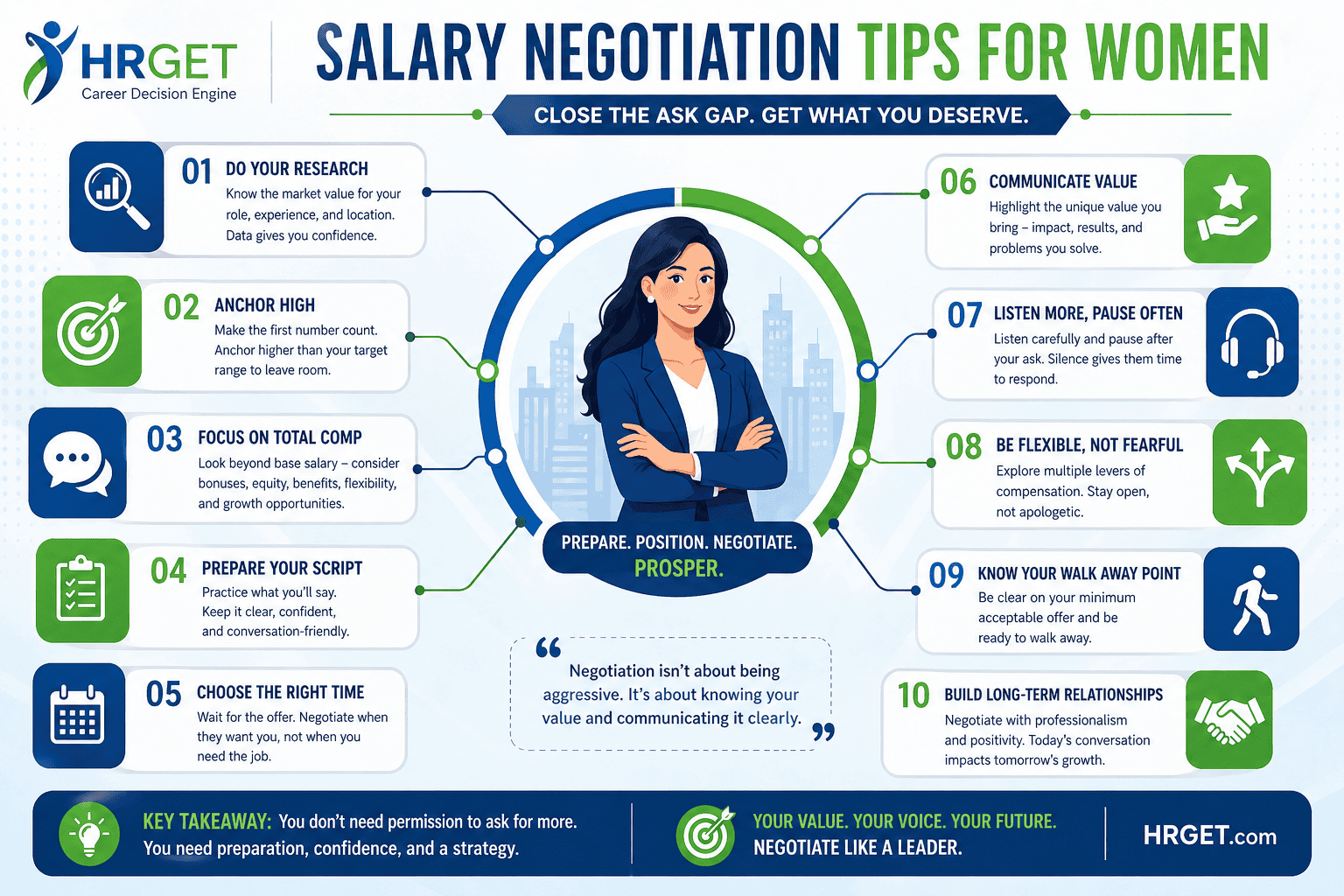
Salary Negotiation Tips for Women That Actually Work
1. Reframe Negotiation as Alignment, Not Aggression
This is the single biggest shift that changes outcomes. Instead of positioning your ask as a demand, position it as a mutual interest. The backlash bias I mentioned earlier decreases significantly when you use collaborative language — not because you’re softening your ask, but because you’re removing the adversarial frame.
Instead of: “I want more money”
Try: “I want to make sure this offer aligns with the scope of the role and what I bring to it.”
Same outcome. Very different reception.
2. Use Data — But Don’t Lead With It
Citing Glassdoor or Levels.fyi the moment you open your ask makes you sound reactive rather than informed. The better move is to demonstrate market awareness without relying on public databases as your primary justification.
Instead of: “Glassdoor says the median for this role is $145K…”
Try: “Based on similar roles I’ve evaluated at this scope and seniority, I was expecting something in the $145K–$155K range.”
You’ve positioned yourself as someone who does their own market analysis — not someone who looked it up the night before.
3. Anchor Higher Than Your Target
If your target is $140,000, open at $150,000–$155,000. The research on anchoring effects is clear: the first number stated in a negotiation has an outsized influence on the final outcome. Employers expect to negotiate down — so give yourself room.
The candidates who anchor at exactly what they want almost always end up below it. The ones who anchor 10–15% higher almost always land at or above their target.
4. Bundle Your Ask Across Multiple Levers
Base salary is the most visible number, but it’s often the most constrained one — especially in companies with rigid pay bands. Smart negotiators expand the conversation beyond base.
Your full negotiation bundle should include:
- Base salary
- Signing bonus (often easier to approve — doesn’t affect recurring payroll cost)
- RSUs / equity grant size or vesting acceleration
- Annual bonus target %
- Remote/hybrid flexibility (real financial value: $5K–$15K/year in commute and relocation savings)
- PTO, title adjustment, or 90-day performance review for early salary revisit
When you negotiate across multiple levers, you give both sides multiple ways to say yes. That’s a much easier conversation than a binary battle over one number.
5. Stop Talking After You Ask
This one is uncomfortable. After you state your number, go silent. Don’t soften it. Don’t immediately offer a fallback. Don’t fill the pause with qualifiers.
Silence creates social pressure — and in a negotiation, that pressure works in your favor. The person who speaks first after the ask is made is the one who tends to move. Most candidates undermine their own position by rushing to justify the moment they sense hesitation. Don’t.
Scripts That Don’t Backfire
These are word-for-word frameworks I’ve seen work consistently. Adapt them to your voice — but keep the structure intact.
Script 1 — Standard Ask
“I’m genuinely excited about this role and the team. Based on the scope and what I bring to it, I was expecting something closer to $145,000. Is there flexibility on the base?”
Script 2 — When Base Is “Fixed”
“I understand base may be constrained. Is there flexibility in the signing bonus or equity component? I want to make this work.”
Script 3 — Competing Offer
“I have another opportunity I’m evaluating in the $150K range. This role is my preference — can we see if we can get closer to that number?”
Script 4 — The Soft Push
“Is this the strongest offer you’re able to put forward, or is there room to revisit?”
Note on Script 3: only use it if a competing offer is real, or at minimum actively being evaluated. Using a fabricated offer is a negotiation risk you don’t need to take.
Real Scenario: How One Negotiation Added $25K
📋 The Situation
A senior product manager — let’s call her Priya — received an initial offer of $130,000 from a Series B tech company in Austin. The recruiter mentioned the band was “competitive.” Priya almost accepted on the call.
What she did instead:
- Asked for 48 hours to review the written offer
- Anchored at $155,000 in her response email, citing scope and market data
- Mentioned she was “actively evaluating another opportunity”
- When base came back at $140K, asked about the signing bonus and RSU grant
- Stayed quiet after each ask — didn’t volunteer concessions
Final package:
- Base salary: $140,000 (up from $130K)
- Signing bonus: $10,000
- RSU grant: increased from $80K to $100K over 4 years
Total Year-1 gain: $25,000+. She didn’t push aggressively. She negotiated strategically.
Smart Strategy: Think Total Compensation, Not Just Base Salary
Here’s an insider truth most candidates don’t know: companies have more flexibility in signing bonuses and equity grants than they do in base salary. Base salary affects payroll costs, internal equity across the team, and benefits calculations. A signing bonus is a one-time budget item — easier to approve, doesn’t set a precedent.
When you hit a wall on base, pivot the conversation rather than accepting defeat.
| Component | Why It’s Negotiable | Typical Range to Push For |
|---|---|---|
| Base Salary | Core ask — always try | 10–20% above initial offer |
| Signing Bonus | One-time cost; easier to approve | $5K–$25K depending on level |
| RSUs / Equity | Negotiated quietly; large upside | 10–25% increase on grant |
| Bonus Target % | Often flexible at director+ level | Push from 10% to 15–20% |
| Remote Flexibility | Financial value + quality of life | 3–5 days WFH; commute savings |
Common Mistakes Women Make in Salary Negotiation
I’ve watched these play out across hundreds of offer conversations. These are the patterns that cost candidates the most:
1. Asking too politely. There’s a difference between professional tone and weak positioning. “I was just wondering if maybe there might be any room to…” signals uncertainty before you’ve even named a number. State your ask clearly. Be warm — not tentative.
2. Revealing your current salary. Once you say “I currently make $110,000,” you’ve handed them your ceiling. In many US states (California, New York, Colorado, Illinois, and others), employers are legally prohibited from asking for salary history. Know your rights and redirect: “I’d rather focus on the value of the role and what a fair compensation looks like going forward.”
3. Accepting the first offer. First offers are almost always not final offers. Even in companies with “rigid bands,” there’s usually a signing bonus, a faster performance review, or an equity adjustment available. The first offer is a starting position — treat it like one.
4. Over-justifying your ask. The more you explain why you deserve something, the less confident you sound. State your number. Let it stand. A two-sentence ask is stronger than a five-paragraph one.
5. Assuming negotiation will cost you the offer. It almost never does. In 15+ years advising on compensation strategy, I can count on one hand the number of times a respectful, professional negotiation actually torpedoed an offer. Companies don’t rescind offers because a candidate asked. They might — occasionally — if the ask is wildly unreasonable or the tone is adversarial. Neither of those describes a well-prepared negotiation.
Pro Tips Most Career Advice Doesn’t Cover
🔥 Pro Tip #1: Your negotiation starts in the interview — not after the offer. The stronger your interview performance, the more they’ve invested in you emotionally and logistically. A high-impact interview creates leverage before any number is on the table.Silence is a strategy, not a gap to fill. The best negotiators I’ve worked with are not the most talkative ones. They state their position and wait. Get comfortable with three to five seconds of silence after you name your number. Most people can’t tolerate it — and they move first.
Practice out loud before the call. This sounds obvious but almost no one does it. Say your script out loud at least three to five times. The first time, you’ll stumble. By the fifth, it’ll sound natural. Candidates who sound uncertain about their own ask almost always get less.
Email first, call to follow up. A written negotiation gives you time to craft your message carefully and gives the recruiter time to go back to the hiring manager. The follow-up call — where you ask for an update — is where you close. Starting with email is the structured approach; the call is where energy and tone work in your favor.
This is a business transaction, not a favor. The mindset shift that changes everything. You’re not asking for a gift. You’re negotiating the terms of a business relationship. Frame it that way internally, and it changes how you come across externally.
Final Checklist Before You Negotiate
- ✅ You have the offer in writing
- ✅ You know your target number — and your anchor number (10–15% higher)
- ✅ You’ve identified at least 3 levers beyond base salary
- ✅ You have 2–3 scripts prepared and have said them out loud
- ✅ You’ve checked salary history ban laws in your state / country
- ✅ You’re prepared to stay silent after making your ask
If any of these aren’t ready — take 24 more hours. A prepared negotiation outperforms an unprepared one every single time.
FAQ: Salary Negotiation Tips for Women
Do women actually face backlash when negotiating salary?
Yes — but the risk is much lower with collaborative framing. Research consistently shows that women who negotiate using assertive-but-communal language (“I want this to work for both of us”) face significantly less pushback than those using purely assertive language. The backlash risk is real; it’s also largely manageable with the right framing.
How much higher should I negotiate above the initial offer?
For most mid-to-senior professional roles, aim for a 10–20% anchor above the initial offer. In high-demand roles in tech, finance, or consulting, 20–25% anchors are not unusual. The key is that your anchor should feel ambitious but not absurd — you want room to land at your real target, not trigger an immediate “that’s not going to happen.”
Can negotiating actually cost me the job offer?
Rarely. Employers expect negotiation, especially at the professional level. A reasonable ask with a professional tone almost never results in a rescinded offer. The scenarios where it does go wrong typically involve either an unreasonably large ask (2x the offered salary) or an adversarial tone. Neither describes a well-prepared negotiation.
Should I negotiate even if the offer already seems good?
Yes, almost always. “Good” is relative to what’s available — and you rarely know the full range until you ask. Even a $5,000 improvement in signing bonus compounds through future raises and the salary anchor it sets at your next company. The question to ask yourself isn’t “is this offer good?” — it’s “is this the best they can do?”
What do I say when they tell me the offer is final?
Shift the conversation: “I understand — is there flexibility in other components like the signing bonus or equity?” In my experience, “final” on base salary is often not final on total package. Companies have more flexibility in one-time costs (bonuses) than recurring payroll commitments. Always pivot before accepting “final” at face value.
Is it better to negotiate by email or on a call?
Start with email — it gives you time to craft your ask carefully and gives them time to consult internally. Follow up with a call to close. Email creates a paper trail and removes the emotional pressure of a live conversation; a call lets you read tone and close decisively. Used in sequence, they’re stronger than either alone.
How do I negotiate salary as a woman in India without revealing my current CTC?
In India, sharing current CTC is still common practice — but it’s not mandatory. You can redirect: “I’m targeting a package in the ₹28–32 LPA range for this role, which reflects the scope and my experience level.” Frame around your target, not your current number. In senior roles at MNCs and startups, this is increasingly accepted. The more you’re in demand, the easier this redirect becomes.
The One Thing Most Candidates Get Wrong
Negotiation isn’t about being aggressive. It never was. The women I’ve watched negotiate most effectively weren’t the loudest in the room or the most demanding. They were the most prepared. They knew their number. They knew their levers. They asked clearly, waited calmly, and didn’t blink.
The ask gap in 2026 isn’t primarily a confidence problem — it’s a strategy problem. And strategy is learnable.
Take the salary negotiation tips for women in this guide and work through them before your next offer. Run your scripts out loud. Identify your bundle before the call. And when you make your ask — stop talking, and let the silence work for you.
The first offer is almost never the real offer. Don’t let it be the last word.
📎 Related on HRGet.com
Facing a layoff instead of an offer? The same negotiation principles apply to your severance package. Read: How to Negotiate a Severance Package — and Actually Win
Eleanor Whitmore
Director of Compensation & Benefits with 15+ years advising Fortune 500 HR teams at Mercer and PwC. Based in New York and London, Eleanor specializes in total compensation strategy, pay equity, and offer negotiation across US, UK, and European markets.

Eleanor Whitmore | Former Partner, Mercer | Advisor, World Economic Forum | 20+ Years in Global Compensation
Author bio: Eleanor Whitmore has spent over two decades shaping how the world’s leading organisations pay, retain, and reward talent. As a former Partner at Mercer and an advisor to World Economic Forum working groups on the Future of Work, she has designed compensation frameworks for Fortune 500 companies across the US, UK, Europe, and emerging markets. Based between London and New York, Eleanor writes for HRGet.com to translate boardroom-level pay strategy into actionable guidance for working professionals navigating real compensation decisions.