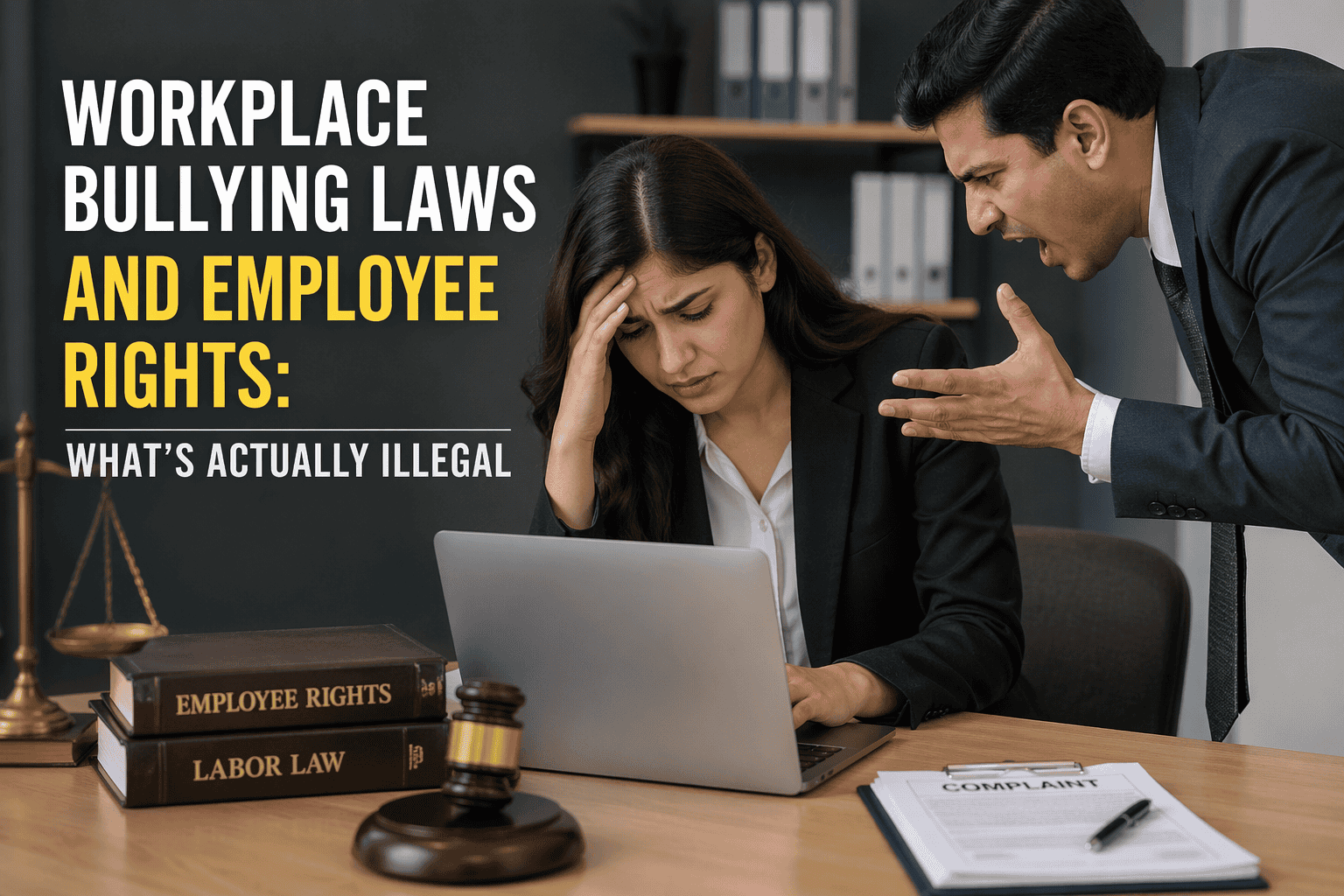
Here’s the uncomfortable truth about workplace bullying laws: most employees who are experiencing real, damaging workplace bullying have no legal recourse. Not because the behavior isn’t harmful — it clearly is. But because the law in the US, India, and most countries doesn’t protect against “being treated badly.” It protects against discrimination and rights violations.
That gap is where people get trapped. They spend months tolerating toxic behavior, then complain to HR, get told nothing violates policy, and feel completely stuck. I’ve seen this scenario play out dozens of times across the 20+ years I’ve spent in employment law — in Fortune 500 boardrooms, tribunal hearings, and quiet conversations with professionals who just needed someone to tell them where the legal line actually is.
This guide does exactly that. You’ll leave knowing what workplace bullying is illegal, what isn’t, what your actual employee rights are across the US, UK, and India, and the strategically smart way to respond — without destroying your career in the process.
⚡ Quick Answer
Is workplace bullying illegal? In most countries, general workplace bullying is not illegal on its own. It becomes illegal when it involves discriminatory harassment (targeting race, gender, age, religion, disability, or national origin), retaliation after a complaint, constructive dismissal, or specific safety violations. In the US, Title VII, the ADA, and the ADEA are the primary legal frameworks. The UK’s Equality Act 2010 covers similar ground. Document everything before you do anything else.
What Is Workplace Bullying — Legally vs Practically
The plain-English definition is this: workplace bullying is repeated behavior intended to intimidate, humiliate, or undermine an employee. The key word is “repeated.” A single bad day with a harsh manager doesn’t qualify. Courts and HR departments are looking for a pattern.
Common forms include public humiliation or shouting, persistent micromanagement, being excluded from meetings you should be part of, having your ideas ignored or stolen, spreading rumors, or being assigned work designed to set you up to fail. Sound familiar? Most people in a toxic workplace recognize at least three of these.
But here’s where it gets complicated: the legal definition of workplace bullying is almost entirely absent in US law. There is no federal anti-bullying statute. The same is true in India, where protections are fragmented across industrial tribunals and company HR policies. The UK comes closest, but even there, the law requires a link to a protected characteristic or a breach of duty of care to create a legal claim.
The distinction that matters is this: “bad behavior” and “illegal conduct” are two different things. Understanding where one ends and the other begins is your first and most important move.
Is Workplace Bullying Illegal?
The honest answer: usually no — unless it crosses into one of several specific legal categories.
Most people searching this question are hoping to discover that what they’re experiencing is a clean-cut legal violation. Unfortunately, that’s not how employment law works in most jurisdictions. A boss who screams at you daily, takes credit for your work, and makes your life miserable is a terrible boss — but in the US, they are not necessarily breaking any law.
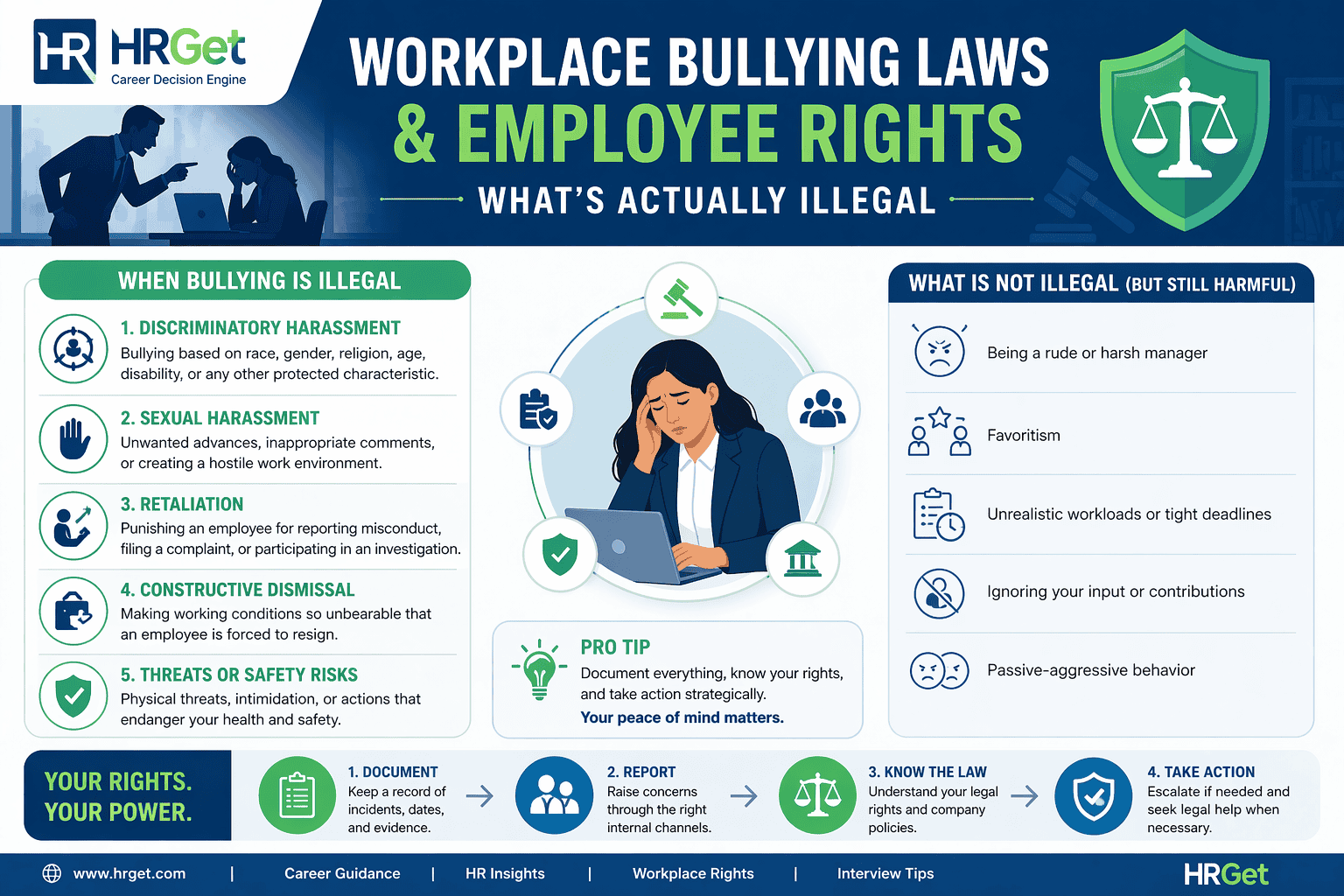
Workplace bullying becomes illegal only when it falls under one of these categories:
- Harassment based on a protected characteristic (race, gender, religion, age, disability, national origin, sexual orientation)
- Retaliation after a protected activity (filing a complaint, participating in an investigation, whistleblowing)
- Constructive dismissal — being forced out through deliberately intolerable conditions
- Health and safety violations in jurisdictions where psychological harm triggers employer liability
Outside those categories? The behavior may be morally indefensible, but your legal options are limited. This is why knowing the exact territory matters before you decide your next move.
Types of Workplace Bullying That ARE Illegal
Let’s get specific — because this is where most articles stay frustratingly vague.
1. Discriminatory Harassment
This is the most legally actionable category. Bullying becomes illegal when the behavior is directed at you because of a protected characteristic — and it’s severe or pervasive enough to create a hostile work environment. Under US federal law (Title VII, ADA, ADEA), those protected characteristics include race, color, national origin, sex, religion, age (40+), and disability. Many states extend this to sexual orientation, gender identity, and more.
The important nuance: the harassment doesn’t have to be overt. A manager who consistently assigns menial tasks to the only woman on the team, makes offhand comments about her “being too sensitive,” and denies her client meetings that male peers routinely attend — that pattern, taken together, can establish discriminatory harassment even if no single act is egregious.
2. Sexual Harassment
Two forms exist: quid pro quo (conditioning work benefits on sexual favors) and hostile work environment (conduct severe or pervasive enough to make work conditions hostile). Sexual harassment via text, email, messaging apps, or in-person all qualify. Even subtle, repeated conduct — not just dramatic incidents — can meet the legal threshold. India’s POSH Act (Prevention of Sexual Harassment at the Workplace, 2013) creates a mandatory Internal Complaints Committee structure for this exact reason.
3. Retaliation
This is, frankly, one of the strongest legal angles available to employees — and often overlooked. If you filed a complaint, reported harassment, participated in an HR investigation, or raised a legal concern, and your employer then took adverse action against you (demotion, reduced hours, exclusion, negative reviews, termination), that’s illegal retaliation under Title VII, the ADEA, the ADA, and equivalent state laws.
Here’s the piece most people don’t know: the original complaint doesn’t have to be proven for a retaliation claim to succeed. You just have to demonstrate you engaged in protected activity, and that adverse action followed.
4. Constructive Dismissal
If conditions are made so deliberately intolerable that a reasonable person in your position would feel they had no choice but to resign, courts may treat that resignation as an involuntary termination — which opens the door to wrongful termination claims. This is called constructive discharge in US law and constructive dismissal in UK law. The burden of proof is on you to show the conditions were severe and the employer either created or tolerated them. It’s hard to prove, but it’s a real legal avenue.
5. Threats, Physical Intimidation, or Extreme Psychological Abuse
Physical threats or conduct that crosses into criminal intimidation can violate both workplace safety laws (OSHA in the US, Health and Safety at Work Act in the UK) and criminal statutes in severe cases. These situations are rarer, but they exist. If someone physically threatens you or creates a credible fear for your safety, that’s a police matter as much as an HR matter.
What Is NOT Illegal (But Still Damaging)
I’ll be direct about this, because I think employees deserve honesty over comfort.
A significant portion of genuinely harmful workplace behavior is completely legal under current employment law frameworks. This includes:
| Behavior | Legal Status | Why |
|---|---|---|
| Harsh, rude, or demeaning management style | Legal | No anti-bullying statute in the US; management style is not regulated |
| Favoritism in promotions or assignments | Legal | Illegal only if tied to a protected characteristic |
| Unrealistic workloads and constant pressure | Legal | Performance expectations — even unreasonable ones — are generally at employer discretion |
| Being excluded from meetings or projects | Legal | Unless tied to discrimination, exclusion alone is not actionable |
| Passive-aggressive behavior or silent treatment | Legal | Difficult to define, let alone litigate |
| Discriminatory harassment (race, gender, etc.) | Illegal | Violates Title VII, ADA, ADEA and state equivalents |
| Retaliation after a complaint | Illegal | Protected activity under federal and most state laws |
| Constructive dismissal | Illegal | Courts may treat forced resignation as wrongful termination |
The law — at least in the US — protects against discrimination and rights violations, not against being managed badly. That’s a policy gap many advocates are pushing to close, but as of 2026, no federal anti-bullying workplace statute exists.
Real Scenario: When Bullying Becomes a Legal Case
📋 Real Scenario
Priya works as a senior product analyst at a mid-size tech company in New York. Her manager has been criticizing her work publicly in team meetings for months, excludes her from a key client project, and assigns her last-minute Friday deadlines that no one else receives.
On paper, this is frustrating and demoralizing — but so far, it’s not illegal. Then the picture shifts. He starts making comments about her being “too emotional” and “not assertive enough for this team.” He promotes two less-experienced male colleagues over her, despite her stronger performance metrics. When she raises concerns with HR, he gives her the lowest performance review she’s ever received — despite nothing in her output changing.
Now it’s no longer just bullying. The comments about emotionality and gender, combined with the demonstrably unequal treatment and the timing of the negative review after she complained, create overlapping claims: gender discrimination under Title VII, plus retaliation. That’s legally actionable. An employment attorney would likely take that case on contingency.
The lesson here isn’t that Priya got lucky with a bad manager. It’s that the legal angle often emerges from the pattern, not any single incident. Your job is to document every thread and understand which ones, taken together, cross the legal threshold.
Your Employee Rights — US, India & UK
United States
Federal protections are anchored in three primary laws. Title VII of the Civil Rights Act (1964) prohibits workplace harassment based on race, color, national origin, sex, and religion. The Americans with Disabilities Act (ADA) extends those protections to disability. The Age Discrimination in Employment Act (ADEA) covers employees over 40. Many states — California, New York, Illinois in particular — go further, covering sexual orientation, gender identity, and, in some cases, lower thresholds for what constitutes a hostile work environment.
Filing process: Complaints go to the Equal Employment Opportunity Commission (EEOC). You generally have 180 days (or 300 days in states with their own agencies) from the discriminatory act to file a charge. Getting that timeline right matters — missing it can bar your claim entirely.
India
India has no single anti-bullying statute. The POSH Act (2013) is the strongest specific protection, covering sexual harassment at the workplace. Beyond that, employees in the organized sector may have limited recourse through the Industrial Disputes Act for certain wrongful conduct, and company HR policies often fill the gap. Pure workplace bullying — absent sexual harassment or severe mental harm documented by a psychiatrist — is extremely difficult to litigate in Indian courts. The practical reality in most Tier 1 city tech and finance firms is that escalation through HR and internal grievance mechanisms is the primary available route.
United Kingdom
The UK sits closest to having real anti-bullying protections. The Equality Act 2010 covers harassment related to protected characteristics in a similar way to US law. But crucially, employers also have a duty of care under the Health and Safety at Work Act 1974 — which can create liability for psychological harm from a sustained campaign of bullying, even without a protected characteristic element. Constructive dismissal claims are also more accessible through Employment Tribunals than in the US court system. The UK’s ACAS Code of Practice sets out employer obligations on grievance procedures, and failure to follow it can increase any tribunal award by up to 25%.
How to Prove Workplace Bullying
Most people fail at this step — not because their case isn’t strong, but because they start documenting too late and too loosely.
✅ Pro Tip
Start documenting the day you notice a pattern — not the day you decide to take action. Contemporaneous records (written at the time, not reconstructed from memory weeks later) carry dramatically more weight with HR, the EEOC, and courts. A personal journal entry dated the same day as an incident is legally meaningful. A “recollection” filed three months later is much easier to dismiss.
What strong documentation looks like:
- Incident logs: Date, time, location, who was present, exactly what was said or done, and how it affected your work or wellbeing
- Written evidence: Save emails, Slack messages, and any written communications. If something is verbal, follow up with an email: “Just confirming our conversation — you mentioned that my presentation wasn’t suitable because [reason].” This creates a paper trail.
- Witnesses: Note who was present. Don’t approach them initially, but know who saw what.
- Performance records: Keep copies of your own positive reviews, emails praising your work, and project outcomes. If a sudden negative shift in reviews follows a complaint, that contrast matters.
- Medical records: If you’ve seen a doctor, therapist, or psychiatrist for stress or anxiety related to work, those records can establish the harm caused.
The pattern is what creates legal cases. Individual incidents are easy to explain away. A documented timeline of 15 incidents over 4 months, with written evidence for seven of them and two witnesses, is a different conversation entirely.
What HR Won’t Tell You
🔍 Insider View
Let me be blunt about something I rarely hear stated plainly in these articles: HR exists to manage risk for the company, not to be your advocate. That’s not cynicism — it’s just an accurate description of their institutional role. Most HR professionals are genuinely decent people who care about fair treatment. But when your interests conflict with the company’s interests, understand which way their incentives point.
When an employee walks into HR describing a “toxic boss” or “bad management,” HR’s first calculation is: “does this create legal liability?” If the answer is no — meaning the behavior doesn’t clearly fall under discrimination, harassment, or retaliation — many HR departments will offer mediation, suggest “communication training,” or do nothing at all. They will not proactively investigate general bad management unless they’re legally required to.
The strategic implication: how you frame your complaint changes what HR does with it.
Compare these two approaches to the same situation:
- “My manager is really harsh and makes me feel bad in team meetings.” → HR files this as a communication issue. Minimal action.
- “I want to formally raise a concern that this behavior may constitute a hostile work environment, and I’m concerned there may be a retaliation element following my previous complaint.” → HR now has a potential legal exposure. This triggers a very different response.
Use the legal vocabulary deliberately. Words like “hostile work environment,” “discriminatory,” and “retaliation” are not just emotional labels — they’re legal triggers that activate HR’s compliance function. You don’t have to prove the claim to use the language. You just have to raise it in good faith.
Smart Strategy: How to Respond Without Risking Your Career
Most people approach workplace bullying emotionally — which is completely understandable, but strategically costly. The professionals who come out of these situations with their careers and leverage intact are the ones who treat it like a project, not a personal crisis.
- Don’t react in the moment. No angry emails. No public confrontations. No venting to colleagues who might repeat it. Every emotional reaction you have in writing or in public becomes material that can be used to characterize you as “difficult” or “unstable.” Take your frustration offline — talk to a trusted friend, therapist, or employment attorney.
- Start your documentation immediately. Use a private, timestamped log — a personal email to yourself, a private Google Doc, or a dated journal. Include dates, quotes, and the names of anyone present. Don’t do this on your work computer or phone.
- Build internal allies strategically. This doesn’t mean gossiping. It means staying visible and building relationships with peers, skip-level managers, and senior leaders who can speak to your professionalism and output. Your reputation is your protection.
- Raise concerns in writing, using the right language. When you’re ready to escalate, do it formally and in writing. Use phrases like “I want to raise a formal concern that this conduct may constitute harassment” or “I’m documenting this as potential retaliation following my previous complaint.”
- Know your exit options. Sometimes the smartest move isn’t winning the internal battle — it’s leaving with your career intact and, if warranted, negotiating a favourable exit package. A documented hostile work environment gives you real leverage in a separation negotiation that most employees don’t realise they have.
Common Mistakes That Backfire
⚠️ Warning
These four mistakes don’t just fail to help — they actively undermine your position and make it harder to take action later.
Going to HR without evidence. A verbal complaint with no documentation gives HR nothing to act on and warns your manager that you’ve complained, putting you at risk of retaliation before you’re protected.
Emotional escalation. Sending an angry email, confronting your manager in front of colleagues, or crying in an HR meeting are all moments that get used to paint you as an unstable employee rather than a person raising a legitimate grievance. Unfair? Yes. True? Also yes.
Posting on social media. Even vague posts about “toxic workplaces” can be traced, used in legal proceedings, and seriously damage your credibility. Keep everything offline until your situation is fully resolved.
Waiting too long. The EEOC deadline for filing a discrimination charge is 180 to 300 days. Delay long enough and your legal options disappear entirely, regardless of how strong the case was.
When to Take Legal Action
Legal action is not the first resort — it’s the last one. That’s not because you shouldn’t pursue it, but because it’s expensive, time-consuming, emotionally draining, and uncertain even with strong evidence. Understand that going in.
Consider consulting an employment attorney when:
- You’ve documented a clear pattern of discriminatory harassment tied to a protected characteristic
- You’ve experienced retaliation after making a formal complaint
- Your career trajectory has been materially damaged (missed promotions, reduced responsibilities, negative reviews following a complaint)
- You’re being pushed toward resignation through deliberately intolerable conditions
- HR has been made aware and taken no meaningful action
Most employment attorneys offer free initial consultations. Many take discrimination and retaliation cases on contingency — meaning you pay nothing unless you win. Use that consultation to get an honest assessment of whether your documented evidence meets the legal threshold, not just emotional validation.
⚖️ Victoria Hale’s Verdict
Think Like a Strategist, Not a Victim
Workplace bullying sits in a frustrating grey zone: morally wrong far more often than it is legally actionable. Your advantage comes from knowing exactly where that legal line is, documenting everything before you need it, and framing your response in terms that activate the right mechanisms.
The question isn’t just “is this illegal?” It’s: do I have evidence, what outcome do I actually want, and is staying in this environment worth the cost? Sometimes the highest-value move is a well-negotiated exit into a better opportunity. Don’t let the desire for justice trap you in a situation that’s damaging your health and career.
Whatever you decide — act strategically, not emotionally. That’s the advice I’d give a close colleague, and it’s the same advice I’m giving you.
Frequently Asked Questions
Can I sue my boss for workplace bullying?
You can sue if the bullying constitutes illegal discrimination, sexual harassment, or retaliation under federal or state law. Pure bullying without a protected characteristic angle is not actionable in the US. Consult an employment attorney to assess whether your situation meets the legal threshold — most offer free initial consultations.
Is verbal abuse illegal at work?
Verbal abuse is illegal when it targets a protected characteristic (race, gender, religion, age, disability, national origin) or forms part of a pattern that creates a hostile work environment. General yelling or persistent rudeness, while seriously damaging, typically does not cross the legal line under US federal law without that protected-characteristic link.
What qualifies as a hostile work environment?
A hostile work environment exists when harassment based on a protected characteristic is severe or pervasive enough to alter your actual work conditions. Courts look at frequency, severity, whether conduct was physically threatening, and whether it unreasonably interfered with work performance. A single offensive comment rarely qualifies; a sustained pattern over months typically does.
Can I quit and still file a workplace bullying case?
Yes. Under the doctrine of constructive dismissal (constructive discharge in the US), if your employer made conditions so intolerable that a reasonable person would feel forced to resign, courts may treat that resignation as involuntary — opening the door to wrongful termination claims. The burden of proof is yours, so documentation before you resign is critical.
Does HR have to act on bullying complaints?
HR is legally compelled to act when a complaint creates legal liability — meaning it involves discrimination, harassment, or retaliation. For general complaints about rude managers or difficult working conditions, there is no legal obligation to intervene, though internal company policy may require it. Framing your complaint in legal terms significantly changes HR’s level of engagement.
How do I prove workplace bullying legally?
Document every incident with the date, exact words used, witnesses present, and any written evidence. Build a timeline showing a pattern, not just isolated events. Save emails and messages somewhere outside your work devices. If you’ve sought medical help for work-related stress, keep those records too. Contemporaneous notes — written at the time — carry far more legal weight than later reconstructions.
Is workplace bullying illegal in the UK?
The UK has no standalone anti-bullying law, but the Equality Act 2010 covers harassment linked to protected characteristics, and employers have a duty of care under the Health and Safety at Work Act 1974 that can create liability for psychological harm from sustained bullying. Constructive dismissal claims are also more accessible through UK Employment Tribunals than US courts.
What should I do if my manager retaliates after I complain?
Document the retaliation immediately — note the date, what changed, and how it connects to your complaint. Retaliation is illegal under Title VII, the ADA, ADEA, and most state equivalents, even if your original complaint was not ultimately proven. This is often the strongest legal angle available to employees and should be raised formally with HR in writing.
Dealing with a toxic workplace situation and not sure how to document it properly?
Read: How to Document Workplace Harassment — The Step-by-Step Guide →

Victoria Hale | Former Partner, Freshfields Bruckhaus Deringer | Employment Law Specialist | 20+ Years Advising Multinationals & Executives
Author: Victoria Hale spent over two decades as an Employment Law Partner at Freshfields Bruckhaus Deringer — one of the world’s most prestigious Magic Circle law firms — advising multinational corporations and senior executives on some of the most complex employment disputes in the US and Europe. Her practice covered wrongful termination litigation, executive exits, non-compete enforcement, FLSA compliance, and cross-border workforce restructuring under EU labour law. Now based between London and New York, Victoria writes for HRGet.com to close the gap between legal theory and how employment law actually plays out in the real world — for employees who need to know their rights before it’s too late.