

If you’re asking whether layoffs are coming in 2026, you’re already paying closer attention than most. The professionals I speak with — across tech, finance, and consulting — are all reading the same signals: tightening headcount, quieter town halls, and leadership emails full of words like “efficiency” and “optimization.” That’s not confidence. That’s a company preparing itself.
I’ve advised on workforce reductions at Fortune 500 companies for nearly two decades. I’ve seen layoffs get announced on a Tuesday after a “record quarter” the Friday before. The misconception that layoffs only happen to struggling companies is one of the most expensive beliefs a professional can hold.
This article breaks down what’s actually driving layoffs in 2026, which industries are most exposed, the signals most people miss until it’s too late, and the specific steps you should be taking right now — whether you feel safe or not.
Quick Answer
Yes, layoffs are coming in 2026 — but they’ll be surgical, not mass-scale. Expect AI-driven restructuring and margin optimization to cut specific roles and teams, particularly in tech, IT services, and late-stage startups. The key is reading the signals 3–6 months before they become headlines.
Are Layoffs Coming in 2026? The Short Answer
Yes — but not everywhere, and not equally. That’s the nuance most headlines miss.
The 2022–2023 tech layoffs were a correction: companies that hired 40% more headcount than they needed during the pandemic boom finally had to reckon with bloated payrolls. That era is largely over. What’s building now is different — and in some ways harder to see coming.
Layoffs in 2026 are being driven by three forces: AI-driven role elimination, relentless margin pressure from investors, and a permanent shift in how companies think about headcount efficiency. This isn’t a recession story. This is a structural story. And structural changes don’t reverse when the economy picks up.
What that means for you: the question isn’t will layoffs happen. It’s who gets selected — and whether you’ve made yourself genuinely hard to cut.
Why Companies Lay Off Employees (Reality Check)
Here’s the uncomfortable truth I tell every professional I work with: companies lay people off to solve business problems, not performance problems. These two things are completely different, and confusing them is what leaves people blindsided.
1. Efficiency Over Headcount Growth
The era of “hire first, figure out the org chart later” ended around 2023 and hasn’t returned. The companies that survived the last few years of cost pressure are now structurally leaner — and they intend to stay that way. Teams that were built for growth are being reconfigured for output-per-person. That’s a fundamentally different calculation.
2. AI Replacing Process-Heavy Roles
I want to be specific here, because vague warnings about “AI taking jobs” aren’t useful. What’s actually happening in 2026 is this: roles that involve managing workflows, producing routine reports, coordinating between teams, handling tier-1 support, or executing repetitive coding tasks are being quietly eliminated. Not loudly, not all at once — but one backfill at a time. Companies aren’t saying “we’re laying off our reporting team because of AI.” They’re just not replacing those people when they leave, and then restructuring to consolidate the gap.
3. Investor Pressure on Public Companies
Public company CFOs are under constant scrutiny from investors and analysts on operating margins. Workforce costs typically represent 60–75% of operating expenses. When a company needs to improve margin by even 2–3 percentage points, a targeted reduction of 5–8% of headcount often delivers that in one quarter. The stock often goes up. The incentive structure is unfortunately clear.
Insider View
From my work on restructuring projects: layoff decisions are almost always made at the CFO and board level before HR is even involved. By the time HR is drafting severance packages, the employee list is already set. The performance review process that precedes many layoffs isn’t to identify who should go — it’s to build legal documentation to justify who’s already been selected. This is why “improving your performance” in the month before layoffs is largely irrelevant.
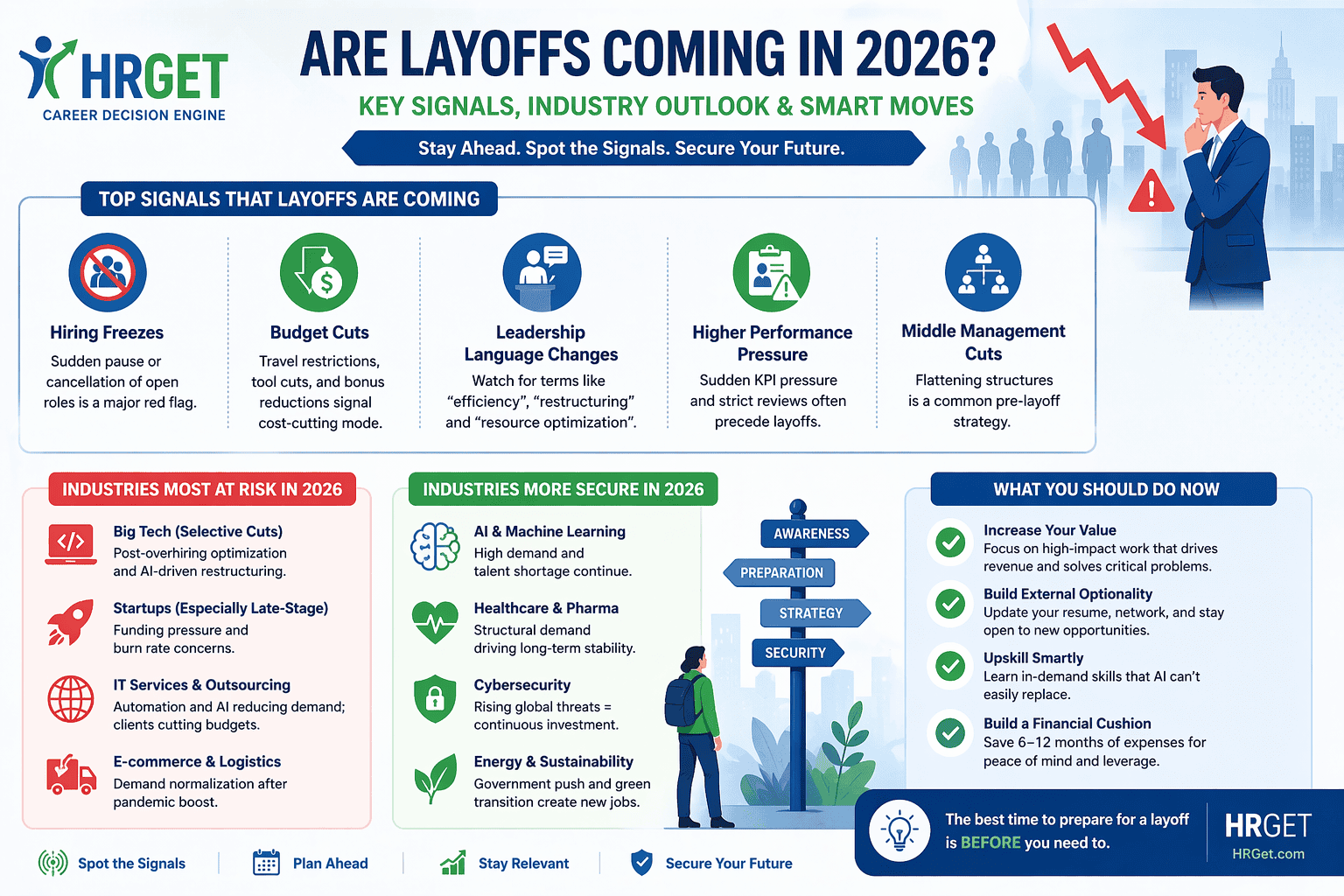
Top Signals That Layoffs Are Coming in 2026
Most people look for announcements. The professionals who get out ahead of layoffs look for signals — and there’s typically a 3–6 month window between the first signals and the formal announcement.
Signal 1: Hiring Freeze (The Earliest and Clearest Warning)
A sudden halt in hiring — especially for roles that were previously posted and active — is the single most reliable early indicator I’ve seen in 18 years. When a company stops bringing people in, it’s because leadership has decided headcount is a problem to solve, not add to. If your company has pulled back job postings or started “pausing” roles mid-process, take that seriously. Layoffs typically follow within 3–6 months of a meaningful hiring freeze.
Signal 2: Budget Restrictions Cascading Downward
Travel restrictions, tool and software cancellations, conference budget cuts, reduced team offsite budgets — these are the precursors to headcount decisions. Companies cut discretionary spend before they cut people because it’s faster and less disruptive. If your team’s non-salary budget has been trimmed in 2026, that’s not a bad quarter — that’s a structural shift being tested before a bigger one.
Signal 3: Leadership Language Shifts
Pay close attention to all-hands calls and executive communications. Phrases like “operational efficiency,” “strategic restructuring,” “right-sizing the organization,” and “doing more with less” are not corporate boilerplate — they are active messaging designed to prepare employees without triggering panic. I’ve reviewed enough restructuring communications to tell you: when these phrases appear with frequency, the plan is already written.
Signal 4: Aggressive Performance Management
A sudden rollout of strict KPIs, surprise performance improvement plans (PIPs), or managers becoming unusually documentation-heavy in feedback — these are often legal groundwork. Companies want to ensure that any layoffs can withstand a wrongful termination challenge. If performance standards have suddenly changed without a clear business rationale, that’s not coincidence.
Signal 5: Middle Management Thinning
When companies want to cut costs fast while maintaining output, management layers are often the first target. A director whose team reports directly to a VP after a “restructuring” is a director whose role has been structurally eliminated — even if they’re kept on temporarily. If you’re in people management and your span of control has been reduced or redistributed, your role is at risk.
Industries Most at Risk in 2026
| Industry | Risk Level | Primary Driver | Roles Most Exposed |
|---|---|---|---|
| Big Tech (FAANG-tier) | Medium | AI tools replacing internal ops teams; margin discipline post-2023 | Program managers, internal tools engineers, data coordinators |
| Late-Stage Startups (Series B–D) | High | Funding pressure, burn rate concerns, delayed IPO timelines | Ops, HR, marketing, non-technical roles |
| IT Services & Outsourcing | High | Client budget reductions; AI reducing billable service demand | BPO roles, junior developers, QA testers, data entry |
| E-commerce & Logistics | Medium | Post-pandemic demand normalization; automation in warehouses | Operations, fulfillment management, demand planning |
| Financial Services (mid-tier) | Medium | Fintech disruption; interest rate normalization reducing margins | Back-office roles, compliance ops, retail banking |
| Media & Publishing | High | AI content generation reducing editorial headcount needs | Editors, content coordinators, SEO specialists at scale |
A note on the IT services industry specifically: this one deserves attention if you’re in India’s Tier 1 tech hubs. TCS, Infosys, Wipro, and HCL have all publicly signaled AI-driven headcount restructuring in 2025–2026. The junior-to-mid level roles that historically provided career stability are being compressed. If you’re a 3–7 year IT professional in this space, the career calculus has genuinely changed.
Industries Likely to Stay Stable or Grow
Look, not every sector is contracting. Here’s where the job market is structurally strong heading into 2026 — and why these areas are worth targeting if you’re considering a move.
AI and Machine Learning Engineering
Demand continues to significantly outpace supply. Senior ML engineers with production deployment experience command $180K–$280K in the US market. This isn’t a bubble — it’s a skills gap that will take years to close.
Healthcare and Clinical Operations
Demographic demand for healthcare is structural and growing. Nursing, physician, and clinical specialist shortages are deepening, not resolving. Administrative healthcare roles face more pressure, but clinical roles remain highly protected.
Cybersecurity
Global threat surface expansion means companies cannot cut security headcount without taking on material regulatory and operational risk. Senior security engineers and threat analysts are essentially recession-proof in 2026.
Energy and Infrastructure
Government-backed infrastructure investment in the US (IRA), UK (clean energy targets), and UAE (Vision 2030) is generating sustained engineering and project management demand. Not glamorous, but genuinely stable.
Regulatory Compliance and Legal
As AI regulation, data privacy law, and cross-border employment law become more complex, companies are hiring — not cutting — compliance professionals. This is a counterintuitive growth area in a cost-cutting environment.
Real Scenario: How Layoffs Actually Unfold
Real Scenario
The situation: A 34-year-old senior product manager at a SaaS company in Bangalore — let’s call her Priya — had been with the company for four years and received “exceeds expectations” in her last two performance reviews. In Q3 2025, she noticed her company stopped posting new engineering roles. Then travel was restricted. Then the Q4 planning cycle was delayed by six weeks.
She told herself it was a tough quarter. She didn’t update her resume. She didn’t reconnect with her network. In February 2026, 12% of the company was laid off. Priya was in that group — not because she performed poorly, but because her product line was being sunset in favor of AI-native tooling.
What she could have done differently: Noticed the hiring freeze in Q3 and started quietly exploring options. That 3–4 month window would have given her leverage, not desperation. She had strong options — but she discovered them while unemployed, which is always the weaker negotiating position.
The timeline of a typical restructuring looks like this:
- Month 1–2Hiring freeze begins. Budget reviews initiated. Travel and discretionary spend restricted.
- Month 3–4Leadership communications shift to “efficiency” language. Internal org reviews start quietly. Some managers are brought into planning discussions.
- Month 5–6Performance documentation increases. Some voluntary exits happen as senior people read the signals. Unofficial “quiet firing” may begin.
- Month 6+Formal layoff announcement. By this point, the list was set 2–3 months ago.
By the time your CEO sends that company-wide email, the decisions are done. The window to act is before the announcement — not after it.
How to Predict Layoffs in Your Own Company
I’ve built a mental framework I use when advising clients on whether they should start exploring options. Run through this honestly.
The Four-Question Risk Assessment
1. Is your team directly tied to revenue? Revenue-generating roles — sales, core product, key engineering — are almost always cut last. Support functions (HR, internal IT, some marketing) are often cut first. If your work doesn’t connect to revenue within two steps, you’re more exposed.
2. Can your primary work be described in a workflow? If a reasonably intelligent person could document what you do step-by-step and then build a tool to automate it, that work is automatable. Be honest. “Coordinates weekly reporting across five teams” is automatable. “Negotiates complex enterprise contracts with ambiguous stakeholders” is not.
3. Are you cross-functionally known? Professionals who work across multiple teams and have visible stakeholder relationships are harder to cut without creating operational friction. If your impact is entirely contained within your own team, you have fewer internal advocates in a restructuring conversation.
4. Has your company’s financial narrative changed? When investor calls, earnings reports, or executive communications shift from talking about growth to talking about margins and efficiency, that is the signal. Track it. It’s public information for listed companies and usually evident in internal communications at private ones.
If you answered “yes” to two or more of the above risk questions, start treating your career situation as active rather than stable.
Insider View
One signal most people completely overlook: watch who is leaving voluntarily. When top performers — the ones with options — start exiting quietly without much fanfare, they’ve seen something. They don’t always say what. But senior, well-regarded people don’t leave stable, healthy environments without reason. If two or three of the strongest people in your org have exited in the last quarter, that’s a meaningful data point.
Smart Strategy: What You Should Do Now
Don’t panic. But don’t confuse “calm” with “passive.” Here’s the play.
Step 1: Make Yourself Revenue-Adjacent
Whatever your role, find a way to connect your work to revenue or critical product delivery. Volunteer for high-visibility projects that cross departmental lines. A finance analyst who helps close a major client deal is remembered differently than one who produces the monthly variance report. The work might be the same effort — but the visibility is not.
Step 2: Build External Optionality — Quietly
Start updating your LinkedIn profile, not your job title — but your accomplishments and measurable outcomes. Reach out to two or three recruiters for a “market check” conversation. Apply for one role even if you don’t need it. The purpose is information: you want to know your market value and have a relationship network warmed up before you need it. Job searches launched in desperation are always weaker than ones launched from a position of stability.
Step 3: Learn Skills AI Can’t Replicate Quickly
The clearest AI-resistant skillsets in 2026 combine judgment with context. Product sense, stakeholder management, cross-functional strategy, executive communication, and domain expertise that requires human relationship-building are genuinely hard to automate. Narrow your time investment into these areas. If you’re spending significant professional development time on tools and processes, redirect some of that toward judgment and influence skills.
Step 4: Build a 6-Month Financial Runway
This is the single most underrated piece of career advice I give: if you have six months of living expenses in accessible savings, a layoff becomes a negotiating position rather than a crisis. You can take time to find the right role. You can negotiate severance. You can decline a lowball offer. Financial cushion is career leverage — full stop.
Pro Tip
If your company has a formal severance policy, find out what it says now — not after a layoff is announced. Many professionals don’t realize their severance package is often negotiable, especially at manager level and above. Know what your baseline entitlement is under your contract, your state or country’s labor laws, and your company’s stated policy before you ever need to use that information. The WARN Act (US) and UK redundancy rules provide legal minimums — but those are floors, not ceilings.
Common Mistakes That Cost People Their Jobs
Mistake 1: Assuming Profitability Means Security
Meta laid off 11,000 people in November 2022 when it had over $50 billion in revenue. Amazon laid off 18,000 people in early 2023 during a period of strong AWS growth. Profitability and layoffs are not mutually exclusive. Companies cut headcount to improve margins, not just to survive losses. “But the company is doing well” is not a safety signal — it’s potentially a yellow flag if leadership has publicly committed to margin targets.
Mistake 2: Ignoring Early Signals Because They’re Inconvenient
I’ve spoken with hundreds of professionals post-layoff. The most common thing I hear: “I saw the signs but told myself it wasn’t that serious.” Cognitive dissonance is powerful — especially when acting on the signals feels disruptive. Update your resume anyway. Have the recruiter conversation anyway. It costs you nothing to be prepared and potentially costs you months of scrambling if you’re not.
Mistake 3: Treating Tenure as a Shield
I’ve seen 12-year company veterans cut in the same round as employees who joined 18 months ago. Tenure matters somewhat in cultures that value loyalty — but it provides almost no legal protection in at-will employment states, and it’s increasingly irrelevant in cost-driven restructurings. What protects you is current, visible, revenue-relevant impact — not how long you’ve been there.
Mistake 4: Only Networking When You Need Something
The professionals who recover from layoffs fastest are the ones who maintained relationships continuously — not the ones who reconnect with people they haven’t spoken to in two years because they suddenly need help. LinkedIn connections, coffee chats, attending industry events: these are career infrastructure, not luxuries. Opportunities don’t appear on command — they come from relationships already in place.
Verdict
Layoffs in 2026 Are Selective, Not Random
The professionals who get cut are disproportionately those in automatable roles, low-visibility positions, and teams disconnected from core revenue. The professionals who survive — and often advance during restructurings — are the ones with cross-functional visibility, strong external optionality, and a financial cushion that gives them negotiating leverage.
The signals are already visible in 2026. The question is whether you’re reading them or waiting for the announcement.
FAQ: Layoffs in 2026
Will layoffs in 2026 be worse than the 2023 tech layoffs?
No — 2026 layoffs are expected to be more targeted and strategic rather than mass-scale. The 2022–2023 wave was driven by pandemic overhiring corrections. The 2026 wave is driven by AI restructuring and margin optimization, meaning cuts will be surgical: specific roles, specific teams, not broad 10–15% headcount reductions across the company.
Which roles are safest from layoffs in 2026?
Roles tied directly to revenue generation, critical infrastructure, and specialized expertise that AI cannot easily replicate. Enterprise sales, cybersecurity engineers, ML/AI engineers, clinical healthcare roles, and regulatory compliance professionals in financial services are among the most protected. The common thread: irreplaceability plus demonstrated business-critical impact.
How early can you predict layoffs at your company?
Typically 3–6 months before the announcement if you watch the right signals — hiring freezes, budget cuts, leadership language shifts toward “efficiency,” and voluntary exits by top performers. By the time it’s public knowledge, the decision was made months ago. The window to act is during those pre-announcement months, not after.
Should I switch jobs now if I’m worried about layoffs?
If your role shows multiple risk signals — automatable tasks, low revenue connection, recent budget cuts in your team — start exploring quietly. You don’t have to quit immediately, but having active options is always better than scrambling after the fact. A proactive job search from a position of employment is always stronger than a reactive one from unemployment.
Are startups riskier than large companies when it comes to layoffs?
Generally, yes. Startups — especially Series B and later — are highly sensitive to funding cycles, burn rates, and investor sentiment. When a portfolio company misses targets or a funding round falls through, layoffs can happen within weeks. Large enterprises move slower but aren’t immune, especially in over-hired divisions.
Can AI really cause layoffs in 2026?
Yes — and it already is. The roles most affected are process-driven: data entry, basic coding, internal reporting, tier-1 customer support, and document review. Companies aren’t announcing “AI layoffs” by name — they’re quietly eliminating roles during restructuring and not backfilling them. That’s the pattern to watch in 2026.
What’s the safest long-term career move to survive layoffs?
Build skills that combine technical knowledge with strategic judgment and business impact. The professionals hardest to let go are those who translate complex decisions into business outcomes — a finance manager who understands AI tools, or a product manager driving measurable revenue growth. Narrow specialists without cross-functional value are the most vulnerable in any restructuring.
The Bottom Line on Layoffs in 2026
Here’s what 18 years of restructuring work has taught me: layoffs in 2026 are not a question of if, but of who. The structural forces driving workforce reductions — AI efficiency gains, investor margin pressure, and permanent headcount discipline — aren’t going away when the next earnings call goes well.
Most people will read this article, recognize the signals in their own company, and do nothing. Not because they don’t care — but because acting feels premature and uncomfortable. That hesitation is exactly what separates professionals who navigate layoffs cleanly from those who get caught flat-footed.
The steps aren’t dramatic: update your resume, have one recruiter conversation, get your finances to six months of runway, and make sure at least two people in senior leadership can articulate what you specifically contribute to the business. That’s it. Those four moves close the gap between being vulnerable and being prepared.
If you want to understand what you’re entitled to if a layoff does hit — including how to negotiate severance above the standard package — read our guide on how to negotiate a severance package.
Were you recently laid off or preparing for the possibility?
Understand your rights, severance entitlements, and next steps with our complete Layoff Survival Guide on HRGet.com.

Michael Reeves | Former Senior Counsel, Littler Mendelson | Severance & Restructuring Specialist | 18+ Years in Employment Law
Author bio: Michael Reeves spent nearly two decades as Senior Counsel at Littler Mendelson — one of the world’s largest employment law firms — advising on mass layoffs, corporate restructurings, and severance negotiations for Fortune 500 companies across the US and Europe. He has worked both sides of the table: structuring cost-efficient separation packages for employers and, more recently, helping employees understand exactly where their leverage lies. Based between Chicago and London, Michael writes for HRGet.com to demystify the legal and financial dimensions of layoffs — so employees stop leaving money on the table.


Pingback: Dlaczego Agentic AI i redukcje etatów w 2026 roku nie obniżają kosztów operacyjnych – BitBiz