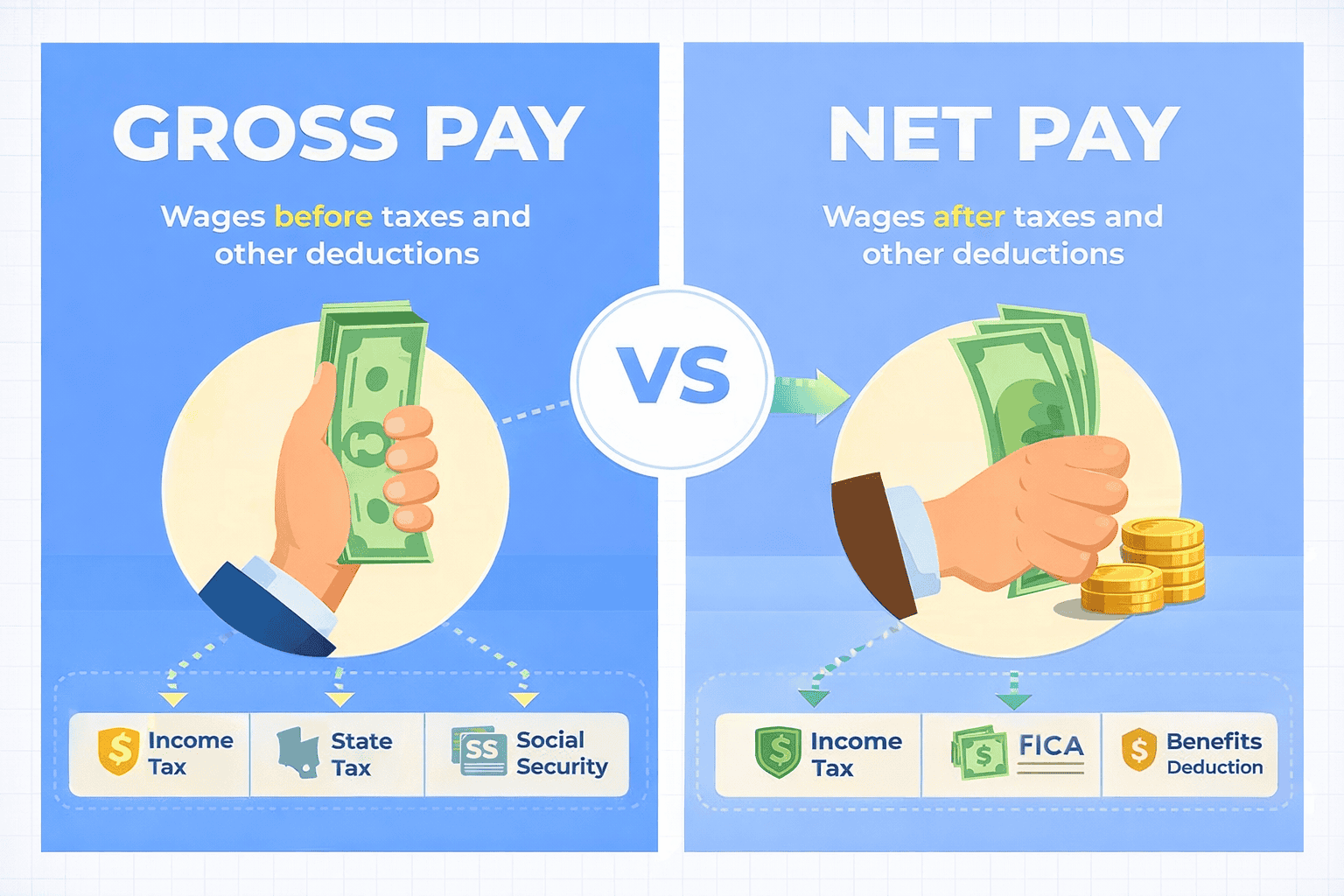
Self-employed workers, freelancers, and contractors can deduct work-related home office equipment — computers, desks, webcams, software — based on their business-use percentage. W-2 employees working remotely generally cannot claim these deductions at the federal level under post-TCJA rules. Deductions are claimed via Schedule C, separate from personal itemized deductions.
Here’s the uncomfortable truth: most people either miss out on legitimate work from home equipment tax deductions entirely — or they claim things that have no business being on a tax return and end up with an audit notice in their inbox.
In 2026, the rules around work from home equipment tax deduction are tighter and more nuanced than most articles suggest — especially given the ongoing extensions of post-pandemic tax reforms and the TCJA’s suppression of employee expense deductions.
I’ve spent over 20 years advising senior professionals and business leaders on compensation strategy across the US and UK. In that time, I’ve watched people leave thousands of dollars on the table because they weren’t sure what they could legally claim. That ends today. This guide will show you exactly what qualifies, what doesn’t, how to choose your deduction method, and how to document everything so you’re audit-proof.
Who Can Claim Work From Home Equipment Deductions in 2026
Let’s settle the biggest confusion before anything else — because getting this wrong wastes your time and potentially creates legal exposure.
✅ YOU CAN CLAIM if you are:
- Self-employed / sole proprietor
- Freelancer or independent contractor
- Gig worker (1099 income)
- Small business owner (LLC, S-Corp)
- Running a side hustle with reported income
❌ YOU GENERALLY CANNOT if you are:
- A W-2 employee working remotely
- Remote by choice, not employer requirement
- Reimbursed by your employer already
Here’s the legal context: the Tax Cuts and Jobs Act (TCJA), enacted in 2017 and extended through at least 2025–2026, eliminated the miscellaneous itemized deduction that used to cover unreimbursed employee expenses. Before TCJA, a W-2 employee could deduct home office costs above 2% of adjusted gross income. That’s gone — at least at the federal level.
If you’re a W-2 employee, your path forward is to negotiate employer reimbursement, not to claim deductions on your own return. Some employers offer equipment stipends — that’s a conversation worth having with HR.
⚠️ State Exception
States like California, New York, Illinois, and Massachusetts maintain their own rules and may allow limited deductions or require employers to reimburse remote work expenses. Always file state taxes separately and check your state’s current rules — they can diverge significantly from federal treatment.
The bottom line: if you’re self-employed and using a home office, you’re sitting on a legitimate deduction most people don’t fully exploit. If you’re a W-2 employee, federal deductions aren’t your tool here — employer reimbursement is.
What Equipment Qualifies for the Work From Home Tax Deduction
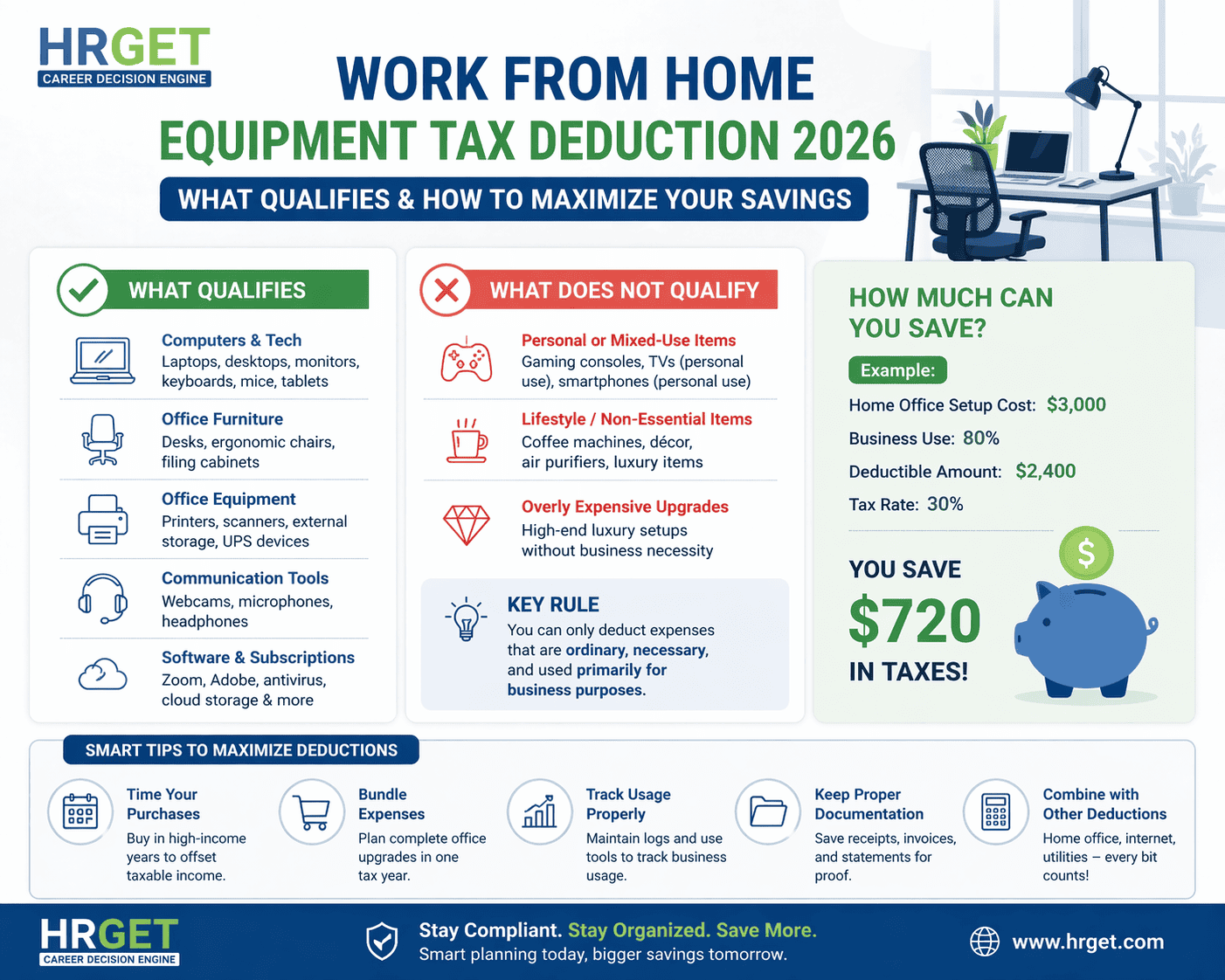
The IRS standard is straightforward but often misapplied: equipment must be “ordinary and necessary” for your business. Ordinary means common in your industry. Necessary means helpful and appropriate — it doesn’t have to be indispensable.
Here’s what falls cleanly into the qualifying category:
| Equipment Category | Examples | Deductibility |
|---|---|---|
| Computers & Tech | Laptop, desktop, external monitors, keyboard, mouse, tablet | Business-use % of cost |
| Office Furniture | Standing desk, ergonomic chair, filing cabinet, bookshelf | Full cost if work-only use |
| Communication Tools | Webcam, microphone, headset, ring light (content creators) | Business-use % of cost |
| Office Equipment | Printer, scanner, shredder, external hard drive, UPS | Business-use % of cost |
| Software & Subscriptions | Zoom, Adobe Creative Cloud, Notion, Slack, antivirus, cloud storage | Full cost if business-only |
| Connectivity | Internet service, Wi-Fi router, network switch | Business-use % only |
💡 The Business-Use Percentage Rule
You can only deduct the portion of any item used for business. A laptop used 75% for client work and 25% for personal use? You deduct 75% of its cost. A standing desk in a dedicated home office used exclusively for work? You deduct 100%. Track this honestly — it’s the number the IRS will scrutinize first if you’re ever reviewed.
One thing worth calling out: software subscriptions are often the most overlooked deduction. Freelancers paying $600/year for Adobe, $150/year for Notion, and $200/year for a project management tool are sitting on $950 in fully deductible business expenses. Those add up fast.
What Does NOT Qualify — And Where Most People Go Wrong
This is where I see the most expensive mistakes — not just missed deductions, but overclaimed ones that invite scrutiny. The IRS isn’t checking whether you work from home. They’re checking whether what you bought is genuinely a business expense or personal consumption dressed up as one.
Items that fail the test:
- Gaming consoles and gaming PCs — unless you’re a professional content creator with documented revenue tied directly to gaming
- Televisions — unless it’s a dedicated presentation or monitoring screen in a home studio, and you can prove it
- Coffee machines, mini-fridges, snack subscriptions — personal consumption, full stop
- Home décor, artwork, plants — aesthetics don’t meet “ordinary and necessary”
- Overly expensive luxury furniture — a $3,000 Italian designer chair may be questioned when a $500 ergonomic chair does the same job
- Air purifiers, aromatherapy diffusers — unless there’s documented medical necessity tied to work performance
- Personal phone plan upgrades — you can deduct the business-use portion of your existing plan, but upgrading to a premium plan just because you work from home is on shaky ground
The IRS 3-Part Test for Deductible Equipment
1. Business necessity — Is this item required or directly helpful for generating income?
2. Direct usage — Are you actually using it primarily for business activities?
3. Reasonable cost — Does the expense match what a reasonable businessperson would spend?
Here’s the framing I use with clients: if you’d still buy that item even if you weren’t self-employed, and if its primary value to you is personal enjoyment or comfort rather than income generation — it’s probably not deductible. The test isn’t “did I use it while working?” It’s “would I have bought it specifically because of my work?”
Depreciation vs. Immediate Deduction: How Section 179 Works in 2026
Once you’ve identified what qualifies, the next question is how to take the deduction. This is where strategy actually matters — and where most freelancers default to the wrong approach because they don’t know they have a choice.
You have two main paths:
| Method | How It Works | Best When |
|---|---|---|
| Section 179 (Immediate Expensing) | Deduct the full cost of qualifying equipment in the year you buy it | High-income year; you want to reduce taxable income now |
| Bonus Depreciation | Deduct a significant percentage immediately (phasing down through 2026) | Large equipment purchase; check current phase-down rates |
| MACRS Depreciation | Spread the deduction over 5–7 years using IRS depreciation schedules | Income fluctuates; you want deductions spread over multiple years |
Section 179 in 2026: The deduction limit is $1,220,000 (subject to IRS annual inflation adjustments). For most freelancers and small business owners, this limit will never be a constraint — you’re far more likely to have $3,000–$15,000 in annual equipment purchases, not millions. This means Section 179 is almost always available to you if it’s the right strategic choice.
| Item Value | Recommended Approach | Why |
|---|---|---|
| Under $2,500 | Expense immediately (de minimis safe harbor) | Minimal paperwork, simpler |
| $2,500 – $15,000 | Section 179 deduction | Maximize deduction in current year |
| Over $15,000 or high-value assets | MACRS depreciation | Spread deductions if income is likely to grow |
💡 Insider View
I advise senior professionals to make this decision in October or November each year — when you have a clear picture of your annual income but still have time to make strategic equipment purchases before December 31. Buying a $2,800 workstation in December instead of January can save you $840 in taxes at a 30% marginal rate, simply by timing it correctly.
Real Scenario: A $3,200 Home Office Setup — Full Tax Breakdown
Let me make this concrete. Here’s a realistic setup a mid-level freelance consultant or content strategist might build out in 2026:
| Item | Cost | Business Use % | Deductible Amount |
|---|---|---|---|
| MacBook Pro 14″ | $1,600 | 80% | $1,280 |
| Standing Desk (UPLIFT / Flexispot) | $550 | 100% | $550 |
| Ergonomic Chair (Herman Miller / Steelcase alternative) | $600 | 100% | $600 |
| External Monitor (LG 27″) | $280 | 90% | $252 |
| Webcam + Microphone | $170 | 100% | $170 |
| Software Subscriptions (annual total) | $0 | (tracked separately) | — |
| Total Setup Cost | $3,200 | $2,852 |
At a 30% effective tax rate (common for a self-employed professional earning $80K–$120K), that $2,852 deduction translates to approximately $855 in actual tax savings.
If that same professional adds $1,200 in annual software subscriptions (Adobe, Zoom Pro, cloud storage, Notion Teams), their total deductible amount rises to over $4,000 — and their tax savings top $1,200 for the year. That’s a material number.
⚡ The Insight Most Articles Miss
This is why financially disciplined freelancers accumulate wealth faster than many salaried employees at similar gross incomes — they legally reduce their taxable income through legitimate business expenses that employees can’t touch. The gap compounds every year.
Smart Strategy to Maximize Your Work From Home Tax Deduction
Here’s how experienced professionals approach this — not reactively at tax time, but proactively throughout the year.
1. Time your purchases strategically. If you know Q4 is going to be a high-revenue quarter, buy that workstation upgrade in November — not in January when the deduction won’t hit until next year’s return. This isn’t aggressive tax planning; it’s basic timing awareness.
2. Bundle your office upgrade into a single tax year. Rather than buying a monitor in March, a chair in August, and a desk in January, plan a complete office upgrade in one calendar year. Concentration maximizes the deduction impact in that year — especially useful in high-income years when you most want to reduce taxable income.
3. Combine equipment deductions with other home office deductions. Equipment deductions stack on top of the home office deduction (the square footage calculation), plus a partial deduction for utilities and internet. Each deduction is calculated separately, and they don’t compete — they compound.
4. Track usage rigorously, not conservatively. Some freelancers underestimate their business-use percentage out of caution. That’s leaving money behind. Use time-tracking tools (Toggl, Harvest, Clockify) to establish an accurate record of work hours vs. personal use. If the data shows 85% business use, claim 85% — not 70% out of vague anxiety.
5. Open a dedicated business account. This single step simplifies your tax preparation, separates business expenses cleanly, and makes the business-use case stronger to any reviewer. A dedicated business credit card for equipment purchases means your statement is your documentation.
💡 Pro Tip
If your business income fluctuates significantly year to year, consider a tax planning call with a CPA in October — not April. By the time you’re filing, the year is over and your options are gone. Proactive planning can shift thousands of dollars in timing.
Common Mistakes That Trigger IRS Scrutiny
Look — most audits don’t happen because someone committed fraud. They happen because of sloppy documentation, overconfident claims, and patterns that flag automated IRS screening. Here’s what to avoid:
Mistake 1: Claiming 100% business use for everything. If you claim that your laptop, phone, internet, and home office space are all 100% business use — that flags. People use personal devices for personal things. The IRS knows this. Claim accurate percentages, not aspirational ones.
Mistake 2: No receipts, no records. “I know I bought it” isn’t documentation. Receipts can be digital — an email confirmation, a PDF from Amazon, a credit card statement — but they must exist. The standard rule is to retain records for 3 years from your filing date, longer for significant assets.
Mistake 3: Mixing personal and business expenses on the same card. When your business expenses are buried in a personal credit card statement alongside groceries and Netflix, it looks casual — and casual documentation loses audits. Use a separate card for business purchases from day one.
Mistake 4: Claiming luxury items without justification. A $1,800 standing desk is defensible with the right documentation and business context. A $3,500 designer chair with no ergonomic certification and no usage log? That’s a conversation you don’t want to have with an IRS agent.
Mistake 5: Forgetting to recapture depreciation when you stop using something for business. If you claimed depreciation on a piece of equipment and then converted it to personal use or sold it, there may be recapture tax implications. This surprises people. Work with a CPA if you’re depreciating high-value items.
⚠️ Warning
W-2 employees who attempt to claim home office equipment deductions on their federal return — when those expenses weren’t reimbursed and weren’t a condition of employment — are not just missing the deduction. They’re potentially creating an incorrect tax return. Get professional guidance if your situation is ambiguous.
Documentation You Must Keep to Stay Audit-Proof
The difference between a confident tax filer and an anxious one comes down to documentation. Here’s exactly what you need:
Required Documentation Checklist
- Purchase receipts or order confirmations for every item (digital is fine)
- Bank or credit card statements showing the transaction date and amount
- Usage log for any item used for both business and personal purposes — showing hours or percentage breakdown
- Written business justification — a one-line note explaining why the item was necessary for your work (“dual monitor setup required for video editing client projects”)
- Photographs of your dedicated workspace (especially useful for home office deduction)
- Asset register if you’re depreciating equipment over multiple years — listing item, cost, date purchased, depreciation method
Create a simple folder structure and stick to it:
/Taxes/2026/Work-Equipment/
– laptop_receipt_jan2026.pdf
– desk_receipt_feb2026.pdf
– chair_receipt_feb2026.pdf
– usage_log_2026.xlsx
– business_justification_notes.txt
This alone puts you ahead of 90% of self-employed professionals. Most people scramble for receipts in March. Having a running folder means your tax preparer gets clean inputs and you get an accurate return.
How the Rules Differ in the UK and India
If you’re based outside the US, the same principles apply — but the mechanics differ. Here’s a quick orientation:
United Kingdom: Self-employed individuals and sole traders can claim Capital Allowances on business equipment through the Annual Investment Allowance (AIA), which allows immediate deduction of up to £1,000,000 in qualifying plant and machinery per year. Software and subscriptions are treated as revenue expenses — deductible in full in the year incurred. Employees working from home can claim a flat-rate allowance via HMRC (£6/week as of 2025–26), but claiming actual equipment costs as an employee is much more restricted than for the self-employed.
India: For salaried employees in India, equipment deductions are generally not available — the income tax structure doesn’t have an equivalent of Schedule C for employees. However, self-employed professionals and businesses can deduct business equipment costs under Section 37 of the Income Tax Act as ordinary business expenditure. Professionals registered under presumptive taxation (Section 44ADA) have a simplified structure but may benefit from actual expense deduction if their taxable income is higher under that route.
⚠️ Note for Indian & UK Readers
Tax law changes frequently. The figures here reflect my understanding as of early 2026, but always verify against HMRC guidance (uk.gov) or the Indian Income Tax Department’s latest circulars before filing.
FAQ: Work From Home Equipment Tax Deduction 2026
Can remote employees claim work from home equipment deductions in 2026?
Generally no — not at the federal level. The Tax Cuts and Jobs Act eliminated unreimbursed employee expense deductions through at least 2025–2026. If you’re a W-2 employee, your best path is to negotiate an equipment reimbursement from your employer rather than claiming it yourself. Some states (California, New York) have additional rules — check your state return separately.
Can I deduct my laptop for remote work?
Yes, if you’re self-employed or a contractor. Deduct the business-use percentage — if 80% of your laptop use is work-related, you deduct 80% of the cost. You can take the full deduction in the current year via Section 179, or depreciate it over 5 years. Keep the purchase receipt and a usage estimate.
Is home internet deductible as a business expense?
Yes, but only the business-use portion. If you work 60% of the time and use the internet personally the other 40%, you can deduct approximately 60% of your monthly internet bill. Keep your ISP statements — they’re the documentation. Don’t claim 100% unless you have a completely separate business internet line.
What is the Section 179 deduction limit for 2026?
The Section 179 limit for 2026 is approximately $1,220,000 (subject to IRS annual inflation adjustments). For most freelancers and small business owners, this ceiling is never a constraint — it’s designed for companies purchasing large equipment inventories. If your annual equipment purchases are under $50,000, Section 179 effectively lets you deduct everything in the current year.
Can I deduct a standing desk or ergonomic chair?
Yes — both are legitimate business expenses if used in a dedicated work area. A standing desk at $400–$800 or an ergonomic chair at $350–$700 is fully deductible if used exclusively for work. The cost must be reasonable — a $2,500 designer chair may invite questions without a strong business justification. Document that the workspace is used exclusively for business.
Do I need to itemize deductions to claim home office equipment?
No. Business equipment expenses for the self-employed are reported on Schedule C — completely separate from personal itemized deductions on Schedule A. You can take the standard deduction on your personal return and still deduct all your qualifying business equipment on Schedule C. The two are independent.
What records do I need to keep for these deductions?
Receipts or order confirmations, bank/card statements showing the purchase, a usage log for any item with mixed personal and business use, and a brief written note explaining why each item was necessary for your work. The IRS recommends keeping records for at least 3 years from the filing date. For depreciated assets, keep records for 3 years after the final deduction.
How do work from home equipment deductions work in the UK and India?
In the UK, self-employed individuals can claim Capital Allowances on equipment under the Annual Investment Allowance. Employees have very limited options — mainly the HMRC flat-rate WFH allowance (£6/week). In India, self-employed professionals and business owners can deduct equipment costs under Section 37 of the Income Tax Act, but salaried employees generally cannot claim equipment deductions on their personal tax returns.
The Bottom Line
If you’re self-employed in 2026, work from home equipment tax deductions are one of the most accessible ways to reduce your taxable income — and one of the most under-optimized by people who assume the rules are too complicated to navigate.
They’re not complicated. Know what qualifies, track your business-use percentages honestly, choose the right deduction method for your income level, and document everything in a folder you could hand to an IRS agent without breaking a sweat.
The difference between the professionals who maximize these deductions and those who guess at them? It’s not sophistication — it’s consistency. Start the folder. Log the receipts. Make the call to a CPA in Q4. Small discipline, real money saved.
Related Reading on HRGet.com
If you’re building out your freelance or self-employed income picture, see our detailed guide on the home office deduction — the square footage calculation explained. Equipment and home office deductions stack — understanding both together can save you significantly more.

Eleanor Whitmore | Former Partner, Mercer | Advisor, World Economic Forum | 20+ Years in Global Compensation
Author bio: Eleanor Whitmore has spent over two decades shaping how the world’s leading organisations pay, retain, and reward talent. As a former Partner at Mercer and an advisor to World Economic Forum working groups on the Future of Work, she has designed compensation frameworks for Fortune 500 companies across the US, UK, Europe, and emerging markets. Based between London and New York, Eleanor writes for HRGet.com to translate boardroom-level pay strategy into actionable guidance for working professionals navigating real compensation decisions.