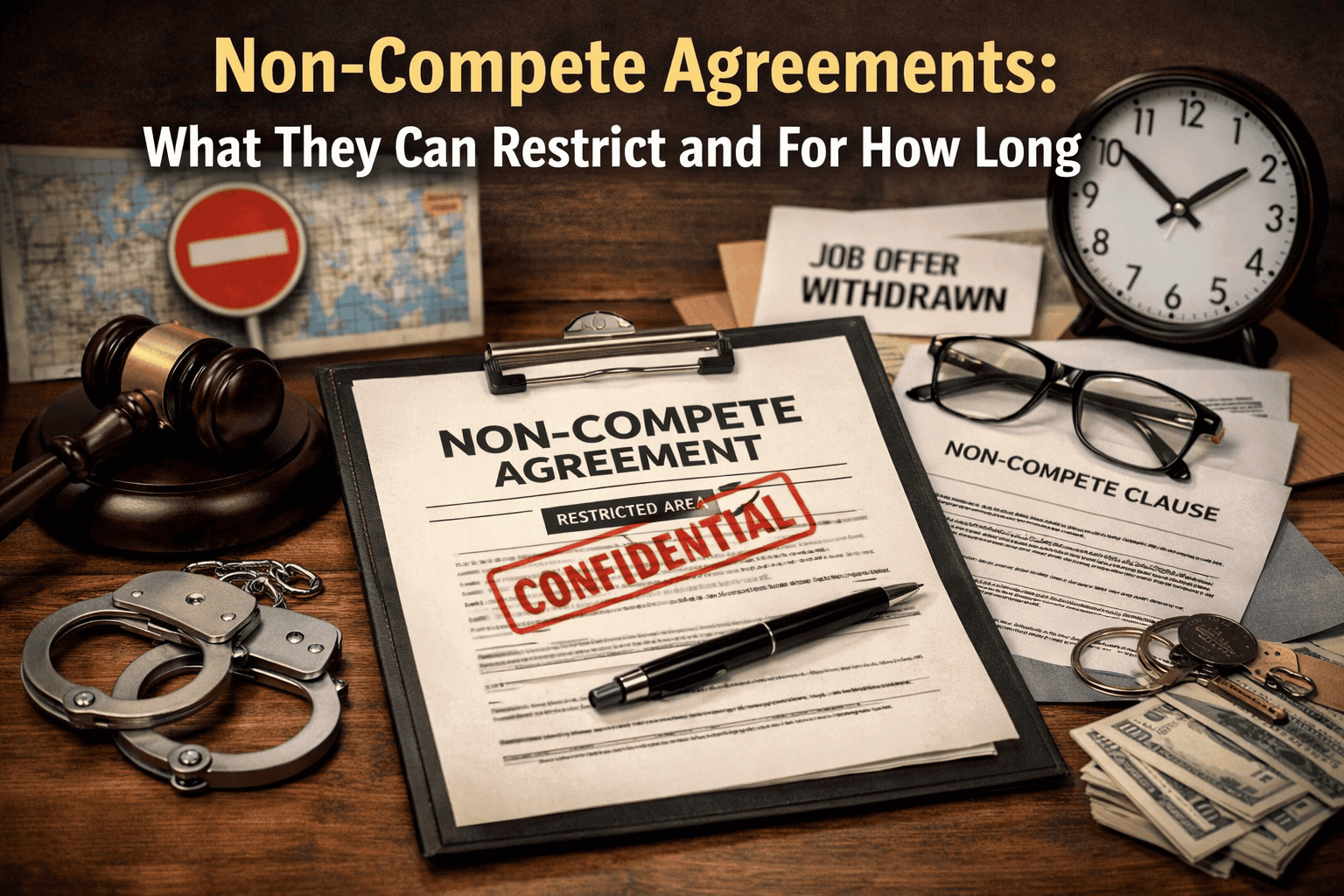
If you signed an offer letter without reading the fine print — and let’s be real, most people do — there’s a reasonable chance you already agreed to a non-compete agreement that could limit your next career move.
I’ve reviewed hundreds of employment contracts over 15 years in HR. And the pattern is almost always the same: the clause is buried on page six, the font is smaller than everything else, and nobody flags it during onboarding. Then, two years later, a hiring manager at a competing firm makes a great offer — and suddenly you’re calling a lawyer.
This guide cuts through the legal fog. You’ll learn exactly what non-compete agreements can and cannot restrict, how long they typically last, how enforcement actually works across the US, India, and Europe — and most importantly, what to do right now if you’re staring at one.
What Is a Non-Compete Agreement?
A non-compete agreement (NCA) is a contractual clause — sometimes a standalone document, sometimes buried inside your offer letter or employment contract — that limits what work you can do after you leave the company.
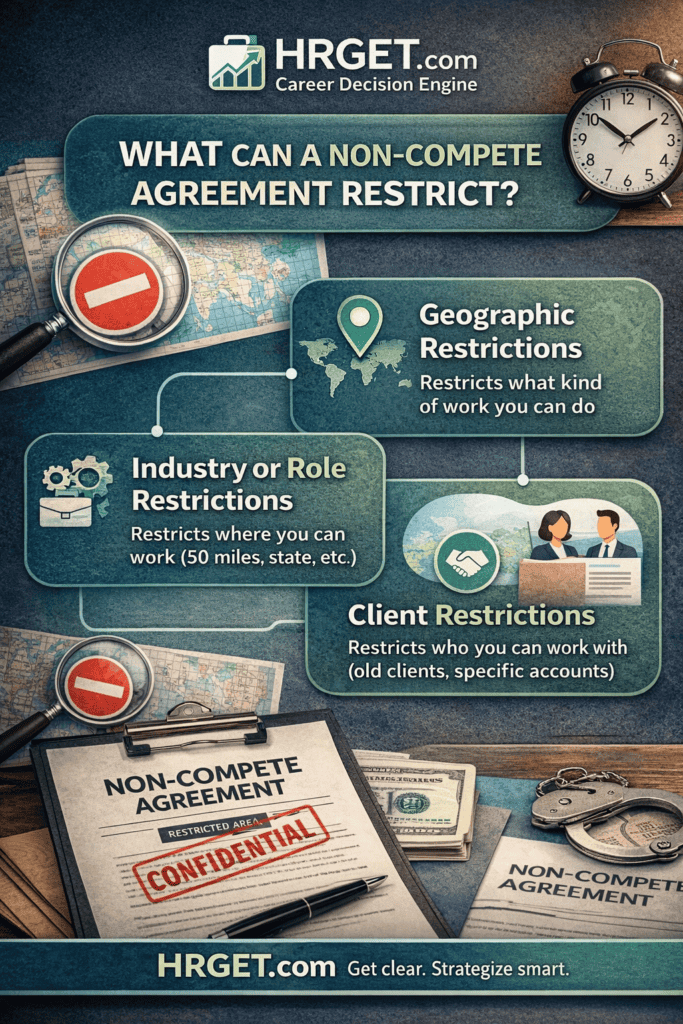
Specifically, it typically prevents you from joining a competitor, starting a competing business, or working in a similar capacity within a defined scope. The three standard dimensions are industry or role, geography, and time duration.
Companies use them to protect legitimate business interests: trade secrets, client relationships, proprietary processes, and strategic knowledge that took years (and significant investment) to build. That’s a fair concern. The problem is that many non-competes go far beyond that — they’re drafted broadly as a deterrent, not because every clause is actually enforceable.
Insider View:
Most non-competes are written by corporate legal teams with a simple goal: make the clause broad enough that employees won’t challenge it. The intent isn’t always enforcement — it’s hesitation. A well-informed candidate who understands the limits of enforceability has far more negotiating power than the employer wants them to know.
What Non-Compete Clauses Can Actually Restrict
Here’s where most people get blindsided. A non-compete clause isn’t just one restriction — it’s typically three layered restrictions working together. Understanding each one separately is the only way to assess whether yours is reasonable or overreaching.
1. Role or Industry Restrictions
This defines the type of work you cannot do. A SaaS product manager may be blocked from joining another SaaS company in a similar role. A recruiter at a staffing firm may be restricted from working for any competing recruitment agency. A senior sales rep may be prohibited from selling directly competing products.
The critical question here: how broadly is “competing” defined? If your contract says you can’t work for any company that “offers similar services” — and your employer is a large tech firm — you could theoretically be blocked from most of the industry. That’s a red flag.
2. Geographic Restrictions
This defines where the restriction applies. Historically, this was framed as a radius (50 miles from your employer’s office) or a specific state or country. In the era of remote work, geographic clauses have become increasingly difficult to justify and enforce — but they still appear in contracts regularly.
If you’re a fully remote employee whose “office” is your home, a 50-mile radius clause is practically meaningless. Courts in multiple US states have started recognizing this. Still, don’t assume it won’t create friction with a new employer.
3. Client and Non-Solicitation Restrictions
Often bundled into or alongside the non-compete, non-solicitation clauses prevent you from approaching former clients, working with specific accounts you managed, or bringing key relationships to your next company. These tend to be more narrowly written — and therefore more consistently enforced — than broad non-compete clauses.
A sales leader who spent three years building a book of business with named accounts, then tries to take those relationships to a direct competitor within six months of leaving, is in a vulnerable position. Non-solicitation clauses in that scenario are routinely upheld.
Watch Out:
Some contracts use “non-compete” and “non-solicitation” interchangeably — but they’re legally distinct. Read yours carefully. A clause that restricts client contact may survive even if the broader non-compete is struck down by a court.
How Long Do Non-Compete Agreements Last?
Duration is the most concrete aspect of any non-compete, and it’s what most people fixate on — for good reason. Here’s the realistic breakdown across role levels:
| Role Level | Typical Duration | Likelihood of Enforcement |
|---|---|---|
| Junior / Individual Contributor | 3–6 months | Low (often not worth pursuing) |
| Mid-Level Manager / Specialist | 6–12 months | Moderate (depends on role and jurisdiction) |
| Senior Manager / Director | 12–18 months | Higher (especially with sensitive access) |
| C-Suite / Executive | 12–24 months | High (often negotiated, but vigorously defended) |
Anything beyond 24 months is considered excessive in most jurisdictions and rarely survives court scrutiny. Courts — particularly in the US — apply a “reasonableness” test: does the duration protect a legitimate business interest without unreasonably blocking the person’s ability to earn a living?
The longer the duration, the higher the bar the employer must clear to enforce it. A 12-month restriction on a senior engineer with access to unreleased product roadmaps? Courts may uphold that. An 18-month restriction on a mid-level customer success rep with no trade secret access? Much harder to justify.
Pro Tip:
Duration isn’t just about the calendar. It’s also about your career velocity. A 12-month pause at 28 is very different from a 12-month pause at 38 when you’re competing for director-level roles. Factor your career stage into how aggressively you should negotiate the duration before signing.
Are Non-Compete Agreements Enforceable? US, India, and Europe
This is the question behind the question — what everyone actually wants to know. And the honest answer is: it depends enormously on where you work. Here’s the real picture, jurisdiction by jurisdiction.
United States
Enforceability in the US is a patchwork determined almost entirely by state law. California is the most famous example — the state effectively bans post-employment non-competes for most workers. Minnesota, North Dakota, and Oklahoma follow similar approaches. Other states like Florida historically allowed aggressive enforcement.
In 2024, the FTC attempted to pass a federal rule banning most non-competes. While that rule faced significant legal challenges and its status remained contested into 2026, it signaled a clear national trend: enforcement appetite is declining, and courts are increasingly skeptical of overly broad clauses.
Even in states that allow non-competes, companies often choose not to litigate unless you’re senior, you hold genuinely sensitive information, and you’ve joined a direct competitor in an obvious way. Legal action is expensive, public, and bad for employer branding.
India
Here’s where most Indian professionals get it wrong — usually because their employer doesn’t correct them.
Under the Indian Contract Act, Section 27, any agreement that restricts a person’s right to carry on a lawful trade or profession is void. Post-employment non-competes in India are generally not enforceable. Courts have consistently held that once you leave the company, your employer cannot prevent you from earning a living in your field.
What can be enforced during the employment period: confidentiality clauses, non-disclosure agreements, and non-solicitation of clients during active tenure. But after you resign? The picture changes substantially.
That said, many Indian employers still include aggressive non-compete language in contracts — and rely on the fact that most employees won’t challenge it. Some companies have pursued civil litigation to obtain injunctions, particularly in high-stakes executive cases. The threat still works even when the legal ground is weak.
Europe
European countries allow non-competes but regulate them more strictly than most US states. A key difference: several European jurisdictions — including Germany, France, and the Netherlands — require employers to compensate employees during the restriction period, typically 50% of their last salary or more.
This completely changes the employer’s calculus. If enforcing a 12-month non-compete means paying you for 12 months of not working, companies become far more selective about which employees they actually pursue.
The UK operates under common law principles. Post-Brexit, UK courts still apply reasonableness tests, and the courts have become somewhat more willing to strike down overly broad clauses — though senior employee restrictions in financial services, tech, and consulting continue to be enforced with some regularity.
Real Scenario: When a Non-Compete Derails a Career Move
Real Scenario:
A product manager at a mid-sized SaaS company in Bangalore — let’s call her Priya — received an offer from a direct competitor: a 40% salary jump, better title, and equity. She accepted, resigned, and served her notice period. Two weeks before her start date at the new company, her old employer’s legal team sent a cease-and-desist letter citing a non-compete clause in her original contract.
The new company, spooked by the legal noise, withdrew the offer. Priya spent three months unemployed, eventually joining a company outside her core domain at a lower salary than the original competing offer. The non-compete was, by all legal analysis, unenforceable under Indian law. But the threat worked.
What went wrong: She didn’t review the clause before accepting. She didn’t disclose it upfront to the new employer. And she assumed that because enforcement was unlikely, it didn’t matter. All three were avoidable mistakes.
Smart Strategy: How to Handle a Non-Compete at Every Stage
There are three moments where you have real leverage over a non-compete: before you sign, when you’re negotiating an exit, and when you’re considering your next move. Most people only act at the third stage — which is the worst time.
Before Signing a New Offer
Read the clause in full. Don’t skim it. Ask your prospective employer three direct questions: Which specific companies are considered competitors? What geography does the restriction cover? What’s the exact duration? If the answers are vague or they push back on your questions, that tells you something.
If the clause is overly broad, negotiate it before you sign. Ask to reduce the duration (12 months to 6), limit the definition of “competitor,” or narrow the geography to your metro area. Most candidates don’t try this — which is precisely why most employers don’t offer flexibility. It’s a negotiation. Act like it.
When You’re Actively Job Searching
Disclose your non-compete to potential employers early — ideally before a formal offer is extended. This is the professional thing to do, and it also protects you. Good companies have in-house legal teams that deal with this regularly. They’ll assess the risk and let you know where you stand.
Hiding a non-compete and hoping it doesn’t come up is not a strategy. It’s a liability that can unravel an offer days before your start date.
If You’re Weighing the Risk
Not every non-compete requires a lawyer. Ask yourself honestly: Are you senior or junior in the organization? Do you have access to trade secrets, unreleased products, or strategic roadmaps? Are you joining a direct competitor in the same market segment, or moving into an adjacent role?
The lower your seniority, the more generic your role, and the less directly competitive your next company — the lower the real-world risk. Companies pick their battles. A junior analyst moving to a different industry vertical is rarely worth the legal cost of enforcement.
Common Mistakes That Cost People Offers and Career Mobility
I’ve seen smart professionals make the same errors repeatedly. Here are the four that cause the most damage.
Mistake 1: Treating the clause as boilerplate. “Everyone has one, it doesn’t really apply to me.” This assumption is how people end up unemployed for three months. Every clause is specific. Read yours.
Mistake 2: Assuming unenforceability means zero risk. Even an unenforceable non-compete can delay your joining date, scare a risk-averse hiring manager, or force you into a costly legal consultation. The friction cost is real even when enforcement fails.
Mistake 3: Not retaining a copy of your signed contract. This sounds basic — but you’d be surprised. Store a PDF of every employment contract you sign. Your company’s HR system won’t always give you easy access after you leave.
Mistake 4: Rushing to join without a gap analysis. If your old employer is the type to pursue legal action (they have the resources, you’re senior, and the move is to a direct competitor), failing to plan a strategy around the transition period is a real mistake. Sometimes waiting 30–60 extra days significantly reduces your exposure.
What to Do If You Already Signed a Non-Compete
First: don’t panic. Signed doesn’t mean automatically enforceable. Here’s a practical four-step approach.
Step 1 — Read the exact clause, not your memory of it. Pull up the actual contract. Focus on duration, scope of restricted roles, and geography. What you think you signed and what you actually signed are often different.
Step 2 — Assess your personal risk profile. Are you moving to a direct competitor in the same market? Are you senior enough that your knowledge genuinely poses a competitive threat? Do you hold customer relationships that were central to your role? The more “yes” answers, the higher the risk.
Step 3 — Get a legal consultation if needed. If you’re in a high-risk scenario — senior level, direct competitor, broad clause — a 60-minute consultation with an employment attorney is worth the cost. In the US, many offer free initial consultations. In India, the analysis is often straightforward given the general non-enforceability of post-employment restrictions.
Step 4 — Explore structural workarounds. Options include taking a role in a different division of the competing company that doesn’t overlap with your previous work, joining a company adjacent to (but not directly competing with) your former employer, or negotiating a shorter restriction period with your outgoing employer as part of a mutual separation agreement. These aren’t loopholes — they’re legitimate approaches that employment lawyers use regularly.
Insider View:
Here’s what most articles won’t tell you: non-competes are primarily a deterrent tool. Companies count on candidates not knowing their rights, not consulting lawyers, and overestimating enforcement risk. The moment you demonstrate that you’ve actually read the clause, understand jurisdiction-specific enforceability, and are prepared to have a legal conversation — the employer’s leverage drops significantly. Knowledge is the actual negotiating position here.
Frequently Asked Questions
Can I ignore a non-compete agreement if it seems unenforceable?
Not recommended — even weak non-competes create friction. An unenforceable clause can still spook a new employer, delay your start date, or force you into legal consultations you didn’t budget for. Assess the enforceability, understand your specific risk level, and make an informed decision rather than ignoring it entirely.
What happens if I violate a non-compete agreement?
Your former employer could send a cease-and-desist letter, seek a court injunction to block you from working, or pursue damages. In practice, most companies stop at legal notices unless you’re senior and the competitive threat is significant. Injunctions are expensive and hard to win — but they do happen in high-stakes cases, especially in financial services and tech.
Are non-compete agreements enforceable in India?
Post-employment non-competes in India are generally not enforceable under Section 27 of the Indian Contract Act, which voids agreements that restrain trade. However, non-disclosure agreements and non-solicitation clauses during active employment may be upheld. Employers sometimes use the clause to create legal uncertainty — knowing enforcement is weak but that the threat alone discourages movement.
How do I negotiate a non-compete clause before signing an offer?
Ask to reduce the duration (aim to halve whatever’s in the draft), narrow the definition of “competitor” to specific named companies, and limit geographic scope to your metro area. Frame it professionally: “I want to commit fully to this role — I’d just like the restriction to reflect the actual competitive landscape.” Most candidates don’t ask. Most employers will negotiate if you do.
Is a 2-year non-compete agreement reasonable?
Rarely. Courts in most US states and internationally view 24-month restrictions as excessive unless you’re a C-suite executive with genuinely sensitive strategic knowledge. Beyond 12 months, the employer typically needs to demonstrate substantial legitimate business interest to make the clause hold. If you’re a mid-level professional being asked to sign a 2-year NCA, push back — hard.
Do startups typically enforce non-compete agreements?
Rarely, for practical reasons — litigation is expensive, time-consuming, and bad for employer branding during fundraising cycles. Early-stage startups almost never pursue it. Growth-stage or late-stage startups with significant IP, a strong legal team, and a named competitor you’re joining? The risk increases. Assess the startup’s maturity and resources before assuming enforcement won’t happen.
Can a non-compete clause be part of an offer letter instead of a separate contract?
Yes — and this is increasingly common. Non-compete language is frequently embedded directly in offer letters, employment agreements, or even equity grant documents. Many professionals sign all three without reading them carefully. The legal weight is the same regardless of which document it appears in. Always read every document you’re asked to sign, not just the offer summary page.
The Bottom Line on Non-Compete Agreements
Non-compete agreements are not just legal boilerplate — they’re career documents that can directly constrain your earning potential and professional mobility for months or years. The professionals who navigate them well share one trait: they engage with the clause before it becomes a problem.
Read it before signing. Negotiate what you can. Disclose it early to prospective employers. And if you’re already in a situation where a non-compete is blocking a move, get a proper legal read on enforceability in your jurisdiction before assuming the worst.
The non-compete clause controls you only if you let it operate in the dark. Bring it into the light, and your leverage changes entirely.

Jonathan Reed: Executive Career Strategist & Leadership Advisor | Former Partner, McKinsey & Company | Executive Coach to Amazon & Unilever Leaders | 18+ Years in Career Strategy
Jonathan Reed spent nearly two decades as a Partner at McKinsey & Company, where he advised organisations on leadership development, talent strategy, and organisational design across the US, UK, and Asia. Since leaving consulting, he has worked as an executive coach to senior leaders at Amazon, Unilever, and a clutch of high-growth scale-ups — helping them navigate promotions, career pivots, and the unwritten rules of visibility and influence at the top. Based between London and New York, Jonathan writes for HRGet.com to give working professionals an honest look at how careers actually scale — and why so many talented people stall without ever knowing why.