Workplace bullying is not automatically illegal in the US, UK, or India. It becomes legally actionable only when it involves discrimination based on a protected characteristic (race, gender, age, disability, religion), constitutes harassment that creates a hostile work environment, crosses into retaliation after a protected complaint, or amounts to constructive dismissal. Rude managers and toxic cultures, while harmful, do not on their own violate employment law. Knowing this distinction is what separates employees who protect themselves effectively from those who stay stuck.
Workplace bullying is one of those problems that feels enormous when you’re living it — and frustratingly invisible when you try to fight it. Subtle insults, public humiliation, exclusion from decisions, impossible deadlines set up to make you fail. Your body knows something is wrong. Your gut is screaming at you. But the moment you sit down to figure out what you can actually do about it, you run into the uncomfortable reality that most guides skip over entirely.
Not all workplace bullying is illegal. That gap between what feels deeply wrong and what employment law actually covers is exactly why so many employees feel paralyzed — and why so many complaints go nowhere.
I’ve spent 15 years studying workplace dynamics, advising organizations on culture and psychological safety, and supporting individuals navigating some genuinely hostile environments. What I’ve seen, over and over, is that the employees who protect themselves most effectively aren’t the ones who react emotionally — they’re the ones who understand precisely where the legal line sits and act accordingly.
This guide gives you that clarity: what counts as bullying, when it becomes illegal, your rights as an employee, and the smart strategy that actually moves the needle.
What Is Workplace Bullying?
Workplace bullying refers to repeated, unreasonable behavior directed at an employee that intimidates, humiliates, degrades, or undermines them. The key word there is repeated. A single heated exchange doesn’t typically qualify. It’s the pattern — the sustained, deliberate behavior that chips away at someone’s confidence and ability to do their job.
Here’s what it commonly looks like in practice: a manager who publicly criticizes you in team meetings but praises everyone else; a colleague who spreads rumors about your competence; a senior leader who excludes you from meetings you should be in; micromanagement so intense it’s designed to make you fail rather than succeed. Assigning deadlines that are physically impossible to meet, then using the missed targets as performance justification. These are all real patterns, and they’re all damaging.
But here’s the critical distinction most employees miss: bullying is defined by its behavior, not its legality. A behavior can be genuinely toxic, organizationally harmful, and morally reprehensible — and still not be illegal. Understanding that gap is where everything starts.
Insider View:
In organizational psychology research, workplace bullying is associated with significantly elevated rates of burnout, anxiety disorders, and voluntary attrition. One consistent finding: the targets who fare best aren’t those who escalate fastest — they’re those who document earliest. The paper trail you build in week one is worth more than any complaint filed in month six.
Is Workplace Bullying Illegal?
Short answer: not automatically. This is where most people get blindsided, and where most HR conversations go sideways.
In the United States, there is no federal anti-bullying statute. A manager can be consistently rude, play aggressive favorites, shut you out of opportunities, and generally make your working life miserable — and none of that, on its own, breaks any employment law. It’s frustrating. It feels wrong. But it’s the legal reality as of 2026.
The same gap exists in India, where general workplace bullying isn’t covered by a standalone law. The UK has somewhat stronger protections through its health and safety framework, but even there, “bullying” as a concept isn’t explicitly illegal unless it connects to a protected characteristic or meets specific legal thresholds.
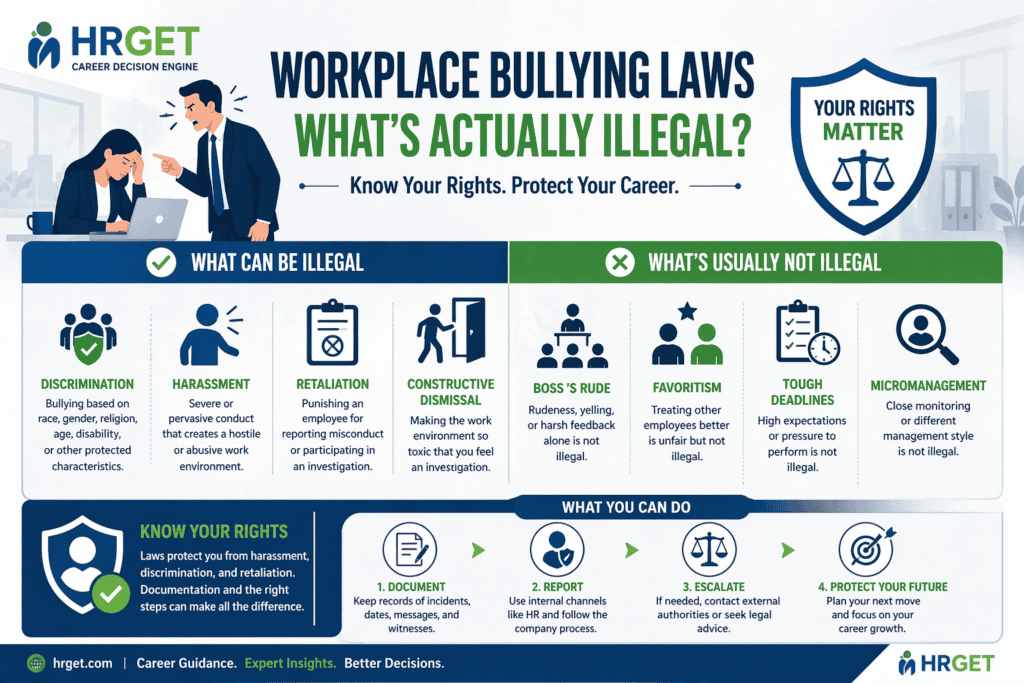
What is illegal is the subset of bullying that crosses into protected legal territory. And that subset is more significant than most people realize — which is actually good news if you know how to recognize it.
| Behavior | Toxic? | Likely Illegal? |
|---|---|---|
| Rude or aggressive management style | Yes | No |
| Unfair criticism, public humiliation | Yes | No (usually) |
| Favoritism toward other employees | Yes | No (unless discriminatory) |
| Bullying tied to race, gender, religion, age, disability | Yes | Yes — discrimination |
| Severe or pervasive hostile behavior | Yes | Yes — hostile work environment |
| Punishment after filing a complaint | Yes | Yes — retaliation |
| Forced resignation through intolerable conditions | Yes | Potentially — constructive dismissal |
What Makes Bullying Legally Actionable
For workplace bullying to cross the legal threshold, it typically needs to fall into one of four categories. Each one opens a different legal door — and understanding which door you’re standing in front of is what determines your options.
1. Discrimination
If the bullying is directed at you specifically because of a protected characteristic — your race, gender, religion, age, national origin, disability status, or pregnancy — it doesn’t just feel wrong, it violates anti-discrimination law. The critical test isn’t whether your manager is a bully in general; it’s whether you’re being treated differently because of who you are. If a manager publicly humiliates female employees but not male employees, that’s not just bad management — it’s gender discrimination.
2. Harassment Creating a Hostile Work Environment
This is where a lot of cases land that people don’t initially recognize. Under US law (and broadly across UK and Indian frameworks), harassment that is severe or pervasive enough to alter your working conditions and create an abusive environment becomes legally actionable. Note that it doesn’t have to be both severe and pervasive — a single extremely severe incident can qualify, as can ongoing lower-intensity behavior that accumulates over time. The legal standard asks whether a reasonable person in your position would find the environment hostile or abusive.
3. Retaliation
This one catches more employers out than any other. If you report misconduct, file an HR complaint, participate in an investigation, or assert a legal right — and then experience negative treatment afterward — that’s retaliation. It doesn’t matter if the original complaint was upheld or not. The act of complaining is protected. Demotion, exclusion from projects, sudden poor performance reviews, reassignment to undesirable roles: these are all classic retaliation patterns, and they’re illegal.
4. Constructive Dismissal
This is the most underused legal concept in the employee toolkit. Constructive dismissal occurs when your employer creates conditions so intolerable that a reasonable employee would feel compelled to resign — even though they were never formally fired. Courts treat this as wrongful termination in disguise. It’s harder to prove than straightforward discrimination, but it’s a genuine pathway for employees who’ve been pushed out through sustained toxic behavior rather than a termination letter.
Key Workplace Bullying Laws (US, UK, India)
The legal landscape varies significantly by country. Here’s what you actually need to know.
US United States
There is no standalone federal anti-bullying law. Your protections come from:
- Title VII of the Civil Rights Act (1964) — covers harassment and discrimination based on race, color, religion, sex, and national origin
- Americans with Disabilities Act (ADA) — protects employees with disabilities from discriminatory treatment
- Age Discrimination in Employment Act (ADEA) — covers workers aged 40 and over
- EEOC enforcement framework — the Equal Employment Opportunity Commission handles federal workplace discrimination complaints
Some US states have gone further. California, New York, and Washington have stronger workplace harassment statutes. As of 2026, several states are actively considering Healthy Workplace Bills that would create explicit anti-bullying protections — but none have yet passed at the federal level. The gap between what’s legal and what’s harmful remains wide.
UK United Kingdom
The UK has stronger structural protections, though still not a direct anti-bullying law:
- Equality Act 2010 — prohibits harassment and discrimination linked to nine protected characteristics, including age, sex, race, disability, and religion
- Protection from Harassment Act 1997 — can apply in extreme workplace cases involving persistent harassment (more commonly used in non-employment contexts, but applicable)
- Health and Safety at Work Act 1974 — creates employer obligations around employee wellbeing; sustained bullying can breach this duty
- Constructive unfair dismissal under the Employment Rights Act 1996 is a viable route for employees forced to resign by toxic conditions
India India
India has no general anti-bullying legislation. Protection is patchwork:
- Sexual Harassment of Women at Workplace Act (POSH, 2013) — specifically covers sexual harassment and mandates Internal Complaints Committees
- Industrial Disputes Act, 1947 — can apply in some bullying-related termination or unfair treatment cases in industrial settings
- Beyond law, most redress in India depends on company policy, employment contract terms, and the willingness of senior leadership to act
For professionals in Bengaluru, Mumbai, or Delhi working at larger tech or financial services firms, internal escalation pathways and contractual protections often matter more practically than the law itself.
Real Scenario: Legal vs Non-Legal Bullying
Real Scenario:
Scenario A — Toxic but Not Illegal: A product manager at a mid-sized tech firm has a director who routinely dismisses her ideas in front of the team, assigns her the least visible projects, and gives harsh feedback in ways she finds demeaning. Other colleagues notice it too. She’s miserable. But her director behaves this way with several team members, regardless of gender, age, or background. It’s genuinely toxic management — but there’s no discriminatory link. HR may care. Courts probably won’t.
Real Scenario:
Scenario B — Potentially Illegal: The same product manager discovers that male colleagues with comparable performance are consistently assigned the visible, high-growth projects while she and the other women on the team are sidelined. Her director makes comments about women not being “built” for leadership. When she raises it with a trusted skip-level, her next performance review suddenly drops — despite no change in her output. That’s a textbook discrimination-plus-retaliation scenario. She has legal options.
Real Scenario — Grey Zone:
Scenario C — Constructive Dismissal Territory: A finance analyst reports his manager to HR for falsifying expense reports. The complaint is “under review” for months. Meanwhile, he’s reassigned to the most tedious work, excluded from team communications, given no feedback on his development, and his office is moved to an isolated corner. He hasn’t been fired. But staying has become psychologically untenable. This is the profile of a constructive dismissal case — the environment has been deliberately made intolerable following a protected act of reporting misconduct.
Employee Rights You Should Know
Even when your situation doesn’t meet the legal bar for illegal harassment or discrimination, you have more rights than most employees realize. Knowing these gives you leverage in internal processes — which is often where the real outcomes happen.
Right to a Safe Work Environment
In all three jurisdictions, employers have a duty of care to provide a psychologically safe working environment. This isn’t just a moral obligation — it’s a legal one. Sustained bullying that demonstrably affects your health can give rise to employer liability even outside discrimination frameworks, particularly in the UK under health and safety legislation.
Right to Report Without Retaliation
Whether you’re reporting discrimination, harassment, safety violations, or financial misconduct, the act of reporting is protected. Retaliation is one of the most legally clear-cut violations an employer can commit — and it’s also one of the most common. If your treatment changes materially after you raise a complaint, start documenting immediately.
Right to Keep Records
You are entirely within your rights to maintain personal records of incidents — dates, what was said, who was present, any written evidence. You don’t need HR’s permission to do this. Your own notes, made contemporaneously, carry evidentiary weight. (Note: laws around recording conversations vary by jurisdiction — in many US states and in the UK, consult a lawyer before recording others without consent.)
Right to File Formal Complaints
Internally: most companies have a grievance procedure. Use it formally, in writing. Externally: in the US, the EEOC handles federal discrimination complaints; in the UK, ACAS mediates and employment tribunals adjudicate; in India, company ICCs (for POSH) and labor courts are the primary routes.
What HR Can (and Cannot) Do
Here’s the perspective most HR professionals won’t give you directly, but that I’ll put plainly: HR exists primarily to manage risk for the company, not to advocate for individual employees. That’s not cynicism — it’s the structural reality of how HR functions are designed and evaluated.
Insider View:
When you walk into an HR complaint meeting, the HR professional is almost certainly thinking about three things simultaneously: is there legal exposure for the company, is there a documented policy violation, and what’s the lowest-friction resolution? They’re not thinking about whether what happened to you feels fair. The employees who get better outcomes from HR processes are the ones who frame their complaint in terms of company risk and policy language — not personal grievance language.
What HR will typically do: investigate when there’s a documented policy violation; document the complaint formally; take action when there’s genuine legal exposure; mediate conflicts that have escalated to disruption level.
What HR won’t typically do: intervene in “personality conflicts” between employees; discipline a manager for being an unpleasant person; take action based on your word against theirs without documentation; prioritize your wellbeing over the company’s interests when those conflict.
The implication: go to HR prepared. Have your documentation. Frame your complaint precisely. Name the policy or legal principle that’s been violated, not just how the behavior made you feel.
Steps to Take If You’re Being Bullied
- Document everything from day one
Keep a private record (not on company devices) of every incident: exact date and time, what was said or done, who was present, any digital trail (emails, Slack messages, performance review comments). This contemporaneous record is your most valuable asset if things escalate. A complaint filed six months later with no documentation is infinitely weaker than one filed with a 47-incident log. - Identify whether it’s legally actionable
Ask yourself: Is this behavior tied to a protected characteristic (my race, gender, age, disability, religion)? Is it severe or pervasive enough to be a hostile work environment? Have I done something protected (filed a complaint, participated in an investigation) and is this treatment the result? If yes to any of these, your options are significantly wider. - Use internal channels — formally, in writing
Don’t have a verbal conversation with HR and call it a complaint. Put it in writing. Request a formal grievance process. This creates a paper trail and — critically — removes HR’s ability to later claim they were unaware of the issue. An unacknowledged verbal complaint is far easier for a company to ignore than a dated email with a formal grievance request. - Escalate externally if the internal process fails
In the US: file with the EEOC (required before suing under most federal statutes, with a 180–300 day deadline). In the UK: raise with ACAS before filing an employment tribunal claim. In India: report to your company’s ICC for POSH-related matters or consult a labor lawyer for other situations. Consult an employment attorney before escalating — many offer free initial consultations. - Protect your exit strategy in parallel
Regardless of whether you plan to stay and fight or leave, start building optionality. Update your CV, reconnect with professional contacts, and note any achievements and projects from the current role that you can reference. If constructive dismissal is in play, get legal advice before you resign — an unadvised resignation can significantly weaken a claim.
Common Mistakes Employees Make
1. Assuming all bullying is illegal and leading with that claim
This undermines your credibility with HR immediately. If you file a complaint claiming illegal discrimination when what you actually experienced was a rude manager with no protected-characteristic link, HR will quietly note the overreach and your subsequent complaints will carry less weight.
2. Not documenting until after it’s already bad
The most common and most damaging mistake. By the time most people start keeping records, months of evidence have evaporated. Start a private incident log the first time something feels off — even if you’re not sure it will become a pattern.
3. Reacting emotionally in documented channels
An angry reply-all email, a heated Slack message, a confrontation witnessed by colleagues — these become exhibits in any investigation. The bully who keeps their composure while their target escalates emotionally is in a much stronger position. I’ve seen too many legitimate complaints weakened by this dynamic.
4. Treating HR as an ally
Go to HR with documentation, a clear policy reference, and specific asks — not expecting sympathy or advocacy. HR can be useful; it’s just useful in a very specific, company-risk-management way. Adjust your expectations accordingly.
5. Waiting too long on legal options
Employment law claims have strict deadlines. In the US, EEOC complaints must generally be filed within 180–300 days of the discriminatory act. In the UK, employment tribunal claims must be filed within three months of the act or the end of employment. If you’re sitting on a potentially illegal situation, get legal advice now — not after the deadline has passed.
Smart Strategy to Protect Yourself
Here’s what I tell professionals who come to me with bullying situations, and it’s advice that consistently contradicts the reflexive “go to HR immediately” narrative:
Build your evidence base before you escalate
The instinct to complain immediately is understandable. But a complaint with no documentation achieves nothing except alerting the bully that you’re on the offensive. Spend two to four weeks building a solid incident record before you put anything in writing to HR. You’ll go in with ammunition rather than just allegations.
Reframe the complaint in risk language
Don’t walk into HR and say “my manager is making my life hell.” Say: “I want to document a pattern of behavior that I believe constitutes a hostile work environment and may expose the company to legal liability.” The first statement gets sympathy. The second one gets attention. HR organizations respond to risk framing far more reliably than to personal grievance language.
Know when the strategic move is the exit
This is the advice most people don’t want to hear: sometimes the smartest play is to leave on your own terms rather than fight a battle that could take years. Legal claims are slow, expensive, emotionally draining, and uncertain. If the bullying is in a legal grey zone and your company culture is unlikely to change, channeling that energy into a strategic job search often delivers better outcomes faster. Document what’s happened (in case you need it later), negotiate the best exit package you can, and redirect your career somewhere better.
Pro Tip:
If your situation isn’t legally strong enough for a discrimination or harassment claim, don’t spend your emotional energy on a legal battle you can’t win. Spend it on career leverage — internal transfer requests, a targeted job search, or a negotiated exit with a reference agreement baked in. A well-handled strategic exit will advance your career faster than a drawn-out HR dispute.
Workplace bullying is a career problem first, and a legal problem second — for most people, in most situations. The employees who navigate it best are the ones who get clear on what’s actually illegal, document precisely, and make strategic moves rather than emotional ones.
If your bullying is discriminatory, retaliatory, or severe enough to constitute a hostile work environment: you have legal options. Use them, and use them with proper legal counsel. If it isn’t: you still have options — they’re just career-strategic rather than courtroom-strategic. Both paths require the same first step: stop reacting, start documenting.
Frequently Asked Questions
Is workplace bullying illegal in the United States?
Not automatically. The US has no standalone federal anti-bullying law. Workplace bullying only becomes illegal when it involves discrimination based on a protected characteristic (race, gender, age, disability, religion), constitutes harassment severe enough to create a hostile work environment, or amounts to retaliation for a protected activity. A manager can be systematically rude and demeaning without violating any federal law, provided the behavior isn’t linked to a protected category.
Can I sue my employer for workplace bullying?
You can sue if the bullying violates employment law — specifically if it constitutes unlawful harassment, discrimination based on a protected characteristic, or retaliation. General bullying not connected to a protected category is not actionable under federal law in the US. Before filing any claim, consult an employment attorney. EEOC filing deadlines (180–300 days) mean you can’t afford to wait indefinitely to get legal advice.
What evidence do I need to prove workplace bullying?
The most effective evidence is contemporaneous documentation: a dated log of every incident with as much specificity as possible, emails and written communications, screenshots of relevant messages, and witness statements where available. Performance records showing a change in how you were evaluated are particularly important in retaliation claims. Courts and HR departments respond to patterns and specificity — “my manager is always mean to me” is not evidence; “on March 4, 2026, my manager said X in front of colleagues A and B” is.
What legally constitutes a hostile work environment?
A hostile work environment exists when harassment based on a protected characteristic is severe or pervasive enough to alter the terms and conditions of your employment and would be considered hostile or abusive by a reasonable person. It doesn’t require physical threats or extreme conduct — sustained demeaning comments, exclusion, or undermining tied to a protected characteristic can qualify. The legal standard requires both a subjective perception (you found it hostile) and an objective one (a reasonable person would too).
Should I quit my job if I’m being bullied?
Don’t resign without a plan — and if constructive dismissal is potentially in play, don’t resign without legal advice first. An unadvised resignation can eliminate a constructive dismissal claim. If you need to leave for your wellbeing, explore whether you can negotiate an exit package, secure a clear reference commitment in writing, and get a formal record of the bullying documented with HR before you go. A strategic departure beats an emotionally reactive resignation every time.
What is constructive dismissal and how does it relate to bullying?
Constructive dismissal occurs when an employer creates such intolerable working conditions that a reasonable employee has no realistic option but to resign — even though they were never formally fired. Courts treat this as wrongful termination. Sustained bullying, particularly following a protected complaint, can form the basis of a constructive dismissal claim. It’s typically harder to prove than direct discrimination and requires evidence that the employer’s conduct was a fundamental breach of the employment contract.
Does HR have to investigate a bullying complaint?
HR is obligated to investigate complaints that raise a policy violation or legal risk — discrimination, harassment, and retaliation complaints trigger stronger obligations. For general bullying that doesn’t meet a legal threshold, HR has more discretion. Filing your complaint in writing creates a formal record and makes it harder for HR to ignore. Frame your complaint around policy language and potential legal exposure to ensure it’s treated as a formal matter.
Are there anti-bullying laws in the UK that don’t exist in the US?
The UK doesn’t have a standalone anti-bullying law either, but its legal framework is somewhat stronger. The Equality Act 2010 provides robust harassment protection linked to nine protected characteristics. Additionally, the employer duty of care under health and safety legislation creates broader obligations around employee wellbeing. Employees can also claim constructive unfair dismissal under the Employment Rights Act 1996. Overall, the practical legal protection against toxic workplace behavior is modestly stronger in the UK than in the US — but significant gaps remain.
If you’re building a case, documentation is everything. Read our step-by-step guide: How to Document Workplace Harassment (Template Included) — the practical framework for creating an evidence trail that HR and courts actually take seriously.

Organizational Psychologist & Workplace Behavior Advisor (Former consultant with Boston Consulting Group, research contributor aligned with Harvard Business Review)
Dr. Amelia Grant is an organizational psychologist specializing in burnout, toxic workplaces, leadership behavior, and employee mental resilience. She writes practical, research-backed workplace guidance for modern professionals.