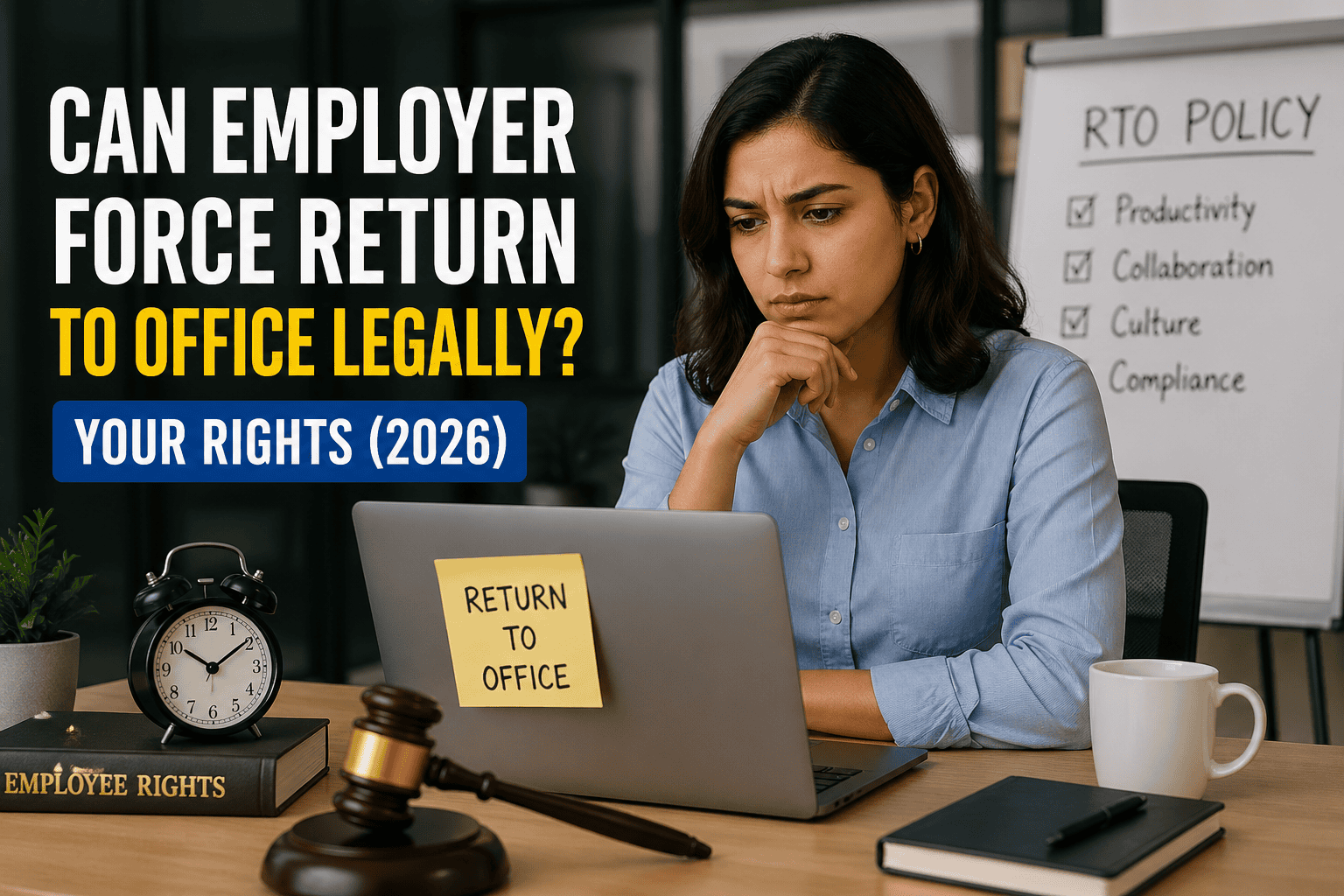
Here’s the uncomfortable truth most employees don’t want to hear: remote work is not a legal right. In the US, UK, India, and most of Europe, your employer can require you to return to the office — even if you’ve been working from home for three years straight.
But that’s not the whole picture.
There are situations where forced return-to-office (RTO) is legally questionable — and where you have real leverage. The problem is that most employees either panic and comply immediately, or push back the wrong way and end up worse off.
This guide cuts through the noise. I’ll break down exactly when your employer can legally force RTO, when they can’t, and how smart professionals in 2026 are handling this — without burning bridges or losing their jobs.
Can Employer Force Return to Office? (The Short Answer)
Yes — in most cases, your employer is on solid legal ground. Here’s why.
In the US, the majority of employees work under at-will employment, which means an employer can change workplace policies — including where you work — with reasonable notice. Refusing to comply isn’t protected activity. It can be treated as insubordination, and in many documented cases, it has led to termination that courts have upheld.
In India, employment is largely contract-based, and most contracts list the registered office as the place of work. If that’s your contract, remote work was a temporary arrangement — not a permanent right.
In the UK and EU, employees have stronger protections — but even there, a unilateral RTO mandate isn’t automatically illegal. Context matters enormously.
Bottom line: The question is never simply “Is RTO legal?” The question is: what are your specific circumstances? Your leverage depends entirely on what’s written in your contract, your country’s employment laws, and whether you have a protected reason to request remote work.
Why Companies Are Forcing RTO in 2026
Before deciding how to respond, understand what’s actually driving this wave of mandates — because it’s rarely what leadership tells you.
I’ve worked with executives at multinationals restructuring post-pandemic operations, and the official rationale (“collaboration,” “culture,” “innovation”) rarely tells the full story. The real drivers in 2026 are:
- Real estate commitments. Long-term office leases signed in 2019–2021 are expensive. Empty floors are a visible liability.
- Manager discomfort with distributed teams. Many senior leaders built their careers in office environments. Remote work makes them feel they’ve lost visibility and control.
- Performance optics. “Proximity bias” is real — managers often unconsciously rate in-office employees higher on performance reviews.
- Quiet headcount reduction. In some cases, RTO mandates are deliberately designed to induce voluntary exits from employees who won’t relocate — saving severance costs.
- Regulatory pressure. Some industries (finance, defence, government contracting) face oversight requirements that favour in-person security controls.
Why does this matter? Because once you understand the real driver, you can address it directly in any negotiation. If it’s a real estate issue, your manager likely has no personal stake in enforcing it. If it’s a quiet layoff mechanism, you need to start preparing your exit regardless.
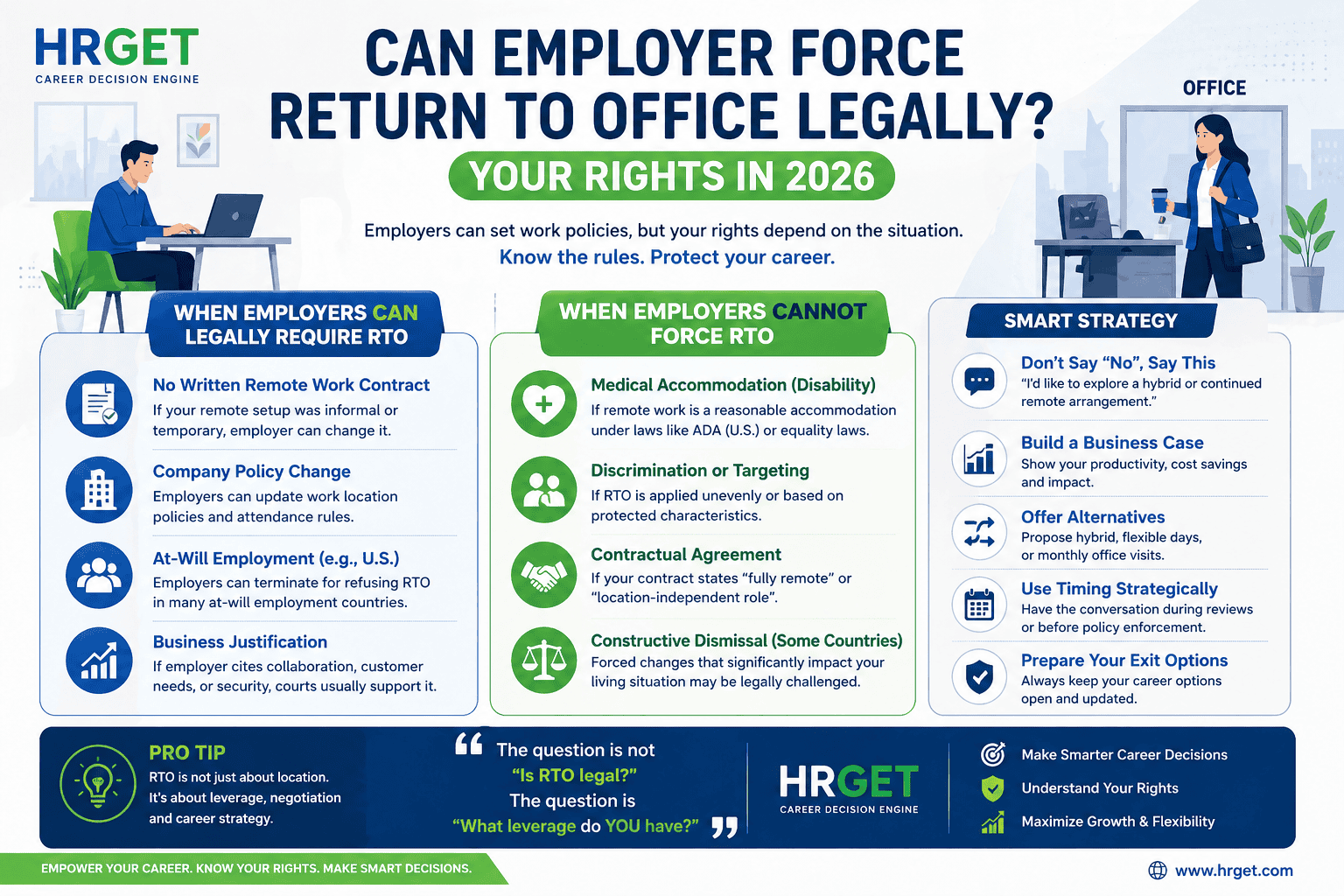
When Employers CAN Legally Require Office Return
In the following situations, your employer is almost certainly within their legal rights — and resistance without a specific protected basis will likely be unsuccessful.
1. Your remote arrangement was informal or pandemic-related
If you started working from home in 2020 without a formal written amendment to your contract — or if your offer letter listed an office address — the employer’s position is strong. Temporary arrangements don’t create permanent entitlements, even if they’ve lasted several years.
2. The work location clause favours the employer
Phrases like “work location subject to business needs” or “place of work may change with reasonable notice” are common in modern employment contracts — and they were often inserted precisely for this scenario. If yours contains language like this, you have very limited contractual protection.
3. At-will employment applies (US)
In most US states, at-will employment means your employer can change your working conditions — including location — without your consent, and can terminate your employment if you refuse to comply. Courts have repeatedly upheld this in RTO-related cases since 2023.
4. The policy is applied consistently and non-discriminatorily
If a company-wide RTO mandate applies to everyone in a role type equally, the employer is on solid ground. The legal risk for employers arises only when RTO is selectively applied — which is exactly the vulnerability you should look for.
When Employers CANNOT Force Return to Office
This is where most articles stop being useful — they tell you the employer usually wins without explaining the real exceptions. Here’s where you actually have power.
❌ Medical or disability accommodation
Under the Americans with Disabilities Act (ADA) in the US and equivalent equality legislation in the UK and EU, if you have a documented condition — chronic illness, anxiety disorder, physical disability — remote work can qualify as a “reasonable accommodation.” Employers must engage in an interactive process before denying it. This is one of the strongest grounds employees have, and it’s consistently underused.
In India, the Rights of Persons with Disabilities Act 2016 also provides similar accommodation obligations for registered disabilities, though enforcement is less consistent.
❌ Selective or discriminatory application
If RTO is being applied unevenly — for example, disproportionately affecting women who requested flexible arrangements, or targeting employees of a particular nationality or age group — that becomes a discrimination issue under Title VII, the Equality Act 2010, or equivalent legislation. Document the pattern carefully before raising it formally.
❌ Explicit contractual remote work clause
If your employment contract, offer letter, or a signed addendum explicitly states “fully remote,” “location-independent,” or “home-based role” — your employer cannot unilaterally change that term without your consent. They must either negotiate a variation or risk a breach of contract claim. I’ve seen this scenario play out dozens of times; the employees who had it in writing were the ones who kept their flexibility or received meaningful compensation for agreeing to change it.
❌ Constructive dismissal (UK and EU)
In the UK and many EU jurisdictions, if an employer fundamentally changes your working conditions without agreement — such as requiring you to relocate from Manchester to London or from Munich to Frankfurt — this can constitute a “fundamental breach of contract.” If you resign in response, you may have grounds for a constructive dismissal claim. This isn’t a fast or easy route, but it’s a legitimate one and it genuinely changes the employer’s risk calculus when negotiating.
Remote Work Agreements: The Document That Decides Everything
I cannot overstate how often I’ve seen employees assume that three years of working remotely — without incident, with full manager approval — gives them some kind of implied contractual right. It doesn’t. Not in the US. Not in India. Usually not in the UK either, unless there’s a formal written agreement.
Before you push back on any RTO mandate, pull out every document you signed and look for these things:
| Document | What to Look For | Your Position If Found |
|---|---|---|
| Offer letter | “Remote,” “home-based,” “location-independent” | Strong — employer must renegotiate |
| Employment contract | Place of work clause — office address listed? | Weak if office address is listed |
| Signed remote work addendum | Any formal agreement specifying remote terms | Strong — enforceable contractual term |
| Company policy handbook | “Policy subject to change” disclaimers | Weak — policies are not contracts |
| Written manager approval email | Confirmation of permanent remote status | Moderate — useful in negotiation, less so legally |
If you don’t have a formal written clause protecting your remote status, focus on negotiation — not legal resistance.
Real Scenario: What Actually Happens When You Refuse RTO
Scenario — composite based on common cases
A senior product manager at a mid-sized UK SaaS company receives an all-staff email in January 2026: three days in-office per week, effective March 1. She’s been fully remote since joining in 2021. Her contract lists the London office as her place of work. She declines verbally, citing her commute (two hours each way). No medical documentation is provided.
Week 1–2: Her manager calls — friendly tone, but the message is clear: this isn’t optional. HR follows up in writing.
Weeks 3–6: Her performance review is flagged as “pending compliance review.” Non-attendance is formally documented. Her peers who are also struggling with the commute start quietly complying.
Month 2: She’s placed on a performance improvement plan (PIP) citing “failure to adhere to workplace policies.” A month later, her role is made redundant — with a basic statutory redundancy payout.
Could she have fought it? Possibly, on a constructive dismissal basis given the commute impact. But by the time HR got involved, her negotiating position had collapsed. The professionals who came out ahead in similar situations did so by acting in weeks one or two — not months later.
Your Legal Rights by Situation
There’s no universal answer to RTO legality. Here’s how the picture breaks down by situation:
| Your Situation | Legal Strength | Recommended Approach |
|---|---|---|
| Remote worker, no written clause | Weak | Negotiate hybrid; don’t resist outright |
| Disability / chronic illness | Strong | Request formal ADA/Equality Act accommodation in writing |
| Written remote clause in contract | Very strong | Push back formally; employer must renegotiate or compensate |
| RTO applied selectively or unequally | Moderate–Strong | Document pattern; seek employment law advice before acting |
| Required to relocate (UK/EU) | Moderate | Explore constructive dismissal — consult an employment solicitor |
| At-will US employee | Weak (unless ADA applies) | Negotiate; start exit planning in parallel |
Smart Strategy: How to Push Back Without Risk
The professionals who succeed in these situations approach RTO as a business negotiation, not an emotional standoff. Here’s the playbook.
Step 1: Don’t lead with refusal
The moment you say “I won’t come in,” you’ve created a compliance issue on paper. Instead: “I’d like to discuss a flexible arrangement that addresses the business goals behind this policy while continuing to deliver my results.” That framing puts the conversation back on business outcomes — which is where you want it.
Step 2: Build a results-based case
Compile your last 12 months of performance — delivery against targets, client feedback, project completion rates. Quantify where possible. If you managed a ₹2 crore campaign from home or shipped a product feature that drove $500K in pipeline, say so. You’re not asking for a favour; you’re showing that presence doesn’t equal performance in your role.
Step 3: Offer a specific alternative
Vague flexibility requests are easy to deny. A specific proposal is harder to dismiss. Try: “I can commit to being in the office every Tuesday and Thursday for team meetings and collaborative sessions, with the remaining days remote.” Specific, reasonable, tied to the collaboration rationale they’ve cited.
Step 4: Time your ask strategically
Raise this conversation before the formal mandate takes effect — not after HR has already documented non-compliance. Other good windows: just after a strong performance review, during a role transition, or when you’re in active conversations about a promotion. Your leverage varies enormously by timing.
Step 5: Quietly prepare alternatives in parallel
Even if you reach an agreement, start scanning the market. In 2026, remote-first companies in your sector do exist — the talent market has normalised it. Update your LinkedIn, have a few conversations, know your options. The best negotiating position is one where you genuinely don’t need the outcome to go your way.
Common Mistakes That Cost Employees Their Jobs
❌ Saying “I won’t come in” — full stop
This immediately becomes a disciplinary matter. Even if you have legal standing, starting with a flat refusal hands your employer the procedural high ground.
❌ Overestimating your legal protection
Most employees who consult me believe they have stronger rights than they do. Unless you have something explicitly in writing or a documented medical reason, the law is usually on the employer’s side — especially in the US and India.
❌ Not documenting your informal agreement
If your manager verbally told you in 2021 that you’d be “permanently remote,” that’s worth almost nothing legally. Always follow up verbal agreements with an email confirming your understanding. Even a short message — “As discussed, I’ll be continuing on a fully remote basis going forward” — creates a paper trail.
❌ Waiting until HR is formally involved
Once a formal compliance process starts, your options narrow significantly. Act in the first two weeks of any RTO announcement — that’s your highest-leverage window.
Pro Tips From HR Experts
💡 Make yourself hard to replace
Replaceable employees get RTO ultimatums. Irreplaceable ones get negotiated exceptions. If you’re the only person on the team who owns a critical system, client relationship, or institutional knowledge — you have leverage that has nothing to do with the law.
💡 Read leadership language carefully
“Encouraged” to return means optional. “Expected” means enforcement is coming. “Required” means it’s already being tracked. When the word changes in internal communications, act immediately — don’t wait for the formal notice.
💡 Internal transfers can be a clean exit from RTO pressure
Not every team within a company applies RTO the same way. A move to a distributed product team or an international business unit can legitimately change your situation without requiring you to leave the company entirely.
💡 Put everything in writing
Emails beat verbal conversations every time. If your manager agrees to a hybrid arrangement verbally, follow up immediately in writing. This isn’t being difficult — it’s being professional. And if things go sideways later, that email is the most valuable document you’ll have.
Frequently Asked Questions
Can my employer fire me for not returning to office?
Yes, in most cases — particularly in at-will employment states in the US. Refusing a legitimate workplace policy directive can be treated as insubordination and grounds for termination. The exception is if you have a documented disability, a contractual remote clause, or if the RTO mandate is being applied in a discriminatory way.
Is remote work a legal right in 2026?
No — not as a standalone right in the US, India, or most of Europe. Remote work only becomes a legal entitlement when it’s explicitly included in your employment contract, or when it qualifies as a reasonable accommodation under disability law. Widespread remote work practice during the pandemic didn’t create any new legal entitlements.
Can I request a permanent remote work arrangement?
Absolutely — but it’s a negotiation, not a demand. Frame it around your performance record, role requirements, and business impact. If you have a documented medical reason, request it formally as an accommodation, which carries legal weight. Without that, your success depends on your leverage within the organisation.
I relocated to another city while remote. Can they still force RTO?
Yes, unless your employer formally approved the relocation in writing and amended your work location clause. If you moved without explicit approval, you may be in a difficult position. In the UK and EU, a requirement to relocate back to the original city could constitute a fundamental change of contract — worth reviewing with an employment lawyer.
What counts as constructive dismissal in an RTO context?
In the UK and EU, constructive dismissal occurs when an employer makes a fundamental and unilateral change to your employment terms — such as requiring you to commute to a location significantly farther than your original workplace — which forces you to resign. It’s a serious legal claim, not a casual threat. Consult an employment solicitor before resigning if you’re considering this route.
Do hybrid schedules have to be agreed in writing?
There’s no universal legal requirement, but if your employer mandates a specific hybrid schedule, get the agreement in writing — and if you negotiate a different arrangement, document that too. Written confirmation of your hybrid terms is your protection if enforcement becomes inconsistent later.
Can my employer reduce my pay if I refuse RTO?
Not unilaterally — reducing your pay without consent is a breach of contract, separate from the RTO issue. Some companies have tried to tie “remote work stipends” or location-based salary adjustments to in-office attendance. Whether these are enforceable depends on how they were structured in your original contract. If your employer attempts a unilateral pay cut, seek legal advice immediately.
The Bottom Line: It’s Not About Legality — It’s About Leverage
After two decades of employment law practice, the professionals who navigate RTO mandates best in 2026 are rarely the ones with the strongest legal case. They’re the ones who understood their leverage early, acted before HR was formally involved, and approached the conversation as a business negotiation rather than a rights dispute.
If you have documented medical grounds or an explicit contractual clause — use them. Push back formally, in writing, and understand what constructive dismissal or reasonable accommodation actually means in your jurisdiction before you act.
If you don’t have that legal backing — negotiate. Build a results case. Offer a specific alternative. And start exploring your options outside the company in parallel, because the best negotiating position is one where you’re not desperate for the answer to go your way.
Can your employer force return to office? Usually yes. But whether they’ll actually enforce it on you, and what you can do about it — that’s a different conversation entirely.
Dealing with an unexpected workplace change? Read our guide on what constructive dismissal means and how to evaluate your options before making any decisions.

Victoria Hale | Former Partner, Freshfields Bruckhaus Deringer | Employment Law Specialist | 20+ Years Advising Multinationals & Executives
Author: Victoria Hale spent over two decades as an Employment Law Partner at Freshfields Bruckhaus Deringer — one of the world’s most prestigious Magic Circle law firms — advising multinational corporations and senior executives on some of the most complex employment disputes in the US and Europe. Her practice covered wrongful termination litigation, executive exits, non-compete enforcement, FLSA compliance, and cross-border workforce restructuring under EU labour law. Now based between London and New York, Victoria writes for HRGet.com to close the gap between legal theory and how employment law actually plays out in the real world — for employees who need to know their rights before it’s too late.