
Jonathan Reed
Executive Career Strategist & Leadership Advisor | Former Partner, McKinsey & Company | Executive Coach to senior leaders at Amazon and Unilever | London & New York | 18+ years
Let’s not dress this up with motivational language. Whether an MBA is worth it in 2026 is one of the highest-stakes financial decisions a working professional will make — and most people get it wrong because they’re asking the wrong question.
The question isn’t “Is an MBA valuable?” The real question is: “Is an MBA worth it for me, at this point in my career, given what I’m trying to achieve?”
I’ve coached senior leaders across McKinsey, Amazon, and Unilever — and I’ve seen the full spectrum. Engineers who doubled their salary in 18 months post-MBA. And talented professionals who spent ₹60–80 lakhs ($70K+), graduated into a sluggish job market, and spent five years just breaking even.
This guide gives you a clear ROI framework — not career-fair cheerleading. By the end, you’ll know exactly whether an MBA makes financial and strategic sense for your situation.
What “MBA ROI” Actually Means
Most professionals calculate MBA ROI like this: “The degree costs ₹40 lakhs, my salary goes up ₹10 lakhs a year — so it pays off in four years.” That’s amateur math, and it leads smart people into bad decisions.
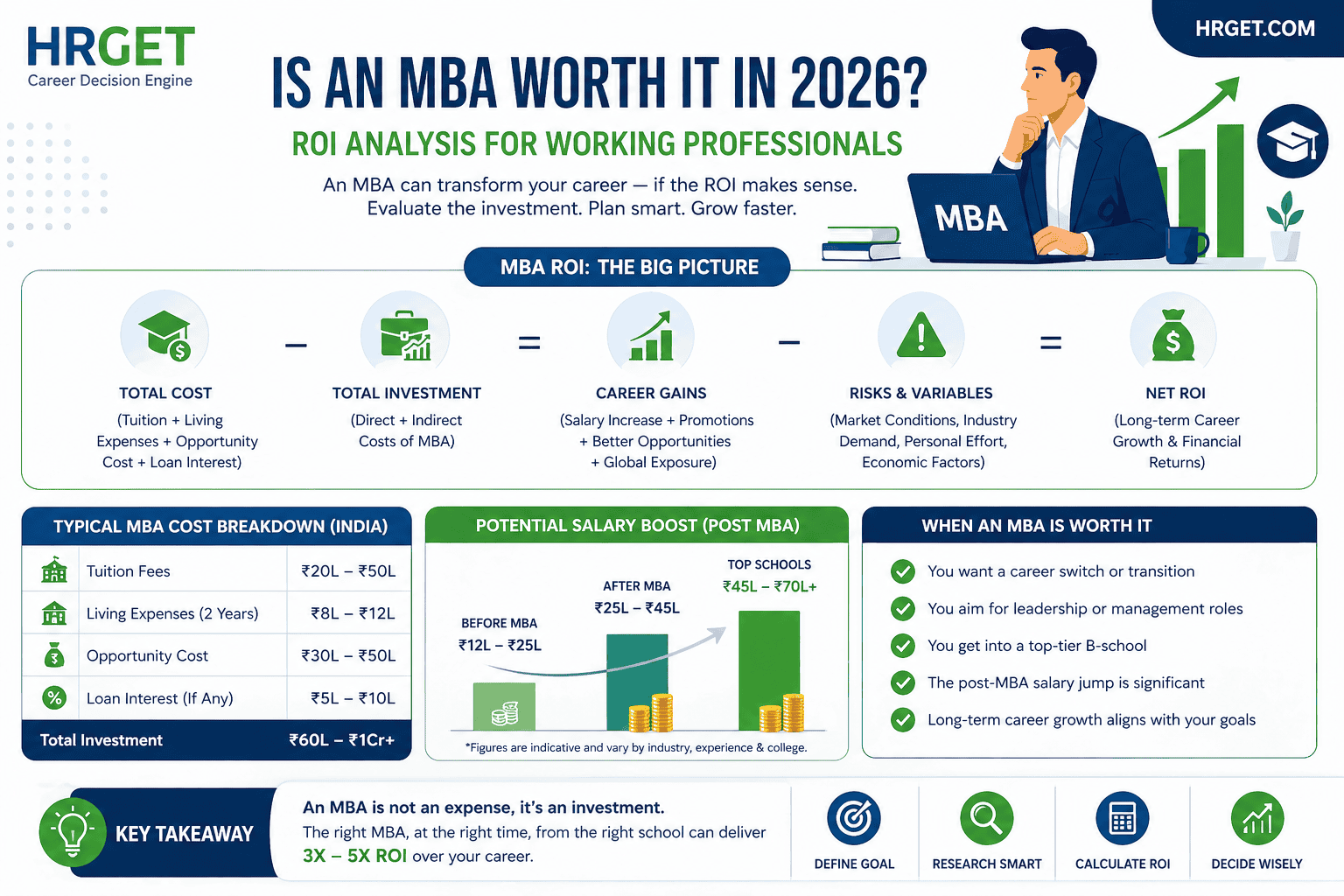
A real ROI calculation has to account for every rupee or dollar the degree costs you — including the income you stopped earning while you were in school. Here’s the full picture:
- Tuition fees — the obvious one
- Opportunity cost — the salary you walked away from (typically the biggest hidden number)
- Interest on education loans — often 9–11% in India, 6–8% in the US
- Living expenses during the program
- Career acceleration value — the speed at which you reach senior roles, not just the salary bump
- Risk premium — the chance you don’t land the role you planned for
The real formula:
MBA ROI = (Total career earnings gain over 5–10 years) − (Total cost of MBA including opportunity cost)
If you’re not thinking in multi-year terms — and accounting for what you gave up — you’re not actually evaluating the investment. You’re just convincing yourself.
Cost Breakdown: What You’ll Really Spend
The sticker price of an MBA is not the real cost. Here’s how the numbers actually stack up in 2026.
Tuition Fees (2026 Estimates)
- India Tier-1 MBA (IIMs A/B/C, ISB): ₹23L – ₹50L
- India Tier-2 MBA: ₹8L – ₹22L
- US Top MBA (Wharton, Harvard, Booth): $80K – $200K
- UK/Europe MBA (LBS, INSEAD, IE): €40K – €120K
The Opportunity Cost Trap
This is the number most people ignore entirely. If you’re earning ₹20 lakhs per year and you take a two-year full-time MBA — you just quietly lost ₹40 lakhs in foregone income. Add career momentum you didn’t build, promotions you didn’t get, and projects you didn’t lead, and the real cost climbs higher still.
True Total Cost (India Example)
| Cost Component | Typical Amount |
|---|---|
| Tuition (IIM / ISB) | ₹30L |
| Lost Salary (2 years @ ₹20L) | ₹40L |
| Living Expenses | ₹10L |
| Loan Interest (if applicable) | ₹5–8L |
| Total Real Investment | ₹85L – ₹90L+ |
That’s the number you need to beat. Not just ₹30 lakhs in tuition — nearly ₹90 lakhs when you count everything. For a US MBA at a top school, that number can comfortably cross $250,000–$280,000 when you factor in two years of foregone income at $80K–$100K.
Salary Impact in 2026 — The Reality Check Most Articles Skip
Here’s where the confusion starts. Business schools publish median salary figures. Those numbers are real — but they represent a specific slice of graduates who landed the roles the school’s placement team worked hardest to fill. They don’t reflect the full distribution.
Typical Pre-MBA vs. Post-MBA Salaries (2026)
| Profile | Before MBA | After MBA (Realistic Median) |
|---|---|---|
| IT Engineer → PM (India Tier-1) | ₹15–25L | ₹28–45L |
| Consultant → Strategy (India) | ₹20–30L | ₹35–60L |
| US MBA Graduate (Top 15 School) | $75–90K | $120K–$180K |
| UK/EU MBA Graduate (LBS, INSEAD) | £55–70K | £85K–£130K |
Here’s the part schools won’t tell you: the 2023–2025 tech and consulting hiring slowdown hit recent MBA graduates hard. McKinsey, Bain, and BCG — the holy trinity for top MBA placements — all reduced intake significantly during that window. Some very capable graduates from reputable programs ended up in roles they could have reached without the degree.
The market is recovering in 2026, but the lesson stands: your pre-MBA profile, your target industry’s hiring cycle, and the specific school you attend collectively determine your outcome more than the degree itself.
ROI Calculation: When Does an MBA Actually Pay Off?
Let me walk you through a clean, realistic example so you can model your own numbers.
India Scenario (IIM Bangalore Graduate)
- Total MBA investment (all-in): ₹85L
- Salary before MBA: ₹18L/year
- Post-MBA salary: ₹40L/year
- Annual net gain: ₹22L
- Payback period: ~3.9 years
US Scenario (Top-15 School)
- Total investment (tuition + 2 years lost income at $85K): ~$270K
- Post-MBA salary in consulting/finance: $150K
- Salary gain over pre-MBA: $65K/year
- Payback period: ~4.2 years
Realistic Timeline — What Nobody Tells You
- Year 1–2: Recovery mode — high EMI payments, entry-level post-MBA role
- Year 3–5: You start seeing real net gains as salary compounds
- Year 6+: Genuine ROI territory — assuming you stayed on the right track
The math can work. But it only works if the salary jump is real, the school brand carries weight, and the job market cooperates. That’s three variables, not one.
Real Scenarios: High ROI vs. Low ROI
I’ve worked with hundreds of professionals across career inflection points. Here are two composite cases that reflect what I see most often.
✅ Case 1: High ROI — The Smart Switch
Background: Software Engineer at a mid-size product company, earning ₹18L. Wants to move into product management and eventually general management. Gets into IIM Calcutta.
Outcome: Joins a consumer tech company as Associate Product Manager at ₹38L. Promoted to Senior PM within 18 months at ₹55L.
- Salary jump: ₹20L in Year 1, compounding fast
- Payback period: ~3.5 years
- 10-year career trajectory: fundamentally changed
Verdict: Absolutely worth it. The MBA was the bridge he couldn’t cross otherwise.
❌ Case 2: Low ROI — The Expensive Lateral Move
Background: Marketing executive at a FMCG brand, earning ₹10L. Joins a Tier-2 B-school (₹22L fees) hoping to transition to brand strategy at a larger company.
Outcome: Lands a senior marketing role at ₹14L. The school’s brand doesn’t open the doors she expected. The strategy roles went to IIM/ISB alumni.
- Salary increase: ₹4L/year
- Payback period: 8–10 years (with EMI eating into net gain)
- Weak brand signal in a market where brand is everything
Verdict: Not worth it. She’d have been better served by a lateral move within her current company plus targeted upskilling.
The difference between these two cases wasn’t intelligence or effort — it was the school tier, the career switch clarity, and the market’s willingness to reward the credential.
When an MBA Is 100% Worth It
There are specific situations where an MBA delivers outsized returns — and these are the situations where I actively encourage professionals to pursue it.
1. You Need a Hard Career Switch
Going from engineering to consulting. From finance to general management. From academia to the corporate world. The MBA functions as a credentialed pivot mechanism — it gives you the structured access to a new industry that’s otherwise incredibly difficult to get. The school’s recruiting ecosystem does the work your résumé can’t.
2. You’re Targeting Senior Leadership Tracks
Certain organizations — particularly in consulting, investment banking, and multinational strategy functions — still use MBA pedigree as a filter at the VP and Director level. If your 10-year goal is a CXO role in one of these environments, an MBA from the right school can still be the most efficient credentialing path available.
3. You Get Into a Top-Tier Institution
I’ll say this plainly: the brand of the school matters more than the content of the MBA program. Two professionals with identical intelligence and work ethic will have dramatically different post-MBA outcomes based on school tier. In India, the effective list is IIM A/B/C, ISB, and a few others. In the US, it’s the M7 plus a handful of programs. The network and the recruiting pipeline — not the coursework — drive the ROI.
4. You Have Strong Pre-MBA Credentials
Here’s something almost no article will say directly: your post-MBA outcome is largely determined by your pre-MBA profile. The top consulting and strategy firms aren’t just hiring MBAs — they’re hiring the best pre-MBA performers who happened to get MBAs. If your background is already strong, an MBA from a top school amplifies that significantly.
When an MBA Is a Terrible Decision
This section matters more than the previous one, because these mistakes are far more common.
1. You’re Already on a High-Growth Trajectory
If you’re earning ₹30L+ in a product or tech role, getting promoted regularly, and building real domain expertise — pause before applying. I’ve coached senior engineers and product leads who considered MBAs and ultimately realized they’d be paying ₹80 lakhs to delay a career that was already ahead of where most MBA graduates end up. Compounding momentum is underrated.
2. “Because Everyone Else Is Doing It”
This is genuinely the most expensive form of peer pressure that exists in the professional world. Cohort anxiety — watching colleagues apply to B-schools and feeling left behind — is not an investment thesis. It’s a feeling. And feelings make terrible financial decisions.
3. You’re Targeting a Tier-2 or Tier-3 School
Insider View
Hiring managers at top firms — and I’ve been one of them — genuinely do filter by school. A weak MBA from an unrecognized institution can actually create a negative signal: it suggests you couldn’t get into a top school but spent the money anyway. That’s a difficult perception to overcome.
4. Your Goal Is Unclear
If you can’t answer the question “What specific career outcome does this MBA unlock that I can’t reach otherwise?” — you’re not ready. Vague goals produce poor school choices, which produce low ROI. Full stop.
Smarter Alternatives to an MBA in 2026
This is where most MBA-ROI articles completely fail you. They compare “MBA vs. no MBA” — when the real comparison is “MBA vs. the best alternatives available today.”
1. Specialized Certifications With Genuine Market Value
Product management programs (PM School, Reforge), data science certifications, CFA (for finance-focused professionals), and AI/ML credentials from credible institutions are generating fast, measurable salary impact. A senior data scientist moving into AI strategy doesn’t need an MBA — they need a targeted credential and one high-profile project.
2. Strategic Internal Moves
This is chronically underused. If you’re at a mid-to-large company, there are almost certainly cross-functional roles, stretch assignments, and adjacent opportunities that could radically change your trajectory — at zero cost. A business analyst who moves into a strategy role internally and delivers one major project will outlearn a classroom in 12 months.
3. Executive Education (Without the Full MBA Commitment)
HBS Online, Kellogg Executive Programs, and ISB’s short executive programs provide genuine credentialing and network access at a fraction of the cost. If your goal is networking or adding a prestigious name to your CV, these are worth serious consideration.
4. Build Independent Consulting Income
For professionals with real domain expertise — in HR, finance, tech, or operations — building a consulting practice on the side can generate ₹5–15L in supplemental income within 12–18 months. No debt, no opportunity cost. In 2026, this path is more viable than ever given the proliferation of fractional executive roles and consulting marketplaces.
Common Mistakes Professionals Make When Evaluating an MBA
❌ Using the school’s reported median salary as your expected salary
Median means half the class earned less. And the schools have incentives to report numbers favorably. Look at the 25th percentile in placement reports — that’s a more honest baseline.
❌ Not accounting for the loan repayment drag
A ₹25L loan at 10.5% interest over 7 years means you’re paying back nearly ₹38L total. That’s ₹13L in interest alone — on top of everything else. Model the EMI impact on your monthly cash flow in years 1–3 post-MBA before you commit.
❌ Treating the degree as the destination
The MBA is a door opener, not a career. The professionals who get maximum ROI are the ones who arrive with a clear plan for how they’ll leverage the alumni network, recruiting access, and brand in their first 90 days after graduation.
❌ Choosing a program based on rankings rather than fit
A school ranked #8 globally with deep connections in your target industry will outperform a school ranked #2 globally where your sector has minimal recruiting presence. Always evaluate placement by sector and role, not just overall ranking.
Smart Strategy: How to Decide Before You Apply
Here’s the four-step framework I walk professionals through when they come to me with this decision.
Step 1: Define the Specific Career Outcome
Not “I want to grow.” Specifically: What role, at what type of company, earning approximately what salary? If you can’t name the role, you can’t evaluate whether the MBA is the right vehicle to get there.
Step 2: Shortlist Only Schools Where the Placement Data Proves It
Request detailed placement reports — not summary brochures. Look at: median salary in your target sector, percentage of class placed within 90 days, company names in your target function. If the school doesn’t publish this granularly, that’s a signal.
Step 3: Run Your Personal ROI Model
Use your actual current salary, not a hypothetical. Calculate the all-in cost including lost income. Set a conservative post-MBA salary estimate (the 25th percentile, not the median). Then calculate your payback period. If it’s longer than 6 years, scrutinize hard.
Step 4: Pressure-Test the Decision Against Alternatives
Ask yourself: Is there a way to achieve this same career outcome in the same timeframe without an MBA? If the honest answer is yes — an internal move, a targeted certification, a company switch — then the MBA is solving a problem you could solve cheaper.
Pro Tip
Before you apply anywhere, spend 30 days actively networking with people who graduated from your target school 5 years ago. Ask them what the MBA actually changed and what it didn’t. Their unfiltered answers will tell you more than any placement brochure.
Final Verdict: Is an MBA Worth It in 2026?
Here’s my honest answer after 18 years of working with professionals who faced exactly this decision.
| Situation | Verdict |
|---|---|
| Top-tier school + clear career switch + strong pre-MBA profile | ✅ Do it |
| Already high-growth trajectory + no career switch needed | ❌ Skip it |
| Tier-2 school + vague goal + primarily peer pressure | ❌ Absolutely skip it |
| Good school + career switch + alternative paths unavailable | ⚠️ Evaluate carefully |
| Part-time / executive MBA + staying employed + targeting credentialing | ⚠️ Can work — depends on school and role |
The highest-ROI MBAs I’ve seen in my career share one characteristic: they were intentional decisions made by people with a clear destination, not emotional responses to career anxiety.
Treat this like the ₹80–90 lakh investment it actually is. Would you put ₹85 lakhs into any other asset without modeling the returns? Of course not. Apply the same discipline here.
If you’re weighing whether your current role has the headroom to get you where you want to go, read our guide on how to get promoted without switching companies — it’s often the step that makes the MBA question moot.
Frequently Asked Questions
Is an MBA still worth it in 2026 given all the tech layoffs?
Yes — for the right profile. The 2023–2025 tech downturn did reduce short-term MBA placement rates at some schools, particularly in tech-adjacent consulting. But as hiring recovers in 2026, demand for MBA-calibre talent in strategy, product, and operations is rebuilding. The key is targeting sectors with genuine hiring momentum, not just following historical MBA career patterns blindly.
How long does it realistically take to recover MBA costs?
For a Tier-1 Indian MBA with a strong placement, payback typically runs 3–5 years when you account for the full investment including lost income. For a US Top-15 MBA, the range is 4–6 years given higher total costs. Tier-2 MBA payback can stretch to 8–10 years — which is why school selection is the single highest-leverage decision in the entire MBA journey.
Is an MBA worth it for IT and software professionals specifically?
Only if you’re making a clear transition out of individual contributor technical work — into product management, consulting, or business strategy. If you want to stay on the engineering or architecture track, an MBA rarely adds value proportional to its cost. Senior engineers at companies like Google and Amazon regularly out-earn MBA graduates without the degree or the debt.
Can you earn more than MBA graduates without the degree?
Absolutely — and it happens more often than MBA marketing materials acknowledge. Domain experts with deep specialization in AI, data, product, or finance routinely earn ₹50–80L+ in India or $150K–$200K+ in the US without an MBA. The competitive edge comes from expertise depth and career positioning, not the degree itself.
Does MBA college brand actually matter in hiring decisions?
More than most people want to hear. At top consulting firms, investment banks, and multinational strategy functions, school tier remains a genuine first-round filter. Hiring managers receive hundreds of applications — school brand is a fast-sorting heuristic. This doesn’t mean non-top-school graduates can’t succeed, but the MBA’s ROI is heavily correlated with institution prestige in high-competition sectors.
Is a part-time or executive MBA better for working professionals?
It eliminates the opportunity cost of lost salary — which is the single biggest financial advantage. However, part-time and executive programs typically have weaker on-campus recruiting access, smaller alumni networks, and lower brand value than full-time equivalents. They work best when you’re targeting promotion within your current industry rather than switching sectors entirely.
Should I take an education loan for an MBA?
Only if the math works conservatively — meaning even at the 25th percentile post-MBA salary (not the median), your payback period is under 6 years and monthly EMIs don’t exceed 30% of your projected post-MBA take-home. Don’t model the best case. Model a scenario where placement takes 6 months and starting salary is 20% below median. If that still works, the loan is defensible.
About the Author: Jonathan Reed is an Executive Career Strategist and former Partner at McKinsey & Company. He has coached senior leaders at Amazon, Unilever, and across FTSE 100 organisations on career transitions, leadership positioning, and high-stakes professional decisions. He writes on career strategy and leadership for HRGet.com.

Jonathan Reed: Executive Career Strategist & Leadership Advisor | Former Partner, McKinsey & Company | Executive Coach to Amazon & Unilever Leaders | 18+ Years in Career Strategy
Jonathan Reed spent nearly two decades as a Partner at McKinsey & Company, where he advised organisations on leadership development, talent strategy, and organisational design across the US, UK, and Asia. Since leaving consulting, he has worked as an executive coach to senior leaders at Amazon, Unilever, and a clutch of high-growth scale-ups — helping them navigate promotions, career pivots, and the unwritten rules of visibility and influence at the top. Based between London and New York, Jonathan writes for HRGet.com to give working professionals an honest look at how careers actually scale — and why so many talented people stall without ever knowing why.