By Eleanor Whitmore | Director, Compensation & Benefits (Ex-Mercer, PwC) | 15+ years | New York / London
Last updated: April 2026
I’ve sat across the table from hundreds of candidates who looked genuinely confused after signing an offer letter. The CTC vs in-hand salary gap catches almost everyone off guard — and it’s not because people are bad at math. It’s because companies deliberately present CTC as the headline number, even though it bears almost no resemblance to what lands in your account each month.
Here’s the version of events I see constantly: a candidate accepts a ₹12 LPA offer feeling like they’ve made it — only to receive ₹67,000 in their first salary credit and wonder what went wrong. Nothing went wrong. That’s just how CTC works.
This article breaks down the CTC vs in-hand salary difference in plain terms. You’ll get a step-by-step calculation, a real ₹12 LPA walkthrough, the specific components that quietly reduce your pay, and a strategy to maximize what you actually keep. By the end, you’ll be able to decode any offer letter in under five minutes.
What Is CTC (Cost to Company)?
CTC is the total annual expenditure your employer bears on your employment — not your salary. That distinction matters enormously, yet most offer letters blur it on purpose.
Think of CTC as your employer’s cost of having you on payroll. It includes what they pay you directly, what they contribute to your retirement, and what they spend on benefits like insurance and gratuity provisioning. Some of those costs you’ll never see in liquid form — at least not for years.
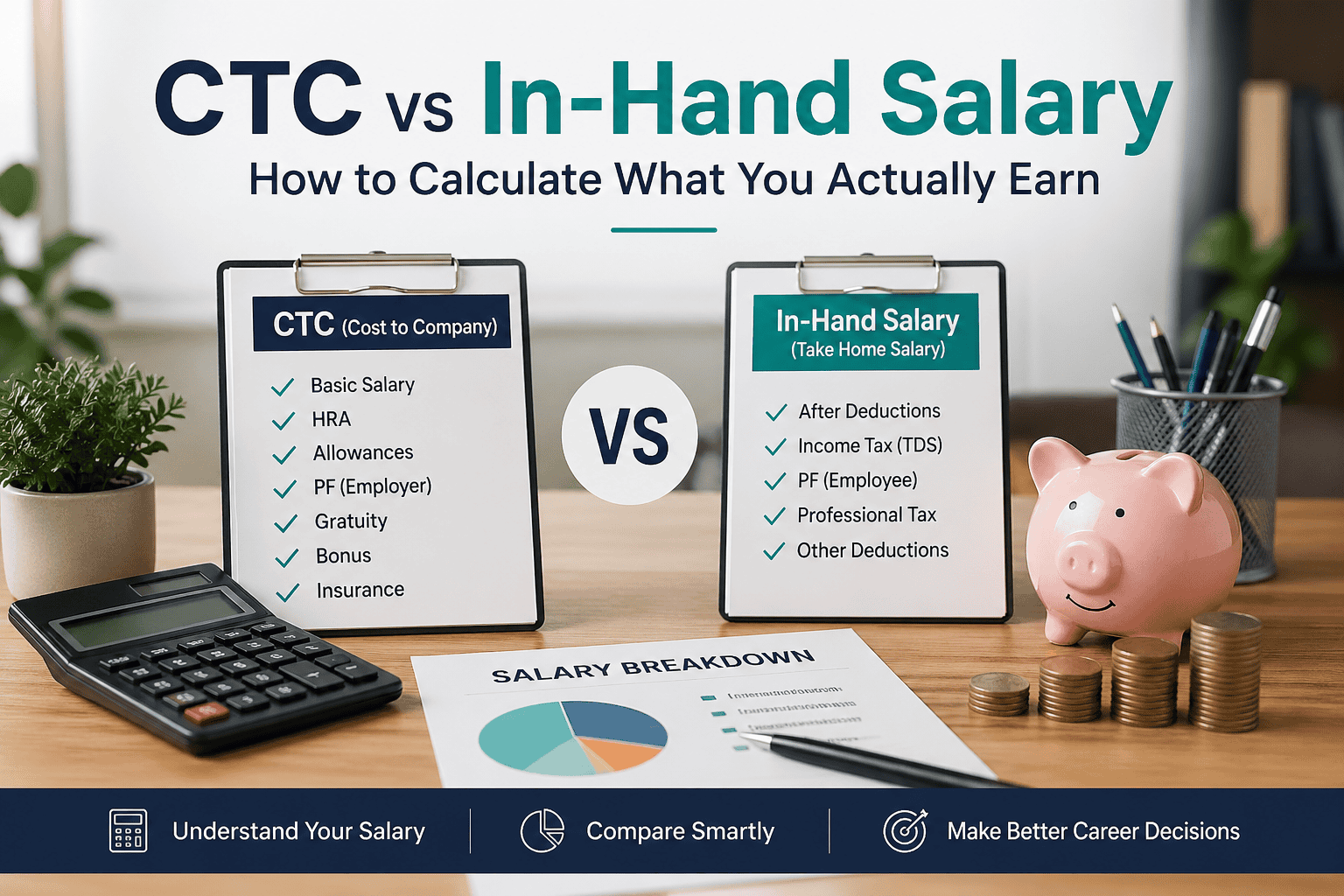
Here’s what’s typically bundled inside a CTC figure:
| Component | What It Is | Comes to You Monthly? |
|---|---|---|
| Basic Salary | Core fixed pay (40–50% of CTC) | Yes |
| HRA | House Rent Allowance | Yes (partially tax-exempt) |
| Special Allowance | Catch-all taxable allowance | Yes (fully taxable) |
| Employer PF Contribution | 12% of basic, paid to EPFO | No — retirement account |
| Gratuity Provision | ~4.81% of basic, accrued annually | No — paid after 5 years |
| Variable / Bonus | Performance-linked pay | Conditional — not guaranteed |
| Insurance Benefits | Group health / term cover | No — benefit-in-kind |
The honest version: CTC is a marketing number. It’s what companies quote to make an offer look bigger than it is. Your bank account cares about zero of these components except the ones that actually transfer as cash.
What Is In-Hand Salary?
In-hand salary — also called take-home salary or net salary — is the amount credited to your bank account every month after all deductions. That’s it. No ambiguity.
The formula is straightforward:
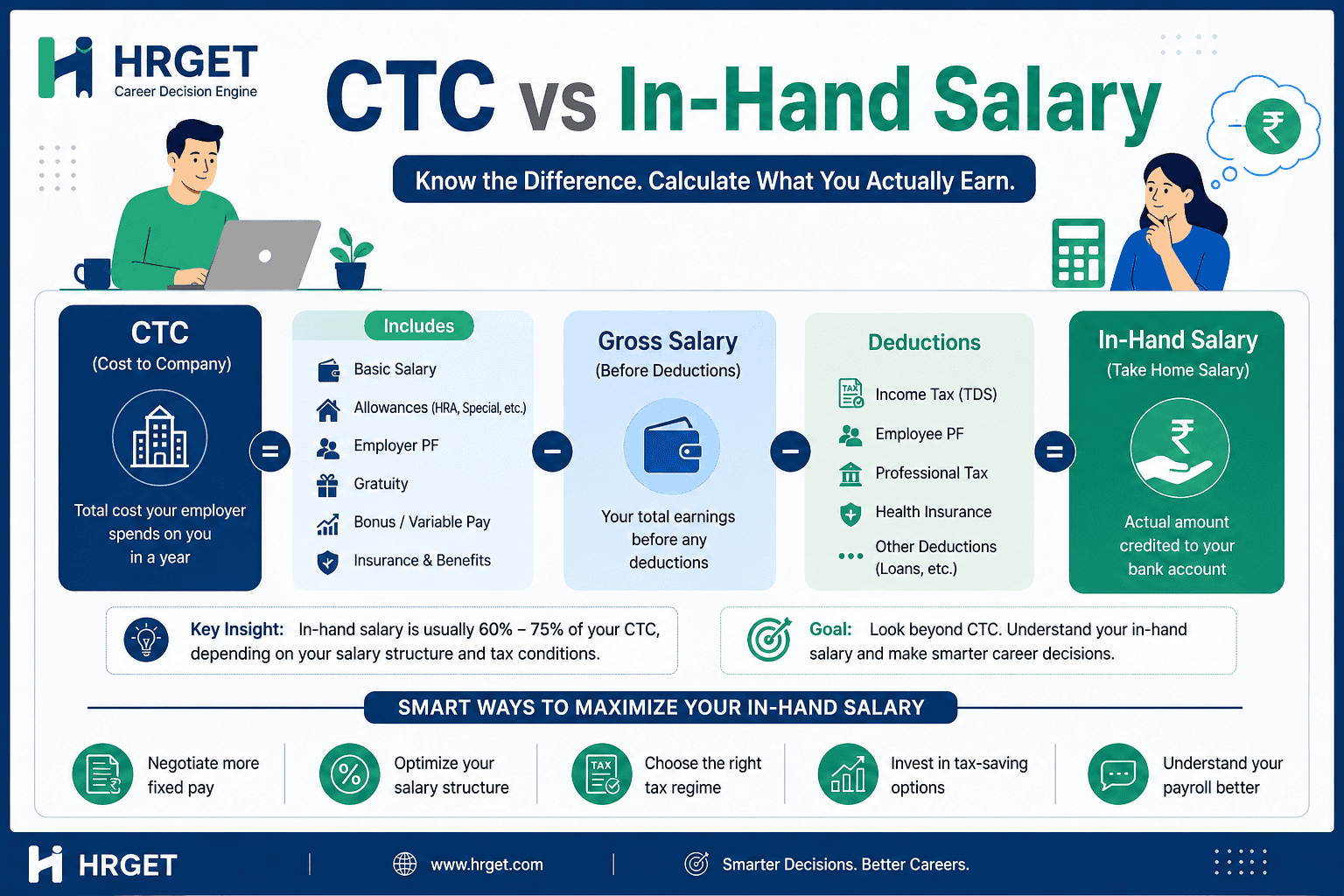
In-Hand Salary = Gross Salary – (Income Tax + Employee PF + Professional Tax + Other Deductions)
And just to be clear on gross salary too:
Gross Salary = CTC – Employer PF – Gratuity – Variable Pay – Other Non-Cash Benefits
Gross salary is what you technically earn before tax. In-hand is what you actually spend. Most people confuse the two — and that confusion leads to bad financial planning after joining a new role.
CTC vs In-Hand Salary: Key Differences
Here’s a direct side-by-side comparison so the gap is crystal clear:
| Factor | CTC | In-Hand Salary |
|---|---|---|
| What it represents | Total employer cost | Cash in your account |
| Where you see it | Offer letter | Bank / payslip |
| Includes employer PF? | Yes | No |
| Includes variable pay? | Yes (even if not guaranteed) | Only if paid out |
| Taxes deducted? | No | Yes |
| Realistic for budgeting? | No | Yes |
Rule of thumb: For most salaried employees in India, in-hand salary lands between 60% and 75% of CTC. If your offer is ₹12 LPA, expect ₹60,000–₹75,000 per month in your account — not ₹1 lakh.
How to Calculate In-Hand Salary (Step-by-Step)
Let’s walk through this properly. I’ll use ₹12 LPA as the base — the most common offer level I see confusing mid-level professionals in Bangalore, Hyderabad, and Pune right now.
1
Start With Your CTC
CTC = ₹12,00,000 per year. This is your starting number — but almost nothing you’ll do to it will keep it intact.
2
Subtract Employer Contributions (Non-Cash)
These go into statutory funds on your behalf — you don’t see them monthly.
- Employer PF contribution: ~12% of basic salary → roughly ₹57,600–₹60,000
- Gratuity provision: ~4.81% of basic → roughly ₹23,000–₹25,000
Remaining after Step 2: ~₹11,15,000
3
Remove Variable / Conditional Pay
If the offer letter says “₹1,00,000 variable pay” — treat it as zero until it’s paid. Variable pay depends on performance ratings, business cycles, and company profitability. Assume nothing.
Remaining after Step 3: ~₹10,15,000 (Gross Salary)
4
Deduct Employee-Side Contributions
Now you subtract what comes out of your pocket each month:
- Employee PF: 12% of basic → ~₹57,600–₹60,000/year
- Professional Tax: ₹2,400–₹2,500/year (state-dependent)
- Insurance premium deductions (if any): ₹5,000–₹15,000/year
5
Deduct Income Tax (TDS)
Under India’s new tax regime (FY 2026), ₹10.15 LPA gross salary falls in the 10%–20% slab range. After standard deduction of ₹75,000 (revised in Budget 2024), estimated TDS lands around ₹80,000–₹1,20,000 annually depending on your investment declarations.
For this example: TDS ≈ ₹1,20,000
6
Divide by 12 — That’s Your Monthly In-Hand
Net annual take-home ≈ ₹8,15,000 → ₹67,900/month. That’s your real salary.
Real Scenario: ₹12 LPA Salary Breakdown
Scenario: Software Engineer, Bangalore, 3 years experience — ₹12 LPA offer
Priya receives a ₹12 LPA offer. She’s budgeting for rent, EMIs, and savings. She assumes she’ll get around ₹1 lakh per month. Her first payslip says ₹68,200.
Here’s exactly where the gap went:
| Component | Annual Amount | Notes |
|---|---|---|
| CTC | ₹12,00,000 | Starting number from offer letter |
| Less: Employer PF | – ₹57,600 | Goes to EPFO, not to you directly |
| Less: Gratuity | – ₹23,088 | Paid only after 5 years of service |
| Less: Variable Pay | – ₹1,00,000 | Performance-linked, not guaranteed |
| Gross Salary | ₹10,19,312 | Taxable income (before deductions) |
| Less: Employee PF | – ₹57,600 | Employee’s 12% PF share |
| Less: Income Tax (TDS) | – ₹1,15,000 | New tax regime, FY 2026 slabs |
| Less: Professional Tax | – ₹2,400 | Karnataka rate (₹200/month) |
| Annual In-Hand Salary | ₹8,18,312 | What Priya actually earns |
| Monthly In-Hand | ≈ ₹68,200 | Bank account credit |
₹12 LPA is not ₹1 lakh per month. It’s closer to ₹65,000–₹70,000, and that range can shift depending on which state you’re in, whether you opt for old or new tax regime, and how much variable pay your company actually pays out.
Salary Components That Silently Reduce Your Pay
Most people read their offer letter and focus on the headline CTC. I’ve seen even experienced managers accept offers without understanding these six components — and then feel underpaid six months later when their payslip doesn’t match expectations.
1. Basic Salary
Basic is typically 40–50% of CTC. Why does it matter? Because PF, gratuity, and leave encashment are all calculated as a percentage of basic. A higher basic means higher PF contributions (which reduces take-home) but also higher retirement corpus. Companies sometimes keep basic low deliberately to reduce their statutory obligations — worth verifying in the breakup.
2. HRA (House Rent Allowance)
If you pay rent, HRA can be a significant tax saver. Under the Income Tax Act, you can claim HRA exemption up to the least of: actual HRA received, 50% of basic (metro) or 40% (non-metro), or actual rent paid minus 10% of basic. If you don’t pay rent, the entire HRA is taxable — a detail many miss when choosing the old tax regime.
3. Special Allowance
This is the fully taxable catch-all bucket companies use after allocating basic, HRA, and other components. It’s often the largest component in modern salary structures, and it’s also the most heavily taxed. I’d call it the silent tax killer — it inflates CTC while giving you nothing in tax savings.
4. Provident Fund (PF)
Both you and your employer contribute 12% of basic to the EPFO. Your employer’s share is inside the CTC. Your share gets deducted from your gross salary. So PF hits you twice in the CTC calculation — once on the employer side (reducing usable CTC) and once on your side (reducing take-home). It’s great for long-term savings, lousy for monthly cash flow.
5. Gratuity
Gratuity is 4.81% of basic per year, accrued by your employer and paid out after five continuous years of service under the Payment of Gratuity Act, 1972. It’s in your CTC but inaccessible for years. If you leave before the five-year mark — common in a market where job changes happen every 2–3 years — you receive zero gratuity.
6. Variable Pay / Annual Bonus
Companies structure anywhere from 10% to 40% of total CTC as variable. In theory, you earn it through performance. In practice, it’s contingent on individual ratings, team ratings, and company-level profitability. I’ve spoken to people who joined on ₹15 LPA offers with 30% variable, and took home less cash than colleagues on ₹12 LPA fully fixed structures. Always ask what the payout history looks like.
Common Mistakes When Evaluating Offers
These mistakes are preventable. Yet I see them made constantly — by freshers, mid-level managers, and even senior professionals who should know better.
Mistake 1: Comparing Offers by CTC
Offer A = ₹15 LPA with 30% variable. Offer B = ₹13 LPA fully fixed. CTC-focused thinking says take Offer A. Cash-flow thinking says Offer B puts ₹5,000–₹10,000 more in your account each month, guaranteed. Compare fixed in-hand, not CTC.
Mistake 2: Treating Variable Pay as Guaranteed Income
Variable pay is a ceiling, not a floor. Budget on your fixed in-hand. If the variable comes through, treat it as a bonus — literally. This keeps you from overcommitting on EMIs or rent based on income that may not materialize.
Mistake 3: Not Factoring in Tax Regime Choice
In 2026, India offers both old regime (with deductions) and new regime (with lower slab rates and limited deductions). The “correct” choice depends on your HRA claims, 80C investments, and home loan status. Two people on identical CTCs in different regimes can have ₹12,000–₹20,000/month difference in take-home.
Mistake 4: Skipping the Salary Breakup Request
Always — I mean always — ask for a detailed salary breakup before accepting. Get a document that shows: basic, HRA, special allowance, employer PF, gratuity, variable structure, and all deductions. If a company refuses or hedges on this, that’s a red flag. You’re entitled to know what you’re signing.
Smart Strategy: How to Maximize In-Hand Salary
You can’t always control the CTC you’re offered. But you can influence how much of it reaches your account. Here’s what actually works — and what most candidates never think to ask.
Strategy 1: Negotiate to Shift Variable to Fixed
Most companies have flexibility here — they just won’t offer it unless asked. The line that works: “I’m very interested in the role. Is there flexibility to increase the fixed component and reduce variable? I work best with income certainty.” In my experience advising on compensation structure, a 10–20% variable can often be partially converted to fixed without changing the headline CTC.
Strategy 2: Optimize Your Salary Structure for Tax
If you’re joining a mid-size or large company, you may be able to request salary restructuring. Ask HR to:
- Increase HRA if you’re paying rent in a metro (saves tax under old regime)
- Add meal allowance, transport allowance, or LTA if applicable
- Reduce special allowance, which is fully taxable
This doesn’t change your CTC — but it can increase in-hand by ₹3,000–₹8,000/month depending on your tax bracket.
Strategy 3: Choose Your Tax Regime Deliberately
Run both calculations before your employer’s TDS declaration deadline — usually April or May. If you have a home loan, HRA claims above ₹1.5 LPA, or significant 80C investments, old regime likely saves more. If you don’t have major deductions, the new regime’s lower slab rates probably work better. Don’t let your employer default you into the wrong regime.
Strategy 4: Ask About the Bonus Payout Track Record
Before accepting any offer with variable pay above 15%, ask: “What percentage of variable pay was actually paid out in 2023, 2024, and 2025?” A company that routinely pays 80–90% of variable is different from one that pays 40–50%. This question tells you a lot about both the culture and the business health.
Pro Tip: The “Guaranteed Annual Income” Number
When comparing offers, calculate one number for each: Fixed Monthly In-Hand × 12. That’s your guaranteed annual income — no variables, no maybes. Then compare that number across offers. The CTC comparison is noise. This number is signal.
Quick Formula Cheat Sheet
Bookmark this. Use it every time you evaluate an offer.
| Step | Formula |
|---|---|
| CTC → Gross Salary | CTC – Employer PF – Gratuity – Variable Pay |
| Gross → Net Annual | Gross – Employee PF – Income Tax – Professional Tax |
| Net Annual → Monthly In-Hand | Net Annual ÷ 12 |
| Quick Estimate | CTC × 0.65 ÷ 12 (conservative estimate) |
Frequently Asked Questions
What percentage of CTC is in-hand salary in India?
For most salaried employees, in-hand salary is between 60% and 75% of CTC. The exact percentage depends on your tax bracket, PF structure, variable pay component, and whether you’re claiming deductions under the old tax regime. Someone in a higher tax slab with 25% variable will sit closer to 60%; someone with a fixed-heavy structure and smart tax planning can reach 72–75%.
Is PF included in CTC?
Yes — both the employer’s PF contribution (12% of basic) and the employee’s PF contribution (also 12% of basic) are reflected in CTC calculations, though differently. The employer’s share is added to CTC as a cost. The employee’s share is deducted from gross salary. This is why PF effectively reduces your take-home from two sides of the equation simultaneously.
Why is my in-hand salary much lower than my CTC?
Because CTC includes items you never receive as cash: employer PF contributions, gratuity provisioning, insurance premiums, and in many cases a variable pay component you may not earn fully. Add income tax and your own PF deductions on top, and the gap between CTC and take-home can easily be 25–40%. This isn’t unusual — it’s the standard structure.
Does bonus count in in-hand salary?
Only when it’s actually paid. If your company pays out quarterly or annually, bonuses appear in your account in that specific month and spike your take-home temporarily. For budgeting and financial planning purposes, never count variable or performance bonus as regular monthly income. Calculate your standard fixed in-hand as your baseline.
Which salary component is taxed the most?
Special allowance is the most heavily taxed component because it’s fully taxable with no exemption. Basic salary is also taxable but anchors PF and other benefits. HRA has partial exemption if you pay rent. The key to maximising take-home is minimising special allowance and maximising components with tax-exempt or partially-exempt status — particularly HRA in metro cities.
How can I calculate my in-hand salary without a payslip?
Use this approach: Take your CTC, subtract employer PF (roughly 12% of basic, usually 4.5–6% of CTC), subtract gratuity (about 2% of CTC), subtract variable pay, then subtract employee PF (same amount as employer PF) and your estimated income tax based on applicable slab rates. Divide the result by 12 for a monthly estimate. For precision, use the Income Tax Department’s online tax calculator at incometaxindia.gov.in.
Is gratuity paid monthly in India?
No. Gratuity is accrued by your employer every year but paid out as a lump sum only when you complete a minimum of five continuous years of service with the same employer, under the Payment of Gratuity Act, 1972. It also becomes payable upon death or disability irrespective of service period. For most professionals who change jobs every 2–3 years, gratuity is effectively a benefit they never collect.
The Bottom Line on CTC vs In-Hand Salary
The CTC vs in-hand salary gap isn’t a bug in the system — it’s a feature designed to make offers look more attractive than they are. Once you understand the mechanics, you stop making decisions based on headline numbers and start making them based on what actually hits your account.
The ₹12 LPA professional who understands this earns ₹68,000/month and plans accordingly. The one who doesn’t budgets for ₹1 lakh and wonders why money runs short every month.
Before your next offer negotiation, ask for the full salary breakup, calculate your guaranteed fixed in-hand, choose your tax regime deliberately, and negotiate fixed over variable where possible. That’s how you close the gap between CTC and what you actually live on.
Related reading: If you’re preparing to negotiate your next offer, read our guide on negotiating compensation packages — the same principles apply whether you’re entering or exiting a role.

Eleanor Whitmore | Former Partner, Mercer | Advisor, World Economic Forum | 20+ Years in Global Compensation
Author bio: Eleanor Whitmore has spent over two decades shaping how the world’s leading organisations pay, retain, and reward talent. As a former Partner at Mercer and an advisor to World Economic Forum working groups on the Future of Work, she has designed compensation frameworks for Fortune 500 companies across the US, UK, Europe, and emerging markets. Based between London and New York, Eleanor writes for HRGet.com to translate boardroom-level pay strategy into actionable guidance for working professionals navigating real compensation decisions.