
Remote work burnout prevention is no longer a “nice-to-have” productivity topic. For millions of professionals, remote work has quietly become always-on work: back-to-back video calls, late-night Slack messages, blurred home boundaries, and the constant unspoken pressure to prove you’re working — even when nobody can see you.
And here’s the truth: most burnout advice is too shallow.
“Take a walk.” “Drink more water.” “Do yoga.” “Close your laptop on time.”
Useful? Sometimes. Enough? Not even close.
Remote work burnout is not just tiredness. The World Health Organization classifies burnout as an occupational phenomenon driven by chronic workplace stress that hasn’t been successfully managed — defined by exhaustion, mental distance or cynicism toward work, and reduced professional effectiveness. That means the real solution isn’t just personal discipline. It’s workload design, boundary management, communication norms, recovery systems, and career strategy.
This guide breaks down practical remote work burnout prevention strategies that go beyond generic wellness advice — and directly into the structural fixes that actually work in 2026.
What Remote Work Burnout Really Looks Like
Remote work burnout doesn’t always arrive dramatically. It often starts quietly — and that’s exactly what makes it dangerous.
You still attend meetings. You still reply to messages. You still deliver work. On the surface, you may even look productive.
But internally, something shifts. You feel tired before the day starts. Small requests irritate you. You delay tasks you used to handle easily. You stop feeling proud of good work. You begin checking messages compulsively — not because you’re productive, but because you’re anxious.
That’s the dangerous part of remote burnout: it can hide behind performance.
In an office, colleagues notice when you look drained. At home, your burnout stays invisible — until your output drops, your mood shifts, or your health starts sending warning signals you can no longer ignore.
| Workload Burnout | Career Burnout |
|---|---|
| Too many tasks, too little time | The work itself no longer feels meaningful |
| Rest and recovery can help | You feel stuck even after real time off |
| Fix: Better calendar, clearer priorities | Fix: Role change, team switch, or exit plan |
| You still care; you’re just overwhelmed | You’re bored and resentful, not just tired |
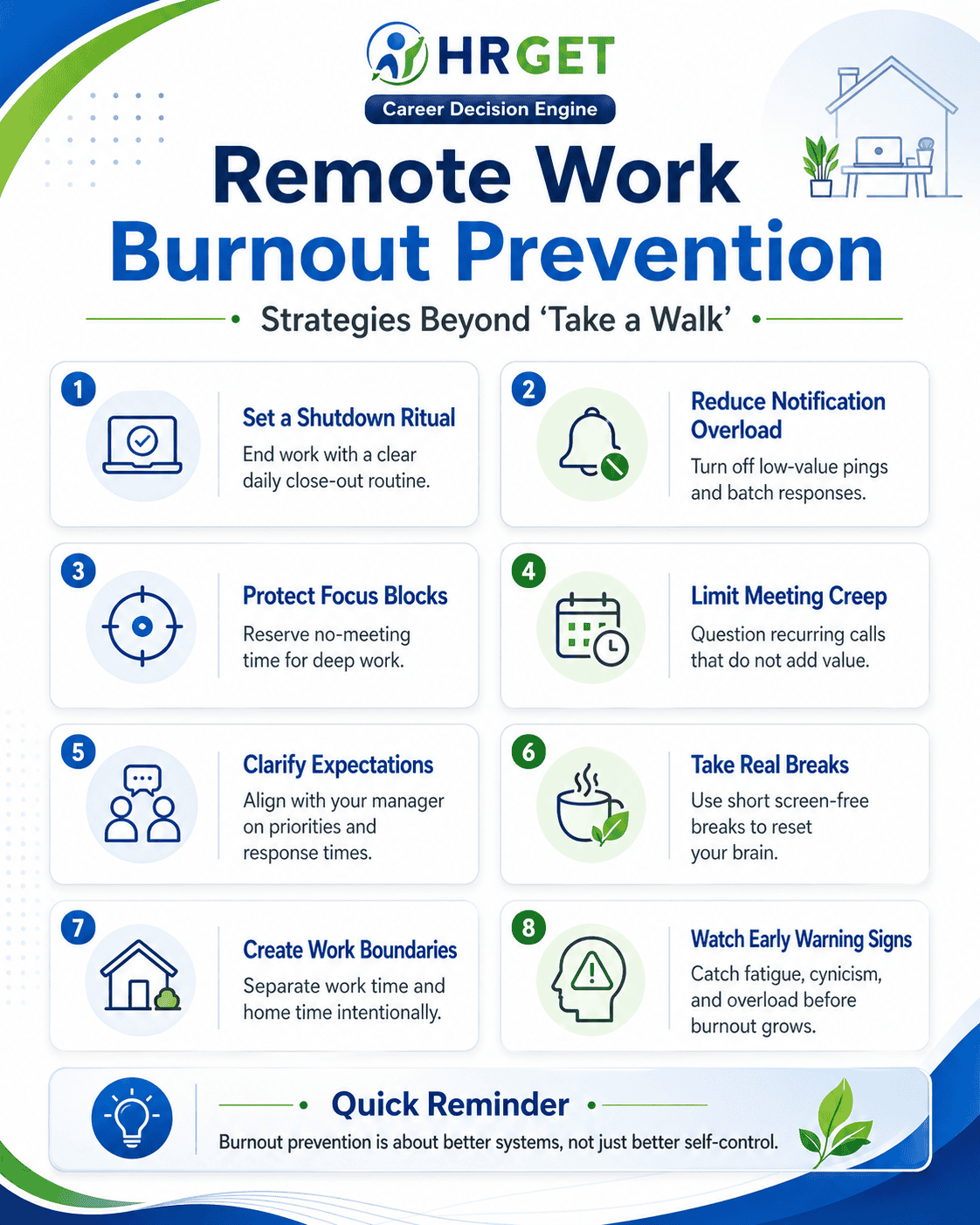
Why Remote Workers Burn Out Faster Than They Expect
Remote work gives flexibility, but it also removes friction — and that friction was doing more work than you realised.
There’s no commute to mark the start and end of the day. No physical meeting room to leave. No lunch break triggered by colleagues walking past your desk. No visual cue that the office is empty and it’s time to go home.
So your brain starts treating work as something that can happen anytime. The laptop is always nearby. Your phone carries work notifications. Your home becomes your office, recovery space, meeting room, and stress zone — all at once.
NIOSH research describes job stress as harmful physical and emotional responses that occur when work demands don’t match a worker’s capabilities, resources, or needs. Remote work intensifies that mismatch when expectations rise but boundaries, tools, and recovery systems don’t improve alongside them.
The result: a slow, grinding erosion of energy that most professionals don’t notice until they’re already deep in it.
The Hidden Problem: Remote Work Removes Natural Boundaries
Most remote burnout comes from boundary collapse. Not laziness. Not weakness. Not poor attitude.
Boundary collapse means work leaks into every part of life:
- You check messages before brushing your teeth.
- You answer “quick” pings during dinner.
- You work from the same place where you rest.
- You keep the laptop open “just in case.”
- You feel guilty when you’re offline.
The body may be at home, but the nervous system is still at work.
That’s why remote work burnout prevention must focus on structure, not motivation. You cannot willpower your way out of an environment designed to keep you always on.
Strategy 1: Create a Hard Shutdown Ritual
A shutdown ritual is not just closing your laptop. It’s a repeatable signal that tells your brain: work is done.
Remote workers need this because the home environment doesn’t naturally separate work from personal life. Without a deliberate transition, your brain stays in work mode — processing, anticipating, replaying — even when you’re physically away from the screen.
A strong shutdown ritual has three parts:
1. Review what was completed today. This prevents your brain from treating everything as unfinished.
2. Write the top three priorities for tomorrow. This reduces after-hours rumination — your brain no longer needs to hold the to-do list overnight.
3. Physically change your environment. Close the laptop, clear the desk, switch off the monitor, or move to another room. The physical act matters.
The key is consistency. Don’t rely on mood. Build a habit.
Pro Tip
Use a one-line shutdown note: “Done today: X, Y, Z. Tomorrow: A, B, C. Nothing else needs attention tonight.” It sounds basic, but it prevents your brain from reopening work at 10:45 PM — which is exactly when most remote professionals spiral into anxious late-night checking.
Strategy 2: Reduce Digital Noise Before It Becomes Stress
Remote work burnout is often notification burnout. Every ping creates a micro-interruption. Even if you don’t respond, your attention shifts — and attention shifts are cognitively expensive. Over time, this creates a specific kind of mental fatigue that no amount of sleep fully repairs.
Most professionals dramatically underestimate how much energy they lose to “small” interruptions. Start by auditing your digital noise:
- Which channels actually require an instant response?
- Which notifications can be batched to twice daily?
- Which group chats are low-value noise?
- Which alerts can be turned off after work hours?
- Which apps create anxiety without improving your output?
The goal is not to become unavailable. The goal is to stop treating every digital signal as equally urgent.
Smart Strategy: Three Notification Tiers
| Tier | What It Covers | Response Window |
|---|---|---|
| Immediate | Manager escalation, production issue, urgent client blocker | Within 30 min |
| Same-day | Team questions, review requests, project updates | By EOD |
| Batch later | FYI messages, newsletters, announcements, social chat | 2× per day, or next morning |
This one structural change can reduce daily mental load dramatically — without making you less responsive to what actually matters.
Strategy 3: Redesign Your Calendar Like a Capacity System
Your calendar is not just a schedule. It’s a capacity map. If it’s filled with meetings, context switching, and scattered work blocks — burnout is predictable, not accidental.
A healthy remote calendar needs breathing room. That means:
- No-meeting blocks for deep, focused work — protected, not optional.
- Buffer time after intense calls to process and document.
- Lunch protected as a real break, not another meeting slot.
- Admin tasks grouped together rather than scattered between high-focus work.
- Decision-heavy meetings spaced out — you can’t make good decisions back-to-back for eight hours.
Remote workers often accept every available meeting slot because they’re “home anyway.” That is a trap. Being at home does not mean you have unlimited mental capacity.
Practical Rule
For every two hours of meetings, block at least 30 minutes of recovery or execution time. Not scrolling time. Not fake-break time. Actual time to process, document, and act on what was just discussed.
Strategy 4: Stop Treating Every Message as Urgent
One of the biggest structural causes of remote burnout is false urgency. A message arrives. You stop your work. You respond quickly. You feel productive. But your real work gets delayed — so you work late to catch up.
This creates a toxic loop: instant responsiveness during the day, actual work at night.
Remote professionals must develop response discipline. Not every Slack message is a fire. Not every email needs a reply within minutes. Not every “quick question” deserves immediate context switching.
Response Template to Bookmark
“Got it — I’m in focus time right now, but I’ll review this by 3 PM.”
This protects your work without sounding rude. For managers, it also builds trust because you give a clear, reliable response window — which is actually more professional than a rushed, half-attentive reply.
Strategy 5: Build Recovery Into the Workday, Not After Burnout
Most people treat recovery as something they do after work. That’s too late.
If your workday is eight to ten hours of continuous cognitive load, evening recovery cannot fully repair the damage. You need micro-recovery inside the day — and not the fake kind where you scroll Instagram between meetings.
Real recovery lowers stimulation. Try:
- Looking away from screens for five minutes after a long call.
- Walking without headphones — no podcast, no voice notes.
- Stretching without checking messages.
- Sitting quietly for a few minutes after a difficult conversation.
- Eating lunch without your laptop open.
The point is not the activity. The point is nervous system downshifting — a genuine reduction in stimulation that lets your brain step back from high-alert mode.
What Most People Get Wrong
A break is not a break if your brain is still consuming information. Switching from work email to social media is not recovery — it’s just changing the source of stimulation. Your nervous system does not care which screen you’re staring at.
Strategy 6: Clarify Output Expectations With Your Manager
Remote burnout often comes from unclear expectations. When employees don’t know what “strong performance” actually looks like, they overwork to stay safe:
- They attend every meeting — even optional ones.
- They reply faster than necessary.
- They volunteer for tasks that don’t align with their priorities.
- They stay online longer to appear committed.
- They try to be visibly busy rather than meaningfully productive.
This is especially common in remote teams where visibility is low and proximity bias quietly punishes those who work quietly and efficiently.
The solution is expectation clarity. Ask your manager directly:
- What are the top three outcomes you expect from me this month?
- Which tasks take priority if responsibilities conflict?
- What response time do you expect for messages?
- Are there meetings I can attend asynchronously or skip entirely?
- What does strong performance look like in this role, concretely?
The Insider View
High performers don’t just work hard — they negotiate clarity. In my research on remote team dynamics, the professionals who avoided burnout longest were those who proactively defined scope, said no to low-value requests early, and treated workload conversations as professional alignment — not personal weakness. Clarity protects energy. Energy sustains performance.
Strategy 7: Protect Deep Work From Meeting Creep
Remote work often creates more meetings, not fewer. Because people can’t casually ask questions across a desk, they schedule calls. Over time, calendars become crowded with status updates, alignment sessions, and “quick syncs” that collectively consume the entire workday.
The result: no time for meaningful work. Then deep work moves to early mornings, late evenings, or weekends. That is burnout territory.
Before accepting a meeting, ask five questions:
- Is there a clear decision to make — or just information to share?
- Can this be handled in a written document or async update?
- Is my presence actually required?
- Can I attend only the relevant section?
- Is this recurring meeting still producing value?
You don’t need to reject everything. But you do need to protect the work hours that produce your most important output.
Strategy 8: Watch for Career Burnout, Not Just Workload Burnout
Sometimes remote burnout isn’t caused by workload alone. Sometimes the job itself is no longer giving you growth, meaning, adequate compensation, or a sense of control. This is career burnout — and the fix is completely different.
Signs you may be experiencing career burnout rather than temporary overload:
- You’re not just tired — you’re bored and resentful.
- You still feel stuck after taking real time off.
- You no longer care about promotion within your current team.
- You feel your skills are being wasted on low-complexity work.
- You dread returning to work even after a long weekend away.
This matters because better calendar management won’t fix it. The solution may be a role change, team switch, manager conversation, compensation review, or an exit plan — not a productivity hack.
For HRGet readers specifically, this is where remote burnout connects directly to career decision-making. Burnout is not only a wellness issue. It can be a clear signal that your current role is poorly designed for your long-term growth.
Real Scenario: The High Performer Who Looked Fine but Was Burning Out
Scenario
Imagine a remote product manager named Aisha. She manages stakeholders across time zones, is known for being reliable, and is always responsive. On paper, she’s performing well.
But slowly, her day stretches from 8 AM to 10 PM — not because the work is continuous, but because it’s scattered. Strategy work happens between meetings. Messages get answered during lunch. Late calls run into evenings because global alignment requires it. She checks email before bed because she doesn’t want surprises in the morning.
Her manager thinks she’s handling it fine. She is not.
The fix is not “take a walk.” The fix is structural:
- Define response expectations with the team.
- Move recurring status updates to async formats.
- Block deep work windows in the calendar — non-negotiable.
- Reduce or cancel low-value recurring meetings.
- Set explicit time-zone boundaries for late calls.
- Track actual weekly workload and share it with her manager.
- Discuss priority trade-offs rather than absorbing everything.
That is real remote work burnout prevention — structural, specific, and actionable without requiring Aisha to become a different person.
Common Mistakes to Avoid
Mistake 1: Waiting Until You’re Exhausted
Burnout prevention must start before collapse. If you wait until you’re emotionally numb and cynical, recovery takes far longer and costs more — professionally and personally.
Mistake 2: Using Productivity Apps to Solve Capacity Problems
A better task manager will not fix an impossible workload. If your role has too many meetings, unclear priorities, and constant urgency — the issue is work design, not your tooling.
Mistake 3: Confusing Flexibility With Availability
Remote flexibility means control over how work gets done. It does not mean being reachable all day and night. These are two completely different things, and conflating them leads directly to burnout.
Mistake 4: Taking Leave Without Changing the System
Vacation helps, but if you return to the same overloaded calendar and unclear expectations, burnout returns within weeks. Time off without system change is temporary relief, not recovery.
Mistake 5: Hiding Burnout From Your Manager Until It’s a Crisis
You don’t need to overshare. But raise workload risks early. Try: “I want to maintain quality, but the current meeting load is pushing execution into evenings. Can we review priorities and move some meetings async?” That’s professional communication, not emotional disclosure.
When Remote Burnout Becomes a Career Decision
Here’s the uncomfortable truth. Sometimes remote burnout prevention isn’t enough — because the job is structurally unhealthy and no amount of personal adjustment will fix it.
You may be in a role where your manager rewards constant availability, the company has no meeting discipline, time zones are handled carelessly, headcount is too low for the actual workload, performance expectations are vague, or boundaries are treated as lack of commitment.
In that case, your strategy needs to shift from managing yourself better to managing the situation strategically:
Step 1: Document the workload problem. Track meetings, after-hours work, escalations, and priority conflicts — factually, not emotionally.
Step 2: Have a manager conversation. Ask for prioritisation, not sympathy. Frame it as a performance risk, not a personal complaint.
Step 3: Test whether the system changes. Give it a defined window — four to six weeks.
Step 4: If nothing improves after repeated professional conversations, start seriously evaluating internal transfers or external opportunities.
Remote burnout can damage your health, confidence, relationships, and career momentum. It is not worth sacrificing all four for a role that refuses to operate sustainably.
Remote Work Burnout Prevention Checklist
Run through this at the end of each week. Be honest with yourself.
☐Did I shut down work at a clear, consistent time most days?
☐Did I have at least two protected deep-work blocks this week?
☐Did I take real breaks — away from screens, not just switching apps?
☐Did I avoid unnecessary instant replies during focus time?
☐Did I clarify priorities when work conflicted or stacked up?
☐Did I protect lunch or at least one genuine recovery window?
☐Did I decline or challenge at least one low-value meeting?
☐Did I end the week with energy left for life outside work?
If most answers are “no” — don’t blame yourself. Your system needs redesign, not your willpower.
Final Thoughts
Remote work burnout prevention is not about becoming more disciplined, more grateful, or more resilient. It is about designing work so your brain can actually survive it over the long term.
A walk can help. Meditation can help. Exercise can help. But none of them can compensate for endless meetings, unclear expectations, notification overload, false urgency, and a workday with no real ending.
The best remote workers are not the ones who are always online. They are the ones who protect their energy, communicate boundaries clearly, deliver meaningful output, and refuse to let flexibility quietly turn into invisible overwork.
Remote work should give you more control over your life. If it is taking control away — it’s time to redesign the system, not push harder through it.
If you’re also noticing patterns like being sidelined, excluded, or managed out without a direct conversation, read our guide on how to recognise the signs of quiet firing — another burnout driver that often goes unaddressed in remote teams.
FAQs on Remote Work Burnout Prevention
What is remote work burnout?
Remote work burnout is chronic occupational exhaustion caused by unmanaged stress in a remote or hybrid work environment. It typically includes persistent fatigue, cynicism toward work, reduced motivation, lower output quality, and difficulty mentally disconnecting after work hours.
Why does remote work cause burnout?
Remote work causes burnout when physical and psychological boundaries disappear, meetings multiply, communication becomes constant, and employees feel implicit pressure to stay visible. Without the natural separation that a commute or office provides, recovery becomes much harder to achieve.
Is “taking a walk” enough to prevent remote burnout?
No. Walking can reduce acute stress, but it does not fix workload overload, unclear expectations, poor meeting culture, or after-hours communication norms. Sustainable remote work burnout prevention requires structural changes to your schedule, boundaries, and workload design.
How do I tell my manager I’m burned out from remote work?
Frame it as a workload and performance conversation, not an emotional one. Instead of “I’m burned out,” try: “My meeting load is pushing focused execution into evenings. Can we review priorities and decide what can move to async?” This gives your manager something actionable to respond to.
What are the early signs of remote work burnout?
Early signs include starting the day already fatigued, irritability at routine messages, procrastinating tasks you previously handled easily, compulsive notification checking, working late to compensate for a scattered day, and an inability to mentally switch off after work ends.
How can remote employees set better work boundaries?
Set a consistent shutdown ritual, turn off non-urgent notifications, define your response time tiers, protect lunch as a real break, use a dedicated workspace where possible, and communicate your availability clearly to your team. Consistency matters more than perfection.
Can remote burnout affect career growth?
Absolutely. Burnout reduces performance quality, decision-making capacity, and communication effectiveness. It also causes high performers to disengage from visibility opportunities, avoid stretch projects, and stay trapped in roles that no longer serve their career trajectory.
When should I consider changing jobs because of burnout?
Consider a role change if burnout continues after you’ve set clearer boundaries, reduced overload, clarified priorities, and raised the issue with your manager — and nothing has changed. If the organisation structurally rewards constant availability and ignores sustainable work practices, the problem is the role, not you.

Organizational Psychologist & Workplace Behavior Advisor (Former consultant with Boston Consulting Group, research contributor aligned with Harvard Business Review)
Dr. Amelia Grant is an organizational psychologist specializing in burnout, toxic workplaces, leadership behavior, and employee mental resilience. She writes practical, research-backed workplace guidance for modern professionals.