The salary hike percentage in India for 2026 is expected to stay healthy — but here’s the truth most employees miss: your increment won’t depend only on “company performance.”
It’ll depend on your industry, role criticality, skill demand, company profitability, manager rating, location, and — crucially — whether your employer is more afraid of losing you than replacing you.
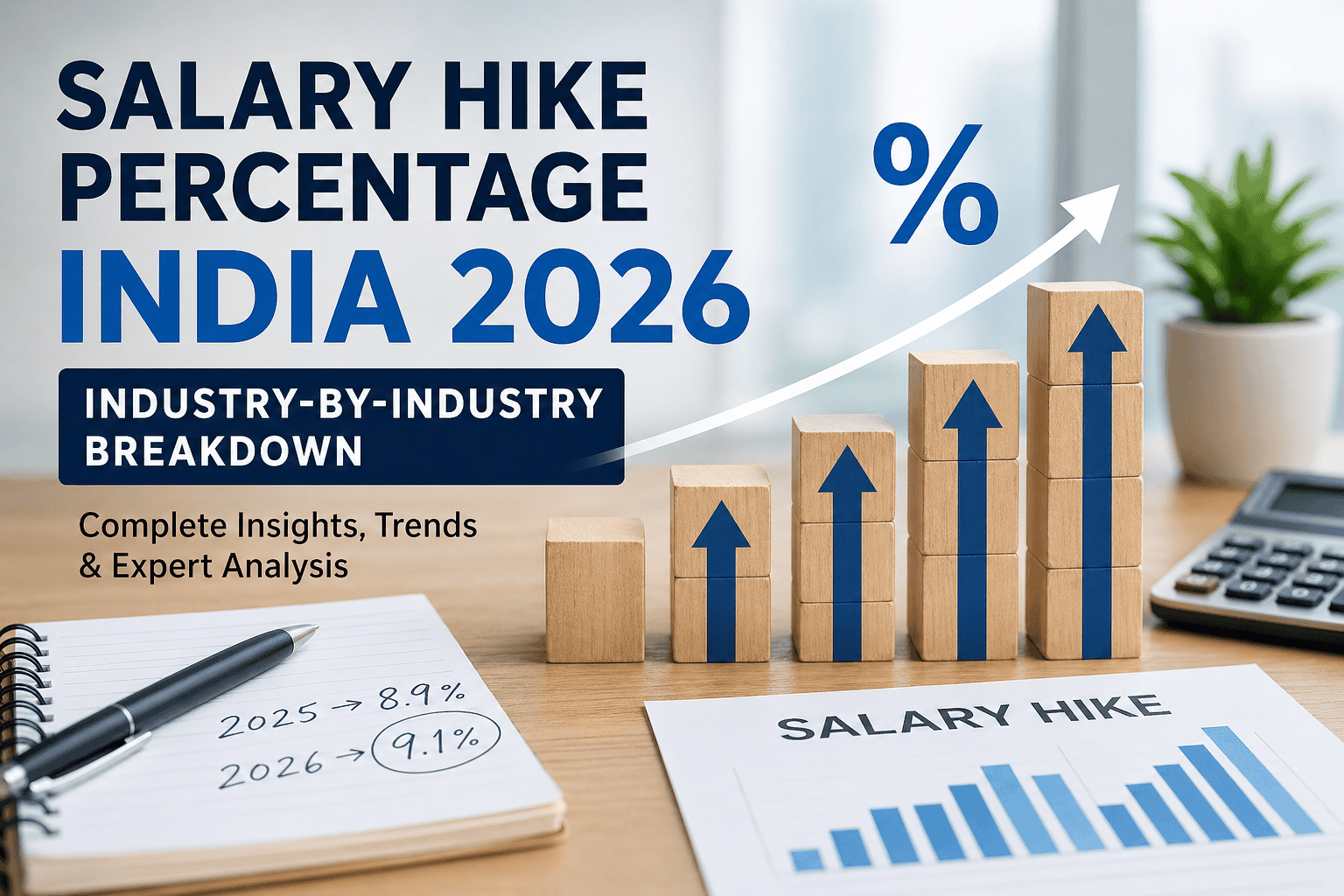
For 2026, India Inc. is projected to see average salary increases of around 9% to 9.1%. Aon’s India salary survey projected a slight uptick from 8.9% in 2025 to approximately 9.1% in 2026, covering over 1,400 organisations across 45 industries. EY’s Future of Pay 2026 report echoed that figure, with pay becoming sharper and more skills-led.
But averages are dangerous.
A 9% average doesn’t mean everyone gets 9%. A top performer in a hot GCC, AI, engineering, NBFC, or real estate role may see double-digit growth. A low-rated employee in a slow-growth function may see 3%–6%, or no meaningful hike at all.
This guide breaks down the expected 2026 salary hike percentages in India by industry, explains what actually drives increments, and shows how you can use this information during appraisal and negotiation.
What Is the Average Salary Hike in India for 2026?
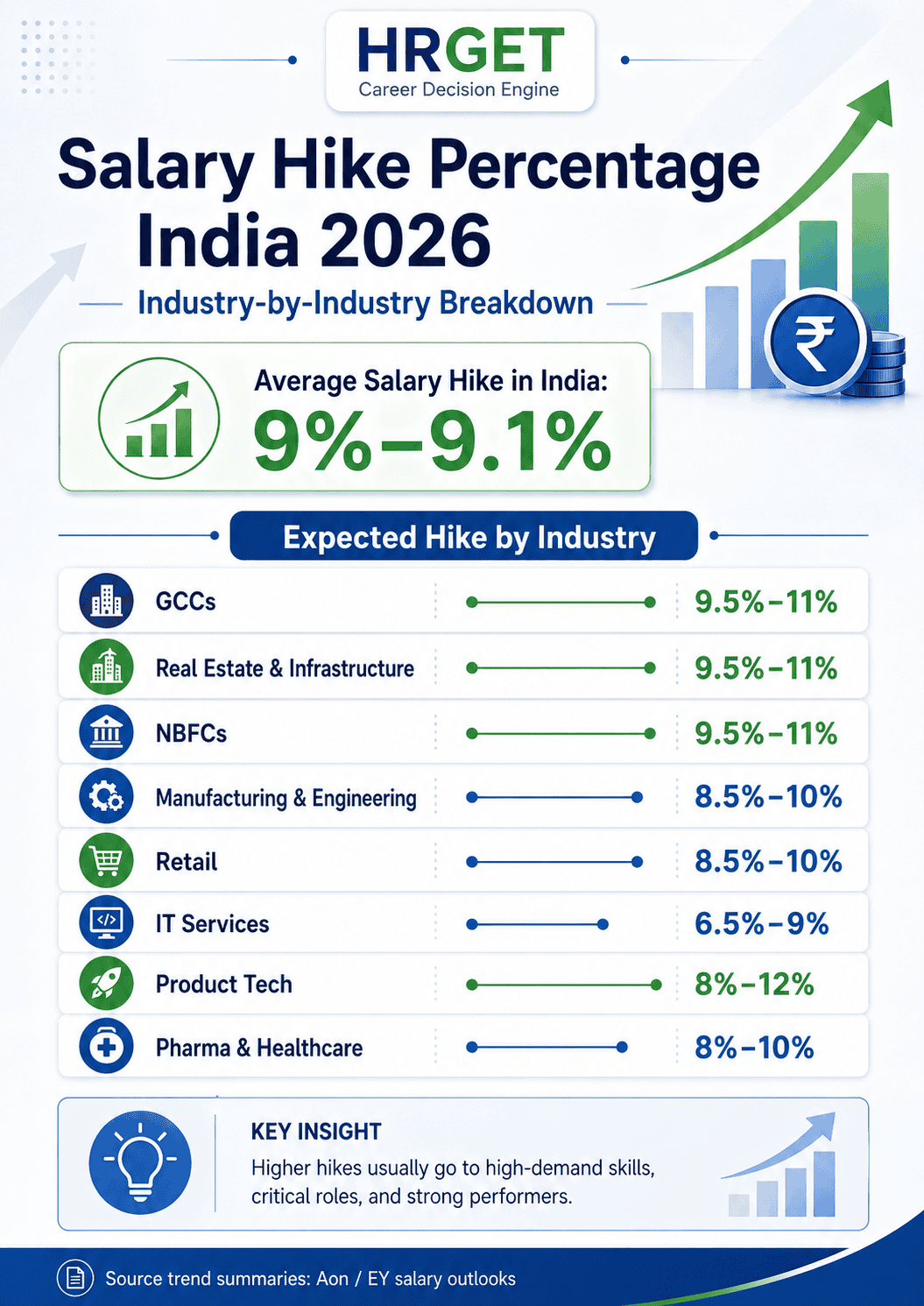
The expected average salary hike in India for 2026 is around 9% to 9.1%.
Aon projected salary increases at that level for 2026, slightly above the 8.9% actual increase recorded in 2025. EY’s Future of Pay 2026 report confirmed the same number, linking compensation growth increasingly to skills, performance, and future-ready capabilities rather than tenure or blanket cost-of-living adjustments.
So the headline is simple: India average salary hike 2026 ≈ 9% to 9.1%.
But your real-world result depends heavily on where you sit on the performance and role-criticality spectrum:
| Employee Situation | Likely 2026 Hike Range |
|---|---|
| Low performer / role at risk | 0%–5% |
| Average performer | 6%–9% |
| Strong performer | 9%–13% |
| Top performer in high-demand role | 13%–20%+ |
| Job switcher in hot skill area | 20%–50%+ |
Most people compare their hike to the company average. That’s the wrong benchmark.
The better question is: “What is the market willing to pay for my exact role, skill, location, and experience in 2026?” That’s where the real career decision starts.
Salary Hike Percentage India 2026 by Industry
Below is a practical industry-by-industry breakdown for 2026. These ranges combine reported projections from Aon, EY, and TeamLease, along with compensation market behaviour observed across sectors.
| Industry | Expected Hike 2026 | Outlook |
|---|---|---|
| Global Capability Centres (GCC) | 9.5%–11% | Strong |
| Real Estate & Infrastructure | 9.5%–11% | Very strong |
| NBFCs | 9.5%–11% | Very strong |
| Engineering & Manufacturing | 8.5%–10% | Strong |
| Retail | 8.5%–10% | Strong |
| Automotive & EV | 8.5%–11% | Strong |
| IT Services | 6.5%–9% | Mixed |
| Product Tech | 8%–12% | Selectively strong |
| Fintech | 8%–11% | Strong but selective |
| Banking & Financial Services | 8%–10% | Stable |
| Pharma & Life Sciences | 8%–10% | Stable to strong |
| Healthcare | 7%–10% | Stable |
| E-commerce | 7%–10% | Role-dependent |
| Startups | 5%–12% | Highly uneven |
| Consulting | 8%–11% | Strong for performers |
| Education / EdTech | 5%–8% | Weak to moderate |
| Media / Advertising | 5%–8% | Moderate |
| BPO / Customer Support | 5%–8% | Moderate |
Highest Salary Hike Industries in India 2026
The sectors positioned to offer the best salary hike percentages in India in 2026 are Global Capability Centres, real estate and infrastructure, NBFCs, automotive and EV, engineering and manufacturing, fintech, product technology, and life sciences. Here’s why each one is outperforming the average.
1. Global Capability Centres (GCCs)
GCCs are no longer just “backend offices.” Many now own global product engineering, finance analytics, cybersecurity, cloud platforms, AI operations, supply chain systems, and enterprise transformation. They need high-quality talent in India — and they’re willing to pay for it.
EY identified GCCs as a leading sector for 2026 salary growth, with above-average increments driven by demand for digital and technology capabilities.
Expected GCC salary hike 2026: 9.5%–11%
Hot roles: AI engineers, cloud architects, product managers, data engineers, cybersecurity specialists, SAP/ERP transformation experts, finance analytics professionals.
2. Real Estate and Infrastructure
India’s infrastructure push, commercial real estate demand, warehousing, logistics parks, and urban development are sustaining strong hiring — and therefore strong salary growth.
Expected salary hike 2026: 9.5%–11%
Hot roles: project managers, civil engineers, quantity surveyors, procurement leads, real estate sales leaders, construction technology professionals.
3. NBFCs
NBFCs continue to compete heavily for sales, credit, risk, analytics, collections, product, and digital lending talent. The sector’s expansion into tier-2 and tier-3 markets is creating sustained demand for experienced professionals at every level.
Expected salary hike 2026: 9.5%–11%
Hot roles: credit risk, loan officers, relationship managers, digital lending product managers, compliance, collections strategy, data analytics.
4. Manufacturing, Auto and EV
Manufacturing is seeing renewed hiring momentum due to supply-chain diversification, EV growth, electronics manufacturing, defence, semiconductors, industrial automation, and government-linked investment. TeamLease-linked reporting for FY2025–26 pointed to strong growth in EV, consumer durables, and NBFC roles, with some high-demand functions seeing double-digit hikes.
Expected salary hike 2026: 8.5%–11%
Hot roles: EV engineers, automation engineers, plant operations, quality, design engineering, supply chain, procurement.
IT and Software Salary Hike 2026
The IT salary hike in India for 2026 will be uneven. Don’t assume “IT = high hike.” That was true during the 2021–2022 hiring boom. In 2026, IT compensation is far more selective.
| IT Segment | Expected Hike 2026 |
|---|---|
| Traditional IT services | 6.5%–9% |
| Cloud, AI, cybersecurity | 10%–18% |
| Product companies | 8%–12% |
| SaaS companies | 8%–12% |
| Support / legacy roles | 4%–8% |
If you’re in a generic maintenance, support, QA, or legacy technology role, your hike may be at or below the company average. If you’re in AI, cloud migration, data engineering, platform engineering, cybersecurity, distributed systems, or enterprise architecture, your earning power in 2026 is significantly stronger.
💡 Pro Tip
In 2026, don’t negotiate as “I have 7 years of experience.” Negotiate as “I own a business-critical system that reduces risk, saves cost, and accelerates revenue.” Experience alone is no longer enough — business impact is the currency.
GCC Salary Hike 2026
GCCs may be one of the strongest salary-growth areas in India in 2026. A GCC employee in Bengaluru, Hyderabad, Pune, Chennai, Mumbai, NCR, or Coimbatore may see better increments than someone in a traditional outsourcing setup — especially where the GCC owns core global functions rather than just support delivery.
| GCC Role Type | Expected Hike 2026 |
|---|---|
| Average performer | 8%–10% |
| Strong performer | 10%–14% |
| Niche digital skill | 12%–20% |
| Leadership role | 10%–18% |
GCCs often compete with product companies, consulting firms, banks, and tech startups for the same talent pool. They also strongly prefer retaining trained employees because replacing domain-trained GCC talent is expensive — both in time and institutional knowledge.
📋 Real Scenario
A data engineer at a GCC supporting global supply chain analytics receives a 12% hike even when the company average is 9% — because the role directly feeds business continuity, global reporting, and executive dashboards. The closer your work is to revenue, risk, automation, or decision-making, the stronger your hike potential.
BFSI, NBFC and Fintech Salary Hike 2026
Banking, financial services, insurance, NBFCs, and fintech remain strong compensation sectors in India — but the hike depends heavily on whether your role is front-office, digital, risk, compliance, product, sales, or operations.
| Sector | Expected Hike 2026 |
|---|---|
| NBFC | 9.5%–11% |
| Fintech | 8%–11% |
| Banking | 8%–10% |
| Insurance | 7%–10% |
| Wealth management | 8%–12% |
Hot BFSI roles in 2026 include credit risk analytics, digital lending, product management, compliance and regulatory reporting, wealth advisory, relationship management, fraud detection, collections strategy, and data science for underwriting.
If you work in BFSI, don’t walk into your appraisal talking only about targets hit. Connect your contribution to portfolio quality, revenue impact, risk reduction, customer acquisition, cost-to-income improvement, compliance accuracy, or process automation. Managers fight harder for employees whose output directly touches business numbers.
Manufacturing, Auto and Engineering Salary Hike 2026
Manufacturing is quietly becoming one of the more attractive salary-hike sectors in India in 2026. For years, software pulled most of the attention. But manufacturing, automotive, electronics, EV, aerospace, industrial automation, and engineering design are now serious compensation zones.
| Segment | Expected Hike 2026 |
|---|---|
| Engineering design | 8.5%–10.5% |
| Auto / EV | 8.5%–11% |
| Electronics manufacturing | 8%–11% |
| Industrial manufacturing | 8%–10% |
| Plant operations | 7%–10% |
Many manufacturing employees under-negotiate because they assume only software professionals can demand higher hikes. That’s wrong. If you have demonstrable experience in automation, quality improvement, yield improvement, vendor cost reduction, plant efficiency, EV systems, robotics, or production planning, you carry strong negotiation value — especially as India pushes deeper into the PLI (Production Linked Incentive) scheme and domestic manufacturing investment rises.
Retail, E-commerce and Consumer Salary Hike 2026
Retail salary hikes in India for 2026 are expected to be healthy, especially for customer-facing, sales, store expansion, supply chain, category management, and digital commerce roles. EY-linked reporting projected retail increments around 9.5% on average for 2026.
| Segment | Expected Hike 2026 |
|---|---|
| Retail | 8.5%–10% |
| E-commerce | 7%–10% |
| Consumer goods | 8%–10% |
| D2C brands | 7%–11% |
| Store operations | 6%–9% |
Employees who earn better hikes in this sector are those who can prove measurable impact on sales per square foot, repeat purchase rates, customer conversion, inventory efficiency, delivery cost reduction, category growth, marketplace revenue, or store expansion. Showing up to appraisals with a number — not just a narrative — matters enormously.
Pharma, Healthcare and Life Sciences Salary Hike 2026
Pharma and life sciences have quietly become consistent mid-to-high salary hike performers in India. Domestic API demand, export-driven R&D, biosimilars, clinical research, and regulatory compliance have all driven sustained hiring — and sustained increments.
| Segment | Expected Hike 2026 |
|---|---|
| Pharma (domestic) | 8%–10% |
| Life sciences / biotech | 9%–12% |
| CROs / clinical research | 8.5%–11% |
| Medical devices | 8%–10% |
| Hospital / healthcare delivery | 7%–10% |
The highest-paid profiles in pharma in 2026 will be in regulatory affairs, pharmacovigilance, medical affairs, clinical data management, quality assurance (US FDA/EU GMP compliance), and R&D roles with export exposure. If your work touches US FDA or EU EMA compliance, your compensation leverage is significantly above the sector average.
Startup Salary Hike 2026
Here’s the honest answer: startup salary hikes in 2026 will be the most uneven of all sectors.
Some Series B and Series C startups — particularly in fintech, SaaS, health tech, and B2B software — will offer 10%–14% increments to retain key talent and stay competitive with GCCs and product companies. Others, especially those still navigating burn rate, extended runways, or structural pivots, may offer 4%–6%, or keep the hike nominal while defending with equity.
| Startup Stage / Situation | Likely Hike 2026 |
|---|---|
| Well-funded, growth stage (Series B+) | 9%–14% |
| Profitable or near-profitable startup | 8%–12% |
| Seed-stage / pre-revenue | 3%–7% |
| Burning cash / cost-cutting mode | 0%–5% |
If you’re in a startup, the key question to ask before your appraisal isn’t “what’s the company policy?” — it’s “what is the company’s financial runway, and am I in a role that’s considered core to survival or growth?” That answer shapes your leverage more than any industry average.
Why Your Hike May Be Lower Than the Industry Average
I’ve seen this happen dozens of times: a competent professional receives a 5% hike in a year where their sector average was 9%. The reason is almost never about company performance alone. Here are the real drivers.
Performance band placement. Most companies distribute their salary budget unevenly across performance ratings. The top 15%–20% of performers typically absorb a disproportionate share of the hike pool — often 1.5x to 2x the average. If you’re rated “meets expectations,” you will likely receive a below-average hike even in a strong year.
Role replaceability. If your manager can hire someone at roughly the same cost externally, there’s less internal pressure to protect your increment. Roles with scarce skill supply — AI, cloud, regulatory, risk — have stronger hike protection.
Visibility gap. Compensation decisions in India’s corporate environment are heavily manager-influenced. If your manager doesn’t fight for you in the calibration session, you lose ground. And managers fight for people they can quantify — not just like.
Tenure trap. Counterintuitively, very long-tenured employees in the same band sometimes get smaller hikes because they’ve already drifted toward the top of their pay band. The system assumes they’re “safe” and won’t leave.
You didn’t negotiate. In many Indian companies, appraisal hikes are negotiable — especially for strong performers. Employees who accept the first number without a conversation leave money on the table. More on this in the next section.
How to Negotiate Your Salary Hike in 2026
Most salary negotiation guides focus on “saying the right thing.” The real leverage comes from what you’ve built before the conversation starts. Here’s a practical approach for 2026.
Step 1: Build your evidence file 60 days before appraisal
Document every significant outcome from the past 12 months. Not tasks — outcomes. Revenue generated, cost saved, time reduced, risk mitigated, projects delivered, team performance improved. Attach numbers wherever possible. ₹15 lakh revenue contribution is a stronger conversation opener than “led key accounts.”
Step 2: Know your market rate, not just your company average
Check platforms like AmbitionBox, LinkedIn Salary, Glassdoor India, and Naukri’s salary insights for your exact role in your city. If the market pays ₹22–26 LPA for your profile and you’re earning ₹18 LPA, that gap is your negotiation anchor — use it.
Step 3: Ask for a specific number, not a range
When you negotiate, say: “Based on my contributions and market data, I’m seeking a 13% increment.” Don’t say “I was hoping for somewhere between 10% and 15%.” Ranges signal that you’ll accept the lower end.
Step 4: Pre-sell your manager before the formal review
I’ve seen the most successful increment conversations start three months before appraisal — not in the appraisal meeting itself. If your manager knows what you want, and understands why, they have time to advocate for you in the calibration process. Surprise requests in appraisal meetings rarely win.
Step 5: Have a credible alternative
The strongest leverage in any salary negotiation is a real outside offer — or at minimum, a clear, visible willingness to explore the market. You don’t need to threaten to leave. But your manager should sense that you have options. That changes the dynamic entirely.
⚡ Smart Strategy: The Three-Number Approach
Walk into your appraisal knowing three numbers: (1) your current CTC, (2) the market rate for your profile in 2026, and (3) the minimum hike you’d accept before exploring external options. Never reveal number 3. Lead with number 2.
Common Mistakes Employees Make During Appraisal
After 15 years of sitting on both sides of the appraisal table — first as a manager, then as a compensation consultant — here are the five mistakes I see most consistently.
1. Waiting for the company to be “fair.” Fairness is a goal, not a guarantee. Compensation processes are influenced by budget constraints, manager advocacy, and calibration politics. Passivity is expensive.
2. Listing responsibilities instead of results. “Managed key client accounts” is a job description. “Grew key account revenue by 28% and reduced escalation rate by 40%” is a negotiation asset. Make sure your self-appraisal reads like an impact report.
3. Comparing yourself to colleagues. You won’t win this argument, and it creates political friction. Compare yourself to the market, not the person two desks away.
4. Accepting equity, bonuses, or “future opportunity” instead of a base hike without analysis. ESOPs and variable pay have value — but verify vesting timelines, company valuation trajectory, and liquidity windows before you accept them as substitutes for base salary. Fixed CTC compounds over time; variable doesn’t always materialise.
5. Bringing up the topic only once. If your appraisal outcome disappoints, you’re allowed to follow up — professionally, constructively, and with a clear ask. Many employees leave frustrated without ever asking their manager what would need to change for a better outcome next cycle. Ask that question. You’ll be surprised how often it opens a real conversation.
FAQs: Salary Hike Percentage India 2026
What is the average salary hike in India in 2026?
The projected average salary hike in India for 2026 is around 9% to 9.1%, according to Aon’s India salary survey and EY’s Future of Pay 2026 report. This is a slight increase from the 8.9% actual hike recorded in 2025. However, actual hikes vary significantly by industry, performance band, and role criticality.
Which industry will give the highest salary hike in India in 2026?
Global Capability Centres, NBFCs, real estate and infrastructure, and EV/automotive sectors are projected to offer the highest salary hikes in India for 2026 — typically in the 9.5%–11% range for average performers, and 12%–20%+ for top performers in critical roles.
Will IT sector salary hikes be good in 2026?
IT salary hikes in 2026 will be uneven. Traditional IT services are expected to see 6.5%–9%, while cloud, AI, and cybersecurity specialists may see 10%–18%. Product companies and SaaS roles are in the 8%–12% range. The era of uniform IT hikes is over — specialisation now drives compensation.
How much salary hike is considered good in India in 2026?
For 2026, a hike of 9%–12% is considered solid for a strong performer in most sectors. A 13%–20% hike signals outstanding performance or a critical skill. Anything below 6% in a year where inflation is running 4%–5% represents a real-terms pay cut and may be a signal to evaluate your market options.
Can I negotiate my salary hike percentage in India?
Yes — especially if you’re a strong performer with market data to back your ask. Many Indian companies have discretionary headroom in their compensation budgets for high-value employees. The key is building your evidence file before the appraisal cycle opens, knowing your market rate, and making a specific, data-backed ask rather than a general appeal.
What salary hike should I expect after switching jobs in India in 2026?
Job switchers in high-demand roles can realistically expect 20%–40% salary increases in 2026, and in niche areas like AI engineering, cybersecurity, or digital lending, hikes of 40%–60% are not uncommon. The external market consistently outpaces internal increments — which is why top performers often switch every two to three years to reset their compensation baseline.
How does the salary hike percentage vary between Bengaluru, Mumbai, and Hyderabad in 2026?
The hike percentage itself is generally consistent across tier-1 cities, but the absolute salary levels differ. Bengaluru and Hyderabad lead for tech and GCC roles; Mumbai commands premiums in BFSI, media, and consulting; Pune is competitive in engineering and manufacturing. The real variable is not city-based hike percentage but city-adjusted market rate — which is why it’s critical to benchmark your CTC against your specific city and role.
The Real Decision Behind Your 2026 Salary Hike
The salary hike percentage in India for 2026 is broadly positive — a 9% average in a growing, demand-driven market means real compensation gains are possible for most professionals. But the average doesn’t determine your outcome. You do.
If you’re in a high-demand sector — GCC, NBFC, EV, fintech, AI-adjacent tech, life sciences — and you can clearly quantify your contribution, you have every reason to push for 12%–15% or higher. If you’re in a sector where increments are compressed, the math often favours an external move over waiting for an internal correction.
Here’s the single most useful thing I can tell you from 15 years in compensation: the professionals who consistently earn above-average hikes aren’t just the best performers. They’re the ones who treat their compensation as a strategic decision — not an annual surprise.
Start building your evidence file today. Know your market rate. Have the conversation early. And if your organisation can’t match the market in 2026, the market is one application away.
Related reading: If you’re preparing for a salary negotiation conversation, see our guide on how to negotiate your salary in India — including scripts, timing strategies, and what HR is actually thinking on the other side of the table.

Eleanor Whitmore | Former Partner, Mercer | Advisor, World Economic Forum | 20+ Years in Global Compensation
Author bio: Eleanor Whitmore has spent over two decades shaping how the world’s leading organisations pay, retain, and reward talent. As a former Partner at Mercer and an advisor to World Economic Forum working groups on the Future of Work, she has designed compensation frameworks for Fortune 500 companies across the US, UK, Europe, and emerging markets. Based between London and New York, Eleanor writes for HRGet.com to translate boardroom-level pay strategy into actionable guidance for working professionals navigating real compensation decisions.