WORKPLACE PSYCHOLOGY
By Dr. Amelia Grant | Organizational Psychologist & Workplace Behavior Advisor | Updated 2026
You are still employed. Your salary is still coming. Nobody has formally warned you.
But something has changed. Your manager has stopped involving you in key meetings. Projects you used to own are quietly shifting to others. Feedback has turned vague, cold, or oddly critical. Promotions are suddenly “not the right time.” You feel technically inside the company but slowly being erased from its future.
That is where quiet firing signs become essential to understand.
Quiet firing is when an employer makes your job frustrating, stagnant, isolating, or unrewarding enough that you eventually walk out on your own. It is not always illegal. It is rarely obvious. And here is the part most articles miss: the danger is not just losing your job — it is reacting emotionally before you fully understand what is happening.
In over fifteen years studying workplace behavior and organizational dynamics, I have seen this pattern destroy careers that could have been rescued — and I have seen people escape it with their reputation and income intact. This guide gives you the framework to do the latter.
What Is Quiet Firing?
Quiet firing happens when an employer does not directly terminate an employee but creates conditions designed to push them toward resignation.
Instead of saying “We no longer want you here,” the company reduces your responsibilities, excludes you from meaningful work, denies growth opportunities, or makes the environment uncomfortable enough that staying feels worse than leaving.
It can look like being ignored by your manager, losing access to key projects, receiving unfair criticism, being passed over repeatedly for promotion, or getting no career path at all. Sometimes it is one manager acting alone. Sometimes it comes from above.
The tricky part: Most quiet firing signs start subtly. That is why employees doubt themselves. “Maybe I am overthinking.” “Maybe the company is busy.” “Maybe my manager is stressed.” Sometimes it really is temporary — but when the same signs repeat over weeks and months, you need to treat it seriously.
The pattern matters more than any single incident. One missed meeting is noise. Six consecutive exclusions from your own project reviews is a signal.
Why Employers Quiet Fire Instead of Firing Directly
Direct termination requires documentation, severance discussions, legal review, HR involvement, and manager accountability. Quiet firing sidesteps most of that. Here is why it happens, so you can recognize which situation you are in.
They want you to resign voluntarily
If you quit, the company may avoid severance pay, unemployment claims, and awkward termination conversations. This is the most common motivation. Instead of saying “Your role is ending,” they make the role unattractive enough that you leave on your own schedule.
Your manager has lost confidence but avoids direct feedback
Some managers are conflict-avoidant. They do not want a tough performance conversation so they pull back, stop coaching, reduce trust, and hope you “get the message.” This is bad leadership, but it is more common than most organisations want to admit — I have seen it at Fortune 500 companies as readily as at start-ups.
A reorganisation is coming
Before layoffs or restructuring, some teams shift work away from certain employees quietly. Your projects move, your visibility shrinks, your role becomes less critical. This does not always mean personal failure — sometimes your position is simply being deprioritised ahead of a formal announcement.
They want to replace you quietly
A strong quiet firing sign is seeing someone else trained on your responsibilities without a clear reason. If your core work is being documented, reassigned, or shadowed while you are excluded from future planning, pay close attention.
You challenged someone powerful
Quiet firing can also follow workplace conflict. You questioned a decision, reported an issue, pushed back on unrealistic deadlines, or refused extra unpaid work — and after that, the atmosphere shifted. This is where documentation becomes critical, because what starts as a management style issue can cross into legally protected territory.
Early Quiet Firing Signs Most Employees Ignore
Quiet firing usually starts softly. The early signs are easy to rationalise away. But if you notice three or more together, start tracking patterns rather than dismissing them.
Your manager stops having meaningful one-on-ones
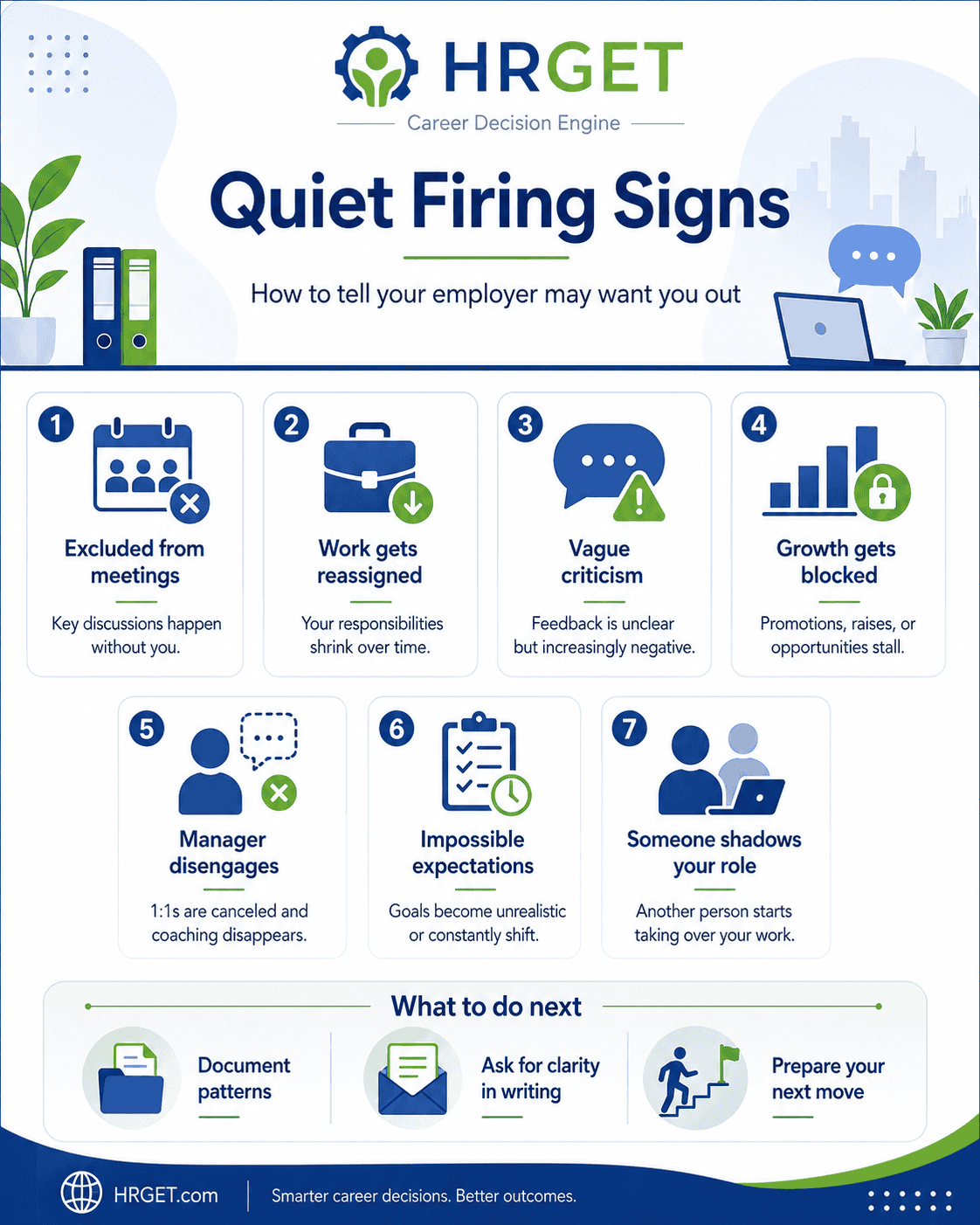
Your one-on-ones become shorter, colder, or frequently cancelled. Earlier, your manager discussed your goals, blockers, and growth. Now the conversation feels mechanical — “Nothing much today,” “Let’s sync later,” “Just continue what you’re doing.” A skipped meeting once or twice means nothing. A repeated pattern means your manager may be disengaging from your development entirely.
You stop receiving useful feedback
This is one of the most underrated quiet firing signs. Many employees think criticism is the danger, but silence can be worse. If your manager stops giving you specific feedback or coaching, it may mean they no longer see you as worth investing in. Healthy managers correct the people they still believe in. Quiet firing managers often simply stop trying.
You are excluded from meetings you used to attend
One missed invite may be accidental. Repeated exclusion from planning meetings, leadership updates, client calls, or project reviews related to your work should concern you. Ask yourself: “Would my role normally require me to be in that room?” If yes, exclusion may mean your influence is being intentionally reduced.
Your responsibilities are slowly removed
You used to own key work. Now you are asked to “support” others. Projects are reassigned. Decisions happen without you. New responsibilities go to someone else — with no clear explanation. A normal workload adjustment is transparent. Quiet firing feels silent, political, and one-directional.
You are given low-value work
You used to lead projects; now you update trackers. You used to speak to clients; now you prepare notes. You used to design systems; now you clean documentation. This matters because promotions, raises, and career advancement depend on visible impact. Being stuck in low-value work is not a punishment you feel immediately — it is a slow trap.
Strong Signs Your Employer Wants You Out
Early signs are ambiguous. Strong signs are harder to explain away. If several of the following are happening simultaneously, your employer may already be preparing for your exit.
You are put on a PIP without prior warning
A Performance Improvement Plan is not always a trap — some are genuine attempts to support struggling employees. But a sudden PIP with vague expectations, unrealistic deadlines, or issues that were never raised previously is a significant warning sign. Watch for unclear success criteria, subjective language, very short timelines, no real support, or goals that are structurally impossible to meet.
PRO TIP
Do not panic when you receive a PIP. Ask for measurable expectations in writing. Ask what success looks like. Ask how progress will be evaluated. The goal is not to argue emotionally — it is to create a paper record that can protect you later.
Your work is being audited more than others
If your manager suddenly scrutinises every email, document, ticket, or deliverable while others are treated normally, they may be building documentation for a future termination case. Selective, disproportionate scrutiny directed specifically at you is not accidental management style — it is preparation.
You are denied promotion without specific reasons
A normal promotion denial sounds like: “You need stronger cross-functional influence — here are two areas to build, and we’ll review again in six months.” A quiet firing-style denial sounds like: “Not this cycle.” “Leadership did not feel confident.” “You need more ownership.” When you ask what specifically to improve, you get vague answers. Vague denial plus no growth plan is a red flag.
Your manager stops defending you publicly
Careers are not built only by performance — they are also built by trust, visibility, and internal advocacy. If your manager used to support your work and now stays silent when others criticise you, your internal sponsorship is gone. Without a sponsor, your position weakens even when your output is strong.
You are isolated from important people
Fewer cross-functional invites, less leadership exposure, reduced client interaction, fewer stakeholder meetings, your manager becoming the sole communication channel between you and the rest of the company. This makes you less visible and significantly easier to remove later.
Your replacement is being trained
If someone is suddenly learning your systems, owning your tasks, attending your meetings, or being introduced as a “backup” without a clear explanation, your role may be actively shifting away from you. Not every backup arrangement means replacement — companies need redundancy. But backup plus exclusion plus reduced responsibilities is a combination worth taking seriously.
You are given impossible goals
Deadlines no reasonable person could meet. Goals without resources. Conflicting priorities. Targets outside your control. Expectations that keep shifting after the fact. If success is structurally impossible and every failure is being documented, you may be in a managed-exit situation rather than a genuine performance conversation.
Your manager communicates mostly in writing
Written clarity is not bad by itself — good managers document expectations too. But if the tone suddenly becomes defensive, legalistic, or blame-heavy, and every conversation now has a recap email highlighting your mistakes or missed deadlines, assume the company is building a paper trail for future use.
Quiet Firing vs Poor Management vs Business Change
This is where most employees get confused — and where I see people make the most expensive mistakes. Not every bad manager is quietly firing you. Not every reorganisation means you are being pushed out. Use this comparison to orient yourself.
| Situation | Who Is Affected | Key Indicator |
|---|---|---|
| Poor Management | Everyone on the team | Chaotic behaviour affects all; no one gets clear feedback |
| Business Change | Multiple roles or teams | Leadership explains the transition openly; several people affected |
| Quiet Firing | You — specifically | Singled out; responsibilities reduced with no explanation; replacement being prepared |
Poor management feels broad and disorganised. Quiet firing feels targeted and deliberate. Business change is usually acknowledged. Quiet firing rarely is.
The test: are your colleagues experiencing the same treatment, or is the pattern directed specifically at you? That answer changes everything about how you should respond.
Real Workplace Scenarios
SCENARIO 1
The Invisible Employee
Priya used to lead weekly client calls. After a leadership change, her manager started routing those calls through a junior colleague — framed as a “development opportunity.” Over three months, Priya stopped receiving client emails, was removed from planning meetings, and received no new projects. The issue was not one meeting. It was the systematic loss of visibility, ownership, and future relevance.
SCENARIO 2
The Promotion Freeze Trap
Marcus was told he was “almost ready” for promotion — three cycles in a row. Each cycle, the reason changed. More ownership. Then more leadership presence. Then better stakeholder management. No written plan, no specific examples, no timeline. The company was keeping him working without investing in his growth. That is quiet firing through career stagnation.
SCENARIO 3
The Sudden Performance Concern
For two years, Sophia received strong performance reviews. After she disagreed with her manager in a team meeting, critical emails began arriving about her tone, responsiveness, and “ownership.” No prior warning. No coaching. No objective examples. The timing was not coincidental. This was either retaliation or the opening move of a quiet firing campaign — and documentation became her most important asset.
REGIONAL NOTE
India Context
In Indian workplaces, quiet firing can be harder to identify because hierarchical deference often normalises exclusion. If you are being moved to “non-critical” projects, passed over for onsite rotations, or quietly removed from leadership visibility in a flat-to-senior transition — treat the same framework. The pattern, not the cultural framing, is what matters.
What to Do If You See Quiet Firing Signs
Here is the practical part. Do not resign immediately. Do not accuse your manager. Do not send emotional emails. Move strategically.
Step 1: Document patterns, not feelings
Create a private timeline. Track meetings you were removed from, projects reassigned, feedback received, cancelled one-on-ones, promotion conversations, unusual criticism, and changes in responsibilities. Keep it factual.
Bad note: “My manager hates me.”
Good note: “April 12: Removed from Q2 planning meeting despite owning the project roadmap. No explanation provided.”
Facts protect you. Feelings do not.
Step 2: Ask for clarity in writing
Use calm, professional language:
“I noticed my responsibilities on the X project have changed. Can you clarify what my current ownership areas are and what success should look like over the next 60 days?”
This shows professionalism, forces clarity, and creates documentation — three things you need simultaneously. If your manager avoids answering, that evasion is itself useful information.
Step 3: Request specific feedback
“What are the top two things I should focus on to be successful in this role over the next 60 to 90 days — and how will we measure progress?”
A manager who genuinely wants you to improve will answer this. A manager preparing your exit will stay vague or change the subject.
Step 4: Rebuild internal visibility
If you still want to stay, increase your visibility carefully. Send concise project updates. Document your wins. Confirm decisions in writing. Build relationships outside your direct manager. Ask stakeholders for feedback directly. Quiet firing becomes easier when you are invisible — so stop being invisible.
Step 5: Start your job search quietly
This is not pessimism. It is risk management. Update your resume, LinkedIn profile, portfolio, and interview stories now — while you still have income and confidence. The best time to search is never when you are desperate.
Step 6: Understand your financial runway
Before making any exit decision, calculate monthly expenses, emergency savings, notice period obligations, health insurance impact, severance possibility, and visa or work authorisation risks. Do not let workplace pressure force a financially bad decision.
Step 7: Consider HR carefully
HR exists to protect the company, not to advocate for you. That said, go to HR when discrimination, harassment, retaliation, policy violation, unpaid wages, or documented unfair treatment is involved. If the issue is simply “my manager is excluding me,” HR will ask for evidence — so go prepared, not venting.
Smart Strategy: Stay, Transfer, or Exit?
When you suspect quiet firing, you typically have three options. The right one depends on your specific situation.
OPTION 1
Stay and Repair
Choose this if the company is worth keeping, the manager relationship is repairable, feedback is specific, and leadership is open to conversation. Goal: regain trust and visibility.
OPTION 2
Transfer Internally
Choose this if the company is good but the manager relationship is damaged and another team values you. Move fast — internal reputation damage spreads.
OPTION 3
Exit Strategically
Choose this if your work is shrinking, your replacement is being trained, or your mental health is declining. The goal is not to “win” — it is to protect your income, reputation, and next opportunity.
Common Mistakes to Avoid
Resigning too early
Many employees resign out of frustration before understanding their options. That may cost you severance, unemployment eligibility, negotiation leverage, or internal transfer possibilities. Pause before quitting.
Accusing your manager of quiet firing
Do not say “You are quiet firing me.” That phrase makes you look emotional and adversarial. Say instead: “I’d like clarity on my role expectations and success metrics.” Professional language wins in these situations — always.
Overworking to prove your worth
This is extremely common. Employees sense danger and start working nights and weekends hoping to “save” the relationship. But if the decision is political or already made, overworking only drains you. Work professionally, document your impact, but do not destroy yourself over a decision someone else may have already reached.
Ignoring the external market
Even if you want to stay, interview preparation gives you confidence and options. Options reduce fear, and fear is the single biggest reason people make bad decisions in quiet firing situations.
Venting to coworkers
Workplace gossip travels fast. If you complain emotionally to colleagues, it may be used against you. Discuss details only with trusted mentors, career advisors, or people outside the organisation entirely.
Not saving evidence
Save relevant emails, performance reviews, written feedback, project assignments, and policy documents in a way that complies with company rules. Do not take confidential data. Do not violate security policies. But keep everything you are permitted to keep.
When Quiet Firing May Become a Legal Issue
Quiet firing itself is not automatically illegal. A company can change responsibilities, deny promotions, restructure teams, or manage performance. But it becomes legally serious when it involves discrimination, retaliation, harassment, unpaid wages, forced resignation due to intolerable conditions, disability-related unfair treatment, pregnancy bias, whistleblower retaliation, or violation of contractual terms.
If you reported harassment and then suddenly lost responsibilities, that may constitute retaliation under Title VII in the US or the Equality Act 2010 in the UK. If you requested a reasonable accommodation and were subsequently isolated or pushed out, that may require legal review under the ADA (US) or equivalent frameworks in the EU and India.
If employees only from a certain age group, gender, caste, race, or protected category are being pushed out — the issue is bigger than management style.
Important: Employment laws vary by country, state, and contract type. If money, reputation, visa status, or legal rights are at stake, speak with an employment lawyer before resigning — not after.
The Insider View: The Best Question to Ask Your Manager
If you suspect quiet firing, ask this in your next one-on-one — and then stay silent after you ask it:
“What would make you confident that I’m succeeding in this role over the next 60 to 90 days?”
A supportive manager gives specifics. A disengaged manager gives vague language. A manager already preparing your exit avoids commitment entirely. Their answer — or their evasion — tells you more about your situation than any other signal.
How to Protect Your Career: A 14-Day Action Plan
14-DAY RESPONSE PLAN FOR QUIET FIRING SIGNS
Days 1–3: Observe and Document — Write down what has changed. List facts only, with dates. Separate patterns from isolated events.
Days 4–6: Ask for Role Clarity — Send a calm message asking about responsibilities, priorities, and success metrics for the next 60 days. Document the response.
Days 7–10: Rebuild Visibility — Share project updates. Reconnect with stakeholders. Document your contributions. Ask for feedback from people outside your immediate manager.
Days 11–14: Prepare External Options — Update your resume and LinkedIn. Contact two or three trusted recruiters. Begin light interview preparation. This is not giving up — it is eliminating the fear that forces bad decisions.
Quiet Firing Is a Signal, Not a Sentence
Quiet firing can feel humiliating because nobody says the truth openly. But you still have power — and you have more of it when you act early rather than after the situation has already defined you.
Your job is not to panic. Your job is to read the signals, confirm the pattern, document facts, and move before the company controls your options. Sometimes the situation can be repaired. Sometimes an internal transfer solves it cleanly. Sometimes leaving is the smartest career decision you will make.
Quiet firing signs are not just warnings that your employer may want you out. They are reminders to protect your income, reputation, and next opportunity — before someone else writes that chapter for you. If you are also seeing signs your workplace culture is turning toxic, read our guide on recognising and responding to a toxic boss for what comes next.
FAQ: Quiet Firing Signs
What are the most common quiet firing signs?
The most common signs are being excluded from meetings you previously attended, having responsibilities removed without explanation, receiving vague or absent feedback, being denied promotion without specific reasons, and noticing someone else being trained on your tasks. When three or more of these appear together over several weeks, the pattern warrants serious attention.
Is quiet firing illegal?
Quiet firing is not automatically illegal. Employers have broad rights to restructure roles, change responsibilities, and manage performance. However, it becomes legally serious if it involves discrimination, retaliation for whistleblowing or protected activity, harassment, or constructive dismissal — where working conditions are made deliberately intolerable. Employment lawyers in the US, UK, EU, and India can advise on whether a specific situation crosses a legal threshold.
How do I know if I am being quiet fired or if my manager is just a poor communicator?
Poor management affects everyone on the team — chaotic communication, missed meetings, unclear feedback directed at all. Quiet firing is targeted specifically at you while others are treated differently. If your colleagues receive engagement, feedback, and project ownership while you are consistently excluded or downgraded, the issue is likely directional rather than general.
Should I confront my manager about quiet firing directly?
Avoid using the phrase “quiet firing” — it tends to make the conversation adversarial before you have the leverage to handle that. Instead, ask for specific clarity: “Can you clarify my current ownership areas and what success looks like over the next 60 days?” This achieves the same goal — forcing a direct conversation — without triggering a defensive response.
What should I do first if I suspect quiet firing at work?
Start by documenting a factual timeline of what has changed — meetings removed, projects reassigned, feedback received, one-on-ones cancelled. Then ask your manager for written role clarity. Do not resign, overwork, or vent to colleagues. Move to update your resume and external options only after you have assessed the pattern clearly over at least two to three weeks.
Can a PIP be a quiet firing tactic?
A PIP can be a genuine performance tool or a documentation exercise designed to build justification for termination. Red flags include vague success criteria, unrealistic timelines, issues that were never raised previously, no real managerial support, and goals that structurally cannot be met. Ask for measurable targets in writing and document every interaction from the moment a PIP begins.
How do quiet firing signs differ across the US, UK, and India?
The behavioural signals are similar globally, but the legal and cultural framing differs. In the US, at-will employment makes quiet firing common; retaliation and discrimination protections remain the main legal recourse. In the UK, constructive dismissal claims under the Employment Rights Act 1996 offer stronger protection when working conditions are made intolerable. In India, the Industrial Disputes Act and Shops and Establishment Acts provide some protection, though enforcement varies significantly by state and employment type.

Organizational Psychologist & Workplace Behavior Advisor (Former consultant with Boston Consulting Group, research contributor aligned with Harvard Business Review)
Dr. Amelia Grant is an organizational psychologist specializing in burnout, toxic workplaces, leadership behavior, and employee mental resilience. She writes practical, research-backed workplace guidance for modern professionals.