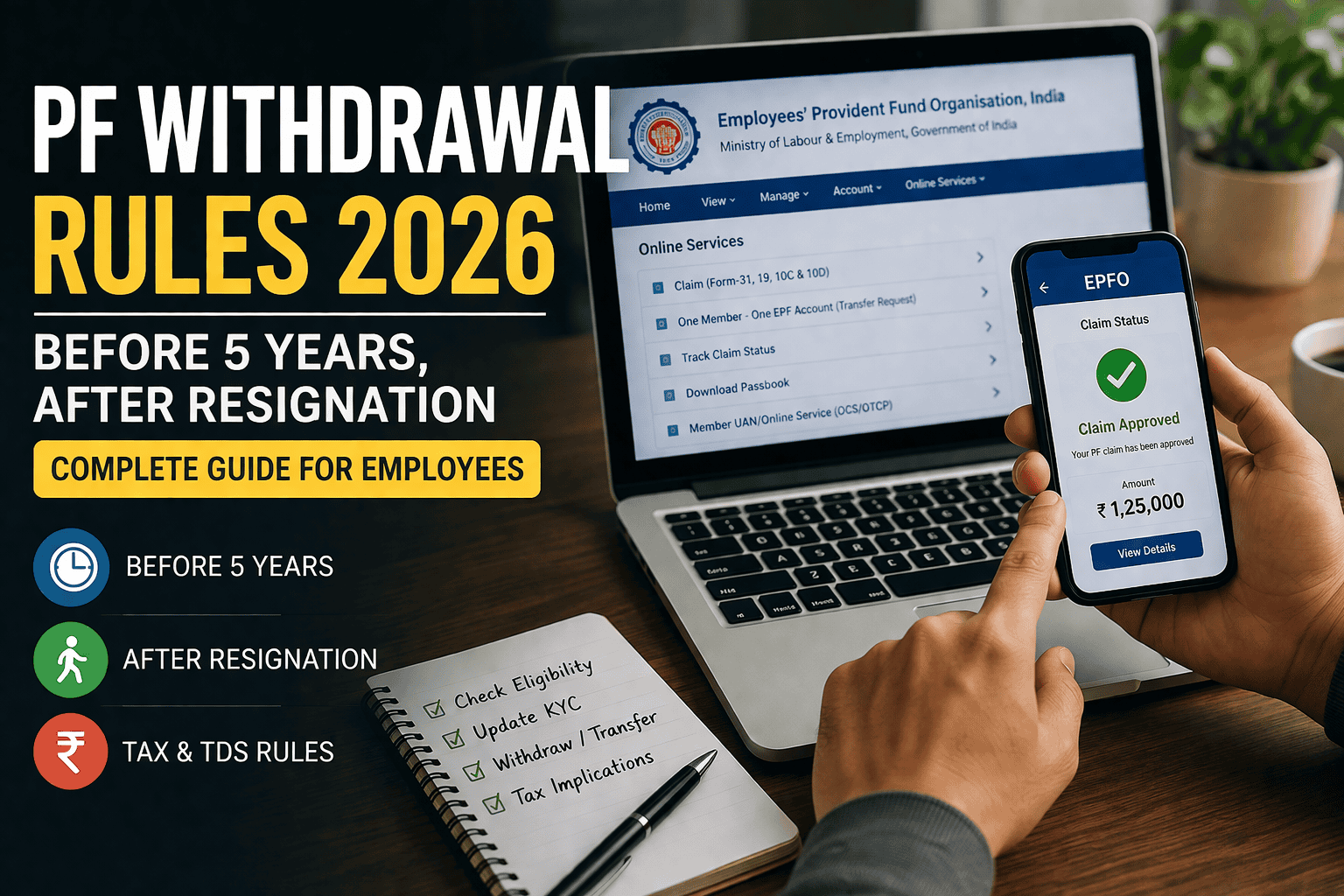
Most employees treat PF withdrawal like a formality — resign, wait a bit, apply on the EPFO portal, get the money. Here’s the problem: PF withdrawal rules in 2026 are not just about access. They affect your tax liability, pension continuity, long-term retirement corpus, and the speed at which your claim is processed.
I’ve spent two decades advising employees on Indian labour law, and the number of people who withdraw PF without understanding the tax consequences — particularly before completing five years of service — is staggering. One careless click costs them ₹30,000 to ₹80,000 in unexpected TDS, depending on balance size.
The two scenarios where confusion is highest in 2026:
- Withdrawing PF before 5 years of continuous service
- Withdrawing PF after resigning without a new job lined up
Both are permitted under certain conditions — but they are treated very differently by EPFO and the Income Tax Department. The 2025 Ministry of Labour review also simplified partial withdrawal categories and revised the unemployment waiting period, which has created fresh confusion. This article cuts through all of it.
What Is PF Withdrawal?
PF withdrawal means withdrawing money from your Employees’ Provident Fund — commonly called EPF. Your EPF account has three parts: your own employee contribution (12% of basic salary), your employer’s EPF portion, and the interest credited on both every year.
Here’s what employees frequently miss: your employer’s 12% contribution is itself split. A portion goes into your EPF account, and a separate portion — typically 8.33% of basic salary, capped at ₹15,000 base — goes into the Employees’ Pension Scheme (EPS). PF withdrawal and EPS pension withdrawal are not the same thing, and they follow different rules. More on that below.
When you “withdraw PF,” you are typically referring to the EPF balance — your contributions, employer EPF contributions, and accumulated interest. This is the amount shown on your passbook on the EPFO member portal.
PF Withdrawal Rules 2026: Quick Summary
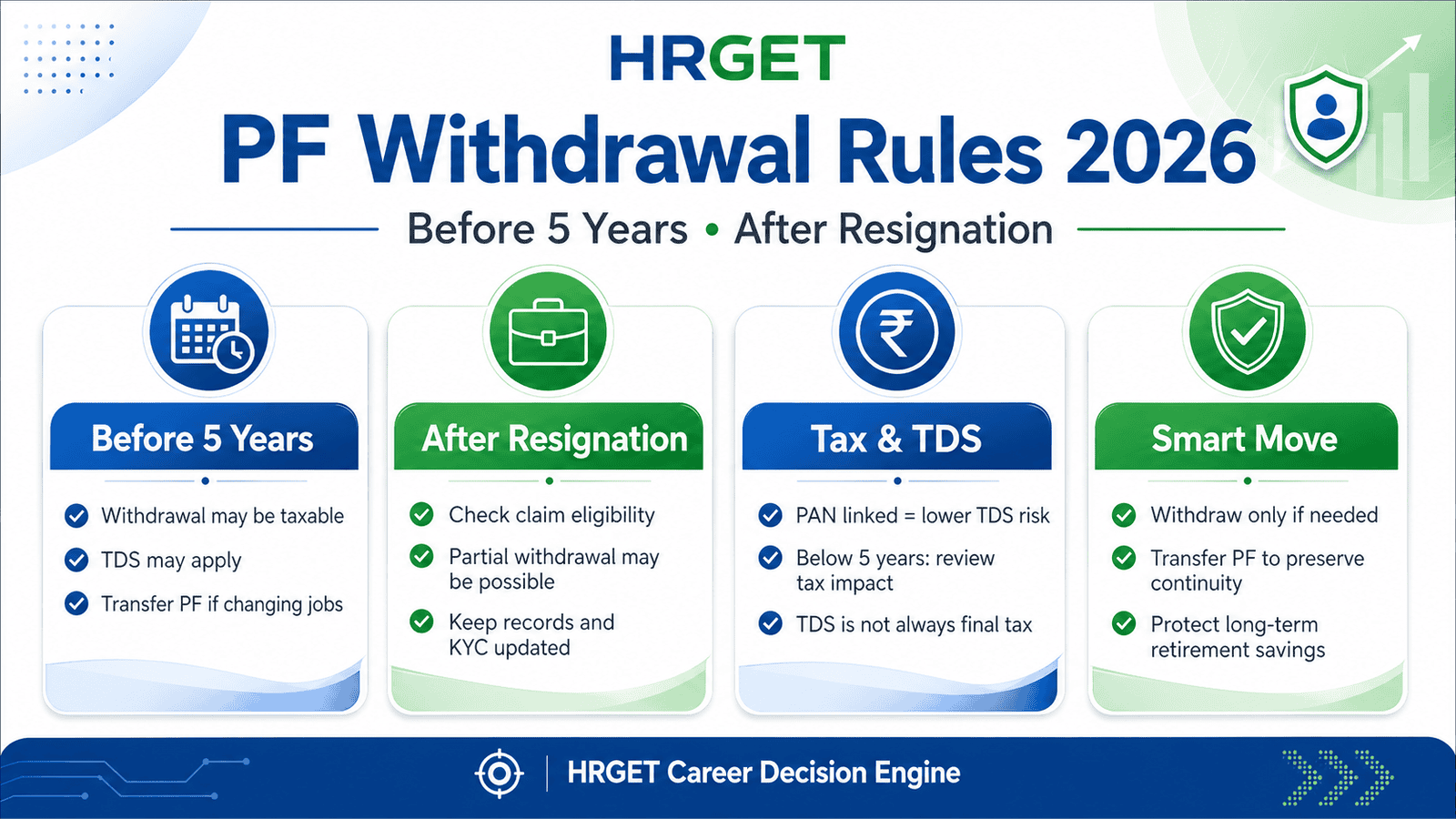
Before diving into the details, here is the practical picture for 2026:
| Your Situation | What Usually Applies in 2026 |
|---|---|
| Still employed, no job change | Partial withdrawal allowed only for eligible categories |
| Resigned and joining a new employer | Transfer PF via UAN — withdrawal not recommended |
| Resigned and unemployed | Access to large portion of PF balance; revised waiting period applies |
| Service less than 5 years | Withdrawal may be taxable; TDS applies above ₹50,000 |
| Service 5 years or more | TDS generally not charged on PF withdrawal |
| PAN not linked to UAN | Higher TDS rate applies (up to 34.606%) |
| Partial withdrawal request | EPFO 2025 reforms simplified into 3 categories; 12 months minimum service |
Key Rule Many Employees Miss
The 5-year threshold is not necessarily 5 years with a single employer. EPFO’s own FAQ confirms that service with previous and present employers is combined when calculating total service for TDS purposes — but only if you transferred your old PF instead of withdrawing it.
That one distinction saves or costs tens of thousands of rupees for mid-career job-hoppers every year.
Can You Withdraw PF Before 5 Years?
Yes — but this is where most employees make their most expensive mistake.
They resign after two or three years at a company, see ₹2–4 lakh sitting in their PF passbook, and withdraw it to fund a gap period or travel plans. What they don’t realise until they file their income tax return is that the withdrawal is treated as income — and in some cases, TDS has already been deducted.
PF is a retirement savings product under Indian law. The EPF Act permits withdrawal in specific eligible situations, but “being allowed” does not mean “being tax-free.”
Permitted Reasons for Early Withdrawal (Before 5 Years)
Following the 2025 EPFO reforms, partial and early withdrawal is permitted in these broad categories:
Essential Needs
Medical emergency, education (up to 10 times), marriage (up to 5 times)
Housing Needs
House purchase, construction, home loan repayment
Special Circumstances
Unemployment, permanent disability, migration abroad, retirement
The Ministry of Labour’s 2025 year-end review confirmed that education withdrawals were liberalised up to 10 times and marriage withdrawals up to 5 times, with partial withdrawals grouped into these three broader categories instead of multiple individual paragraphs of the EPF Scheme.
The Real Issue: Allowed ≠ Tax-Free
EPFO may process your claim without any problem. But the Income Tax Department independently determines whether the withdrawal is taxable based on your service period. The EPFO portal not stopping you is not a clearance from IT.
So the smarter question isn’t “Can I withdraw?” It’s: “Should I withdraw now, or should I transfer PF to protect the 5-year continuity and avoid tax?”
Tax on PF Withdrawal Before 5 Years
Let’s be direct about the numbers.
If you withdraw PF before completing 5 years of continuous service and your balance exceeds ₹50,000, TDS applies. EPFO’s published FAQ states that with a valid, linked PAN, TDS is deducted at 10%. Without PAN, the rate rises sharply — EPFO’s own TDS flowchart instructions cite a rate of 34.606%.
| Condition | Tax / TDS Impact |
|---|---|
| Service < 5 years, balance above ₹50,000, PAN linked | TDS at 10% |
| Service < 5 years, balance above ₹50,000, PAN not linked | TDS at 34.606% |
| Service < 5 years, balance below ₹50,000 | TDS may not apply, but ITR disclosure may be required |
| Service 5 years or more (combined employers) | TDS generally not charged |
TDS Is Not Your Final Tax Bill
This is an important distinction. TDS is deducted at source, but your actual tax depends on your total income for the year, your applicable slab, and whether the PF withdrawal is treated as income from salary or other sources in your ITR. If excess TDS is deducted, you can claim a refund. If less was deducted, you still owe the difference.
The withdrawal amount gets added back to your taxable income. For someone in the 30% slab, a ₹3 lakh PF withdrawal could mean ₹90,000 in additional tax — far more than the 10% TDS upfront.
Form 15G and Form 15H
If your total annual income is below the taxable threshold, you can submit Form 15G (or Form 15H for senior citizens) to prevent TDS deduction. EPFO’s TDS flowchart instructions confirm that PAN must be quoted in Form 15G/15H and Form 19.
Don’t Submit 15G Just to Avoid TDS
I’ve seen employees submit Form 15G under peer pressure or to speed up the claim, even when their income is above the threshold. That is a false declaration to a government authority. Submit it only if you genuinely qualify — i.e., your total income for the year will not be taxable.
PF Withdrawal After Resignation in 2026
This is where the rules have genuinely changed, and the confusion is highest.
Many employees operated on an old assumption: resign, wait two months, withdraw 100% of PF. That framework has been replaced. The 238th CBT (Central Board of Trustees) meeting approved replacing the 2-month waiting period with a 12-month window for full final settlement in cases of unemployment under Para 69(2) of the EPF Scheme.
The intent is clear: allow members access to financial support while preserving a portion of retirement savings and maintaining pension continuity. Full immediate withdrawal was seen as harming long-term retirement preparedness.
Three Practical Paths After Resignation
Path 1: You’re joining a new employer soon
Best move: Transfer PF using UAN. Do not withdraw. If you transfer, your previous employer’s service gets combined with your new employer’s service for the 5-year TDS calculation. Withdrawing breaks this continuity and may trigger tax on the entire balance.
Path 2: You’re unemployed and need liquidity now
Under the revised framework, you can access a substantial portion of your PF balance — the Ministry of Labour’s review indicates up to 75% of total PF balance (employee + employer contributions) — while a portion is preserved. This partial access can cover immediate financial needs without fully liquidating your retirement savings.
Path 3: You remain unemployed for a prolonged period
After the applicable unemployment waiting period under the revised rules, full final settlement may become eligible. The exact timing depends on claim type, portal eligibility, and EPFO processing at your regional office.
The bottom line: immediate full withdrawal right after resignation is not the safe default assumption in 2026. The claim type, your unemployment duration, service period, and portal eligibility all determine what you can access and when.
Always check your actual claim options on the EPFO member portal rather than relying on what a colleague or Reddit thread told you — the rules changed.
Partial PF Withdrawal Rules in 2026
Partial withdrawal means withdrawing a specific portion of your EPF balance for a permitted reason, without closing the account entirely. You remain employed (or recently resigned) and the PF account stays active.
The most significant 2025–26 change: EPFO moved away from multiple technical sub-clauses toward three broad categories, making it easier for members to understand eligibility without reading through the full EPF Scheme.
| Category | Includes | Key Conditions (Revised) |
|---|---|---|
| Essential Needs | Illness, education, marriage | Min. 12 months service; education up to 10x, marriage up to 5x |
| Housing Needs | House purchase, construction, home loan repayment | Min. 12 months service; up to 75% of PF balance |
| Special Circumstances | Emergencies, unemployment, disability, migration | Conditions vary by sub-type; check EPFO portal for eligibility |
Pro Tip: The 75% Rule
The Ministry of Labour’s year-end review states that members can withdraw up to 75% of PF balance (employee + employer contributions combined) under the revised partial withdrawal framework, with a minimum 12-month service requirement. If you have ₹4,00,000 in your PF, do not plan on accessing the full ₹4 lakh immediately — a portion is designed to stay preserved.
That preserved amount is not a penalty. It continues earning interest and protects your retirement corpus if you re-enter employment.
PF vs EPS: Don’t Confuse These Two
This is the single most common misconception I see in employment law queries. Your PF balance and your EPS pension are entirely different.
EPF Balance
- Your 12% employee contribution
- Employer EPF portion (~3.67% after EPS split)
- Accumulated interest (currently ~8.25% p.a.)
- Can be withdrawn or transferred
EPS (Pension)
- 8.33% employer contribution (capped at ₹1,250/month)
- No interest — used to fund monthly pension on retirement
- Withdrawal (scheme certificate or withdrawal benefit) follows separate eligibility
- 10 years of service = monthly pension eligibility at 58
Why does this matter practically? Because the EPFO board discussions around the revised framework include a longer waiting period specifically for pension-related withdrawal after unemployment — the intent is to preserve pension continuity. You may be able to access PF balance quickly, while EPS-linked access follows a different timeline and eligibility path.
Look, I’ll be direct: if you are under 45, in a salaried role, and you break EPS continuity by withdrawing a small scheme certificate now instead of keeping it, you are giving up a guaranteed pension at 58 for a few thousand rupees today. It almost never makes sense.
Smart rule: If you’re likely to continue in salaried employment, do not casually disrupt your PF and EPS continuity for short-term cash.
Step-by-Step PF Withdrawal Process Online (2026)
Most eligible claims can now be processed entirely online through the EPFO member portal, without employer attestation — provided your KYC is complete and verified.
1
Activate and verify your UAN
Your Universal Account Number must be active. If you’ve never activated it, do this first at the EPFO member portal (unifiedportal-mem.epfindia.gov.in).
2
Complete KYC verification
Ensure Aadhaar, PAN, bank account (with IFSC), and Aadhaar-linked mobile number are all seeded and verified on the portal. Also ensure your date of exit from your previous employer is updated — if it’s missing, certain claim options won’t appear.
3
Log in and navigate to Online Claims
Log in with UAN and password. Go to Online Services → Claim (Form 31, 19 & 10C). The system will show only the claim types you are currently eligible for.
4
Select the correct claim type
Full settlement (Form 19), partial withdrawal (Form 31), pension withdrawal (Form 10C), or PF transfer (Form 13). Choosing the wrong form is a very common reason for delays and rejections.
5
Confirm bank account
Payment is credited only to the bank account registered with EPFO — you cannot divert it to a different account. EPFO’s online claim FAQ explicitly confirms this restriction. Make sure the registered account is active and the name matches exactly.
6
Submit and track
Submit the claim and track status under Online Services → Track Claim Status. Processing typically takes 7–20 working days once all KYC is in order.
7
Raise grievance if delayed beyond 20 days
EPFO’s FAQ states that if settlement is not processed within 20 days, you can approach the Regional PF Commissioner or file a grievance via EPFiGMS (epfigms.gov.in). Don’t wait silently — the grievance portal is effective.
Real Scenarios: What Should You Do?
Scenario 1: Aarav resigned after 3 years and is joining a new company in 6 weeks
Best move: Transfer PF. Don’t withdraw.
Aarav has ₹2.8 lakh in PF. If he withdraws, it’s taxable (service less than 5 years, balance above ₹50,000 — TDS at 10% applies). But if he transfers to his new employer using his UAN, his old service combines with the new service. By the time he crosses the 5-year combined mark, any future withdrawal will be tax-free. Withdrawing now costs him ₹28,000 in TDS plus whatever additional income tax is owed — for money he didn’t even need urgently.
Scenario 2: Priya resigned and is unemployed with EMIs due
Best move: Withdraw only what you need — not all of it.
Priya has ₹5.5 lakh in PF across 4 years of service. She needs ₹80,000 to cover 2 months of EMIs while job hunting. Under the revised partial withdrawal framework, she can likely access a significant portion without fully closing the account. Withdrawing only ₹80,000–1,00,000 limits her tax exposure and preserves the remaining corpus. Draining the entire ₹5.5 lakh for a 2-month gap is financially irrational unless she genuinely has no other option.
Scenario 3: Kiran has ₹42,000 in PF and less than 5 years of service
No TDS — but that doesn’t mean tax-free.
Because the balance is below ₹50,000, TDS will not be automatically deducted. But Kiran still needs to consider whether this amount should be disclosed in the ITR. No TDS does not equal no tax obligation. Consult a tax professional before assuming the withdrawal is fully clean.
Scenario 4: Meera is moving permanently to Canada
Eligible for withdrawal — but verify tax treatment carefully.
Permanent migration abroad is a permitted reason for PF withdrawal. However, if Meera’s service is less than 5 years, the withdrawal may still be taxable under Indian income tax law. She should also confirm whether her UAN, KYC, and date of exit are all updated, and check the EPFO portal for the applicable claim form before initiating anything.
Common Mistakes That Delay or Damage PF Withdrawal
Mistake 1: PAN not linked to UAN
Without a linked PAN, TDS jumps to 34.606% on taxable withdrawals. Fix this before you file any claim — it takes 24–48 hours for EPFO to update after you seed PAN through the portal.
Mistake 2: Bank account mismatch
The account name must match EPFO records exactly. Wrong IFSC, a closed account, or name variations (like initials vs full name) will reject the credit. EPFO cannot redirect to an alternate account.
Mistake 3: Date of exit not updated by employer
After resignation, your employer must update your date of exit on the EPFO portal. If they haven’t done it, certain claim options won’t show. Follow up with HR before assuming the portal isn’t working.
Mistake 4: Withdrawing instead of transferring
The costliest mistake for job-changers. Withdrawal breaks compounding, breaks the 5-year continuity for TDS purposes, and may create a tax bill. Use Form 13 (PF Transfer) instead of Form 19 (Full Withdrawal) when joining a new employer.
Mistake 5: Ignoring EPS when withdrawing PF
Many employees close their PF account but don’t think about the EPS scheme certificate. If you have less than 10 years of service, you get a withdrawal benefit from EPS — but if you take it, you permanently lose pension continuity. For anyone who plans to return to employment, keeping the scheme certificate is usually the smarter call.
Mistake 6: Submitting the wrong claim type
Full settlement, partial withdrawal, PF transfer, and pension withdrawal are four different claim types. Submitting the wrong one causes delays or rejections. Read the claim option description on the portal carefully before confirming.
Smart Strategy Before Withdrawing PF in 2026
Before you open the EPFO portal and hit “Claim”, ask yourself these five questions:
Q1
Am I joining another employer within 3 months?
If yes, transfer PF via UAN. No withdrawal needed or advisable.
Q2
Have I crossed 5 years of continuous service (including transferred PF)?
If no, model the tax impact before claiming — TDS may apply and further income tax will be owed.
Q3
Is my PAN linked and KYC complete?
If no, fix these first. Filing a claim with incomplete KYC will either fail or attract higher TDS.
Q4
Do I genuinely need the full amount, or would partial access suffice?
Calculate how much you actually need for the next 60–90 days. Withdraw only that much and leave the rest compounding.
Q5
Will this affect my EPS pension continuity?
If you expect to return to salaried employment, consider keeping the EPS scheme certificate rather than taking the withdrawal benefit. A monthly pension at 58 is worth more than a lump sum of ₹20,000–40,000 today.
PF Withdrawal Before 5 Years vs After 5 Years: Full Comparison
| Factor | Before 5 Years | After 5 Years |
|---|---|---|
| Tax exposure | High — withdrawal added to taxable income | Generally nil |
| TDS applicability | Yes, if balance above ₹50,000 | TDS generally not charged |
| TDS rate (PAN linked) | 10% | Nil |
| Best action if changing jobs | Transfer PF — preserve continuity | Transfer still preferred; withdrawal is tax-clean but breaks compounding |
| Impact on retirement corpus | Severe if withdrawn early | Still significant — compounding lost |
| Risk level | Very high — tax + pension disruption | Moderate — tax-clean but long-term cost |
HRGet’s Bottom Line
PF isn’t just “your money sitting with EPFO.” It is one of the only forced savings mechanisms in India that most salaried employees actually maintain consistently over years. The moment you withdraw it casually, you lose three things at once: compounding at 8.25% p.a., service continuity for TDS purposes, and the retirement discipline that gets harder to rebuild later.
Use PF withdrawal for genuine financial need — not lifestyle spending, not impulse decisions after a stressful resignation.
The worst PF decision is not the withdrawal itself. It’s withdrawing without understanding the tax cost, the pension impact, and the long-term retirement arithmetic behind that number on your passbook.
FAQs: PF Withdrawal Rules 2026
Can I withdraw PF before completing 5 years of service?
Yes, early withdrawal is permitted in eligible categories including unemployment, medical emergency, education, marriage, housing, and special circumstances. However, if your balance exceeds ₹50,000 and service is below 5 years, TDS at 10% (with PAN) applies. The withdrawal may also be added to your taxable income for the year, so assess the full tax impact before claiming.
Is PF withdrawal tax-free after 5 years?
Generally yes. EPFO confirms that TDS is not charged if total service exceeds 5 years. Importantly, service across previous and current employers is combined for this calculation — but only if you transferred PF between employers rather than withdrawing it each time.
How long do I have to wait to withdraw PF after resigning in 2026?
The older 2-month rule has been revised. The 238th CBT meeting approved a 12-month waiting period for full final settlement under unemployment provisions. For partial access during unemployment, the revised framework allows withdrawal of up to 75% of the PF balance subject to eligibility. Check your specific options on the EPFO portal after your date of exit is updated.
What is the TDS rate on PF withdrawal without PAN?
If PAN is not linked to your UAN and you withdraw before 5 years with a balance above ₹50,000, TDS is deducted at 34.606% as per EPFO’s published TDS flowchart instructions. This is the single strongest reason to link PAN before filing any claim — the difference in deduction is enormous.
What happens to EPS (pension) when I withdraw PF?
EPS and EPF are separate. When closing your PF account, you must also decide on EPS — take a withdrawal benefit (small lump sum) or a scheme certificate. If you have fewer than 10 years of EPS service, taking the withdrawal benefit permanently ends pension continuity. For anyone likely to return to salaried employment, the scheme certificate is almost always the smarter choice.
Can I submit Form 15G to avoid TDS on PF withdrawal?
You can submit Form 15G (Form 15H for senior citizens) only if your total annual income for the year is genuinely below the taxable threshold. PAN must be quoted in the form. Submitting 15G when you’re actually taxable constitutes a false declaration — don’t do it just to speed up or inflate the payout.
How much PF can I withdraw partially in 2026?
Under the simplified 2025 EPFO framework, partial withdrawals are grouped into Essential Needs, Housing Needs, and Special Circumstances categories. The revised framework allows up to 75% of your total PF balance (employee + employer contributions), with a minimum 12-month service requirement across all categories. Specific sub-limits may apply within each category based on purpose.
What should I do if my PF claim is not settled within 20 days?
EPFO’s FAQ confirms that if settlement is not processed within 20 days of claim submission, you can approach the Regional PF Commissioner directly or file a grievance through EPFiGMS at epfigms.gov.in. In most cases, the grievance portal resolves delays faster than a direct visit to the regional office.
Conclusion: PF Withdrawal Is a Decision, Not a Formality
PF withdrawal rules in 2026 reward the employees who pause and think — and quietly penalise the ones who treat it as a quick cash-out after a resignation. The 5-year continuity rule, revised waiting periods, simplified partial withdrawal framework, and TDS implications all point in one direction: transferring PF is almost always better than withdrawing it, unless you genuinely have no other option.
If you must withdraw, link PAN first, check your service period carefully (combined across employers, not just your last job), understand which claim type applies to your situation, and consider whether partial access satisfies your actual need.
For employees navigating notice periods, gratuity, and PF simultaneously after a resignation or layoff, understanding all your entitlements together is the smartest move. Explore our guide on notice period rules in India to make sure you aren’t leaving money on the table in that area either.
Quick Reference: The 3 Rules to Remember
✓ Transfer, don’t withdraw — if you’re changing jobs, always transfer PF via UAN
✓ 5 years = TDS-free — combined service across employers counts, but only if you transferred
✓ Partial before full — if you need money during unemployment, access partially and preserve the rest

Victoria Hale | Former Partner, Freshfields Bruckhaus Deringer | Employment Law Specialist | 20+ Years Advising Multinationals & Executives
Author: Victoria Hale spent over two decades as an Employment Law Partner at Freshfields Bruckhaus Deringer — one of the world’s most prestigious Magic Circle law firms — advising multinational corporations and senior executives on some of the most complex employment disputes in the US and Europe. Her practice covered wrongful termination litigation, executive exits, non-compete enforcement, FLSA compliance, and cross-border workforce restructuring under EU labour law. Now based between London and New York, Victoria writes for HRGet.com to close the gap between legal theory and how employment law actually plays out in the real world — for employees who need to know their rights before it’s too late.