

The moment HR hands you a severance agreement, most people do one of two things: they panic and sign immediately, or they freeze and do nothing. Both are costly mistakes.
Here’s what I’ve learned after nearly two decades advising employees through layoffs — from warehouse workers to C-suite executives: almost every severance package has negotiating room. Companies build a buffer into their initial offer precisely because they expect pushback. When you don’t push back, you’re leaving money, benefits, and legal protections on the table.
This guide walks you through exactly how to negotiate a layoff severance package — step by step — with the strategy, language, and insider context that actually moves the needle.
What a Severance Package Really Includes
Before you negotiate, you need to know exactly what you’re working with. Most employees focus narrowly on “weeks of pay” and miss the bigger picture. A severance package is actually a bundle of several elements — each negotiable to different degrees.
| Component | What It Means | Negotiable? |
|---|---|---|
| Severance Pay | Weeks or months of base salary paid as lump sum or continuation | ✅ Yes — almost always |
| Accrued PTO Payout | Payment for unused vacation days (required in many US states) | ⚠️ Often legally mandated |
| Health Insurance Continuation | COBRA subsidy or employer-paid coverage extension | ✅ Yes — highly valuable |
| RSU / Equity Treatment | What happens to unvested stock, options, or RSUs | ✅ Yes — often overlooked |
| Non-Compete / NDA Clauses | Restrictions on your future employment and speech | ✅ Yes — critical to review |
| Release of Claims | You waive your right to sue the company in exchange for payment | ✅ Scope is negotiable |
| Reference / Departure Terms | How your exit is framed to future employers | ✅ Yes — often overlooked |
The release of claims clause is the most important part of any severance agreement — and companies know it. They are paying you, in part, to give up your right to sue them for wrongful termination, discrimination, or other claims. That release has real legal value. Understanding that shifts the entire dynamic of the negotiation.
Can You Actually Negotiate Severance?
Yes. Full stop. The question isn’t whether negotiation is possible — it’s how much leverage you have.
I’ve seen employees at every level negotiate better terms: from software engineers getting an extra four weeks added to their pay, to executives securing partial RSU acceleration worth hundreds of thousands. The baseline matters, but almost no offer is truly final the moment it lands in your inbox.
Your leverage depends on several factors:
| Stronger Leverage | Weaker Leverage |
|---|---|
| Laid off in a reduction-in-force (not fired for cause) | Terminated for performance or policy violations |
| 5+ years of tenure with the company | Under 12 months or still in probation |
| Senior, specialized, or hard-to-replace role | Entry-level or easily replaceable position |
| Potential discrimination or legal exposure exists | Clean, straightforward performance exit |
| Part of a mass layoff (company wants quiet, smooth exits) | One-off departure with minimal PR risk |
Even with weaker leverage, don’t assume nothing is possible. I’ve seen plenty of “non-negotiable” packages get improved with a single polite email — usually by adjusting non-monetary terms like the reference language, exit date, or non-compete scope.
Step-by-Step: How to Negotiate Your Layoff Severance Package
Do Not Accept or Sign Immediately
Under the Older Workers Benefit Protection Act (OWBPA), employees over 40 must receive at least 21 days to review a severance agreement, plus 7 days to revoke after signing. Employees under 40 are typically given at least 5–7 days. Use every single day you’re given.
The most disarming thing you can say in that room: “I appreciate this. I’ll need time to review it carefully.” That’s it. Professional, non-combative, and completely within your rights.
Get the Full Written Agreement Before Discussing Anything
Never negotiate based on a verbal description of what the package includes. Request the complete, written severance agreement — every page. If HR says “we’ll send it later,” respond: “I’d prefer to have the written document before we continue any discussion.”
You need to see the exact release language, non-compete scope, equity provisions, and benefits continuation terms before you can assess what’s actually worth fighting for.
Map Your Priorities Before You Counter
Don’t walk in asking for everything. Know what matters most based on your situation — then sequence your asks accordingly.
| Your Situation | Top Priorities |
|---|---|
| No job lined up, job market is slow | Maximum cash + health insurance extension |
| Have a new role starting soon | Clean exit terms + lump sum (not installments) |
| Senior or executive role | Non-compete removal + RSU acceleration |
| US employee with unvested RSUs | Equity acceleration or extended exercise window |
| Concerned about next job reference | Negotiated reference language + LinkedIn support |
Build Your Case — Don’t Just Ask for More
This is where most employees lose the negotiation before it starts. Walking in and saying “I want more” gives HR nothing to work with. You need a business case — even a simple one.
Tie your ask to your tenure, your contributions, and market norms. A clear, calm, evidence-based counter is almost impossible to dismiss.
“Given my [X years] of service, the [specific contributions — team built, revenue driven, projects delivered], and industry norms for roles at this level, I was hoping we could revisit [specific item]. I’d like to propose [specific counter-offer].”
Short. Professional. Grounded in logic — not emotion.
Make Specific, Targeted Requests
Vague asks get vague responses. The moment you say “can you make it a bit more?” you’ve given HR the easiest possible rejection. Instead, give them an exact number or term to respond to.
- Not: “Can you increase the pay?” → Instead: “Can we extend from 10 weeks to 14 weeks of base salary?”
- Not: “Can I keep benefits longer?” → Instead: “Can the company cover COBRA premiums for 3 months?”
- Not: “What about my stock?” → Instead: “Can we accelerate vesting on the tranche due in Q3?”
Specific asks feel reasonable. They give HR something concrete to approve or counter — and that moves the negotiation forward.
Stay Professional — This Is a Business Transaction
I know that’s easier said than done. Being laid off is painful, and for many people it feels deeply personal. But the moment you bring visible emotion into the negotiation — frustration, desperation, anger — you lose credibility and leverage simultaneously.
The company is operating on policy and legal risk, not sentiment. Match that energy. Be measured, clear, and business-like. HR remembers the employees who negotiate with grace, and that goodwill often shows up in a better final offer.
Get Every Agreed Change in Writing Before You Sign
Verbal commitments made during negotiation mean nothing legally. If HR agrees to extend your health benefits by two months, that needs to be reflected in the official, signed severance agreement — not confirmed in a Slack message or mentioned on a phone call.
Before you sign: request a revised document. Read it fully. Confirm every negotiated point is accurately captured. Only then sign.
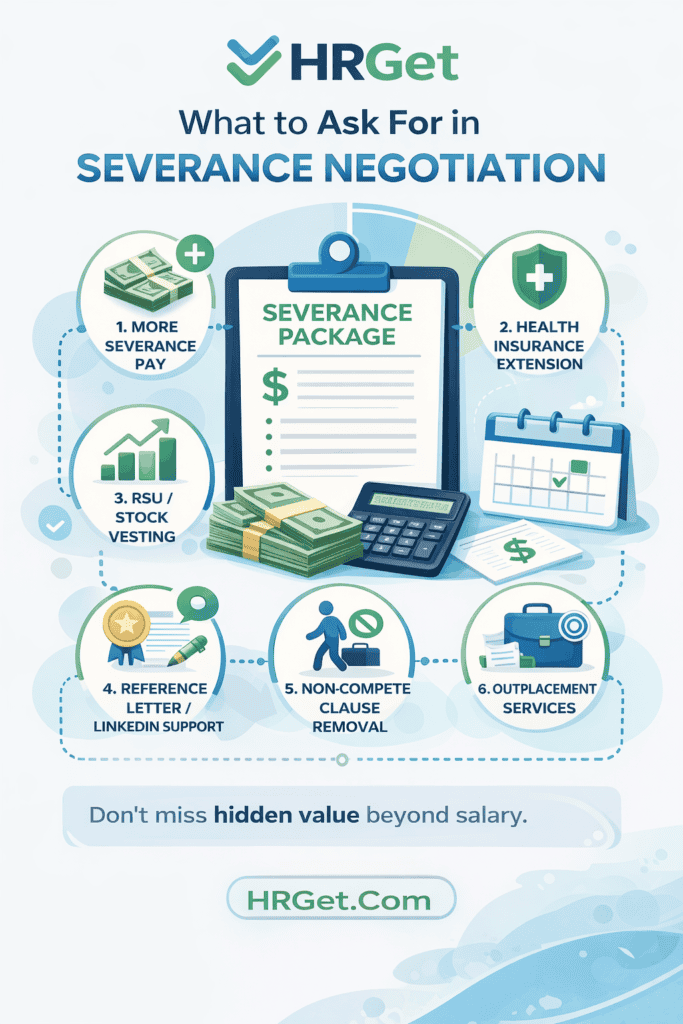
What to Ask For: The Most Overlooked Severance Items
Most employees think “severance negotiation” means asking for more weeks of pay. That’s table stakes. The real value — and the items companies are often more willing to concede — sits elsewhere.
Health Insurance Extension (COBRA Subsidy)
In the US, COBRA continuation coverage can cost $600–$800/month for an individual and $1,800–$2,200/month for a family. If a company agrees to cover your COBRA premiums for even three months, that’s potentially $5,000–$6,000 of real value — often easier to approve than additional salary weeks.
RSU Acceleration or Extended Exercise Windows
This is the most underestimated item on almost every severance agreement. If you have unvested restricted stock units (RSUs) or options, the standard policy is “you lose them upon termination.” But that’s a policy, not a law. Companies regularly make exceptions — especially for senior employees or those laid off close to a vesting cliff. For someone with $50,000–$200,000 in unvested equity, this ask alone can dwarf the value of any pay negotiation.
Non-Compete Clause Removal or Narrowing
A broad non-compete that bars you from working in your industry for 12 months within 50 miles isn’t just inconvenient — it’s potentially career-limiting. Push to remove it entirely, or narrow the scope to specific direct competitors, with a shortened duration (3–6 months maximum).
Reference Letter and LinkedIn Terms
Ask for a pre-written, signed reference letter from your direct manager. Also negotiate what the official company response will be to reference checks — at minimum, you want confirmation of employment dates, title, and eligibility for rehire. This protects your next job search in ways money can’t.
Extended Official Exit Date
Staying “on payroll” for an extra 30–60 days — even without active work — keeps you employed on paper during your job search. This matters for background checks, loan applications, and simply the optics of being actively employed when you apply.
Outplacement Services
Many companies have vendor contracts with outplacement firms (Lee Hecht Harrison, Right Management) that provide career coaching, resume help, and interview prep. It costs the company almost nothing extra to add you to an existing contract. Worth asking.
Real Scenario: Smart vs. Rushed Negotiation
Sarah, a Senior Product Manager at a US tech company, 4.5 years of tenure, $145,000 base salary, laid off in a company-wide restructuring.
Initial offer: 10 weeks of base salary, health insurance through end of month, standard NDA/non-compete, 850 unvested RSUs forfeited.
What Sarah almost did: Sign within 48 hours because she was scared and the package looked “fine.”
What Sarah actually did: Took 10 days to review. Identified that her RSU tranche of 850 units was vesting in 6 weeks. Made a calm, specific counter-proposal in writing — 14 weeks of base pay, 3 months of COBRA coverage, RSU acceleration on the imminent tranche, and removal of the non-compete covering her direct next employer.
What she got: 13 weeks of pay (not 14, but a real improvement), 2 months of COBRA covered, 425 of the RSUs accelerated, and the non-compete narrowed to 3 months. At her RSU price of ~$38/unit, that equity alone was worth roughly $16,000.
The total additional value from one professional email: over $28,000. Her instinct to “just sign and move on” would have cost her that.
The Insider View: What HR Is Actually Thinking During Severance Negotiations
I spent years on the employer side of these conversations. Here’s what HR is actually calculating — and what that means for you.
HR’s primary goal is a clean, documented exit. They do not want disputes, negative Glassdoor reviews, complaints to the NLRB, or WARN Act violations. Every day a laid-off employee is “unhappy” represents legal and reputational risk. That risk is your leverage — use it quietly, not loudly.
Most HR professionals have a range, not a fixed number. When they present “10 weeks,” they likely have authorization to go to 12 or 13 without escalating. They’re not lying when they say the package is standard — it is standard. But standard doesn’t mean maximum.
The phrase “this is our standard package” is technically true and strategically misleading at the same time. It tells you what the company’s default is — not what’s possible. Senior HR professionals know that most employees don’t push back, and they’re not lying when they say it’s standard. They’re just not telling you the ceiling. Your job is to find it.
Legal risk escalates their flexibility fast. If you mention — calmly, without threatening — that you have questions about how your role was selected for the reduction, or that you’d like clarity on the discrimination review process, HR’s posture often shifts noticeably. You don’t need to threaten. Just asking the right questions signals awareness. That changes the calculus.
Common Mistakes That Cost Employees Thousands
Signing Too Fast
The single most expensive mistake. Companies know that employees in emotional distress sign quickly. The review period exists for a reason — use all of it, even if you think the offer looks reasonable.
Negotiating With Emotion Instead of Evidence
“I’m really struggling financially” doesn’t help your case — it signals desperation. “Based on my 6 years of tenure and industry benchmarks of 1–2 weeks per year of service, I’d like to propose 14 weeks” is a business conversation. HR responds to the latter, not the former.
Ignoring the Legal Clauses
The release of claims section isn’t boilerplate you skip. You’re waiving significant legal rights. At minimum, understand what you’re releasing. If there’s any possibility of a discrimination claim, harassment complaint, or retaliation issue, you should not sign without having an employment lawyer review the agreement first.
Forgetting About Equity
If you have any unvested RSUs, options, or performance shares, their treatment in the severance agreement is often worth more than weeks of additional salary. Don’t let the conversation end without specifically addressing what happens to your equity.
Over-Negotiating and Souring the Relationship
There’s a difference between advocating professionally and making a drawn-out adversarial negotiation out of a standard layoff. Push once, clearly and specifically. If they meet you partway, accept it graciously. You’ll need references, and the professional world is smaller than it feels in that meeting room.
If your severance agreement contains an arbitration clause, a broad class action waiver, or language releasing claims you don’t fully understand — stop. Don’t sign until an employment attorney has reviewed it. These clauses can permanently foreclose legal options that may be worth far more than the severance itself.
When to Bring in an Employment Lawyer
You don’t always need a lawyer — and for a straightforward severance at a mid-level role, the cost (typically $300–$600/hour for a good employment attorney) may not justify the expected improvement. But there are clear situations where legal review is non-negotiable.
- You suspect your layoff was discriminatory — based on age, race, gender, disability, or protected activity (whistleblowing, FMLA use)
- You’re in a senior leadership or executive role where the severance value is $100,000 or more
- The release of claims language is unusually broad — covering claims you don’t understand or that feel disproportionate
- The non-compete is aggressive and covers most of your realistic next job options
- There’s an ongoing internal investigation or you’ve recently filed an HR complaint
A competent employment attorney can often pay for themselves many times over — not just by increasing the package, but by protecting you from signing away rights that matter more than the check itself.
Final Checklist Before You Sign
Before your pen touches that agreement, run through every item below. If any one of these is unclear or unresolved — don’t sign yet.
- Severance pay amount and payment structure (lump sum vs. continuation) are both specified and acceptable
- Health insurance continuation dates are clearly stated and match what was negotiated
- RSU / equity treatment is explicitly addressed — not left to “standard policy”
- Non-compete scope, geography, and duration are reasonable for your next career move
- Release of claims section has been read and understood (or reviewed by an attorney)
- Reference terms and official separation language are documented
- Official last day of employment is stated and agrees with your records
- Every item verbally agreed during negotiation appears in the written document
- You have a copy of the fully executed agreement (signed by both parties)
Frequently Asked Questions
Here’s the uncomfortable reality: when you receive a severance package, the company has already been optimizing for its interests for weeks. They’ve worked with legal, finalized the numbers, and prepared the documentation. You have, at most, a few days to review it cold.
That’s exactly why the advice to “take your time, make a specific ask, and get everything in writing” isn’t just best practice — it’s the only way to level a fundamentally uneven situation. Knowing how to negotiate a layoff severance package isn’t about being difficult. It’s about being prepared.
Take the time. Make the ask. Protect your transition.
Want to calculate how much severance you should be entitled to?

Michael Reeves | Former Senior Counsel, Littler Mendelson | Severance & Restructuring Specialist | 18+ Years in Employment Law
Author bio: Michael Reeves spent nearly two decades as Senior Counsel at Littler Mendelson — one of the world’s largest employment law firms — advising on mass layoffs, corporate restructurings, and severance negotiations for Fortune 500 companies across the US and Europe. He has worked both sides of the table: structuring cost-efficient separation packages for employers and, more recently, helping employees understand exactly where their leverage lies. Based between Chicago and London, Michael writes for HRGet.com to demystify the legal and financial dimensions of layoffs — so employees stop leaving money on the table.