Let me say something that most HR tech vendors won’t: the majority of HR performance review software on the market doesn’t actually fix your review problem. It digitizes it. And a broken process running on expensive software is still a broken process — it just costs more.
I’ve spent 17 years implementing and advising on performance management systems across 40+ organizations — from 30-person startups to 12,000-person global enterprises. I’ve seen Workday rollouts that transformed how companies develop talent, and I’ve seen Lattice deployments that nobody used six months later because the culture wasn’t ready.
This guide cuts through the vendor noise. I’ll show you which tools genuinely reduce bias, which are overbuilt for their audience, and how to make a decision you won’t regret in 12 months.
Why Performance Reviews Fail — And Why Software Alone Won’t Save You
Every year, Gallup and similar research firms resurface the same finding: most employees don’t believe their performance review accurately reflects their work. And every year, HR teams respond by evaluating a new software platform.
Here’s the uncomfortable truth — the software isn’t the problem. The process is.
Three structural failures kill the integrity of most reviews before they even start:
Recency bias is the most pervasive. A manager conducting an annual review on December 15th is mostly reviewing October and November. The eight months before that — including the stretch where an employee carried a failing project — barely registers. Studies in organizational psychology consistently show that without systematic note-taking, managers recall roughly the last 6–8 weeks of performance when rating employees.
Halo and horn effects are equally damaging. Employees who present confidently in meetings get rated higher on execution — even when the actual execution data doesn’t support it. I’ve seen quiet engineers with 98% OKR completion scores rated “meets expectations” while their more vocal peers who hit 70% scored “exceeds.” The manager wasn’t malicious. They were just human.
Lack of calibration is the third failure. Without a cross-team view of ratings, departments inflate scores independently. Your engineering team’s “4 out of 5” means something completely different from your sales team’s “4 out of 5.” When merit budgets get distributed, the injustice becomes obvious — and it destroys trust.
Insider View:
When I was leading HR systems at a 3,000-person SaaS company, we found that 22% of managers hadn’t logged a single piece of feedback in the 12 months before annual reviews. Not one note. They were rating employees from memory alone. That’s not a software problem — that’s a management accountability problem. The right software creates the friction that forces better habits. But only if leadership commits to using it.
What “Fair” Actually Means in a Performance Evaluation System
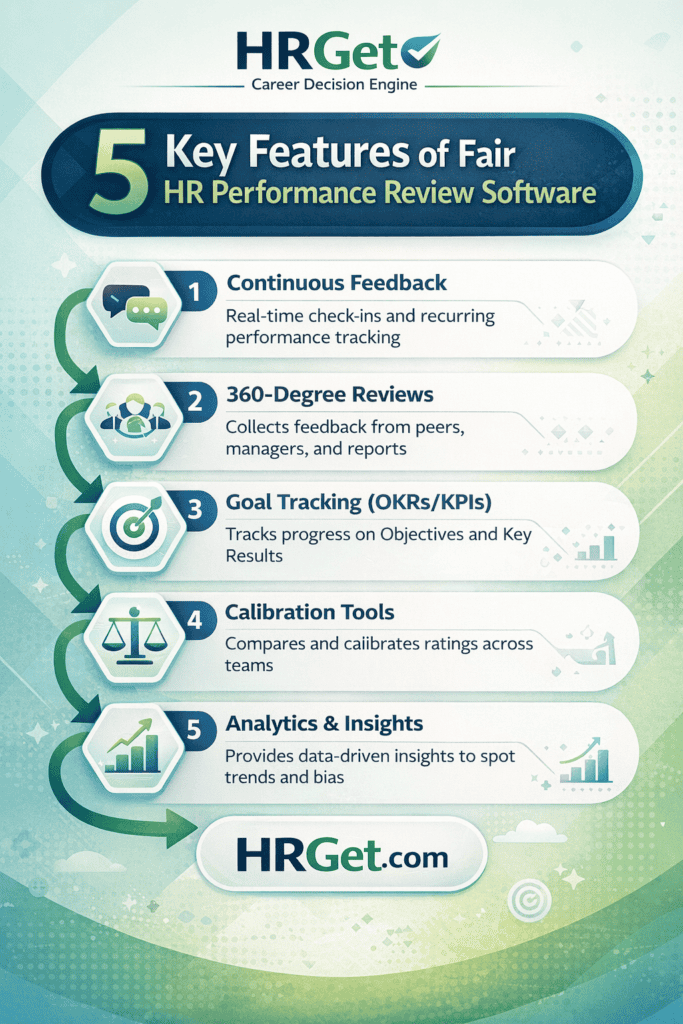
Before you evaluate any tool, you need to agree internally on what fairness requires. These are the five non-negotiables I’ve seen separate genuinely fair evaluation systems from theater:
Continuous data capture. Reviews must draw on a documented record — not a manager’s memory. This means the system needs to support ongoing check-ins, feedback logging, and goal tracking throughout the year. Not just at review time.
Multi-source input. 360-degree feedback isn’t just a nice feature — it’s essential for reducing single-manager bias. When peer feedback, direct report feedback, and self-assessments are part of the formal record, the picture gets significantly more accurate.
Calibration tooling. The software must allow HR and senior leaders to see ratings across teams simultaneously. Calibration sessions — where managers jointly discuss their ratings before they’re finalized — are the single most effective bias-reduction intervention that exists. Without tooling that supports this, calibration becomes chaotic.
Goal visibility and alignment. Employees should be able to see their goals, how they’re being measured, and how their objectives connect to team and company priorities. Hidden or ambiguous success criteria are a fairness problem, not just an engagement problem.
Audit trail. Every rating change, feedback submission, and calibration adjustment should be logged. This protects employees from arbitrary score changes after the fact and gives HR leaders visibility into manager behavior patterns.
Best HR Performance Review Software for 2026: Ranked by Use Case
I’m not going to give you a ranked list of “best to worst” — because that framing is misleading. The right tool depends entirely on your company size, maturity level, and what problem you’re actually trying to solve. Here’s how I’d segment the market in 2026:
Lattice — Mid-size to Large Companies (200–5,000 employees)
Lattice has become the go-to platform for companies that want to build a continuous feedback culture, not just run annual reviews. The combination of 1:1 tracking, real-time feedback, OKR management, and performance reviews in a single interface is genuinely useful — and it’s one of the few tools where managers actually adopt the feedback features voluntarily.
- Standout feature: Growth plans linked directly to performance reviews, so development conversations don’t sit separate from evaluation conversations
- Real limitation: The reporting suite is functional but not deep. If you’re an analytics-heavy HR team, you’ll find yourself exporting to spreadsheets more than you’d like
- Pricing: Starts around $11–$15 per person/month depending on modules; budget accordingly for a 500-person org
15Five — Growth-Stage Companies (50–500 employees)
15Five earns its reputation by connecting performance data with employee sentiment — something almost no other platform does well. The weekly check-in model means managers have a rolling record of what employees are working on, what’s blocking them, and how they’re feeling. When review time comes, you’re drawing on 52 weeks of data, not 3.
- Standout feature: High-fives and engagement signals built into the flow — employees feel seen throughout the year, not just during review cycles
- Real limitation: The 360 feedback module is less configurable than Lattice or Leapsome; if you need complex multi-rater frameworks, it may feel constrained
- Pricing: Engage plan starts around $4/person/month; full Performance suite around $14/person/month
Leapsome — Tech and Analytics-Heavy Organizations
If your HR team runs on data and your leadership team asks hard questions about performance distribution, rating inflation, and manager consistency, Leapsome is the most sophisticated mid-market option available. Its analytics capabilities are closer to enterprise-grade than anything else in this price range.
- Standout feature: Calibration view that shows rating distributions across managers in real time — this alone is worth the subscription for companies trying to eliminate grade inflation
- Real limitation: Implementation is non-trivial. Budget 6–8 weeks for proper setup and manager training, or you’ll underuse what you’re paying for
- Pricing: Custom pricing; typically $8–$16/person/month depending on company size and modules
BambooHR Performance — Small Companies (10–150 employees)
BambooHR doesn’t try to be a comprehensive performance platform. It tries to be good enough for companies that need something structured but don’t have a dedicated HR tech team to manage a complex rollout. And on those terms, it delivers.
- Standout feature: Bundled with the BambooHR HRIS, so employee data flows automatically — no manual syncing or integration headaches
- Real limitation: No native OKR management, limited 360 feedback customization, and analytics are basic. This is a starting point, not a destination for scaling companies
- Pricing: Bundled into BambooHR plans; performance module typically adds ~$5–$8/person/month above base
Workday Performance Management — Large Enterprises (1,000+ employees)
Workday is in its own category. The performance module is deeply integrated with compensation, succession planning, learning, and workforce analytics — which makes it uniquely powerful for large organizations that need those connections to actually work. If you’re managing 5,000+ employees across multiple countries, that integration is worth its weight in implementation hours.
- Standout feature: The ability to link performance outcomes directly to compensation decisions, succession pools, and learning assignments within a single system of record
- Real limitation: Expensive, complex, and slow to configure. Implementation typically takes 6–18 months. Not for companies under 500 employees — full stop
- Pricing: Enterprise pricing only; expect total cost of ownership (including implementation) to be significant
Culture Amp — Companies Prioritizing Retention Strategy
Culture Amp approaches performance through the lens of engagement and retention, which makes it particularly valuable if you’re in a high-turnover industry or trying to understand the relationship between how people feel and how they perform. Their benchmarking data — drawn from thousands of companies — gives HR leaders external comparison points that are genuinely rare.
- Standout feature: Industry benchmarking on both engagement and performance metrics, so you can tell whether your scores are good in absolute terms or just good relative to a low baseline
- Real limitation: Performance management features are less mature than Culture Amp’s engagement features. If reviews are your primary use case, Lattice or Leapsome will feel more purpose-built
- Pricing: Custom; typically $5–$11/person/month for the performance module
Real Scenario: Biased Review vs. Structured Evaluation
Real Scenario:
The situation: Priya is a senior product manager at a 400-person SaaS company. She’s been on the team for two years. She’s methodical, detail-oriented, and consistently delivers — but she doesn’t speak up much in executive meetings. Her manager, who values visible leadership, gives her a 3/5 rating (“meets expectations”) at year-end review. Meanwhile, a male peer who’s missed two product launches rates 4/5 because he presents confidently in leadership reviews and has strong relationships with senior stakeholders.
Without software: Priya’s rating stands. She doesn’t get promoted. She starts job searching six months later. The company loses $120K+ in replacement costs for a high performer it didn’t recognize.
With a structured system (Leapsome or Lattice): HR runs a calibration session. The system shows Priya’s OKR completion at 94% vs her peer’s 61%. Peer feedback scores tell the same story. The manager’s instinct is checked by data. Priya gets a 4/5. She gets the promotion she deserved. She stays. The peer gets a development conversation about execution gaps.
That’s not a hypothetical. I’ve watched this exact dynamic play out — in both directions — more times than I can count.
How to Choose the Right Performance Management Tool
Most buying guides tell you to “evaluate your needs.” That’s unhelpful. Here’s how I’d actually walk through this decision:
Step 1: Be Honest About Your Process Maturity
If your managers don’t currently have structured 1:1s, don’t log feedback, and treat goal-setting as a once-a-year checkbox — you don’t need a sophisticated platform. You need BambooHR or 15Five and a 90-day change management program. Buying Leapsome when your managers haven’t built basic feedback habits is like buying a professional chef’s kitchen when you can’t scramble eggs.
Step 2: Match the Tool to Your Primary Problem
| Primary Problem | Best Tool Match | Why |
|---|---|---|
| Manager bias in ratings | Leapsome | Calibration tooling is the strongest in the mid-market |
| Low employee engagement | 15Five | Connects engagement signals to performance data |
| Lack of feedback culture | Lattice | Feedback loops are embedded in day-to-day workflow |
| Simple, fast setup | BambooHR | Bundled with HRIS, minimal training required |
| Multi-country enterprise | Workday | Only platform with true global compliance depth |
| High attrition, culture problems | Culture Amp | Benchmarking + engagement data surfaces root causes |
Step 3: Budget Realistically — Including Implementation
Per-seat pricing is the visible cost. The invisible cost is implementation, training, and ongoing administration. For a 200-person company, budget 3x the annual software cost for year-one total cost of ownership. This is especially true for Leapsome and Workday, where poor configuration can make the tool actively counterproductive.
Watch Out:
Free trials are almost always scoped to core features. The calibration, analytics, and integration capabilities — the ones that actually justify the cost — are often locked behind enterprise tiers or add-on modules. Always request a demo of the specific features that solve your primary problem, not a polished product tour of the flagship UI.
Common Mistakes That Kill Performance Review ROI
I’ve watched companies spend $80,000 on software and see zero measurable improvement in review quality. Almost always, one of these four mistakes is responsible:
Digitizing a broken review structure. If you run annual reviews with vague competencies and no calibration process, moving that structure into Lattice doesn’t fix it. You get the same biased outcomes with a cleaner UI. Software implementation must come alongside process redesign — not instead of it.
Skipping manager training. The most sophisticated performance platform in the world will fail if managers don’t know how to give useful feedback, document performance observations, or have honest development conversations. In my experience, companies that invest $15,000 in manager training alongside a software rollout see 3–4x better adoption than those who skip it.
Too many competencies and KPIs. There is a direct correlation between the number of competencies in your review framework and the quality of manager responses. When you ask a manager to rate someone on 14 different dimensions, they default to intellectual shortcuts. Three to five focused competencies with clear behavioral anchors consistently produce more accurate ratings than twelve vague ones.
Treating annual reviews as the primary evaluation event. If your employees only receive formal feedback once a year, you’ve already failed them — regardless of how sophisticated your review platform is. Annual reviews should be a summary of a year’s worth of documented conversations. If the year-end form is where feedback starts, the tool is a formality, not a system.
Smart Strategy: The Rhythm That High-Growth Teams Actually Use
Pro Tip:
The companies I’ve seen get the most from their performance software — in terms of retention, engagement, and actual performance improvement — don’t think in “annual review cycles.” They think in feedback rhythms. The software is just the container. The discipline is the practice.
Here’s the specific cadence that consistently works for companies between 100 and 2,000 employees:
Weekly: Structured 1:1s between manager and direct report. 15–30 minutes. The agenda includes: what’s progressing, what’s blocked, one piece of specific feedback (positive or developmental). This gets logged in the platform — not written up, just tagged. Takes 5 minutes of admin time.
Monthly: Brief check-in on goal progress. Where are you against your quarterly OKRs? Any context changes that affect the plan? This can be asynchronous — a quick comment thread in the platform works fine. The goal is that both parties stay synced on expectations.
Quarterly: Formal but lightweight review. 30–45 minute conversation. Review OKR progress, discuss one key strength and one key development area, agree on next quarter’s priorities. Document the summary in the platform. This is where 360 input becomes useful — quarterly cycles are the right frequency for peer feedback without triggering survey fatigue.
Annually: Comprehensive performance review tied to compensation decisions. This conversation should contain no surprises — because you’ve been having the real conversations all year. The annual review becomes a formal record of what both parties already know, plus a forward-looking career development discussion.
The platform that supports this rhythm doesn’t need to be the most expensive one available. It needs to make these touchpoints frictionless for managers and visible to HR leadership. That’s the bar.
Frequently Asked Questions
What is HR performance review software?
HR performance review software is a platform that helps organizations evaluate employee performance using structured data, continuous feedback, and goal tracking — replacing subjective manager memory with documented, comparable information. The best systems include 360-degree feedback, OKR/KPI tracking, calibration tools, and analytics that surface patterns in ratings across managers and teams.
How does performance management software reduce bias in evaluations?
It reduces bias through three primary mechanisms: calibration sessions that let HR compare ratings across managers simultaneously, multi-source feedback that dilutes any single manager’s subjective view, and continuous data capture that ensures reviews draw on a full year of documented performance rather than recent memory alone. None of these completely eliminate bias — but they create structural friction that makes biased decisions visible and challengeable.
What is the best performance review software for small companies?
For companies under 150 employees, BambooHR’s performance module is the most practical starting point — it integrates with the HRIS and requires minimal setup. 15Five is a better choice if engagement data matters alongside performance; their $4/person/month Engage plan gives you meaningful signal without overwhelming your HR team. Avoid enterprise-grade tools like Workday at this scale — the implementation burden exceeds the value you’ll get.
How often should performance reviews happen?
Annual-only reviews are consistently associated with lower employee engagement and less accurate performance data. The research-backed best practice is quarterly formal reviews supported by monthly goal check-ins and weekly 1:1s. If that feels like too much process, start with semi-annual reviews and structured weekly 1:1s — that alone is a significant improvement over a once-a-year conversation built on 12 months of undocumented memory.
Can performance review software replace manager judgment?
No — and it shouldn’t try to. The value of these tools is that they inform and constrain manager judgment, not replace it. A manager still decides what weight to give peer feedback vs. their own observations. A calibration tool still needs a skilled HR leader to facilitate the conversation. Software surfaces data; humans interpret it. The goal is better-informed decisions, not automated ones.
What’s the difference between performance review software and a full HRIS?
An HRIS (Human Resource Information System) is the system of record for employee data — headcount, compensation history, benefits, compliance. Performance review software is specialized for evaluation workflows: feedback cycles, goal tracking, review forms, and calibration. Some platforms like Workday and BambooHR offer both. Others like Lattice and Leapsome are pure performance tools that integrate with your HRIS via API. If you need both, evaluate integrated solutions first to reduce data fragmentation.
How long does it take to implement performance review software?
BambooHR can be live in under two weeks for a 50-person company. Lattice and 15Five typically take 4–8 weeks including configuration, manager training, and a pilot cycle. Leapsome is closer to 6–10 weeks for a proper implementation. Workday implementations are in a different class entirely — 12–18 months for a large enterprise is standard, and under-resourced implementations routinely extend past 24 months. Budget time as carefully as you budget cost.
The Bottom Line
The best HR performance review software is whichever tool your managers will actually use consistently — supported by a feedback culture your leadership has genuinely committed to. For most mid-size companies, Lattice or 15Five will get you 90% of the way there. If calibration and analytics are your priority, Leapsome is worth the implementation investment. Enterprise clients with multi-country operations should be evaluating Workday. What none of these tools can do is substitute for leadership accountability and manager training. Start there. Then buy the platform.
If you’re evaluating your broader HR tech stack alongside performance management, read our guide to the best HRIS software for small and mid-size businesses — it covers how to sequence your HR technology investments to avoid paying for overlapping features across multiple platforms.
Still deciding between platforms? Use our HR Software Comparison Tool to match your company size and priorities to the right performance management solution.

David Schneider : HR Technology Consultant & Former Head of People Systems | Former SAP SuccessFactors Implementation Lead | HR Tech Consultant (Workday, ADP) | 17+ Years in People Systems
David Schneider has spent 17 years on the implementation side of HR technology — the part vendors never show you in the demo. As a former SAP SuccessFactors implementation lead and Head of People Systems, he has designed and deployed HRIS, payroll, ATS, and performance management systems for organisations ranging from 1,000 to 50,000 employees across Europe and North America. He has advised enterprise clients on Workday and ADP migrations, untangled integration disasters, and helped HR teams understand why they’re overpaying for tools they’re only using at 30% capacity. Based between Berlin and New York, David writes for HRGet.com to give buyers the honest, implementation-level perspective that analyst reports and vendor case studies never will.