Payroll is the one area where being “pretty good” isn’t good enough.
Miss a tax deadline, misclassify an employee, or botch a direct deposit — and you’re looking at IRS penalties, angry staff, and a compliance headache that takes weeks to untangle. I’ve seen it happen to smart founders who simply picked the wrong payroll software at the wrong stage of their business.
The Gusto vs ADP vs Paychex debate isn’t really about features. It’s about fit. The right tool at 10 employees will actively hurt you at 100 — and the enterprise-grade platform that sounds impressive will overwhelm a founder running payroll solo on a Tuesday night.
This guide gives you the honest comparison. No affiliate spin, no vague “it depends” answers. Just a clear framework so you walk away knowing exactly which platform belongs in your business right now.
Quick Verdict: Which One Wins?
Here’s the blunt answer before we get into the details:
Gusto is the best starting point for most small businesses — clean interface, transparent pricing, solid compliance for teams under 50 people.
ADP is the right call when you’re scaling aggressively, operating across multiple states, or need enterprise-grade compliance tools with a dedicated HR team to manage them.
Paychex lives in the middle — more flexible than Gusto, less overwhelming than ADP, and genuinely strong on human support. It’s the right pick for businesses that want guidance, not just software.
Now, here’s what most comparison articles won’t tell you: the “best” platform is almost always the one you’ll actually use correctly. A powerful system used badly is worse than a simpler one used well. Keep that in mind as you read.
Pricing Breakdown — What They Don’t Advertise
Let’s start with money, because that’s usually where the conversation begins — and where it gets muddiest.
Gusto is the most transparent of the three. Their Simple plan starts at around $40/month base plus $6 per employee per month. The Plus plan (which includes time tracking, next-day direct deposit, and scheduling) runs about $80/month plus $12 per person. For a 10-person team, you’re looking at roughly $100–$200/month all-in. That’s genuinely affordable, and there are almost no surprise add-ons for core features.
ADP doesn’t publish pricing publicly, which is a red flag worth noting. You have to request a quote, and the final number depends heavily on your employee count, the modules you need, and frankly how good you are at negotiating. From what businesses consistently report, ADP’s RUN platform (built for small businesses) starts around $59/month for very small teams — but the price climbs quickly once you add workers’ comp, HR advisory services, or background checks. For a 25-person team with moderate HR needs, $300–$500/month is a realistic expectation.
Paychex sits somewhere between the two on pricing. Their Flex Essentials plan is competitive with Gusto at the entry level, but like ADP, costs escalate as you add modules — HR advisors, benefits administration, time and attendance. The lack of full pricing transparency is a minor frustration.
The honest insight here: Gusto’s total cost of ownership at under 50 employees is almost always lower. ADP and Paychex recoup their value through compliance insurance and HR support — which matters enormously once you’re beyond that threshold.
Ease of Use: Where Most Payroll Tools Fail Small Businesses
I’ll be direct: most founders picking payroll software aren’t HR professionals. They’re running operations, closing sales, and doing payroll on Friday afternoon before heading out.
Gusto was designed for exactly that person.
The interface is clean, the onboarding flow is genuinely intuitive, and running payroll takes about 5 minutes once your team is set up. Employee self-service is excellent — new hires can complete their own onboarding, add bank details, and access pay stubs without calling you. For a solo founder or a team without dedicated HR staff, this matters more than any enterprise feature.
ADP is powerful in ways that can work against you if you’re under-resourced.
The RUN by ADP platform has improved considerably, but it still carries that “enterprise software” feel — lots of menus, more clicks than you’d like, and a learning curve that takes a few weeks to flatten. If you have an office manager or HR coordinator handling payroll, ADP becomes manageable. If you’re doing it yourself between other responsibilities, it’s going to slow you down.
Paychex lands in the middle, with one advantage the others don’t fully match: human support.
Paychex assigns dedicated payroll specialists to accounts, which means when something goes wrong (and eventually something always does), you’re calling a person who knows your account — not navigating a support queue. For business owners who are not comfortable handling compliance questions solo, that peace of mind has real dollar value.
Compliance and Tax Filing: Where Bad Decisions Get Expensive
This is the section that actually determines whether your payroll software choice costs you money or saves it.
Payroll compliance in the US is genuinely complicated. You’re managing federal income tax withholding, FICA taxes (Social Security and Medicare), FUTA, state income taxes, state unemployment insurance (SUI), and in some cities, local taxes on top of all that. Get any of it wrong, and the IRS doesn’t care that it was a software error.
Gusto handles automatic tax filing across all plans. Federal, state, and local payroll taxes are calculated, filed, and paid on your behalf. They also handle year-end W-2s and 1099s. For single-state businesses with W-2 employees and straightforward contractor setups, Gusto’s compliance coverage is genuinely sufficient. Where Gusto shows limits is multi-state payroll — it handles it, but it’s not as seamlessly battle-tested as ADP for businesses with employees scattered across 8+ states.
ADP is the industry benchmark for compliance, full stop.
If you’re operating in multiple states, managing international employees, working in a regulated industry (healthcare, finance, construction), or have any exposure to union payroll rules — ADP’s compliance infrastructure is worth the premium. They have dedicated compliance specialists, real-time regulatory updates, and audit support that other platforms simply can’t match at scale.
Paychex is strong on compliance and notably better than most people give it credit for.
Their tax filing accuracy is reliable, they handle multi-state payroll competently, and they offer HR advisory services that can flag compliance risks before they become problems. For businesses in the 25–100 employee range navigating growing complexity, Paychex’s compliance toolkit is more than adequate.
Pro Tip: If your business operates in California, New York, or Illinois — states with notoriously complex labor laws — I’d lean toward ADP or Paychex over Gusto simply for the compliance depth. The extra monthly cost is cheap insurance against a $10,000+ penalty.
HR and Benefits: Beyond Just Cutting Paychecks
Payroll is where these platforms start. Benefits and HR is where they really differentiate.
Gusto’s benefits capabilities are surprisingly strong for its price point. Health insurance, dental, vision, 401(k) administration, HSAs, FSAs, and commuter benefits are all available through Gusto’s licensed insurance brokerage. The integration with payroll is seamless — benefits deductions update automatically when coverage changes. For a small team that wants to offer competitive benefits without a dedicated benefits administrator, Gusto handles it well.
What Gusto doesn’t have: performance management, advanced HR analytics, talent acquisition tools, or anything resembling enterprise workforce planning. It’s a payroll-first platform with solid benefits layered on top.
ADP offers a full human capital management (HCM) suite through ADP Workforce Now, which covers everything from applicant tracking and onboarding through performance management, learning and development, and workforce analytics. For a company with 150+ employees and a real HR team, this depth is invaluable. For a 20-person startup, it’s mostly unused complexity.
Paychex sits squarely between the two and arguably has the best balance for a business in growth mode. Their HR advisory service — where you get access to certified HR professionals for guidance on terminations, policy questions, and compliance issues — is something neither Gusto nor ADP matches at the mid-market level. That’s a real differentiator.
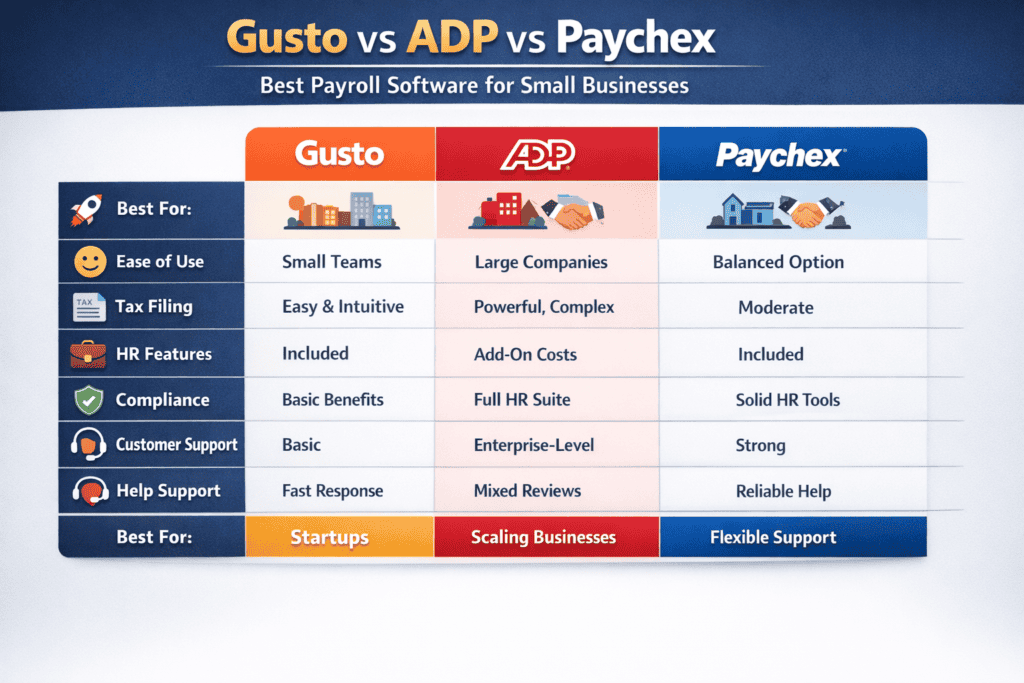
Feature-by-Feature Comparison Table
| Feature | Gusto | ADP RUN | Paychex Flex |
|---|---|---|---|
| Transparent Pricing | ✅ Yes | ❌ No | ⚠️ Partial |
| Automatic Tax Filing | ✅ Included | ✅ Included | ✅ Included |
| Multi-State Payroll | ⚠️ Available | ✅ Strong | ✅ Strong |
| Employee Self-Service | ✅ Excellent | ✅ Good | ⚠️ Decent |
| Benefits Administration | ✅ Built-in | ✅ Extensive | ✅ Strong |
| HR Advisory Support | ❌ No | ⚠️ Add-on | ✅ Included in plans |
| Time & Attendance | ⚠️ Plus plan+ | ✅ Available | ✅ Available |
| Contractor Payments | ✅ Yes | ✅ Yes | ✅ Yes |
| QuickBooks Integration | ✅ Native | ✅ Native | ✅ Available |
| Mobile App Quality | ✅ Strong | ⚠️ Functional | ⚠️ Functional |
| Customer Support | ✅ Fast (chat/email) | ⚠️ Mixed reviews | ✅ Dedicated specialist |
| Best For | 1–50 employees | 100+ employees | 25–150 employees |
Real Scenario: Which Platform Fits Your Stage?
Here are three situations I see play out constantly. Find the one closest to yours.
Scenario A — The Solo Founder at 8 Employees
You’re running a SaaS startup. Eight full-time employees, two part-time contractors. You handle payroll yourself, usually on the last Thursday of the month. You don’t have an HR manager. Benefits are basic right now, but you want to offer health insurance soon.
The right call is Gusto. You’ll be set up in an afternoon, running payroll will take under 10 minutes, and when you’re ready to add health benefits, it’s a few clicks inside the same platform. At around $88/month for your team size, it’s money well spent.
Scenario B — The Growing Company at 60 Employees
You’ve got a VP of Operations who handles HR. You’re adding employees in two new states this quarter. Benefits are getting complex — 401(k) matching, health insurance with multiple tiers, some remote workers on different state tax schedules.
Paychex Flex is your call here. The dedicated specialist means your VP has a real human to call when state compliance questions come up. The multi-state payroll is handled reliably, and the HR advisory add-on is worth every dollar at this stage.
Scenario C — The Scaling Company at 200 Employees
You have a full HR team, a CFO reviewing workforce costs quarterly, and operations in six states. Compliance exposure is real. You need audit trails, advanced reporting, and the ability to build out performance management without switching platforms in 18 months.
ADP Workforce Now. The cost is higher, but you’re not buying convenience — you’re buying infrastructure. At this scale, a single missed state compliance update can cost more than ADP’s annual contract.
Common Mistakes Small Business Owners Make
1. Choosing based on brand recognition alone
ADP is the biggest name in payroll. That doesn’t mean it’s the right fit for a 12-person agency. Brand trust and product fit are different things.
2. Not accounting for growth trajectory
The platform that’s perfect today can become a migration nightmare at 75 employees. Think about where you’ll be in 18 months, not just right now. Switching payroll providers mid-year is painful — it touches tax filings, employee records, and benefits data simultaneously.
3. Underweighting the cost of poor support
When payroll goes wrong, it goes wrong on Friday afternoon. Gusto’s support is fast and helpful during business hours. ADP’s support reputation is mixed — some users report long hold times. Paychex’s dedicated specialist model shines in exactly these moments.
4. Ignoring integration needs
Your payroll software needs to talk to your accounting platform (QuickBooks, Xero, NetSuite), your time tracking tool, and potentially your benefits broker. Before you commit, map your existing tech stack and verify native integrations. Workarounds here cost hours every month.
5. Treating payroll software as a commodity
It’s not. Payroll software is compliance infrastructure. The wrong choice doesn’t just inconvenience you — it exposes you to IRS penalties, state labor board audits, and employee trust issues that are hard to recover from.
Smart Strategy: How to Choose in 10 Minutes
Stop overthinking it. Run through this decision framework:
Step 1: Count your employees and project 18 months out. Under 50 today and under 100 in 18 months → Gusto. 50–150 range → Paychex. 150+ or scaling aggressively across states → ADP.
Step 2: Assess who’s actually running payroll. Solo founder or office manager without HR training → needs Gusto’s simplicity. Dedicated HR coordinator → can handle Paychex. Full HR/Finance team → ready for ADP’s complexity.
Step 3: Map your compliance exposure. Single state, W-2 only, simple contractor setup → Gusto is fine. Multi-state, regulated industry, or union payroll → don’t compromise. Go ADP or Paychex.
Step 4: Request demos, not just pricing. Every platform offers free demos. Take them. Run a mock payroll, call support with a test question, and see how the interface feels on your worst day — not your best.
One thing I’d add: don’t let the demo salesperson upsell you on modules you don’t need yet. Start with the core payroll plan and add features as you grow into them.
FAQs
Is Gusto better than ADP for small businesses?
For most small businesses under 50 employees, yes. Gusto is easier to use, more transparent on pricing, and covers the core payroll and benefits needs of small teams without the complexity that ADP brings. ADP earns its premium at scale — 100+ employees, multi-state operations, and enterprise compliance needs. Under that threshold, Gusto wins on value and usability.
How much does ADP cost for a small business with 10 employees?
ADP doesn’t publish prices publicly, but based on consistent market reports, a 10-person team on ADP RUN typically runs $100–$180/month depending on the plan tier and add-ons. That’s comparable to Gusto’s Plus plan but often with less transparency about what’s included versus extra.
Can Paychex handle multi-state payroll?
Yes, Paychex handles multi-state payroll reliably and is a solid choice for businesses operating across 2–8 states. They manage state tax registration, withholding, and year-end filings across jurisdictions. For businesses in 10+ states with high compliance exposure, ADP’s infrastructure is generally more robust.
Is Gusto good for contractor payments and 1099s?
Gusto handles contractor payments cleanly and automatically files 1099-NEC forms at year end. If you’re managing a mix of W-2 employees and contractors — a common setup for startups and agencies — Gusto is one of the smoothest platforms for handling both in one place.
What happens if I need to switch payroll providers later?
Switching is doable but genuinely painful. It touches tax records, year-to-date payroll data, employee benefit enrollments, and direct deposit information. Mid-year switches are particularly messy because they complicate W-2 filing at year end. The right time to switch is January 1st. The best strategy is choosing the right platform now so you don’t have to.
Does ADP offer HR features beyond payroll?
ADP’s Workforce Now platform includes a full HCM suite — talent acquisition, onboarding, performance management, learning and development, and workforce analytics. For small businesses on ADP RUN, HR features are more limited but include basic onboarding, document management, and compliance alerts. The full HCM suite is an enterprise play.
Which payroll software is easiest to set up?
Gusto is consistently rated the easiest to set up. Most small businesses are fully operational within a few hours of starting. Paychex’s onboarding involves more hand-holding from a specialist, which some businesses prefer. ADP’s setup is the most involved and typically benefits from their implementation support.
Final Verdict
Here’s the decision, stripped of all the noise.
Gusto if you’re a small business under 50 employees, running payroll without dedicated HR staff, and want clean software at a transparent price. It’s the right starting point for most, and it’ll carry you further than you think.
ADP if you’re scaling past 100 employees, operating across multiple states, or in a compliance-heavy industry where a missed regulatory update has real financial consequences. The complexity is a feature at that scale.
Paychex if you sit between those two worlds and value having a dedicated human specialist in your corner. It’s the best option for businesses that want software plus guidance, not just software.
The Gusto vs ADP vs Paychex decision ultimately comes down to your stage, your team, and your compliance exposure. Get those three things clear, and the right platform picks itself.
Start with the one that fits today. Build toward the one you’ll need tomorrow.

Eleanor Whitmore | Former Partner, Mercer | Advisor, World Economic Forum | 20+ Years in Global Compensation
Author bio: Eleanor Whitmore has spent over two decades shaping how the world’s leading organisations pay, retain, and reward talent. As a former Partner at Mercer and an advisor to World Economic Forum working groups on the Future of Work, she has designed compensation frameworks for Fortune 500 companies across the US, UK, Europe, and emerging markets. Based between London and New York, Eleanor writes for HRGet.com to translate boardroom-level pay strategy into actionable guidance for working professionals navigating real compensation decisions.