
Employment & Severance Advisor — Former Senior Counsel, Littler Mendelson | Fortune 500 Restructurings, WARN Act, UK/EU Redundancy | Chicago & London | 18+ Years
Important: This article is general career and HR information, not legal advice. For a high-stakes job offer, a cease-and-desist letter, or an executive-level non-compete dispute, speak with an employment lawyer before signing or responding to anything.Getting laid off is already one of the more disorienting professional experiences you can have. Getting laid off and then being told — weeks later, often through an HR form letter — that you still cannot join a competitor feels like a different kind of injury entirely.
Here’s where most people land: they either panic and reject a solid offer out of pure fear, or they ignore the agreement completely and create legal exposure they didn’t need to take. I’ve watched both play out badly in my years advising on corporate restructurings. Neither extreme serves you.
A non-compete after layoff is not automatically dead. But it is also not automatically enforceable. The real answer depends on your state or country, the clause’s scope, your seniority, whether you received compensation for the restriction, and whether the employer can point to a legitimate business interest worth protecting. This guide takes you through every layer of that analysis — and tells you exactly what to do next.
Quick Answer
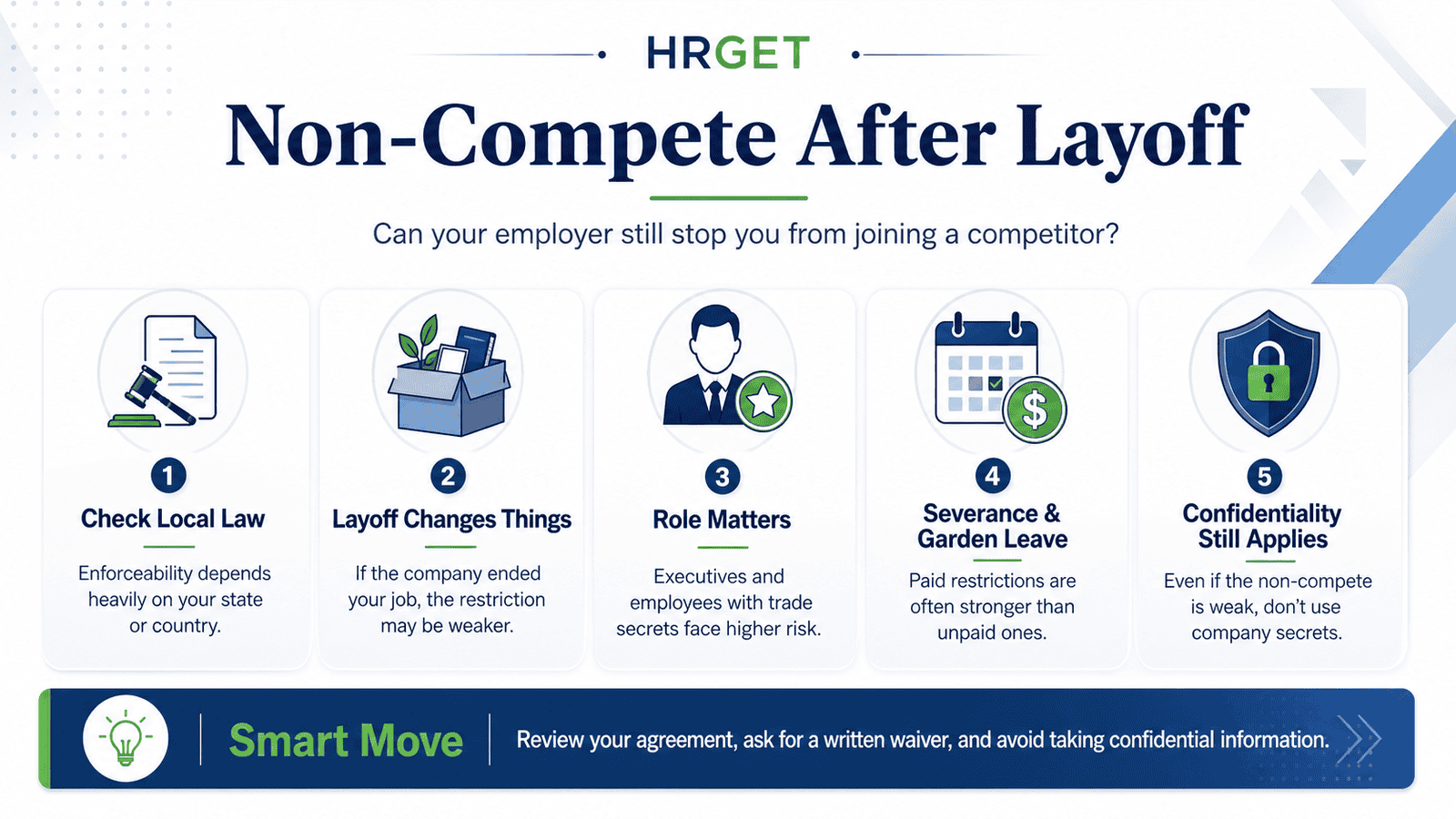
A non-compete can survive a layoff — but a layoff significantly weakens the employer’s position, especially when the restriction is broad, unpaid, or imposed on a mid-level employee. Whether it’s actually enforceable depends on jurisdiction, clause scope, and your role. Being laid off doesn’t void the agreement automatically, but it changes the negotiating landscape in your favour.
Does a Layoff Actually Change Your Non-Compete Position?
It does — meaningfully, though not always decisively. The core logic is straightforward: the employer chose to end the employment relationship. You didn’t walk away to compete. You were terminated involuntarily. That shift in circumstances matters both legally and practically.
Courts and regulators that evaluate non-competes typically apply a reasonableness test. They look at whether the restriction is proportionate to a legitimate business interest, whether the employee had real bargaining power when signing, and whether enforcing the clause would effectively prevent that person from earning a living in their field. A layoff — particularly one driven by cost-cutting rather than misconduct — tends to push all three of those factors toward the employee.
The better question to ask is not simply “did I sign this?” The better question is: can my employer realistically enforce this restriction, in this jurisdiction, for this role, after a company-initiated termination? That answer requires working through each element individually.
Insider View
In my experience at Littler, most employers don’t actually want to litigate non-competes against laid-off mid-level employees. Litigation is expensive, slow, and generates bad press. The threat is often more valuable to the employer than the enforcement. That doesn’t mean the threat is empty — but it does mean a well-prepared response changes the dynamics considerably.
What a Non-Compete Agreement Actually Covers
A non-compete is a contract clause that restricts an employee from working for a competitor, starting a competing business, or operating in a similar market for a defined period after leaving a company. The problem is that a lot of these clauses are written far broader than any court would actually enforce.
A fair restriction might read: “Do not use confidential pricing strategy to solicit the company’s existing enterprise accounts for six months after departure.” A questionable one reads: “Employee cannot work for any company in the industry, anywhere in the country, for two years.” The second version usually says more about the employer’s legal team’s ambitions than about what a court will actually uphold.
| Clause Component | What It Specifies | Employer’s Argument |
|---|---|---|
| Time restriction | 6 months, 12 months, 24 months post-employment | Shorter is easier to defend; 2+ years typically scrutinised |
| Geographic restriction | Within 50 miles, same state, nationwide, global | Must align with where employer actually operates |
| Competitor definition | Named companies vs “any similar business” | Broader definitions are more vulnerable to challenge |
| Role restriction | Sales only vs any employment at a named company | Function-specific restrictions are more defensible |
| Penalty or remedy | Injunction, repayment of severance, liquidated damages | Injunctive relief is common first step in US disputes |
When Your Employer Has a Stronger Case After Layoff
There are situations where a non-compete after layoff carries real weight, and you need to take them seriously rather than assume the layoff context saves you.
You held genuine trade secrets or confidential information
This is the strongest employer argument by a significant margin. If you worked with unreleased product architecture, proprietary pricing models, M&A plans, enterprise customer contract terms, or algorithmic IP — the company has a legitimate interest in preventing that information from walking to a direct rival. Note the distinction, though: you’re entitled to take your skills and experience. You are not entitled to take their confidential data — and courts draw that line clearly.
You were a senior executive or decision-maker
Non-competes are taken most seriously when the employee had real strategic authority — a VP of Sales moving to the closest competitor, a Chief Product Officer who led roadmap strategy, a senior engineer who architected unreleased systems. A junior analyst, customer support rep, or standard individual contributor is in a much stronger position to push back on a broad restriction.
The restriction is genuinely narrow
A six-month restriction targeting a specific competitor list in a defined market segment is far easier to enforce than a sweeping two-year industry-wide ban. Courts have consistently been more sympathetic to employers who drafted focused, proportionate restrictions. The narrower the clause, the more a court reads it as legitimate protection rather than career punishment.
You received severance or garden leave pay tied to the restriction
This matters a great deal. If the employer is paying you during the restricted period — via garden leave or a severance condition — its argument that the restriction is reasonable becomes much stronger. If the company laid you off, cut your pay entirely, and still expects you not to work in your field? That is a much harder sell to any judge.
When a Non-Compete After Layoff Is Likely to Be Weak
The clause may have less bite than it looks if it fails basic reasonableness standards — and many do.
If the restriction effectively prevents you from working in your only viable profession — say, a cybersecurity engineer barred from any cybersecurity company for 12 months — that overreach is a vulnerability, not a strength. If “competitor” is defined so broadly that it covers every plausible employer in your sector, courts in most jurisdictions won’t stand behind it. If you were a lower-wage or mid-level employee who signed during onboarding with no negotiation and no additional compensation, that context weakens the employer’s hand further.
And if you were laid off without cause? That doesn’t automatically void the agreement — but combined with any of the factors above, it builds toward a position where an employer’s enforcement threat starts looking like posturing rather than a viable legal strategy.
Warning
Do not assume the clause is unenforceable without checking your jurisdiction. The same agreement that’s essentially worthless in California could be enforced in Texas or Georgia. Your location at the time of signing — and sometimes where you currently work — controls which law applies. Never rely on what you’ve heard from colleagues in a different state.
US Non-Compete Law in 2026: What You Need to Know
The picture in the United States is genuinely fragmented — and more complicated than headlines suggest.
The FTC attempted a broad nationwide non-compete ban via rulemaking in 2024, but the rule was blocked by a federal district court in August 2024 and is not in effect. The FTC moved in September 2025 to dismiss its appeal, meaning there is no federal rule that automatically cancels your non-compete in 2026. What the FTC has continued to do is pursue targeted enforcement actions — in April 2026, the agency took action against specific non-compete arrangements it alleged restricted worker mobility and suppressed wages, particularly where workers had little ability to negotiate and received no additional compensation for signing.
That leaves the analysis at the state level, and the state landscape is genuinely varied. Some states ban non-competes for most employees outright. Others restrict them based on salary thresholds — meaning if you earn below a certain income, the clause simply can’t be enforced against you. Several states have specific carve-outs for healthcare workers. Notice requirements before signing have become more common in multiple states. And the governing law clause in your agreement — which specifies which state’s rules apply — can sometimes override the law of the state you actually live and work in, though courts don’t always honour that.
Two employees at the same company with the same contract language, working in different states, can have completely different outcomes. This is why a conversation with an employment lawyer — even a brief one — is worth it if you’re weighing a high-value offer against a clause your employer has signaled it might enforce.
Pro Tip
Before you call a lawyer, look at your agreement’s governing law clause. If it says “the laws of State X shall govern,” that state’s non-compete rules may control — even if you’re currently living and working somewhere else. Some states, like California, have statutes that override this, but not all do. It’s the most underappreciated detail in the whole document.
India: Post-Employment Non-Competes Are a Much Harder Sell
If you’re working in India — in Bangalore, Hyderabad, Mumbai, or anywhere else — the baseline position is materially different from the US.
Section 27 of the Indian Contract Act declares agreements in restraint of a lawful profession, trade, or business void to that extent. Indian courts have repeatedly distinguished between restrictions that operate during employment (which can be valid as exclusivity obligations) and restrictions that purport to block someone from working after employment ends (which are much more vulnerable to challenge). The Supreme Court’s treatment in Niranjan Shankar Golikari v. Century Spinning made clear that negative covenants during service are treated differently from post-termination restraints. A subsequent Supreme Court case, Superintendence Company of India v. Krishan Murgai, addressed post-termination restrictions directly and characterised them as a restraint of trade within the meaning of Section 27.
The practical upshot: if you’ve been laid off in India and your employer threatens to enforce a non-compete that prevents you from joining another company, the employer faces a steep legal hill to climb. Don’t panic at the clause.
What you should take seriously in India are confidentiality obligations, IP assignment terms, non-solicitation clauses covering clients or employees, and data protection obligations under the Digital Personal Data Protection Act 2023. Those can still create genuine exposure even where the non-compete itself won’t hold.
Non-Compete vs Non-Solicit vs Confidentiality: Not the Same Thing
Many employees conflate these, and it creates confusion in both directions — people either fear everything or dismiss everything. The three restrictions work differently and carry different enforceability levels.
| Clause Type | What It Restricts | Enforceability After Layoff |
|---|---|---|
| Non-compete | Joining a competitor or starting a competing business | Varies heavily by jurisdiction; layoff weakens employer’s case |
| Non-solicitation (clients) | Approaching or taking the old employer’s customers | Often more enforceable than the non-compete itself |
| Non-solicitation (employees) | Recruiting former colleagues to your new employer | Generally enforceable when narrowly drafted |
| Confidentiality / NDA | Disclosing or using company trade secrets and proprietary data | Broadly enforceable in most jurisdictions |
| IP assignment | Ownership of work created during employment | Generally enforceable; work stays with the employer |
| Garden leave | Working elsewhere during a paid notice / restriction period | Stronger than a non-compete because the employer is paying |
| Severance release | Additional obligations agreed in exchange for severance payment | Read extremely carefully — can add or reaffirm restrictions |
The practical rule: your employer may not be able to stop you from working, but they can often stop you from taking their confidential information, soliciting their clients, or recruiting their people. Those distinctions are not semantic — they shape exactly what you can and can’t do in a new role.
Real Scenario: Laid Off on a Friday, Competitor Offer by the Following Month
Real Scenario
Priya is a senior product manager at a mid-size SaaS company that sells project management software to enterprise clients in financial services. She’s laid off in a cost-cutting round — no performance issue, just headcount reduction. Her severance agreement confirms the non-compete clause from her original offer letter: “Employee shall not work for any competing business for 12 months after termination.”
Three weeks later, a well-funded competitor in the same enterprise SaaS space offers her a director-level role at a 35% salary increase. She has no idea what to do.
What actually matters here: The definition of “competing business” — whether it covers all SaaS or only direct product competitors. Whether her new role involves customer relationships or pricing data she held at the old company. Whether the old employer is likely to enforce given the cost and optics. Whether she received severance tied to the non-compete. And most critically: what state governs the agreement, and does that state restrict or ban non-competes? Two of those questions could make the entire clause irrelevant. One could make it a serious problem. She needs those answers before she responds either way.
Smart Strategy: Your 6-Step Playbook Before You Accept
Don’t decide with incomplete information. Here is what to do before you accept or decline the offer.
1Locate Every Agreement You Signed
Non-competes are frequently embedded inside equity agreements, severance paperwork, or bonus repayment clauses — not just the original offer letter. Pull your employment agreement, equity grant documents, any severance offer you’ve received, your confidentiality agreement, invention assignment agreement, and handbook acknowledgments before you assume you know what you signed.
2Read the Exact Clause Language
Don’t rely on memory or what a colleague told you. Check the duration, geographic scope, how “competitor” is defined, which activities are restricted, the penalties specified, the governing law clause, any conditions tied to severance, and whether there’s an arbitration requirement. The governing law clause is the most overlooked — it can control the entire enforceability analysis.
3Check Your State or Country Law
This is the most important step. Research whether your state broadly bans or limits non-competes, whether a salary threshold makes the clause inapplicable to you, whether specific industries are exempt, and whether the employer’s governing law choice can override your state’s protections. If you’re in India, start with Section 27 of the Contract Act as your baseline.
4Disclose the Situation to Your New Employer Early
For senior, technical, client-facing, or sales roles — disclose that you have a restrictive covenant and are reviewing it. Don’t wait until after start date. Serious companies have legal and HR teams that deal with this regularly. They may restructure your initial responsibilities, delay certain account transfers, or offer legal indemnification. Early transparency protects you; late disclosure creates a different problem.
5Leave Everything Behind — Literally
Even if the non-compete itself is unenforceable, data misuse creates a separate, often stronger legal liability. Do not download or forward customer lists, strategy decks, pricing files, unreleased code, internal emails, sales pipeline data, product roadmaps, or anything else marked confidential. This is non-negotiable, regardless of how weak the non-compete clause appears.
6Negotiate a Written Waiver Before You Sign Severance
If you were laid off, it is entirely reasonable to ask your previous employer — in writing — to confirm that it does not intend to enforce the non-compete against future employment, provided you continue to honour confidentiality, IP, and non-solicitation obligations. Frame it professionally: “Given that my role was eliminated as part of a workforce reduction, I’d appreciate written confirmation that the company does not intend to enforce the non-compete restriction.” Many employers will agree. None will offer it unprompted.
Common Mistakes That Make a Hard Situation Worse
I’ve seen each of these create problems that didn’t need to exist.
Assuming “laid off” means “free from everything.” A layoff changes the enforceability analysis — it doesn’t erase confidentiality obligations, IP assignments, non-solicitation terms, or conditions tied to accepted severance. These survive the non-compete question entirely.
Asking HR for legal guidance on your own agreement. HR represents the company, not you. They may give you documents if you request them professionally, but they are not neutral advisors on whether your non-compete is enforceable. For actual legal analysis, you need your own counsel.
Waiting to tell the new employer. Raising the issue after you’ve started is messier than raising it before. It can look like concealment, creates awkwardness around client assignments, and puts the new employer in a reactive rather than proactive position.
Signing severance quickly without reading the non-compete confirmation. Many severance agreements include a clause where you “reaffirm” or “acknowledge” all existing restrictive covenants. You may inadvertently be converting a challengeable old clause into a freshly signed commitment. Read every line before you sign — especially if you’re already holding a competitor offer.
Believing that aggressive contract language automatically wins. Companies often draft intentionally broad non-competes knowing that the threat alone will cause many employees to self-limit. A clause that looks frightening in all-caps legal language may not survive scrutiny for thirty seconds if someone actually challenged it in your jurisdiction. Fear is the enforcement mechanism — not the clause itself.
Pro Tip — 7 Questions Before You Decide
Answer these before accepting or rejecting any competitor offer after a layoff:
- Was I laid off, terminated for cause, or did I resign?
- What state or country law governs the agreement?
- Does the clause restrict work broadly or only specific activities?
- Did I receive severance or garden leave pay tied to the restriction?
- Was my role senior enough that I create real competitive risk?
- Does the new role involve the same customers or confidential strategy?
- Can I get a written waiver from the old employer before I start?
If you can’t confidently answer all seven, you’re not ready to make the decision.
The Verdict: It’s Complicated — But Probably Less Scary Than It Looks
Verdict
A non-compete after layoff is strongest when it is narrow, paid, tied to genuine trade secrets, imposed on a senior employee, and valid under local law. It is weakest when it is broad, unpaid, imposed after an employer-initiated termination on a mid-level employee, and conflicts with state or country law. Most non-competes land somewhere in between — which means the outcome depends on how well-prepared you are and whether you treat the situation as a negotiation, not just a legal threat.
The goal here is not to be reckless. It’s not to ignore what you signed. It’s to stop an overbroad, poorly supported clause from quietly shrinking your career because no one told you it might not survive a legal challenge.
Get your documents together. Understand what the restriction actually says. Protect confidentiality regardless of everything else. Tell the new employer early. Request a written waiver from the old one. And if the role is high-value or you receive a real threat — not just a form letter — spend two hours with an employment lawyer before you respond. That investment almost always pays for itself.
Navigating severance terms alongside your non-compete? Read our complete guide on how to negotiate a better severance package — including what to push back on before you sign.
How to Negotiate Severance Pay →Frequently Asked Questions
Does a non-compete still apply if I was laid off?
It may still apply, depending on the agreement’s wording and the law in your state or country. Being laid off weakens the employer’s position — especially if you received no compensation for the restriction and the clause is broad — but it does not automatically void the agreement. The enforceability test turns on jurisdiction, reasonableness, and whether a genuine business interest is at stake.
Can my employer sue me for joining a competitor after a layoff?
Yes, they can threaten or file legal action regardless of the merits. But filing suit and winning are different things. Their case depends on your seniority, the clause’s scope, whether you used confidential information, and the jurisdiction. Many employers send cease-and-desist letters expecting the threat alone to deter you — especially against mid-level employees.
Should I tell my new employer about my non-compete?
Yes — for any senior, technical, sales, product, or client-facing role, disclose early. Tell the new employer you have a restrictive covenant and are reviewing it. Many established companies have legal teams experienced with this situation and can adjust your initial responsibilities, delay certain client assignments, or provide indemnification. Disclosing after you start creates far bigger problems.
Can I negotiate removal of a non-compete during severance?
Yes, and you should try. If you were laid off, ask for a written waiver or release before you sign severance paperwork. A company that eliminated your role has limited moral authority to block your next job simultaneously. This is especially worth pressing when the severance amount is modest compared to the career value of the offer you’re holding.
Is a non-compete enforceable in California?
California has among the broadest restrictions on employee non-competes in the US. Post-employment non-competes are generally unenforceable for most employees under California Business and Professions Code § 16600, with narrow exceptions. Always verify current state law — California’s rules have continued to evolve, and recent legislation strengthened employee protections further. Never assume general information covers your specific situation.
Is a non-compete enforceable in India after a layoff?
Post-employment non-competes in India are generally difficult to enforce under Section 27 of the Indian Contract Act, which treats agreements restraining a lawful profession or trade as void. Courts have consistently distinguished restrictions during employment from those extending beyond it. Confidentiality, IP, data protection obligations under the DPDPA 2023, and non-solicitation clauses can still create real risk even where the non-compete itself won’t hold.
What should I do if I receive a cease-and-desist letter after joining a competitor?
Don’t ignore it and don’t respond emotionally or immediately. Save every relevant document, inform your new employer’s legal or HR team, and speak with an employment lawyer as quickly as possible. A measured, timely response — particularly one that demonstrates you have not taken or used confidential information — can often resolve the matter well before it reaches litigation.
What if I join a competitor but work in a completely different department?
It can reduce your risk, particularly if your new role has no overlap with the confidential information, customer relationships, or pricing strategy you held previously. But the agreement’s exact wording still controls — some clauses restrict any employment at a named company regardless of function. Read the restriction carefully before assuming the role difference fully protects you.

Michael Reeves | Former Senior Counsel, Littler Mendelson | Severance & Restructuring Specialist | 18+ Years in Employment Law
Author bio: Michael Reeves spent nearly two decades as Senior Counsel at Littler Mendelson — one of the world’s largest employment law firms — advising on mass layoffs, corporate restructurings, and severance negotiations for Fortune 500 companies across the US and Europe. He has worked both sides of the table: structuring cost-efficient separation packages for employers and, more recently, helping employees understand exactly where their leverage lies. Based between Chicago and London, Michael writes for HRGet.com to demystify the legal and financial dimensions of layoffs — so employees stop leaving money on the table.