
A significant number of salaried professionals in India are already working a second job. Some are freelancing on weekends. Some are consulting quietly on the side. A few — bolder ones — are drawing two full-time salaries simultaneously. And almost none of them are talking openly about it.
The silence isn’t just about fear. It’s about genuine confusion. The moonlighting policy in India exists in a grey zone where the law says one thing, your employment contract says another, and your company’s actual enforcement sits somewhere uncomfortably in between. If you’re asking whether moonlighting is legal, whether your company can fire you, or whether you can freelance without telling anyone — you’re asking exactly the right questions.
After 20 years advising on employment law across Indian and UK corporate environments, I’ve seen professionals lose decade-long careers over side income they genuinely believed was harmless. I’ve also seen employees moonlight successfully for years without a single consequence. The difference was almost always in the details — the contract clause they never read, the competitor they accidentally worked for, the performance dip that triggered an HR investigation they didn’t see coming.
This guide gives you the unvarnished answer. No fluff. No jargon. Just a clear-eyed look at what moonlighting means legally in India in 2026, when it crosses a line, and how to do it without destroying the primary career you’ve spent years building.
What Is Moonlighting — and Why India Is Having This Conversation Now
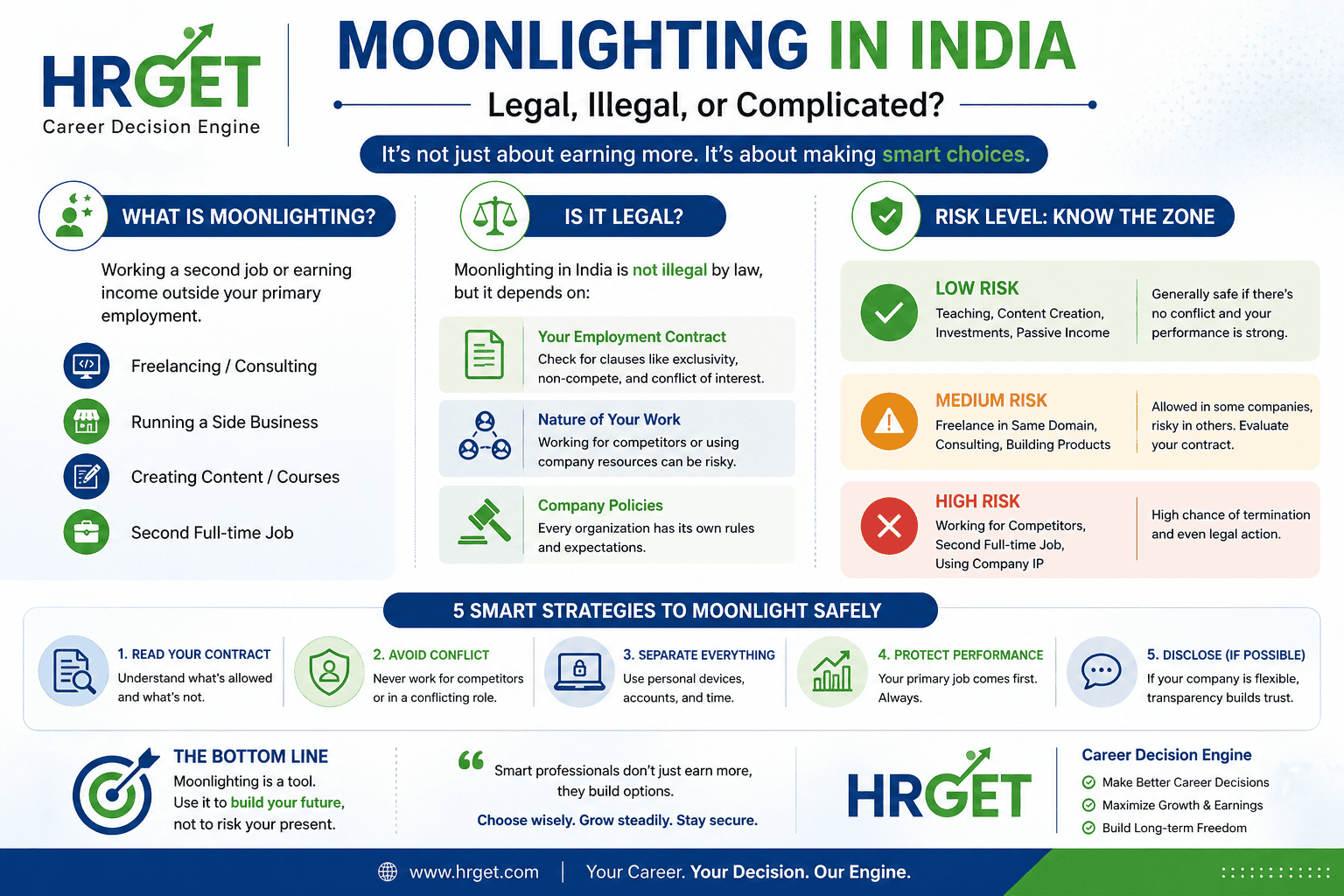
Moonlighting simply means earning income outside your primary employment — a second job, a freelance project, a side business, or a second full-time role. The term became mainstream in India around 2022 when Wipro terminated 300 employees for working with competitors simultaneously, and companies like Infosys and IBM issued formal warnings about dual employment. That episode pulled a practice that was already widespread into full public view.
In the Indian professional context, moonlighting typically covers four categories: freelancing in skills like coding, design, or writing; content creation through YouTube, blogs, or social media; running a startup or side business; or, at the riskiest end, holding two full-time remote jobs simultaneously — something the work-from-home era made logistically easier than ever before.
Here’s the nuance most people miss: moonlighting isn’t about how much you earn on the side. It’s about whether your employer allows it — and whether your contract gives them grounds to act if they find out.
Is Moonlighting Legal in India? The Honest Answer
The short answer is yes — but only conditionally. India does not have a blanket national law that prohibits moonlighting for corporate employees. You will not be arrested or prosecuted under any Indian statute simply for holding a second income source.
However — and this is a significant however — legality under Indian law and permissibility under your employment contract are two completely different things. Most terminations and disciplinary actions related to moonlighting in India are driven entirely by contract law, not criminal or labour statute.
Three factors actually determine whether your moonlighting is safe:
Your Employment Contract
This is the biggest determinant — by a wide margin. If your contract contains language like “no dual employment,” “full-time exclusive commitment,” or “no outside business activity without written approval,” then moonlighting in any form is a contract violation. The company doesn’t need to invoke any law to terminate you. The breach of agreement alone is sufficient grounds.
The Nature of Your Outside Work
Even when a contract is silent on moonlighting, the nature of your second engagement matters enormously. Working for a direct competitor, using proprietary tools or client data from your primary employer, or building a product that competes with your employer’s business — all of these create grounds for termination and potential legal action, regardless of whether the contract explicitly mentions moonlighting.
Labour Law Interpretation
Indian labour legislation — specifically the Factories Act, 1948, and some state-level Shops and Establishments Acts — does contain provisions discouraging or restricting dual employment, but these were primarily written for factory workers and shift-based labour. For IT professionals, knowledge workers, and corporate employees, enforcement is almost entirely contract-driven, not law-driven.
The Maharashtra Shops and Establishments Act, for instance, restricts an employer from permitting an employee to work in another establishment during their off hours if it affects health or leads to exhaustion — but this creates an obligation on the employer, not a criminal liability for the employee.
Bottom Line: Moonlighting is not illegal by law in India — but it can become a serious contract violation depending on what you signed when you joined your employer.
Employment Contracts: The Real Gatekeeper
This is where most professionals make a costly assumption. They think: “There’s no law against this, so I’m legally protected.” That’s a dangerous misread of how employment in India actually works.
Companies don’t need legislation to act against moonlighting. They use the contract you signed on Day 1 — the document you probably read once, skimmed, and never revisited. Pull it out now and look for these specific clauses:
- Exclusivity clause: Requires your full professional commitment to the employer and prohibits outside work, paid or otherwise, without explicit written consent.
- Conflict of interest clause: Prohibits engaging in any activity — including unpaid consulting or advisory roles — that could conflict with the employer’s business interests.
- Non-compete clause: Restricts working for or with competitors during your employment. (Note: post-employment non-competes are largely unenforceable in India, but during-employment restrictions are a different matter.)
- Confidentiality clause: Prohibits sharing or using any company information, processes, or intellectual property outside your role — relevant if your side work is in the same domain.
- Disclosure requirement: Some contracts require you to disclose any outside income sources, even if they don’t prohibit them.
If any of these clauses exist in your contract, you do not have full freedom to moonlight — regardless of what the law does or doesn’t say.
Insider Insight: From an HR and legal perspective, companies don’t primarily care if you earn extra money. What they care about is loyalty, performance continuity, and the risk that proprietary information — client lists, product roadmaps, technical architecture — leaves the building. That’s what these clauses are actually protecting.
When Moonlighting Crosses Into Dangerous Territory
There’s a meaningful difference between moonlighting that’s contractually questionable and moonlighting that exposes you to legal liability beyond simple termination. Here are the four scenarios where the risk escalates sharply:
You Hide It When Disclosure Is Required
If your contract or company policy requires disclosure and you knowingly withhold the information, that’s not just a policy breach — it’s misconduct. In India, misconduct is one of the grounds under which an employer can initiate termination under the Industrial Disputes Act without standard notice periods. For senior roles governed by individual employment agreements, it can trigger clawback provisions and forfeiture of unvested equity or bonuses.
You Work for a Competitor
This is the fastest route to termination — and potentially to a lawsuit. Working for a competitor while employed, even in an advisory or part-time capacity, creates a genuine conflict of interest and gives the company grounds not just for termination but for seeking damages if it can demonstrate that confidential business information was accessed or shared. The Wipro mass termination in 2022 was largely rooted in exactly this scenario.
You Use Company Assets or Data
Using your company-issued laptop, internal software, codebase, or client data for outside work is not just a policy violation — it can constitute misappropriation of trade secrets under the Indian Contract Act, 1872, and potentially attract claims under the Information Technology Act, 2000. This isn’t theoretical. I’ve advised on cases where employees who built freelance projects using employer codebases were served with legal notices seeking injunctions and damages.
Your Primary Job Performance Declines
Even if your moonlighting is technically permissible, a measurable drop in performance creates a second problem. HR teams investigating performance issues in 2026 have access to email logs, code commit records, system login timestamps, and project delivery metrics. A pattern of late deliverables combined with signs of a second engagement — even without direct proof — is often enough to trigger a formal investigation. The moonlighting then becomes the evidence, not the initial complaint.
Real Scenario: How a Developer Lost a ₹32 LPA Job Over Freelancing
Real Scenario
A senior backend developer at a mid-size Bangalore product company — earning ₹32 LPA — began taking freelance contracts through an overseas platform to supplement income after his apartment loan EMI increased substantially. He was careful at first: personal laptop, separate accounts, after-hours only.
Six months in, deadline pressure on his primary job increased. He started missing standup calls. Sprint deliverables slipped by two weeks consecutively. His manager flagged him for a performance review. During the investigation, a colleague mentioned seeing him on a client call while on approved leave — a client that turned out to be a direct competitor.
His employment was terminated within three weeks on dual grounds: violation of the exclusivity clause and the non-disclosure policy. The competitor freelance project was the breach. The performance decline was the trigger that started the investigation. He lost his job — not because of freelancing, but because of the combination of competitor exposure and a performance trail that invited scrutiny.
The lesson here isn’t that moonlighting is always dangerous. It’s that moonlighting while your primary performance is slipping is when companies start asking questions — and those questions lead to answers that weren’t supposed to be found.
Types of Moonlighting in India: A Risk Assessment
Not all moonlighting is created equal. The risk profile varies enormously depending on what you’re doing, for whom, and with what tools. Here’s a clear breakdown:
| Moonlighting Type | Risk Level | Key Condition for Safety |
|---|---|---|
| Blogging, content writing, YouTube | Low | No use of company time or resources |
| Teaching, tutoring, coaching | Low | Unrelated to employer’s domain |
| Passive income (investments, stock dividends) | Low | Always permissible — not employment |
| Freelance work in an unrelated field | Medium-Low | No conflict clause in contract |
| Freelancing in your professional domain | Medium | Disclosure, no competitor clients, clean separation |
| Consulting in your field of expertise | Medium | Contract wording + written approval where required |
| Building a SaaS product or startup | Medium-High | Must not compete; IP ownership must be clear |
| Freelancing for competitor clients | High | Almost always a violation — avoid entirely |
| Full-time second remote job simultaneously | Very High | Typically a misconduct violation; career-threatening if discovered |
The safest moonlighting, in my experience, is income that doesn’t structurally resemble employment — content sites, digital products, online courses, or investment returns. These rarely trigger exclusivity clauses and don’t create the dual-employer dynamic that companies find objectionable.
How Indian Companies Actually Enforce Moonlighting Policies in 2026
Post-pandemic India has produced three distinct corporate camps on moonlighting — and understanding which one your employer falls into matters enormously.
Strict Enforcement Companies
Large IT services firms — particularly those with US enterprise contracts where employee data security is audited — tend to take the hardest line. Companies in this bracket run periodic system usage audits, flag unusual after-hours access patterns, and have HR teams that actively cross-reference public freelancing profiles on LinkedIn and platforms like Upwork or Toptal. For employees in these organisations, moonlighting outside low-risk categories carries genuine termination risk even when performance is strong.
Output-First Flexible Companies
Product companies and startups increasingly operate on output accountability rather than time-based surveillance. These organisations are less likely to investigate moonlighting unless performance or conduct issues surface. Many have informally shifted to a “don’t ask, don’t tell” posture — they expect exclusive commitment on paper but won’t actively investigate side work as long as deliverables are met. The risk here isn’t termination; it’s the informality. The protection disappears the moment performance slips.
Progressive, Disclosure-Friendly Companies
A growing minority — typically founder-led companies and international firms with mature HR practices — actively encourage employees to disclose side work and engage in structured approval processes. Some tech startups have introduced explicit moonlighting policies that permit side work as long as it doesn’t compete and doesn’t consume primary job hours. These employers treat entrepreneurial drive as a talent signal, not a loyalty concern. If you’re in this environment, voluntary disclosure is almost always the right move.
The honest reality: most Indian IT and corporate employers in 2026 sit in an unofficial middle ground — moonlighting is tolerated when performance is strong and the side work doesn’t surface publicly, but that tolerance evaporates instantly when either condition changes.
Smart Strategy: How to Moonlight Without Getting Burned
Here’s the framework I recommend to professionals who want to generate secondary income without putting their primary career at risk:
Step 1: Read Your Contract Before Anything Else
This sounds obvious. It isn’t — because most professionals haven’t read their employment agreement since the week they joined. Pull it out. Find the sections on exclusivity, conflict of interest, and disclosure requirements. If the language is ambiguous, consult an employment lawyer. A one-hour consultation (typically ₹3,000–₹8,000 in metro cities) is far cheaper than a wrongful termination dispute.
Step 2: Maintain an Absolute Firewall from Competitors
Never take outside work from a company that competes, even partially, with your employer. This includes adjacent market players, clients of clients, or companies targeting the same end market. If you’re unsure whether a potential client is a competitor, assume they are and walk away. The upside of a single freelance contract is never worth the downside of a termination that follows you into your next job search.
Step 3: Maintain Complete Separation of Resources
Use your personal device, your personal email, your personal cloud accounts, and your personal banking for all outside work. Never forward company emails to a personal account for convenience. Never use your work VPN while doing side work. Never store side-project files on company-provisioned equipment. This separation is what differentiates a policy question from a potential legal claim.
Step 4: Your Primary Job Performance Is Non-Negotiable
This is the single most important protection you have. Companies almost never investigate moonlighting among high performers. The investigations begin when performance data creates a reason to look closer. Protect your delivery record, your responsiveness, your relationships with your manager and team. If you feel your primary job suffering under the weight of side commitments, pull back from the side work — not the main job.
Step 5: Think Strategically About Disclosure
If your company has a disclosure-friendly culture, voluntary disclosure is almost always worth it. It builds trust, removes the fear of discovery, and often results in a formal arrangement that protects you legally. If your company is in the strict enforcement camp, disclosure may trigger immediate scrutiny — in which case, the smarter play is to limit yourself to genuinely low-risk activities that don’t require disclosure under your contract.
Pro Tip: The safest moonlighting is income that doesn’t structurally resemble employment. Content websites, digital courses, SaaS products where you’re the owner — not the contractor — and investment returns rarely trigger exclusivity clauses. Building assets rather than trading your time again is how you generate scalable income without repeating the risks of dual employment.
Common Mistakes That Damage Careers
After advising on dozens of employment disputes involving moonlighting, these are the five mistakes I see most consistently:
“No One Will Find Out”
They do — eventually. Public freelancing profiles, client references, tax filings, LinkedIn activity, even casual conversations at industry events have all been the starting point of moonlighting investigations I’ve seen. The question is never whether discovery is possible; it’s about when and under what circumstances it happens.
Taking On Too Much Too Fast
The most common progression: freelance income starts strong → workload expands → primary job performance dips → manager notices → investigation begins. The side income that seemed worthwhile at ₹40,000/month rarely justifies the ₹1.2 crore in annual primary compensation you risk losing. Manage your capacity as seriously as you manage the work itself.
Never Reading the Contract
This is the biggest structural blind spot. Many professionals moonlight for months or years genuinely believing they’re safe — until a termination letter cites clauses 7.3 and 12.1 of an agreement they signed four years ago and never re-read. Read your contract. Know what it says.
Using Company Equipment for Outside Work
Using your office-issued laptop for client calls, your work email for side communications, or your employer’s software for outside projects transforms a potential contract dispute into a potential legal claim. This is the line between “we’re letting you go” and “we’re issuing you a legal notice.”
Building on Company Intellectual Property
Developing a product or service that uses ideas, methodologies, or frameworks you encountered in your primary role — even if the final implementation is your own — is a genuinely dangerous grey area. Many employment contracts contain IP assignment clauses that grant the employer ownership of anything you create that’s related to their business domain, even during your personal time. Get clarity on this before building anything.
Should You Moonlight? A Decision Framework
Before you take on any outside work, run through these four questions honestly:
Why are you doing this? If the answer is purely short-term income supplementation, the risk-reward calculus often doesn’t favour moonlighting — especially in higher-compensation roles. If the answer is building long-term assets, developing skills for a career pivot, or creating a path to independence, the calculus changes considerably.
What does your contract actually allow? Not what you assume. Not what a colleague said. What the document you signed actually permits.
Can you maintain your primary job performance at full strength? Not “good enough” — at full strength. If there’s genuine uncertainty here, don’t start.
Does this align with your five-year direction? Smart professionals use moonlighting to build assets that compound over time — content platforms, SaaS tools, consulting practices, skills that command premium rates. The professionals who get burned are typically those using moonlighting as a short-term income band-aid rather than a deliberate career move.
If you answer those four questions honestly and the result is still yes, moonlighting is a calculated and defensible decision. If any answer gives you pause, that’s your answer.
FAQs: Moonlighting Policy India
Is moonlighting legal in India?
Yes, in the sense that no national law specifically criminalises moonlighting for corporate employees. However, legality under statute and permissibility under your employment contract are entirely different questions. Most moonlighting disputes in India are resolved under contract law, not criminal or labour law. Whether your specific moonlighting arrangement is safe depends almost entirely on what your employment agreement says.
Can my company fire me for moonlighting?
Yes — if you’ve violated an exclusivity clause, conflict of interest provision, or disclosure requirement in your contract. Termination on grounds of misconduct is legally valid under Indian employment law when a signed agreement is breached. Companies with strong HR compliance functions treat undisclosed moonlighting that violates contract terms as a serious misconduct issue, particularly at senior levels.
Can I freelance while working a full-time job in India?
Yes, provided your contract doesn’t include an exclusivity clause, there’s no conflict of interest with your employer’s business, and you’re not using company resources. Freelancing in an unrelated domain — say, a software engineer teaching mathematics online — is generally the safest arrangement. Freelancing in your professional domain for non-competing clients sits in a medium-risk zone that depends heavily on your specific contract language.
Is working two full-time jobs simultaneously legal in India?
Legally speaking, there’s no statute that makes this a criminal act. In practice, however, it almost universally violates the exclusivity and full-time commitment clauses in standard Indian employment contracts. It’s also the moonlighting scenario most likely to surface through performance issues, scheduling conflicts, or cross-referencing background checks. Companies that discover dual full-time employment consistently treat it as gross misconduct warranting immediate termination.
Do I need to inform my employer about moonlighting?
Only if your contract includes a disclosure requirement. If it does, failing to disclose is itself a breach — separate from whatever the side work actually involves. If your contract is silent on disclosure, you’re not legally obligated to inform your employer, though voluntary disclosure in a flexible workplace often creates goodwill and protection. Read your agreement carefully before deciding.
Can I run a business while employed in India?
Yes, subject to your contract terms. Running a business that doesn’t compete with your employer, doesn’t use company resources, and doesn’t materially impair your primary job performance is generally permissible — even without formal approval — in many Indian workplaces. However, if your contract contains a conflict of interest clause, or if your business could be construed as competing with any aspect of your employer’s operations, you should get written approval or a legal opinion before proceeding.
What is the safest form of moonlighting for salaried employees in India?
Income that doesn’t structurally resemble employment — content websites, digital courses, self-published products, investment returns — carries the lowest risk profile because it rarely triggers exclusivity or dual-employment provisions. If you want to freelance or consult actively, the safest arrangement is outside your professional domain, for non-competing clients, on your own equipment and time, with disclosure if your company’s culture supports it.
The Verdict: Legal, Illegal, or Complicated?
Here’s the honest summary after everything above: moonlighting in India is legal by statute, but complicated by contract — and its safety depends almost entirely on how smart you are about the details.
The professionals who manage moonlighting successfully share a few common traits: they read their contracts, they maintain an absolute firewall from competitors and company resources, they protect their primary job performance above everything else, and they treat side income as an asset-building exercise rather than a short-term salary patch. The professionals who get burned are those who assumed discovery was unlikely, assumed no law means no risk, or let the side work gradually consume the attention their main job required.
If you’re navigating the question of moonlighting policy in India for the first time, start with your employment contract. Everything else follows from what that document says. If the contract is genuinely ambiguous, a short consultation with an employment lawyer is money well spent.
For a related read on what your employer can and cannot legally restrict after you leave, see our guide on non-compete agreements in India — what’s enforceable and what isn’t.

Victoria Hale | Former Partner, Freshfields Bruckhaus Deringer | Employment Law Specialist | 20+ Years Advising Multinationals & Executives
Author: Victoria Hale spent over two decades as an Employment Law Partner at Freshfields Bruckhaus Deringer — one of the world’s most prestigious Magic Circle law firms — advising multinational corporations and senior executives on some of the most complex employment disputes in the US and Europe. Her practice covered wrongful termination litigation, executive exits, non-compete enforcement, FLSA compliance, and cross-border workforce restructuring under EU labour law. Now based between London and New York, Victoria writes for HRGet.com to close the gap between legal theory and how employment law actually plays out in the real world — for employees who need to know their rights before it’s too late.