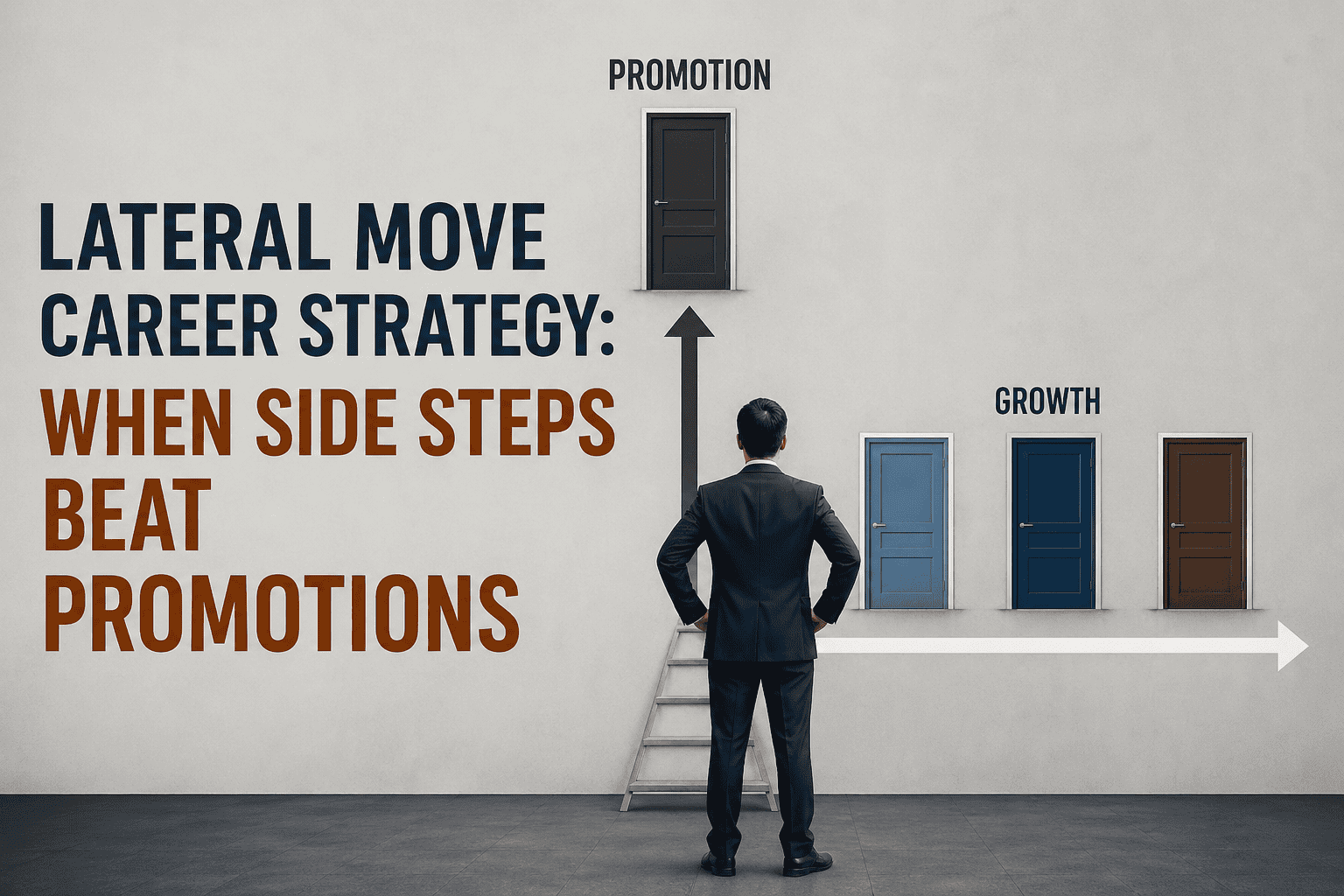
Here’s the uncomfortable truth most professionals don’t want to hear: chasing promotions blindly is one of the fastest ways to stall your career.
You’ve been conditioned — by managers, LinkedIn culture, and annual review cycles — to believe that “up” is the only direction that counts. More title. More direct reports. A bigger org chart bubble. But after 18 years coaching executives at Amazon, Unilever, and across McKinsey’s global talent bench, I’ve watched this mindset quietly cap hundreds of careers that had real potential.
The highest-paid, most influential professionals I know? Many of them didn’t climb straight up. They moved sideways first — deliberately, strategically, and with a clear destination in mind. This is where a lateral move career strategy becomes one of the most powerful tools in a working professional’s playbook.
Done right, a lateral move can accelerate your income, broaden your skill depth, and raise your career ceiling faster than any promotion ever could. Done wrong — or randomly — it sets you back. This guide covers both sides.
What Is a Lateral Move (And Why Most People Get It Wrong)
A lateral career move means switching roles, teams, functions, or companies at the same seniority level — without an immediate promotion or significant title change. On paper, it looks like you’re standing still. That surface-level reading is exactly why so many professionals talk themselves out of it.
Here’s what a lateral move actually looks like in practice:
- Software Engineer → Data Engineer (same level, different domain)
- Marketing Manager → Associate Product Manager
- Backend Engineer → Platform/Infrastructure team
- HR Generalist → HR Analytics Specialist
- Content Strategist → SEO and Growth Analyst
None of these come with a fancier title. But every single one of them repositions the professional into a higher-demand, higher-paying lane — often within 12 to 24 months of making the switch.
That’s the distinction most career advice glosses over. A lateral move isn’t a compromise. It’s a strategic repositioning — moving from a lower-leverage position to a higher one before you climb further. Think of it as changing lanes on a highway before accelerating, rather than flooring it in a lane that’s about to merge into a dead end.
The Real Problem With Promotions That Nobody Talks About
Most professionals operate on a simple equation: perform well → get promoted → salary goes up → repeat. I’ve seen this mindset fail people at every level, from junior analysts to Directors waiting for that VP slot that never opened.
Here’s what actually happens inside most organisations:
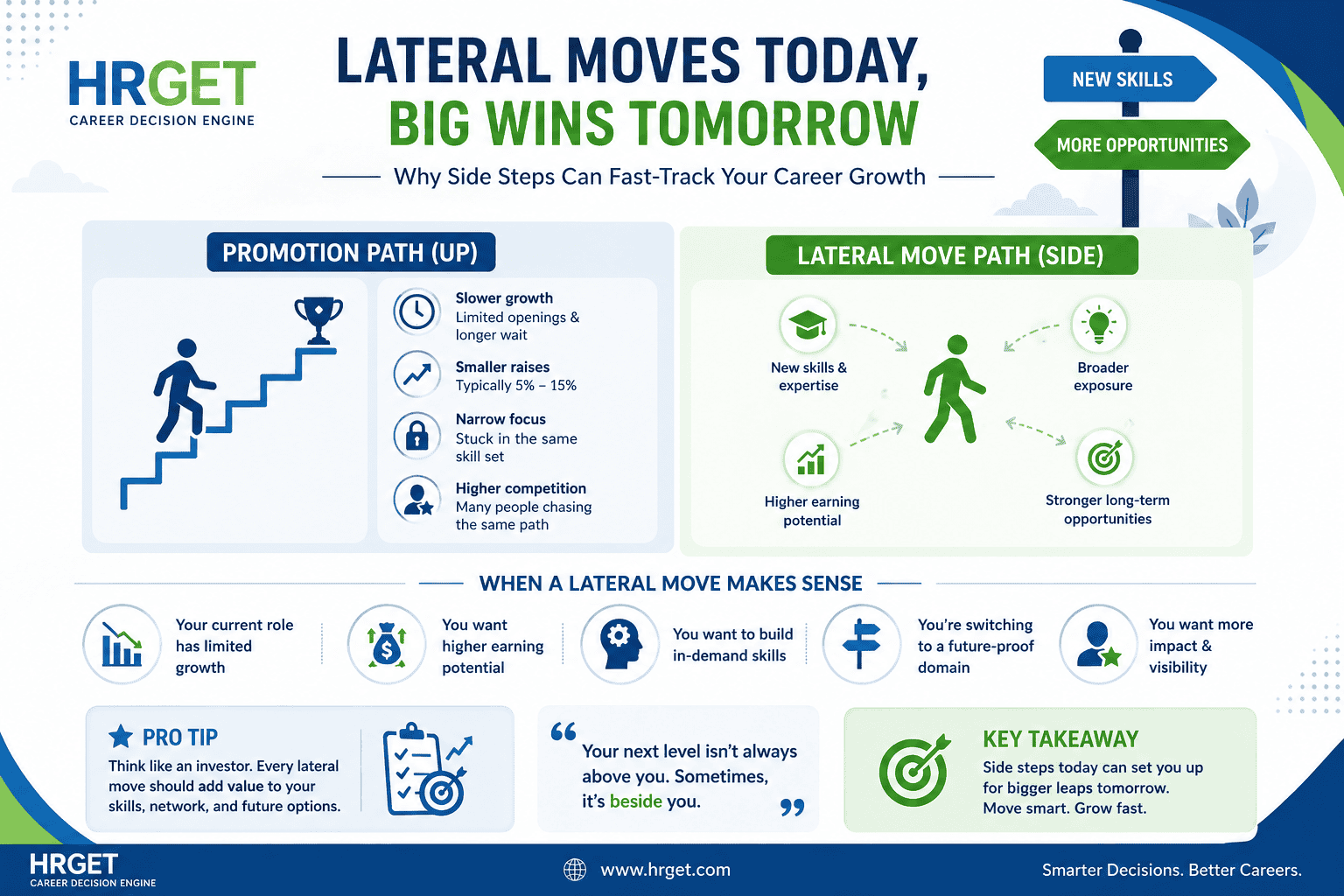
- Promotions are slow and political. Even stellar performers wait 18–36 months between levels in large companies.
- Raises are incremental. The typical merit increase runs 5–12%. In India’s corporate sector, that’s often below inflation in high-demand skill areas.
- You get locked into your current skill path. The deeper you go in one specialisation, the harder it becomes to pivot later — and the more you’re perceived as a one-dimensional hire.
- Your external market value may plateau. If your domain isn’t growing, your salary ceiling isn’t growing either — regardless of your title.
Meanwhile, someone who repositions laterally into a high-demand domain can reset their compensation band entirely, gain skills the market is paying a premium for, and become significantly more valuable within 1–2 years.
The framing I use with every executive I coach:
Promotion = optimising your current path.
Lateral move = expanding your future options.
5 Situations Where a Lateral Move Beats a Promotion
Not every situation calls for a sideways move. But these five scenarios are where I’ve consistently seen lateral moves outperform straight-line promotions over a 3-to-5-year horizon.
1. You’re in a Low-Growth Role or Domain
If your domain has shrinking hiring demand, limited senior roles, or compressed salary bands, climbing up won’t change the structural ceiling. A Senior QA Engineer in manual testing in Bengaluru might earn ₹14–18 LPA at best. An SDET or Automation Engineer in the same city earns ₹22–35 LPA. The title difference is small. The market value difference is enormous.
2. You’re Stuck in a Narrow Skill Box
Promotions deepen your current expertise. But if that expertise is already too narrow for where the market is heading, going deeper digs you further into a corner. A lateral move broadens your skill set, makes you more versatile, and — critically — unlocks future leadership roles that require cross-functional thinking, not deep specialisation.
3. Your Industry Is Shifting Beneath You
Tech, finance, and HR are all in structural transition right now. Traditional IT support is being automated. HR operations is being absorbed by people analytics and HRIS platforms. If you stay in a declining niche and simply get promoted within it, you’re rearranging deck chairs. The examples I’ve watched play out most often:
- Traditional IT support → Cloud/DevOps (compensation uplift of 40–60% within 2 years)
- HR operations → HR analytics and strategy (from ₹8 LPA to ₹18–22 LPA in India; from $65K to $100–120K in the US)
- Content writing → AI-augmented SEO strategy (one of the fastest-growing hybrid roles in 2026)
4. You Want a Higher Salary Ceiling
Some domains simply pay more, full stop. No amount of promotion within a lower-paying domain will match the base compensation of someone mid-level in a higher-paying one. A Senior Product Manager in the US earns $130,000–$170,000. A Senior Marketing Manager at the same level earns $90,000–$115,000. If you’re in marketing and want PM-level income, the path forward isn’t promotion — it’s a strategic lateral move into a product-adjacent role first.
5. You’re Building Toward a Leadership Role
Here’s one most people don’t consider until it’s too late: the best leaders are rarely the deepest specialists. The executives I’ve coached at Amazon and Unilever who made it to VP and above were almost universally people who had worked across multiple functions before ascending. They could speak the language of engineering, finance, and marketing in the same boardroom. Lateral moves build that foundation. Promotions alone don’t.
Types of High-Impact Lateral Moves (Not All Are Equal)
One mistake I see constantly: professionals assume any sideways move is a lateral move. It’s not. A random shift into an adjacent role with no strategic upside is just a distraction. The five types below are the ones that actually compound.
- Skill Upgrade Moves: Same domain, higher-value skill set. Frontend → Full-stack. HR operations → HR tech implementation. These unlock significantly better pay within the same career path.
- Domain Shift Moves: Move into a higher-value domain entirely. Testing → Development. Sales → Product. The income jump can be 30–50% within 2 years.
- Exposure Moves: Join a team with higher organisational visibility. Internal tooling → Customer-facing product. Support → Core engineering. These moves put you in rooms where decisions are made — and where sponsors notice talent.
- Company-Level Laterals: Same role, better company. Moving from a mid-tier firm to a FAANG, a high-growth startup, or a well-funded scale-up can double your compensation without changing your title at all.
- Strategic Role Expansion: Negotiate to absorb adjacent responsibilities — architecture exposure, stakeholder management — without a formal title change. This is often the fastest hidden track to formal promotion.
Real Career Scenarios: What the Data Actually Shows
Let me walk you through three scenarios I’ve seen play out — the names are composites, but the patterns are real.
Scenario 1: The Backend Engineer Who Moved to Infra
Rahul, a backend developer in Hyderabad, was offered a promotion to Senior Backend Engineer — a ₹2 LPA bump and a new title. At the same time, his company’s platform team had an opening. Same level, no title change, but the infra work involved Kubernetes, cloud architecture, and distributed systems.
He took the lateral move. Eighteen months later, Rahul was handling interview conversations with companies offering ₹32–38 LPA — roles he could not have accessed as a Senior Backend Engineer. The infra skills were scarce, the market demand was high, and his negotiating position was entirely different. His promotion path would have landed him at ₹20–22 LPA on the same timeline.
Scenario 2: The HR Manager Who Chose Analytics Instead
Priya was five years into HR operations at a large FMCG company in Mumbai. Her promotion to HR Manager was on the table: a ₹1.5 LPA increase and more administrative scope. A lateral move into the company’s nascent HR analytics team — same pay band, no title upgrade — was also available.
The promotion looked better on paper. The lateral move was the better play. Within two years, Priya had built Python-based workforce dashboards, led attrition modelling projects, and was fielding offers from consulting firms at ₹24–28 LPA. HR analytics professionals with that profile are genuinely scarce in India right now. The HR Manager role would have positioned her for ₹14–16 LPA at best.
Scenario 3: The Marketer Who Couldn’t Get Into Product — Until She Did
There’s no direct promotion path from marketing into product management. Most companies won’t make that leap. But there’s almost always a lateral path — into a growth team, product analytics, or go-to-market strategy role. A marketer I worked with in London took exactly that route: a lateral shift into a growth analytics role. Fourteen months later, she transitioned into an Associate PM role at a SaaS company — a role paying £75,000 vs the £42,000 she was earning in marketing. No lateral move, no entry point.
The Smart Strategy: How to Execute a Lateral Move Without Losing Ground
Most professionals either jump randomly — picking a lateral move based on curiosity or convenience — or they wait too long, hoping the right opportunity falls into their lap. Neither works. Here’s the five-step approach that does.
Step 1: Identify the High-Value Skill Gap in Your Market
Before you move anywhere, do a simple market scan. Which roles in your field are growing fastest? Which skills command a salary premium of 20% or more over your current path? Which domains align with your existing strengths and could use your background as a bridge? LinkedIn Salary Insights, Glassdoor, and Levels.fyi (for tech) give you real benchmarks within 20 minutes.
Step 2: Bridge the Skill Gap Before You Apply
The biggest mistake in lateral moves is walking in with zero demonstrated capability in the target domain. You don’t need to be expert-level — you need to be credible. Take a targeted course. Build a small portfolio project. Volunteer for cross-functional work internally. Even one or two concrete examples of working in the target domain changes how interviewers and hiring managers evaluate you.
Step 3: Use Internal Transfers First
Internal lateral moves are dramatically easier to secure than external ones. You have established credibility, your manager can vouch for you, and the hiring team already knows your work ethic. Most large companies — especially those with formal internal mobility programmes like Unilever, Amazon, or Infosys — actively encourage this. Position the conversation carefully: you’re not fleeing your current team, you’re expanding your contribution to the organisation.
Step 4: Reframe the Narrative — This Is Critical
How you describe the move in interviews and internal conversations will determine whether it reads as strategic or as confused. Don’t say “I want to try something new” — it signals impulsiveness. Instead, say something like: “I want to build X capability because it connects directly to where business value is moving, and it positions me to contribute at a higher level within 12–18 months.” That framing signals maturity, market awareness, and self-direction. Those are exactly the signals hiring managers at strong companies are looking for.
Step 5: Time It Right
The best window for a lateral move is after a strong performance cycle — when your current team values you and your track record is visible. Moving from a position of strength always gives you more negotiating room, better references, and a cleaner story. Moving because you’re burnt out or quietly struggling is rarely strategic — it’s reactive.
Salary Impact: The Short-Term Trade-Off vs the Long-Term Gain
I’ll be direct here because most articles dance around this: yes, a lateral move may not increase your salary immediately. It might not move it at all in the first year. That’s the honest short-term reality.
But the 2–3 year picture tells a completely different story. Here’s a comparison based on real market data I’ve tracked across clients in tech and HR roles:
| Career Path | Year 1 | Year 3 (Typical Outcome) | Growth Pattern |
|---|---|---|---|
| Promotion-only within same domain | +8–12% increase | +20–30% total vs baseline | Linear |
| Lateral move → skill gain → switch | 0–5% change | +40–80% total vs baseline | Exponential |
The reason the lateral path compounds faster: you unlock entirely different compensation bands, not just merit increments within your current one. When you negotiate a new role in a higher-demand domain, you’re resetting the baseline — not incrementally adjusting it.
⚡ Pro Tip
The highest salary jumps I’ve seen in a single career move — 50–80% — almost always came from someone who had made a strategic lateral move 12–24 months earlier and was now switching companies from a position of high-demand skill. The lateral move built the leverage. The external switch cashed it in.
Common Mistakes That Kill Career Momentum
1. Staying Too Long in Your Comfort Zone
Loyalty to your function, team, or company is a virtue — up to a point. When it tips into staying put because change feels uncomfortable, it becomes career avoidance. I’ve worked with professionals who spent six or seven years in the same role category because moving felt risky, and then spent the next five years trying to catch up to peers who left earlier. The opportunity cost of inertia is rarely visible until it’s expensive to reverse.
2. Choosing Title Over Skill
A Senior Manager title in a commoditised or shrinking domain is a short-term ego boost with long-term consequences. Hiring managers at top-tier companies look at the quality and trajectory of your skill set, not just the line on your CV. A person with a broader, higher-demand skill profile at a lower title will almost always outcompete a titled specialist in a declining area — especially in markets moving toward AI-augmented work.
3. Making Random Lateral Moves
Not every sideways move is a smart move. If the lateral switch doesn’t meaningfully increase your skill depth, improve your market exposure, or raise your long-term earning potential — it’s a distraction, not a strategy. Before any lateral move, run it through three tests: Does it increase my skill? Does it improve my visibility? Does it raise my external market value? If the answer to all three is no, keep looking.
4. Fear of “Looking Weak” or “Going Backwards”
This is probably the most common reason smart people talk themselves out of a good lateral move. Here’s the reality: most of your colleagues aren’t tracking your career trajectory as closely as you are. And the hiring managers who matter — at the companies you actually want to join — don’t see a lateral move as weakness. They see adaptability, initiative, and growth mindset. Those are increasingly rare and valuable signals.
5. Not Thinking Three Moves Ahead
Amateur career thinking is “what’s my next job?” Strategic career thinking is “what sequence of moves gets me to my target role in 3 years, and which one do I make first?” Lateral moves make the most sense when you can connect them to a larger arc — not when they’re isolated decisions made under pressure or out of boredom.
Decision Framework: Should You Move Laterally or Stay Put?
Use this as a quick gut-check before making your decision.
| Situation | Recommended Path |
|---|---|
| Your domain has strong future demand and you’re gaining valuable skills | Stay and pursue promotion |
| Promotion leads to real scope and income expansion (not just a title) | Stay and pursue promotion |
| Your role is stagnating and salary growth is hitting a ceiling | Make a lateral move |
| Another domain offers 30%+ higher long-term salary potential | Make a lateral move |
| You want leadership scope that requires cross-functional experience | Make a lateral move first |
| Your industry is contracting or automating your current function | Make a lateral move — urgently |
💡 The Insider View
From hiring panels at top-tier companies: the candidates who consistently impress aren’t the ones with the most linear climb. They’re the ones with strategic zig-zag paths — people who made deliberate moves across domains, built hybrid skill profiles, and can articulate exactly why each move was intentional. Hybrid profiles (tech + business, HR + analytics, product + data) are among the most sought-after profiles in 2026 hiring cycles across the US, UK, and India.
Frequently Asked Questions
Does a lateral move hurt your career long-term?
A poorly chosen lateral move can slow you down — but a strategic one almost always accelerates your trajectory. The key variable isn’t the move itself; it’s whether the move increases your skill depth, market demand, or professional visibility. When all three align, a lateral move is one of the highest-ROI career decisions you can make. The ones that hurt careers are random moves made without a clear destination in mind.
Should I accept a lateral move without a salary increase?
Yes — under specific conditions. If the move puts you in a higher-demand domain, gives you skills that command a significant premium within 12–24 months, or repositions you at a company with stronger brand value, the short-term income trade-off is often worth it. That said, always negotiate. Even a lateral role switch deserves a 5–10% bump for the disruption and learning curve. “No salary increase” should be your fallback, not your starting position.
How long should I stay in a role after making a lateral move?
Typically 12 to 24 months — enough time to build genuine credibility in the new domain, complete at least one full project cycle, and establish a track record that hiring managers can verify. Moving too quickly (under 12 months) raises red flags about follow-through. Staying longer than 2 years without a promotion or significant scope expansion often means you’ve extracted what you came for — time to move again.
Can I make multiple lateral moves during my career?
Absolutely — but they must be progressive and intentional, not circular. Two or three well-sequenced lateral moves that build toward a clear target role are a strong career narrative. Four or five random sideways hops with no common thread look like indecision. Before any second lateral move, be able to articulate how it connects to your first one and where it’s taking you next. That coherence is what separates a strategic career from a scattered one.
Is a lateral move better than switching companies entirely?
The highest-leverage sequence I’ve seen repeatedly is: internal lateral move → skill consolidation → external company switch. The internal move is lower-risk and faster to execute. The external switch, made from a position of demonstrated new-domain capability, is where the big compensation reset happens. Switching companies without the lateral foundation first often means competing for the same roles at the same salary band — just with a different logo on the payslip.
How do I explain lateral moves in job interviews?
Frame every lateral move as intentional skill expansion with a clear business rationale. “I moved into HR analytics because I wanted to build a data capability that directly informs workforce strategy — and that’s where the field is heading.” Avoid framing it as escaping a bad situation, getting bored, or wanting something different. The narrative should make the interviewer nod and think: this person thinks strategically about their own growth. That’s exactly the mindset they want in high-performing hires.
Are lateral moves common in top companies like Amazon, Google, or Infosys?
Very common — and in many cases, actively encouraged. Amazon has formal internal transfer pathways. Google’s internal mobility programme is well-documented. Infosys, TCS, and Wipro have internal job boards specifically for lateral moves. At these companies, staying in one function for too long can actually work against you in leadership assessments. Cross-functional exposure is often an explicit requirement for Principal, Director, or VP-level roles.
Final Take: Think Like an Investor, Not an Employee
Most people manage their careers the way a passive employee manages their workload — doing what’s in front of them, reacting to what’s offered, and hoping the organisation rewards consistency. Top performers treat their career the way a savvy investor treats a portfolio: constantly asking where the highest return is, which assets are appreciating, and when it’s time to reallocate.
A lateral move career strategy is the reallocation move. It’s not stepping back — it’s repositioning before you accelerate. The professionals I’ve watched build genuinely exceptional careers rarely had the most linear paths. They had the most intentional ones.
If promotions are the only metric you’re chasing, you’re optimising for visibility inside your current lane. If you’re thinking in moves, timing, and market positioning — you’re playing a fundamentally different game. And that’s the game where the real career leverage lives.
Before your next performance review, ask yourself honestly: is a promotion the best move available to me right now — or is there a lateral repositioning that opens a bigger door 18 months from now? That question alone is worth sitting with.
Related reading: How to Ask for a Promotion: The Strategy Most Professionals Get Wrong

Jonathan Reed: Executive Career Strategist & Leadership Advisor | Former Partner, McKinsey & Company | Executive Coach to Amazon & Unilever Leaders | 18+ Years in Career Strategy
Jonathan Reed spent nearly two decades as a Partner at McKinsey & Company, where he advised organisations on leadership development, talent strategy, and organisational design across the US, UK, and Asia. Since leaving consulting, he has worked as an executive coach to senior leaders at Amazon, Unilever, and a clutch of high-growth scale-ups — helping them navigate promotions, career pivots, and the unwritten rules of visibility and influence at the top. Based between London and New York, Jonathan writes for HRGet.com to give working professionals an honest look at how careers actually scale — and why so many talented people stall without ever knowing why.