Here’s the uncomfortable truth: most people feel they’re in a hostile work environment long before they can actually prove it. And that gap — between what you experience emotionally and what qualifies legally — is exactly where careers quietly derail, and where cases fall apart before they ever begin.
I’ve spent two decades advising executives, employees, and HR teams on workplace disputes. I’ve seen strong cases crumble because someone waited too long. I’ve also seen borderline situations turn into successful claims because one person was smart enough to start documenting on day one.
This guide cuts through the noise. You’ll know whether your situation meets the legal bar, what proof actually matters, and what your real options are — whether you’re in the US, UK, or India.
What Is a Hostile Work Environment?
A hostile work environment exists when workplace conduct becomes so severe or pervasive that it interferes with an employee’s ability to do their job — and critically, that conduct must be tied to a legally protected characteristic.
That second part is where most people go wrong. They hear “hostile work environment” and think it means any workplace that’s unpleasant, stressful, or run by a difficult manager. It doesn’t. The legal definition is much narrower — and deliberately so.
Under US federal law (primarily enforced through Title VII of the Civil Rights Act of 1964), the EEOC defines a hostile work environment as harassment that creates an abusive or intimidating workplace based on characteristics including race, color, religion, sex, national origin, disability, or age. Similar frameworks exist under the UK Equality Act 2010 and India’s POSH Act 2013 for sexual harassment specifically.
The clearest way I can put it: your boss being difficult is a management problem. Your boss targeting you because of who you are is potentially a legal one.
What Legally Qualifies (and What Doesn’t)
Let me draw a hard line here, because this is where the majority of potential cases fail — not in court, but in the lawyer’s office during the first consultation.
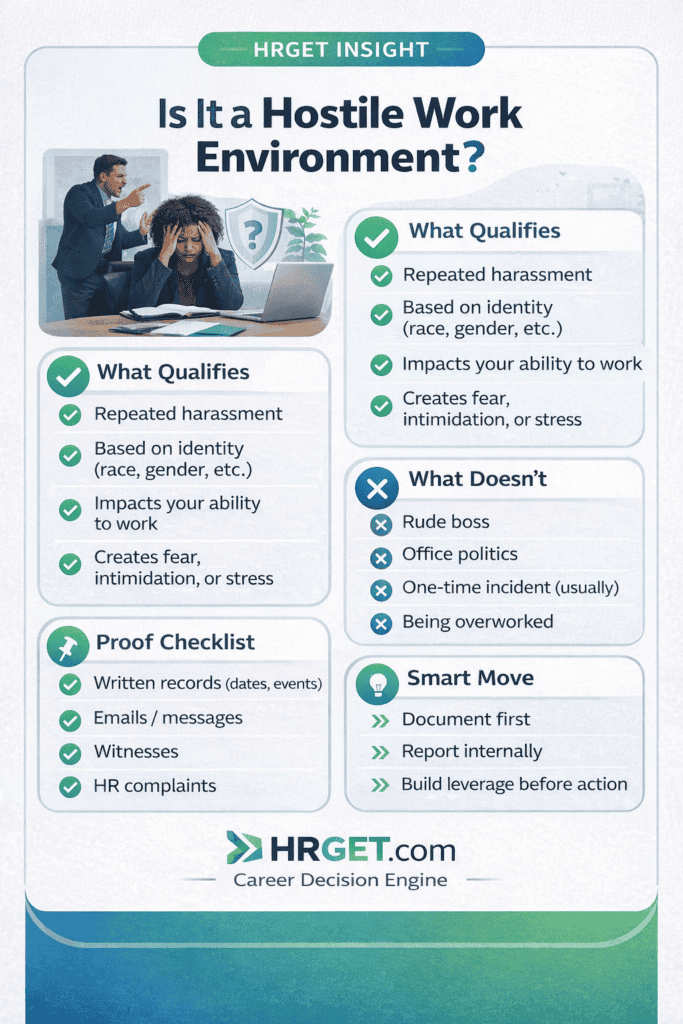
| Likely Qualifies as Hostile Work Environment | Doesn’t Qualify — Even If It Feels Bad |
|---|---|
| Repeated sexist, racist, or religious slurs from a manager or colleagues | A demanding boss who yells at everyone equally |
| Sexual harassment — verbal, physical, or digital | Being overworked or underpaid |
| Threats or intimidation linked to disability, age, or identity | Office politics, favoritism, or being passed over for projects |
| Retaliation after reporting harassment (often easier to prove than the original claim) | One-off rude comments with no pattern or protected characteristic link |
| Systematic exclusion from meetings or decisions targeting a protected group | Personality clashes or general interpersonal conflict |
The courts don’t punish miserable workplaces. They punish workplaces where illegal discrimination or harassment has occurred and the employer failed to act. That distinction matters enormously when you’re deciding whether to pursue legal action or look for another job.
⚠️ Important Legal Note:
Even when behavior clearly qualifies, timing matters. In the US, you typically have 180 to 300 days from the discriminatory act to file a charge with the EEOC. In the UK, it’s generally 3 months from the last incident to file with an employment tribunal. In India under the POSH Act, it’s 3 months from the incident date. Missing these windows can eliminate your options entirely.
Real Examples of Hostile Work Environments
Abstract legal definitions are one thing. Here’s what this actually looks like in practice — the patterns I’ve seen come through employment disputes repeatedly over 20 years.
Gender-Based Harassment
A female senior analyst at a financial services firm is consistently interrupted during presentations, described by her manager as “too emotional” in performance reviews, and excluded from client dinners her male peers attend regularly. Each incident alone might seem minor. The pattern? That’s a case — particularly if the same manager doesn’t apply this treatment to male colleagues at the same level.
Racial Microaggressions That Cross the Line
An employee of South Asian background faces a consistent stream of comments about their accent, jokes about their home country’s food, and a manager who repeatedly mispronounces their name after being corrected multiple times. When that conduct is documented and shown to be persistent, it meets the “pervasive” threshold under most harassment frameworks — even if no single incident feels catastrophic.
Sexual Harassment
Unwanted physical contact, explicit messages sent via Slack or email, or persistent advances from a supervisor after a clear “no.” Here, one serious incident can be enough to establish a case — the law doesn’t require a pattern when the conduct is severe enough. This is also the area where digital evidence (messages, emails) tends to be most decisive.
Retaliation After a Complaint
You report harassment to HR. Within six weeks, your performance review drops from “exceeds expectations” to “meets expectations” with no specific feedback. You’re removed from the project you’ve led for two years. Your promotion is quietly shelved. This is retaliation — and it’s often easier to prove than the original harassment because the timeline tells the story clearly.
🔍 The Insider View:
From my time advising both companies and individuals: HR departments at most mid-to-large companies are well-trained to spot retaliation risk. The problem is that retaliation often happens at the manager level — subtly, informally — and HR doesn’t always connect the dots unless someone has documented the timing. Your job is to make that timeline impossible to ignore.
How to Prove a Hostile Work Environment
This is where cases are won or lost — not in the hearing room, but in the months before you ever file anything.
1. Document Everything — Non-Negotiably
Start a private log (never on a company device or email). Record the date and time of every incident, the exact words or actions, who was present, and any witnesses. If the incident happened via email, Slack, or text, screenshot it and save it outside the company’s systems. Courts want specifics. “He made me feel uncomfortable throughout 2024” loses. “On March 14, 2025, at approximately 10:30am in the conference room, [name] said the following to me in front of [witness]…” wins.
2. Establish a Pattern
One incident rarely meets the “pervasive” standard. You need repetition, escalation, and demonstrable impact on your work. Your documentation should show a timeline — not just a list of complaints. Judges and tribunal panels look for patterns because isolated incidents are legally ambiguous; patterns are not.
3. Connect the Conduct to a Protected Characteristic
This is the crucial link most people miss. Ask yourself: Would this have happened if I were a different race, gender, religion, age, or disability status? If the answer is probably not, you may have a case. If the conduct applies equally to everyone regardless of who they are, you don’t — regardless of how bad it feels.
4. Use Internal Channels First
Most legal frameworks — including the EEOC process in the US and employment tribunal procedures in the UK — require or strongly favour evidence that you raised the issue internally before escalating. Report formally, in writing, to HR. Keep a copy of everything you send and receive. If the company ignores or mishandles your complaint, that failure becomes evidence in your favour.
5. Document the Impact on You
Courts assess compensation partly based on the demonstrable impact: stress, anxiety, decline in performance, medical treatment, missed promotions. If you’ve seen a doctor, a therapist, or taken stress leave related to the situation, keep those records. They quantify what you experienced.
Real Scenario: Where Cases Fall Apart
📋 Real Scenario:
A mid-level marketing manager faces escalating rude behaviour from her director — sarcastic comments, being cut off in meetings, being excluded from a product launch she’d been managing for months. It’s affecting her sleep and her confidence. She’s convinced she has a case. She quits without notice. Three months later, she contacts an employment lawyer.
What went wrong: She had no documentation. She never filed an internal complaint. She resigned before giving the company any opportunity to investigate. The lawyer’s assessment: the behaviour she described was almost certainly discriminatory (the director had a pattern with female managers specifically), but without documentation, internal escalation, or a record of company inaction, the claim was essentially unprovable. The case didn’t proceed.
This is the most painful kind of outcome — because the underlying situation was real. The mistake wasn’t experiencing it. The mistake was not building the case while she was still inside it.
Your Legal Options — US, UK, and India
🇺🇸 United States
The primary enforcement body is the Equal Employment Opportunity Commission (EEOC). You file a charge — typically within 180 days (or 300 days in states with their own anti-discrimination agencies) — and the EEOC investigates. They may offer mediation. If mediation fails or they find cause, you can pursue a lawsuit in federal court. Title VII, the ADA, and the ADEA are the key statutes. Some states (California, New York) have broader protections than federal law.
🇬🇧 United Kingdom
The Equality Act 2010 covers nine protected characteristics including sex, race, disability, religion, and age. Claims go to an employment tribunal, typically within 3 months of the last act. ACAS early conciliation is mandatory before filing. Constructive dismissal — where the hostile environment effectively forces you to resign — is a separate but related claim worth understanding with a solicitor.
🇮🇳 India
The Sexual Harassment of Women at Workplace Act (POSH Act, 2013) is the primary framework for workplace sexual harassment. Any company with 10 or more employees must have an Internal Complaints Committee (ICC). Complaints go to the ICC first; if unresolved, you can escalate to the Local Complaints Committee and labour courts. Beyond POSH, general workplace discrimination falls under the Industrial Disputes Act and, in some cases, constitutional protections — though enforcement is more variable.
⚠️ UAE Note:
For professionals in the UAE, Federal Decree Law No. 33 of 2021 (the New Labour Law) prohibits workplace harassment and discrimination. Complaints can be raised with the Ministry of Human Resources and Emiratisation (MoHRE). Labour courts handle disputes. Free zone employees (DIFC, ADGM) operate under separate, more internationally aligned employment frameworks.
Smart Strategy: What to Do Before Filing a Complaint
Filing a complaint is a significant step. Do these things first — in this order — and you’ll be in a far stronger position regardless of which path you ultimately choose.
- Start documenting immediately and quietly. Don’t tell colleagues you’re doing it. Don’t use company systems. Use a personal device, a personal email, or a password-protected note. Date every entry.
- File an internal complaint in writing. Email HR. Not a verbal conversation — an email. This creates a timestamp, forces a written response, and gives the company an opportunity to act. If they don’t, that inaction becomes evidence.
- Observe the response carefully. Did HR investigate? Did your situation improve or worsen? Did anything change about your work assignments, reviews, or access after you complained? All of this is data.
- Back up all evidence to a personal device. Emails, screenshots, messages. Do this carefully and legally — some jurisdictions restrict recording without consent. Know your local rules before you hit record on anything audio.
- Consult an employment lawyer before you do anything irreversible. Before you quit. Before you send an angry email. Before you go public. One consultation — which many employment lawyers offer at no cost — can completely change your approach and protect your options.
💡 Pro Tip:
If your underlying harassment claim feels borderline, redirect your focus to retaliation. Once you’ve made an internal complaint — even informally — any adverse action that follows (demotion, exclusion, negative reviews) creates a separate and often stronger legal claim. Retaliation claims are frequently cleaner to prove because the timeline speaks for itself. Many employment lawyers consider retaliation the more winnable case when the primary harassment is ambiguous.
Common Mistakes That Kill Your Case
I’ve seen strong situations collapse because of avoidable errors. These are the most common ones — and the most damaging.
Waiting too long. Statutes of limitations are hard cutoffs. In the US, 300 days sounds like a lot — until six months pass while you’re hoping things will improve on their own. Clock starts from the incident, not from when you decided to act.
No documentation. Memory is not evidence. “I remember he said something offensive around mid-2024” doesn’t help an attorney or a tribunal. Specific, contemporaneous records do.
Emotional confrontations or angry emails. I understand the impulse. But a defensive, emotional email chain — or a heated confrontation in a meeting — can reframe the narrative, undermine your credibility, and give the other side material to work with. Keep your communications professional and measured, even when you’re furious.
Quitting without understanding constructive dismissal. If the environment is genuinely intolerable and you’ve documented that, resignation can sometimes be framed as constructive dismissal — meaning you were effectively forced out. But this is a high legal bar and must be handled carefully. Quitting impulsively, without legal advice, often just gives up your position and your leverage.
Confusing toxic with illegal. This is the hardest one. A workplace can be genuinely miserable — bullying culture, poor leadership, unreasonable pressure — and still not meet the legal threshold for a hostile work environment claim. Recognising that distinction early saves you time, money, and emotional energy.
When to Leave vs. Fight
This is ultimately a career and personal decision, not just a legal one. Here’s how I’d frame it for anyone sitting across from me in a consultation.
| Consider Fighting If… | Consider Leaving If… |
|---|---|
| You have clear documentation of discriminatory conduct | The environment is toxic but doesn’t meet the legal threshold |
| You’ve reported internally and the company has ignored or mishandled it | You have no documentation and the incidents have passed the limitation window |
| You’ve experienced retaliation after a complaint | Your mental health is deteriorating and you need to prioritise yourself |
| You’re part of a pattern affecting other employees who may corroborate | The financial and emotional cost of a legal process outweighs the likely outcome |
| An employment lawyer has assessed your case as viable | A lawyer has told you the claim is unlikely to succeed on the evidence available |
The most important thing I tell clients: don’t make this decision alone, and don’t make it while you’re in the middle of the emotional acute phase. Get a legal opinion. Stabilise your situation. Then decide.
Frequently Asked Questions
What legally qualifies as a hostile work environment?
Legally, the conduct must be severe or pervasive, linked to a protected characteristic (race, sex, religion, disability, age, etc.), and create an intimidating or abusive working environment. Courts assess both the objective severity — would a reasonable person find this hostile — and the subjective experience of the employee. Rude or unfair treatment alone doesn’t meet this standard unless it’s tied to who you are.
Can a single incident constitute a hostile work environment?
Yes — but only if it’s extremely serious. A single instance of severe sexual assault, for example, can establish a claim without requiring a pattern. However, for less extreme conduct such as offensive comments or exclusionary behaviour, courts generally require repetition before the “pervasive” standard is met. The more severe the act, the less repetition is required to satisfy the legal threshold.
Can I file a hostile work environment claim without reporting to HR first?
You can, but it significantly weakens your position. Most legal frameworks — including the EEOC process in the US — view internal reporting as evidence that you gave the employer a chance to fix the problem. If you skip that step, the employer can argue they were never informed and therefore had no opportunity to act. Internal complaint first, external escalation second, is the right sequence in nearly every case.
What evidence is most powerful in a hostile work environment case?
Written evidence is strongest: emails, Slack messages, text messages, and any written documentation of incidents with dates and witnesses. After that, witness testimony from colleagues who observed the conduct. Performance review records can show a before-and-after pattern, particularly useful in retaliation claims. Audio or video recordings may be admissible depending on your jurisdiction — check local consent laws before recording anyone.
How long do I have to file a hostile work environment claim?
In the US, typically 180 to 300 days from the discriminatory act to file with the EEOC (300 days if your state has its own anti-discrimination agency). In the UK, 3 months from the last incident to file with an employment tribunal. In India under the POSH Act, 3 months from the incident. These are hard deadlines — missing them generally closes the door permanently, regardless of how strong your underlying case is.
Is workplace bullying the same as a hostile work environment?
Not legally, in most jurisdictions. Bullying — even severe bullying — doesn’t automatically constitute a hostile work environment unless it’s tied to a protected characteristic. A manager who bullies everyone indiscriminately is creating a toxic workplace, but may not be creating a legally actionable one. Where bullying is discriminatory in nature — targeting someone because of their race, gender, or disability — the legal analysis changes significantly.
Can I get compensation if I win a hostile work environment case?
Yes. Depending on the jurisdiction and the specifics, compensation can include back pay (lost wages), front pay (future lost earnings), damages for emotional distress, punitive damages in egregious cases, and legal fees. In the UK, employment tribunal compensation for discrimination claims has no statutory cap. In the US under Title VII, there are caps based on employer size — ranging from $50,000 for smaller employers up to $300,000 for large ones — but these apply per employee, and economic damages are uncapped.
Should I quit my job if I’m experiencing a hostile work environment?
Don’t quit without legal advice first. Resigning can eliminate your claims unless your situation meets the legal standard for constructive dismissal — meaning the environment was so intolerable that any reasonable person would have felt compelled to leave. That’s a high bar and requires specific documentation. If you’re in immediate danger of harm, prioritise your safety. Otherwise, stay, document, and consult an employment lawyer before making any irreversible moves.
A hostile work environment isn’t defined by how bad things feel — it’s defined by what you can prove and whether it crosses the legal threshold. If you take one thing from this: start documenting before you start reacting. That single decision can be the difference between walking away frustrated and walking away with a real legal case — or at minimum, with the leverage to negotiate a better exit.
📖 Related Reading: If you’re dealing with ongoing toxic dynamics at work that don’t rise to the legal level of a hostile environment, read our guide on recognising and responding to workplace bullying — including when documentation alone can shift the power dynamic in your favour.

Victoria Hale | Former Partner, Freshfields Bruckhaus Deringer | Employment Law Specialist | 20+ Years Advising Multinationals & Executives
Author: Victoria Hale spent over two decades as an Employment Law Partner at Freshfields Bruckhaus Deringer — one of the world’s most prestigious Magic Circle law firms — advising multinational corporations and senior executives on some of the most complex employment disputes in the US and Europe. Her practice covered wrongful termination litigation, executive exits, non-compete enforcement, FLSA compliance, and cross-border workforce restructuring under EU labour law. Now based between London and New York, Victoria writes for HRGet.com to close the gap between legal theory and how employment law actually plays out in the real world — for employees who need to know their rights before it’s too late.