You’ve got multiple offers on the table — or you’re seriously thinking about making a move — and you’re trying to figure out whether Amazon, Google, or Meta actually pays more for mid-level engineers. The headline numbers look similar. But the real compensation picture is wildly different once you factor in vesting schedules, refreshers, and the state you’re filing taxes in.
Here’s the blunt answer upfront: Meta pays the highest total compensation for most mid-level engineers in the US in 2026. But that doesn’t make it the automatic right choice for you. The difference between a good decision and a great one often comes down to factors most comparison articles skip entirely — like how Amazon’s back-loaded vesting can trap you, or why a Google offer in Texas beats a Meta offer in San Francisco for some people’s actual bank account.
I’ve spent 15 years in recruiting and HR advising engineers across Big Tech. Let me walk you through this properly.
What “Mid-Level” Actually Means at Each Company
Before you can compare compensation, you need to make sure you’re comparing the same thing. Level mapping across Amazon, Google, and Meta is genuinely confusing, and every article that skips this step ends up comparing apples to tractors.
Here’s how the levels map for US-based mid-level engineering roles in 2026:
| Company | Mid-Level Levels | Common Title | Typical Experience |
|---|---|---|---|
| Amazon | L5 (core mid-level) | SDE II | 3–7 years |
| L4–L5 | Software Engineer III / Senior SWE | 3–8 years | |
| Meta | E4–E5 | Software Engineer / Senior SWE | 3–8 years |
L5 at Amazon is roughly comparable to L5 at Google and E5 at Meta — all three represent the “solid mid-level” band where engineers own meaningful projects but aren’t yet at the staff/principal tier. The compensation ranges I’ll cover below are anchored to these levels.
One important caveat: Google’s L4 and Meta’s E4 are entry-level adjacent at some teams. If you’re being offered L4 at Google, push hard — you may be being low-balled relative to your experience.
Amazon vs Google vs Meta Salary Comparison (US 2026)
Let’s get into the numbers. These ranges reflect 2026 compensation at major US tech hubs (Seattle, Bay Area, New York, Austin) and are consistent with data from levels.fyi and direct offer negotiations I’ve reviewed.
| Company | Base Salary | Annual Bonus | RSUs (Annualized) | Total Comp Range |
|---|---|---|---|---|
| Amazon (L5) | $140K – $185K | 0–15% (inconsistent) | $30K – $120K | $170K – $240K |
| Google (L4–L5) | $150K – $200K | 15–20% | $80K – $180K | $220K – $320K |
| Meta (E4–E5) | $160K – $210K | 20–25% | $120K – $300K | $260K – $400K |
The spread is significant. A strong Meta E5 offer can come in at nearly double a weak Amazon L5 offer. But averages hide nuance — an Amazon L5 in a high-demand org (like AWS or Alexa) with a negotiated sign-on will look very different from an L5 in a cost-center team.
Look at base salary alone and you’ll miss 40–60% of the story. That’s where most engineers make their first mistake.
Total Compensation Breakdown: Base, Bonus, RSUs
US tech compensation has three components, and each company weights them differently. Understanding this isn’t just academic — it tells you when you’ll actually get paid.
Base Salary
This is your guaranteed, taxable income paid bi-weekly. All three companies cap mid-level base somewhere between $185K and $210K. There’s diminishing differentiation here — the real comp gap is in the other two buckets.
Annual Bonus (Cash)
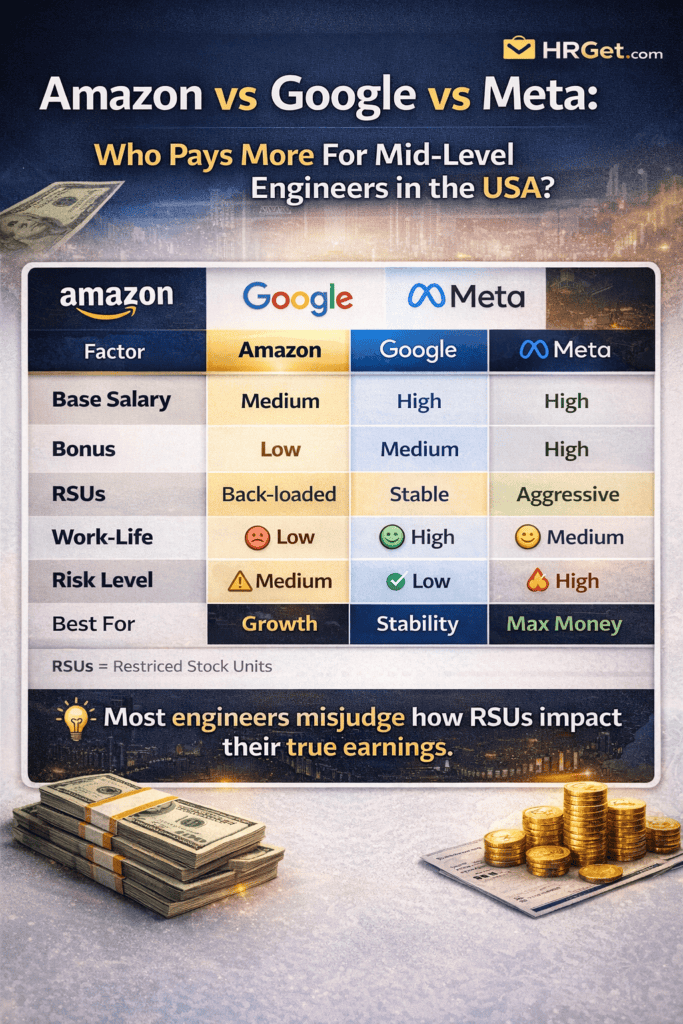
Meta’s bonus structure is the most aggressive. At E5, performance bonuses of 20–25% of base are common, and top performers regularly see 30%+. Google’s bonuses are solid and predictable at 15–20%. Amazon’s bonus program is the weakest of the three — some teams pay consistently, others barely move the needle, and the “Total Compensation Target” framing Amazon uses often front-loads sign-on bonuses to mask a lower annual bonus structure.
RSUs (Restricted Stock Units)
This is where the real money lives — and where the biggest mistakes happen. RSUs vest over time and are taxed as ordinary income at the point of vesting, not at grant. So if Meta’s stock is up 25% when your shares vest, that’s a tax event at the higher value. If it’s down, you’ve taken the risk without the reward.
The vesting schedule matters as much as the total grant size. More on that next.
RSU Vesting Differences — This Is Where You Win or Lose
I’ll be direct: Amazon’s vesting schedule is the most misunderstood thing in tech compensation. Engineers accept Amazon offers without fully grasping what Year 1 is going to feel like.
Amazon’s Vesting Schedule
Amazon vests RSUs on a 5% / 15% / 40% / 40% schedule over four years. That means in Year 1, you’re getting 5% of your RSU grant. Year 2, another 15%. The real payout hits in Years 3 and 4.
To compensate for this, Amazon offers sign-on bonuses (often $30K–$80K+ for L5) that are essentially an advance against future earnings. The problem? If you leave before Year 3, you’ve walked away from the bulk of your stock — and potentially had to repay part of your sign-on.
This is called the “golden handcuff” structure, and it’s very deliberate.
Google’s Vesting Schedule
Google vests roughly 25% of your RSU grant per year, with a one-year cliff. So after 12 months you vest a quarter, then monthly grants kick in. This creates predictable income growth. Google also does regular refresher grants — additional RSU awards based on performance — which make staying at Google financially logical for high performers.
Meta’s Vesting Schedule
Meta also uses a 25% annual schedule but combines it with the most aggressive refresher program in the industry. Top performers at E5 regularly receive $100K–$200K in new RSU grants annually — on top of their original grant. Over four years, a strong performer’s total comp can compound significantly beyond the initial offer number.
Here’s the insider view most articles won’t give you: Meta’s refreshers are performance-gated in a way that creates real income variability. If you perform consistently, Meta is the highest-paying job in tech. If you’re mid-pack, you’ll feel that in your refreshers by Year 2.
Taxes and Real Take-Home Pay (The Most Ignored Factor)
Here’s something that shocks engineers the first time they do the math: a $300K offer in San Francisco and a $300K offer in Austin are not the same paycheck. Not even close.
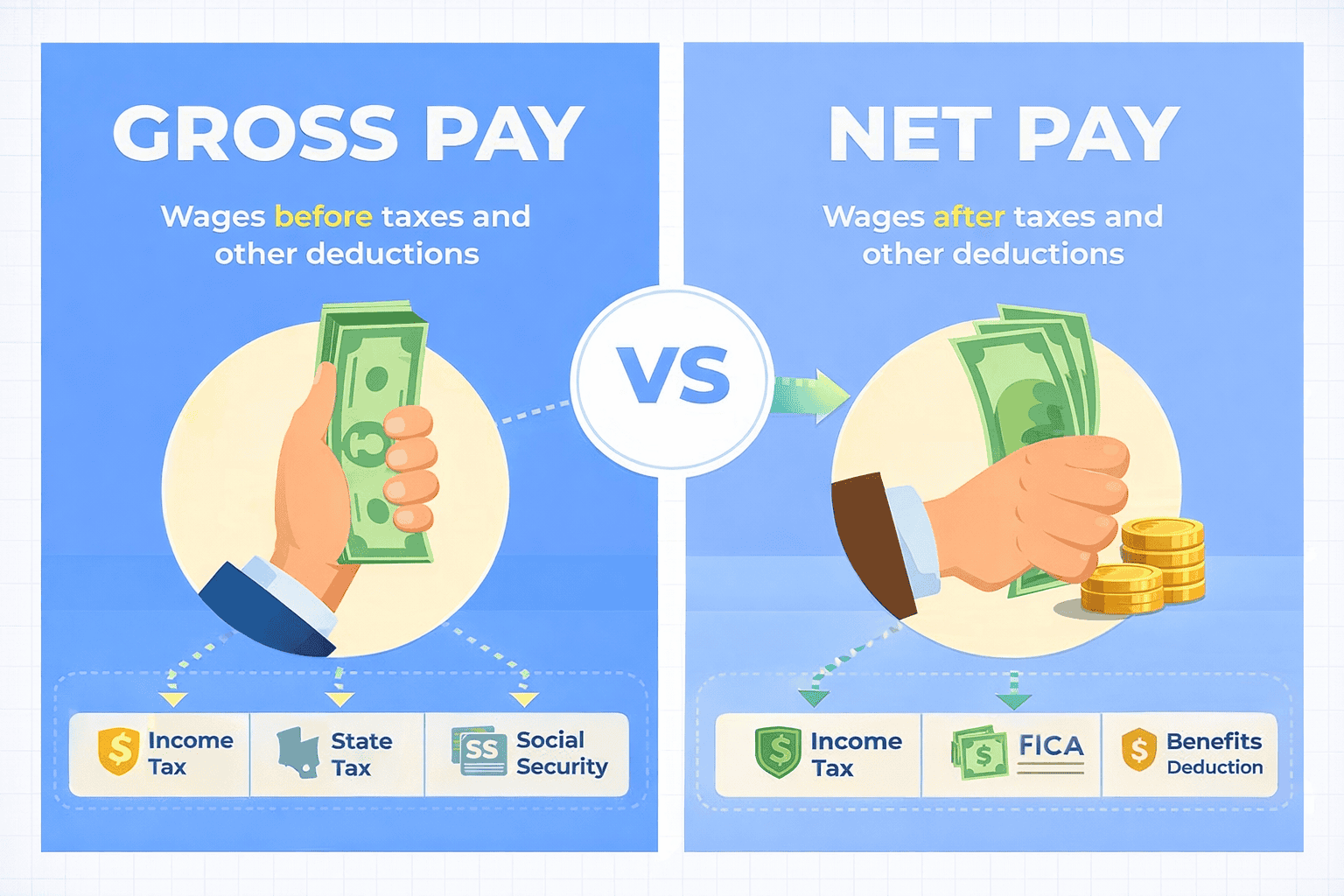
Your RSUs vest as ordinary income. Your bonus is ordinary income. Base is ordinary income. At $250K+ total compensation in California, you’re looking at:
- Federal income tax: 32–35%
- California state income tax: 9.3–13.3%
- Social Security + Medicare: ~7.65% (up to SS wage base)
Effective total deduction: 45–50% in California. You’re taking home roughly half your comp number.
Texas, Washington, and Florida have no state income tax. That single variable can swing your annual take-home by $20K–$40K on the same gross compensation.
| Scenario | Gross Comp | California Take-Home | Texas Take-Home | Difference |
|---|---|---|---|---|
| Google L5 | $270K | ~$155K | ~$185K | +$30K |
| Meta E5 | $340K | ~$185K | ~$225K | +$40K |
| Amazon L5 | $210K | ~$120K | ~$148K | +$28K |
If you’re weighing a Meta offer in Menlo Park against a Google offer at their Austin office, the Google offer might genuinely put more money in your pocket — even if it’s $50K lower on paper. Run the actual numbers before you decide.
Real Scenario: Three Offers, One Engineer
Let me walk you through a situation I’ve seen play out multiple times — the details are composited, but the financial math is real.
Priya is a 6-year software engineer with backend infrastructure experience. She has competing offers from all three companies for mid-level roles (Amazon L5, Google L5, Meta E5) in the Seattle area. Here’s the initial offer landscape:
| Company | Base | Bonus | RSU Grant (4yr) | Sign-On | Year 1 Total |
|---|---|---|---|---|---|
| Amazon | $175K | Variable | $280K | $60K | ~$263K |
| $185K | $32K | $480K | $30K | ~$337K | |
| Meta | $195K | $45K | $640K | $50K | ~$450K |
Amazon’s Year 1 number is inflated by the sign-on. Strip that out and her actual Year 1 run-rate from Amazon is closer to $200K. Google is genuinely strong from Day 1. Meta is exceptional — but notice that $640K RSU grant has to vest, and Meta’s stock has had years of 30%+ swings in both directions.
Over a 3-year period assuming no refreshers and flat stock prices, Priya’s projected cumulative earnings break down like this: Amazon ~$620K, Google ~$790K, Meta ~$990K. Add Meta refreshers for a solid performer and you can add another $150K–$300K on top.
She took Meta. For her risk tolerance and financial situation, it was the right call. But that’s a personal calculation — not a universal answer.
Short-Term vs Long-Term Earnings: Which Company Wins When
The comparison changes depending on your time horizon, and most engineers don’t think about this carefully enough.
If You’re Planning to Stay 1–2 Years
Meta wins, and it’s not particularly close. The high base, aggressive bonus, and front-loaded RSU vesting (vs Amazon’s back-loaded schedule) mean Meta delivers the highest Year 1 and Year 2 cash-equivalent compensation. Amazon is genuinely the worst choice for a short stay — you’ll trigger sign-on clawback provisions and miss the big RSU vest years.
If You’re Planning to Stay 3–4 Years
Meta still leads for high performers. But Google becomes a compelling stability play — consistent refreshers, no cliff-edge clawback risk, and a compensation structure that rewards tenure without penalizing early departures. Amazon’s big RSU years (Years 3 and 4) kick in here, so if you committed to the long game at Amazon intentionally, this is your payoff window.
If You’re Thinking Beyond 4 Years
Promotion trajectory matters more than starting comp at this horizon. Amazon L5 → L6 promotions have historically taken 18–30 months for strong performers. Google L5 → L6 is similar. Meta E5 → E6 is notoriously difficult — the bar is genuinely high — but the E6 comp jump is enormous ($500K–$750K+ total comp territory).
Smart Strategy: How to Maximize Your Offer
This is the part most salary articles skip. Getting the number matters less than playing the negotiation right.
Step 1: Use Competing Offers as Leverage
All three companies respond to competing offers. Get all three if you can. A Meta offer is your strongest lever with Google and Amazon — both have matching processes, and Amazon in particular will improve sign-on bonuses to close a gap with Meta’s Year 1 comp.
Step 2: At Amazon, Fix Year 1 Before You Sign
Amazon’s default L5 offer often front-loads sign-on and back-loads RSUs. Push specifically for a higher sign-on (request $75K–$100K if base is below $170K) and ask for monthly vesting to begin earlier. Amazon recruiters have more flexibility on sign-on than they’ll initially admit.
Step 3: At Google, Negotiate RSUs — Not Base
Google’s base salary bands are tightly constrained by level. You won’t move the base much. But RSU grant size is genuinely negotiable, especially if you have a strong competing offer. Push for a higher initial grant rather than a bigger sign-on — the RSU grant compounds through refreshers in a way the sign-on doesn’t.
Step 4: At Meta, Negotiate the Level First
Getting hired at E5 vs E4 at Meta is a six-figure decision — not just on starting comp, but on every refresher and bonus for the next 3–4 years. If there’s any ambiguity about your level, fight for E5. Bring your highest-complexity project examples to the leveling conversation.
Step 5: Match Based on Your Risk Profile
Be honest with yourself about financial risk tolerance. If you have a mortgage, dependents, or are managing debt, Google’s predictability has real value. If you’re early-career, single, and financially flexible, Meta’s upside is worth pursuing. Amazon makes sense if you believe in their promotion velocity and you’re willing to commit to 3+ years.
Common Mistakes Engineers Make When Comparing Offers
Comparing only base salaries. Base is 40–55% of total comp at these companies. Comparing base salaries alone is like evaluating a car by its cup holders.
Ignoring state tax implications. Engineers moving from a no-tax state to California for a “better” offer routinely discover their take-home is lower than their previous job. Do the after-tax math before you decide.
Not reading the sign-on repayment clause. Amazon and Google sign-on bonuses often require full repayment if you leave within 12 months, and partial repayment up to 24 months. Know exactly what you’re signing.
Leaving Amazon before Year 3. The 5/15/40/40 schedule is designed to test your patience. Engineers who leave at 18–24 months have earned the smallest fraction of their RSU grant. If you’re going to take an Amazon offer, model out what leaving at different points actually costs you.
Skipping the refresher conversation. Refreshers aren’t guaranteed, but you can ask about the historical cadence for your team and level during the offer stage. At Meta especially, this is not a weird question — it’s an expected one.
Pro Tip: The best negotiating leverage you’ll ever have with any of these companies is the 72-hour window after you receive a competing offer. That’s when their urgency peaks. Don’t wait a week to respond — engage immediately and name the competing offer explicitly. “I have an offer from Meta at $340K total comp” is a complete sentence. You don’t need to apologize for it.
Frequently Asked Questions
Which company pays the most for mid-level software engineers in the US in 2026?
Meta pays the highest total compensation for mid-level engineers (E4–E5), with total comp ranging from $260K to $400K annually. Google is a strong second at $220K–$320K, and Amazon trails at $170K–$240K due to its back-loaded RSU vesting structure. However, after-tax take-home varies significantly by state.
Is Amazon’s back-loaded RSU vesting really a problem?
Yes, if you’re not planning to stay 3+ years. Amazon vests only 5% of your RSUs in Year 1 and 15% in Year 2, with the big payouts in Years 3 and 4. Most engineers who leave Amazon before Year 3 feel financially shortchanged — not because the offer was dishonest, but because they didn’t model the vesting curve before accepting.
How much does state income tax affect the Amazon vs Google vs Meta salary comparison?
Significantly. California’s top marginal state tax rate is 13.3%, while Texas, Washington, and Florida have no state income tax. On a $300K gross compensation package, the difference between a California and Texas posting can be $25K–$40K in annual take-home — enough to flip the “better offer” decision entirely.
Can I negotiate my RSU grant at Google or Meta?
Yes, and you should. Base salary at both companies is relatively constrained by internal pay bands. RSU grant size has more flexibility, especially when you bring a competing offer. At Meta, pushing for a higher initial grant also has a multiplier effect on future refreshers, which are often calculated as a percentage of your standing grant value.
Is Meta worth the higher performance pressure for mid-level engineers?
For the right person, absolutely. Meta’s performance culture is demanding — below-average performers face real consequences, including reduced refreshers and managed exits. But for strong performers, Meta’s upside is unmatched in the industry. If you’re consistently in the top 30% of your peer group, Meta will reward that more aggressively than Google or Amazon.
How long should I stay at Amazon to make the compensation worthwhile?
At minimum, 3 years. The 40% vest in Year 3 is the inflection point. If you’re going to leave before Year 3, Amazon’s offer structure works against you — you’ll have received only 20% of your RSU grant. If you’re genuinely committed to 3–4 years, Amazon’s cumulative comp becomes much more competitive.
Which company is best for engineers who want to maximize long-term wealth?
Meta, for high performers willing to stay 3–4 years. The combination of high base, strong bonus, and aggressive RSU refreshers creates a compounding compensation effect that neither Google nor Amazon matches. That said, this assumes you perform consistently — Meta’s comp is more variable than Google’s based on performance ratings.
Final Verdict: Amazon vs Google vs Meta Salary for Mid-Level Engineers
Here’s how to think about the Amazon vs Google vs Meta salary decision without second-guessing yourself after you sign.
If you want maximum compensation and you’re a consistent high performer with flexibility on risk — take the Meta offer. The numbers are better, the refresher upside is real, and for the right person it’s a wealth-building engine.
If you want stability, predictability, and strong total comp without the performance volatility — Google is an outstanding choice. The 25% annual vesting, solid refreshers, and lower-pressure culture make it a long-term career asset, not just a job.
If you’re growth-oriented and willing to commit to 3+ years in exchange for promotion velocity — Amazon can make sense, especially at AWS. But go in with eyes open on the vesting cliff, and negotiate your sign-on aggressively before you sign.
Whatever you decide, don’t compare base salaries in isolation, don’t ignore your state tax situation, and don’t underestimate how much the vesting schedule will shape your actual financial reality. The Amazon vs Google vs Meta salary comparison is ultimately a personal financial modeling exercise — and now you have the framework to run it properly.
Looking to negotiate your tech offer step-by-step? Read our guide on How to Negotiate a FAANG Tech Job Offer for a tactical playbook you can use this week.

Victoria Hale | Former Partner, Freshfields Bruckhaus Deringer | Employment Law Specialist | 20+ Years Advising Multinationals & Executives
Author: Victoria Hale spent over two decades as an Employment Law Partner at Freshfields Bruckhaus Deringer — one of the world’s most prestigious Magic Circle law firms — advising multinational corporations and senior executives on some of the most complex employment disputes in the US and Europe. Her practice covered wrongful termination litigation, executive exits, non-compete enforcement, FLSA compliance, and cross-border workforce restructuring under EU labour law. Now based between London and New York, Victoria writes for HRGet.com to close the gap between legal theory and how employment law actually plays out in the real world — for employees who need to know their rights before it’s too late.