
Updated April 2026 • 10 min read
Most people hesitate to report workplace harassment not because they don’t know it’s wrong — but because they’re terrified of what happens next. Can you be fired for reporting harassment? The short legal answer is no. The real-world answer is considerably messier, and that gap is exactly where careers get destroyed.
I’ve spent two decades advising executives and employees through workplace disputes at firms including Freshfields Bruckhaus Deringer. I’ve seen the retaliation playbook used by employers on three continents. It’s rarely a dramatic firing-on-the-spot. It’s slower, quieter, and — if you’re not prepared — almost impossible to prove.
This article gives you the full picture: what the law actually protects, what employers can still legally do, and the specific steps that determine whether you come out of this with your job and your dignity — or neither.
What Counts as Workplace Harassment?
Before any legal protection kicks in, you need clarity on what legally qualifies. Not every uncomfortable or unkind workplace behaviour crosses the legal threshold — and that distinction matters enormously for your case.
Legally cognisable harassment typically falls into two categories. The first is quid pro quo harassment — where a supervisor conditions employment benefits on submission to unwelcome conduct (a manager implying your promotion depends on socialising outside work, for example). The second is a hostile work environment — where conduct is so severe or pervasive that it alters the conditions of employment for a reasonable person.
Protected categories under most anti-discrimination frameworks include sex, race, religion, national origin, disability, age (40+ in the US), and increasingly gender identity and sexual orientation. One-off rude comments from a peer rarely meet the threshold. Repeated, targeted, or severe behaviour — especially from a manager — almost certainly does.
The Insider View
HR departments are trained to document pattern and severity — not single incidents. If you walk in with one story and no paper trail, the most likely outcome is a note in a file and a “we’ll look into it.” If you walk in with dates, emails, and witnesses, the conversation changes entirely. I’ve seen this distinction determine the outcome of cases worth hundreds of thousands in settlements.
Here’s the practical implication: before you report anything, be honest with yourself about whether what you experienced meets the bar. That’s not victim-blaming — it’s strategy. Reporting weak claims can dilute your credibility if a legitimate pattern emerges later.
Can You Be Fired for Reporting Harassment?
The direct answer: No — not legally, and not without significant risk to the employer. Reporting harassment is a protected activity under employment law in virtually every major jurisdiction. Once you’ve made a complaint in good faith — internally to HR or externally to a government body — your employer is legally prohibited from taking adverse action against you because of that complaint.
That protection exists whether you’re a part-time contractor in Manchester, a senior manager in New York, or an IT professional in Bengaluru. The specific law differs by geography, but the principle is consistent: retaliation for protected activity is illegal.
Here’s the thing, though. “Legally prohibited” and “never happens” are two very different things. What actually happens in practice is that employers rarely fire someone and say “this is because you reported harassment.” They engineer an alternative narrative — and that’s where the real danger lies.
| What the Law Says | What Actually Happens |
|---|---|
| You cannot be fired for making a harassment complaint in good faith | You may be fired for suddenly “underperforming” two months later |
| Retaliation is explicitly illegal under federal and state law (US) and equivalent frameworks globally | Retaliation is disguised as PIPs, project reassignments, or role restructures |
| Employers bear the burden of proving termination was for a legitimate, non-retaliatory reason | Employers often spend months building a paper trail before terminating |
What Retaliation Actually Looks Like
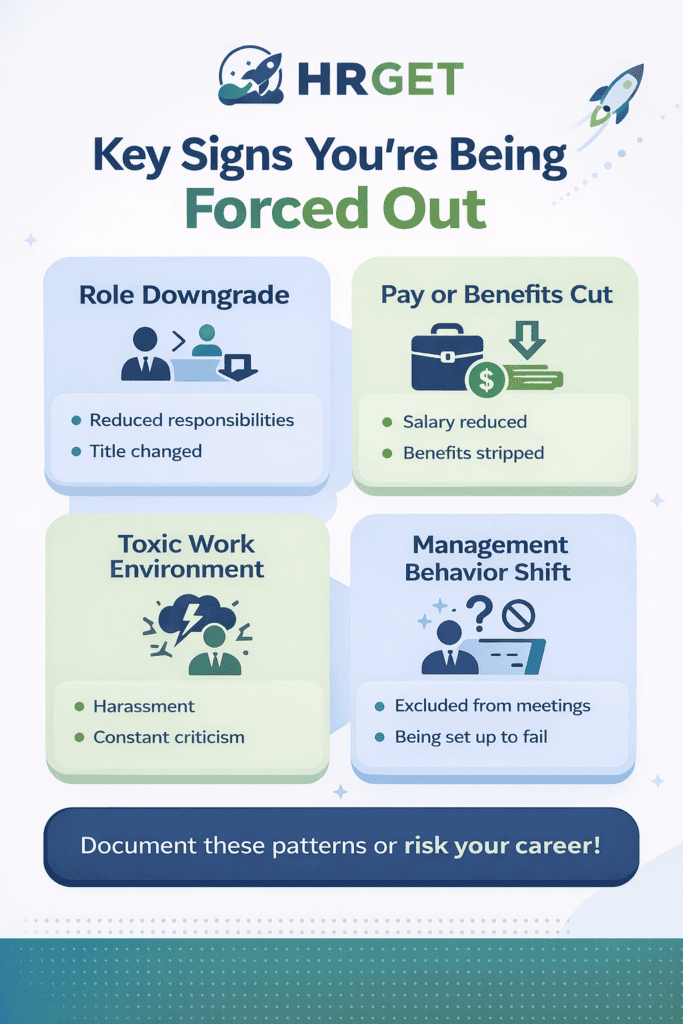
Most people picture retaliation as an immediate firing. In my experience, that’s the rarest form. Sophisticated employers — and their employment lawyers — know better. What you actually encounter is what I call slow retaliation: a deliberate pattern of adverse actions that individually might seem innocuous but collectively tell a clear story.
The legal definition of retaliation is broad on purpose. Under Title VII and equivalent frameworks, any “materially adverse action” that would deter a reasonable person from making a complaint can constitute retaliation. That includes:
- Termination, demotion, or pay cuts
- Sudden negative performance reviews (especially after consistently positive ones)
- Being excluded from key meetings, projects, or client relationships
- A Performance Improvement Plan (PIP) with no prior warning
- Hostile or dismissive treatment from management
- Transfers to less desirable roles, shifts, or locations
- Having complaints dismissed or investigations dragged out without resolution
The timing of these actions matters enormously in a legal claim. Courts and tribunals look very carefully at the gap between your complaint and the adverse action. A PIP issued three weeks after your report looks very different from one issued fourteen months later.
Laws That Protect You: US, UK, India, and Beyond
Your protections vary meaningfully by geography. Here’s a practical breakdown for the markets most of our readers work in.
United States
Title VII of the Civil Rights Act (1964) prohibits both harassment and retaliation for reporting it. The EEOC (Equal Employment Opportunity Commission) enforces these protections at the federal level. Critically, most states add their own anti-retaliation provisions that can be stronger than federal law — California’s FEHA and New York State’s Human Rights Law being two prominent examples. In 2026, several states have also strengthened protections specifically for employees in at-will employment states, narrowing the window for pretextual terminations.
United Kingdom
The Equality Act 2010 provides robust protection against harassment and victimisation (the UK’s term for retaliation). Employees can bring claims to an Employment Tribunal, and since the abolition of tribunal fees, access to justice has improved significantly. Note: UK employees typically need two years of continuous employment to claim unfair dismissal — but retaliation for a protected disclosure or protected act under the Equality Act carries no minimum service threshold. That distinction is vital.
India
The POSH Act (Sexual Harassment of Women at Workplace Act, 2013) requires every organisation with 10 or more employees to constitute an Internal Complaints Committee (ICC). Retaliation against a complainant is prohibited under the Act, and employers who fail to act on complaints — or who retaliate — face penalties including fines and cancellation of licences. In practice, enforcement is inconsistent in smaller organisations, but the legal framework is clear.
UAE
Federal Decree-Law No. 33 of 2021 (the UAE Labour Law) prohibits workplace harassment and arbitrary dismissal. While the UAE’s regulatory framework is less litigious than Western markets, employees in free zones and multinationals benefit from clearer contractual protections, and wrongful termination claims can be pursued through the Ministry of Human Resources and Emiratisation (MOHRE).
Real Scenario: How Retaliation Actually Unfolds
Real Scenario
Priya is a senior marketing manager at a 400-person tech company in London. In January 2026, she reports persistent inappropriate comments from a male director to HR. HR acknowledges the complaint and launches an investigation. The director is verbally warned.
By March, Priya notices she’s been removed from the quarterly strategy meeting she’s attended for two years. Her Q1 performance review — historically strong — now flags “communication issues” for the first time. In April, she’s placed on a 60-day PIP with targets her line manager can’t clearly define.
By June she’s gone, terminated for “failure to meet performance targets.” Is this illegal? Almost certainly yes — but only because Priya had the presence of mind to keep every email, save every review, and document the exact timeline from complaint to termination. Without that paper trail, the company’s story about performance would have been difficult to challenge.
This pattern is extraordinarily common. The employer’s defence is almost always performance — and it works unless you can demonstrate that the performance concerns materialised after the complaint, not before it.
When Employers Can Still Legally Fire You After a Complaint
Look — the law doesn’t make you untouchable the moment you file a complaint. And I think it’s important to be honest about this, even if it’s uncomfortable, because misunderstanding this point leads to poor decisions.
Employers can still lawfully terminate your employment after a harassment report if:
- Genuine pre-existing performance issues are documented — If your Q3 review cited underperformance and your complaint was filed in Q4, the employer has a legitimate business reason. Courts look at whether the documentation predates the complaint.
- A genuine redundancy affects your role — Structural layoffs, role eliminations, or departmental restructures that are organisation-wide can be lawful even if you’re included. The test is whether the process was fair and whether you were selected for reasons unrelated to your complaint.
- You violate a separate, clear company policy — If you share confidential information, commit time theft, or engage in misconduct unrelated to your complaint, disciplinary action remains available to the employer.
- Your complaint was demonstrably made in bad faith — Fabricated or knowingly false complaints can strip you of protection in some jurisdictions, though “bad faith” is a high bar. Good faith means you genuinely believed the conduct was unlawful, not that you were necessarily correct.
Warning
Some employers deliberately begin building a paper trail immediately after receiving a complaint — documenting every minor error, missed deadline, or late arrival. This is a known legal strategy. It’s not always unlawful, but it is the playbook. Your strongest counter-move is to make sure your performance is genuinely impeccable from the day you report onwards.
Smart Strategy: How to Report Harassment Without Destroying Your Career
Here’s the mindset shift that matters most: the goal isn’t just to report — it’s to report in a way that protects your position no matter what happens next. These are the steps that determine outcomes.
Step 1: Document Before You Report
Spend at least two weeks creating a contemporaneous record before filing anything. Write down each incident with date, time, location, what was said or done, and who witnessed it. Forward relevant emails to your personal account where your company policy permits. Screenshot messages. Save performance reviews. This isn’t paranoia — it’s the minimum standard for a viable case.
Step 2: Use Official Channels (Not Casual Conversations)
Report in writing — always. A verbal complaint to a manager that isn’t recorded creates no paper trail and gives the company plausible deniability. Use the company’s formal HR complaint process, ethics hotline, or a written submission with a read receipt. Your complaint creates a timestamp. That timestamp is one of the most powerful tools you have.
Step 3: Protect Your Performance Record
I cannot stress this enough: from the day you file a complaint, your performance becomes a legal asset. Meet every deadline. Respond to every email. Flag any unreasonable instructions in writing. If your manager suddenly sets you an impossible target, reply in writing: “I want to make sure I understand the expectations clearly — can you confirm X by Y date?” That creates a record of the target and, if it’s later found to be unreasonable, it undermines the employer’s performance narrative.
Step 4: Maintain Professional Conduct
Do not send emotional emails. Do not discuss the complaint with colleagues beyond what’s necessary. Do not post about it on social media. Anything you produce after filing a complaint can and will be used against you if the case escalates. I’ve seen solid retaliation claims significantly weakened by a frustrated Slack message or a venting session with a colleague who later gave a statement to the company’s lawyers.
Step 5: Know When to Go External
If the internal process fails — the complaint is dismissed without investigation, or you experience clear retaliation — escalate externally. In the US, that means filing an EEOC charge (you typically have 180 to 300 days from the retaliatory act, depending on your state). In the UK, ACAS early conciliation before an Employment Tribunal claim. In India, the Local Complaints Committee (LCC) for organisations without an ICC. External filing changes the dynamic significantly: it creates a public record and brings regulatory scrutiny that most employers would rather avoid.
Pro Tip
Before you file externally, consult an employment lawyer — even for a single paid hour. In the US, the EEOC charge process has strict procedural requirements. In the UK, ACAS early conciliation has time limits. Getting this procedurally wrong can bar claims that would otherwise be strong. Many employment lawyers offer a free 30-minute consultation for exactly this scenario.
Common Mistakes That Hurt Your Case
After two decades in employment law, these are the mistakes I see most often — and the ones that most reliably sink otherwise strong cases.
| Mistake | Why It Damages Your Case |
|---|---|
| Reporting verbally without a paper trail | No timestamp. Employer can deny receiving the complaint or claim you didn’t use official channels. |
| Conflating personal grievances with legal harassment | Weakens credibility. If your complaint mixes clear harassment with general unhappiness about a manager, it muddies the legal claim. |
| Letting performance slip after filing | Hands the employer a legitimate justification for adverse action. Performance post-complaint is your strongest defence. |
| Waiting too long to file with external agencies | EEOC charges in the US have strict deadlines (180–300 days). UK Employment Tribunal claims must follow ACAS conciliation first. Miss the window and the claim dies. |
| Resigning before legal options are exhausted | Voluntary resignation can complicate or eliminate some legal claims, unless conditions constituted constructive dismissal. Don’t quit unless you’ve spoken to a lawyer first. |
What to Do If You’re Fired After Reporting Harassment
If you’ve already been terminated following a harassment complaint, you’re not out of options — but you need to act quickly and methodically.
Step 1: Reconstruct the timeline. Write down every key date — when the harassment occurred, when you reported, when adverse actions began, when you were terminated. This chronology is the foundation of any retaliation claim. The tighter and more documented it is, the stronger your position.
Step 2: Secure your evidence now. Collect and preserve all relevant emails, performance reviews, offer letters, HR correspondence, and your termination letter. If you had access to company systems, export anything relevant before that access is revoked. You may not get a second chance.
Step 3: File with the appropriate authority. In the US, that’s an EEOC charge. In the UK, initiate ACAS early conciliation. In India, approach the Local Complaints Committee or pursue a civil remedy through the courts. Filing creates a formal record and, in the US, is typically a prerequisite for any subsequent lawsuit.
Step 4: Consult an employment lawyer. Not a general solicitor or a friend who went to law school — an employment law specialist. Many work on contingency for strong retaliation cases, meaning no upfront fees. The strength of retaliation claims often means they settle before trial, but you need professional advice to assess your specific situation and jurisdiction.
Step 5: Be careful about what you say publicly. Social media posts, Glassdoor reviews, and conversations with former colleagues can complicate or undermine a legal claim. Until you’ve spoken to a lawyer, keep the details private.
Victoria’s Verdict
You cannot be legally fired for reporting harassment. But the law is a shield, not a guarantee — and it only works if you know how to hold it. The employees who come out of these situations with their careers and legal claims intact are almost always the ones who documented early, performed well, and treated the process as a strategic exercise, not an emotional one.
Frequently Asked Questions
Can my boss fire me immediately after I report harassment to HR?
Not legally, and not without significant legal exposure. Immediate termination following a harassment complaint creates a clear causal link that courts and tribunals treat with scepticism toward the employer. In practice, most employers who intend to retaliate wait weeks or months to create separation between the complaint and the adverse action. If you are fired immediately, document everything and consult an employment lawyer within days.
What evidence do I need to prove workplace retaliation?
You need to establish three elements: that you engaged in a protected activity (filing the complaint), that your employer took an adverse action, and that there’s a causal link between the two. Evidence includes your written complaint and its timestamp, your performance history before and after the complaint, any communications from management after filing, and witness accounts. Timing alone — complaint in January, PIP in February — can be compelling circumstantial evidence.
Is it better to report harassment internally or go straight to the EEOC?
Start internally in almost every case. Internal reporting creates a documented record, gives the employer an opportunity to investigate (which they’re legally required to do), and preserves the option to escalate externally. Going straight to the EEOC isn’t wrong, but it immediately escalates the situation and can close off informal resolution. The exception: if your company has no HR function, if the harasser is the HR department, or if you’ve already faced clear retaliation after a verbal complaint.
Can I report harassment anonymously and still be protected?
Anonymous reporting through ethics hotlines is an option at many companies, but it significantly limits follow-up and investigation. More importantly, if you later file a formal retaliation claim, you need to have been identifiable as the complainant — otherwise the employer can argue they didn’t know who filed the complaint and therefore couldn’t have retaliated against you specifically. Use anonymity for preliminary intelligence gathering, not as a substitute for a formal complaint.
What if HR investigates and takes no action — what are my options?
An inadequate internal investigation doesn’t end your options — it often strengthens an external claim. Document that you raised the complaint, what the outcome was, and any ongoing harassment post-investigation. Then escalate to an external authority: the EEOC in the US, the Employment Tribunal system in the UK (via ACAS), or the Local Complaints Committee in India. The employer’s failure to act substantively after a complaint is itself a factor courts consider.
Should I quit my job if I’m being harassed?
Not without legal advice first. Voluntary resignation can extinguish some legal claims and eliminate eligibility for unemployment benefits. The exception is constructive dismissal — where conditions are so intolerable that any reasonable person would feel forced to resign. But this is a specific legal doctrine with a high bar, not a general description of a hostile environment. Speak to an employment lawyer before you hand in your notice.
Can I sue my employer for retaliation even if the original harassment claim wasn’t upheld?
Yes — and this surprises many people. Anti-retaliation protections attach to good faith complaints, not successful ones. If you genuinely believed the conduct was unlawful and reported it through proper channels, you’re protected even if the investigation concludes differently. What matters is the good faith of your complaint, not its outcome. This is well-established law in the US under Title VII and in the UK under the Equality Act.
The Bottom Line
Can you be fired for reporting harassment? Legally, no. Practically, it happens — and it happens most often to people who assumed the law would protect them without any effort on their part.
The law gives you a framework. Your documentation, your performance record, and the way you execute the reporting process determine whether that framework actually protects you. The employees I’ve seen walk away from these situations with their careers intact are the ones who treated it as a strategic challenge from day one, not a moment of crisis managed emotionally.
If you’re in this situation right now: slow down, document everything, keep your performance sharp, and get legal advice before you make any irreversible moves. You have more leverage than you think — but only if you use it correctly.
Related Reading on HRGet.com
Understand whether your situation meets the legal threshold → What Is a Hostile Work Environment? The Legal Standard Explained

Victoria Hale | Former Partner, Freshfields Bruckhaus Deringer | Employment Law Specialist | 20+ Years Advising Multinationals & Executives
Author: Victoria Hale spent over two decades as an Employment Law Partner at Freshfields Bruckhaus Deringer — one of the world’s most prestigious Magic Circle law firms — advising multinational corporations and senior executives on some of the most complex employment disputes in the US and Europe. Her practice covered wrongful termination litigation, executive exits, non-compete enforcement, FLSA compliance, and cross-border workforce restructuring under EU labour law. Now based between London and New York, Victoria writes for HRGet.com to close the gap between legal theory and how employment law actually plays out in the real world — for employees who need to know their rights before it’s too late.
This blog is not just about the content, but also the community it fosters I’ve connected with so many like-minded individuals here