
By HRGet Editorial | Updated April 2026 | 10 min read
RSUs after a layoff are where the real financial damage hides — and most people only figure that out weeks after they’ve already signed their severance paperwork. Your salary stops, obviously. But the equity loss? That happens quietly, and it can dwarf the severance check you’re so focused on.
I’ve sat on both sides of this conversation — as the HR professional running layoff processes and as an advisor helping employees figure out what they just lost. The pattern repeats itself constantly: smart, well-paid professionals walk away from hundreds of thousands of dollars in equity because they didn’t ask the right questions fast enough.
This guide gives you the same clarity I’d give a friend who just got the call. What you keep. What you lose. And exactly what’s worth fighting for.
What Actually Happens to RSUs the Day You’re Laid Off
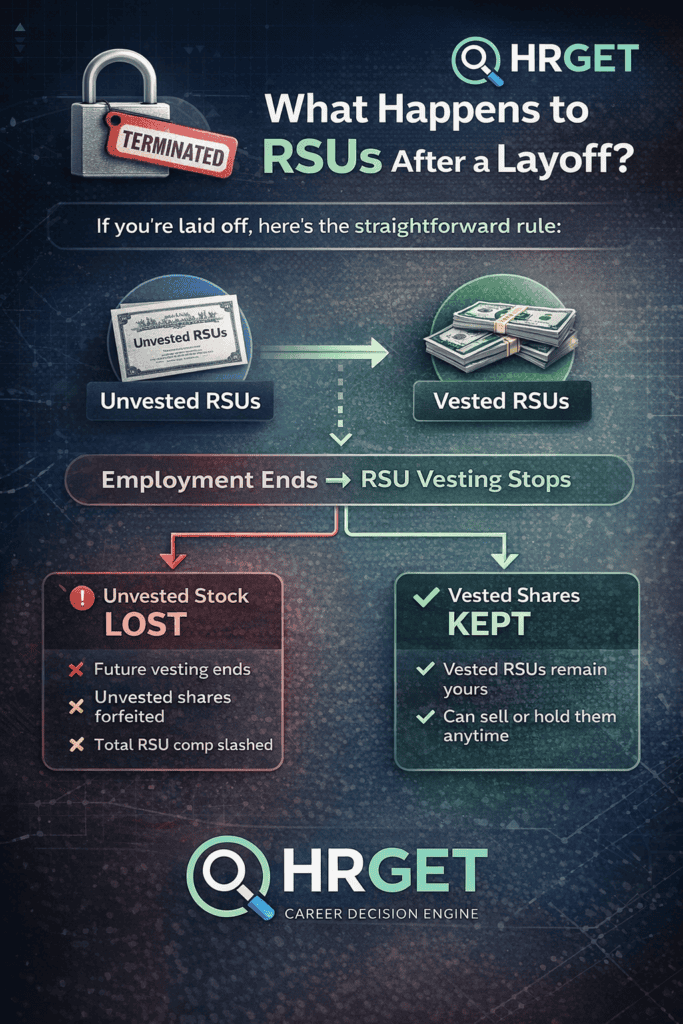
Here’s the mechanic you need to understand before everything else: RSUs vest based on your employment status on the vesting date. Full stop. It doesn’t matter how close you were to that vest. It doesn’t matter how strong your performance reviews were. If you’re not actively employed when the shares are scheduled to vest, you don’t get them.
Most RSU agreements at companies like Amazon, Google, Meta, Salesforce, and similar tech employers follow a standard structure: a four-year vesting schedule with shares releasing quarterly or annually, all conditional on continued employment. When a layoff happens:
- Your active employment status ends on your termination date (which is not always the same as your last working day — more on this shortly)
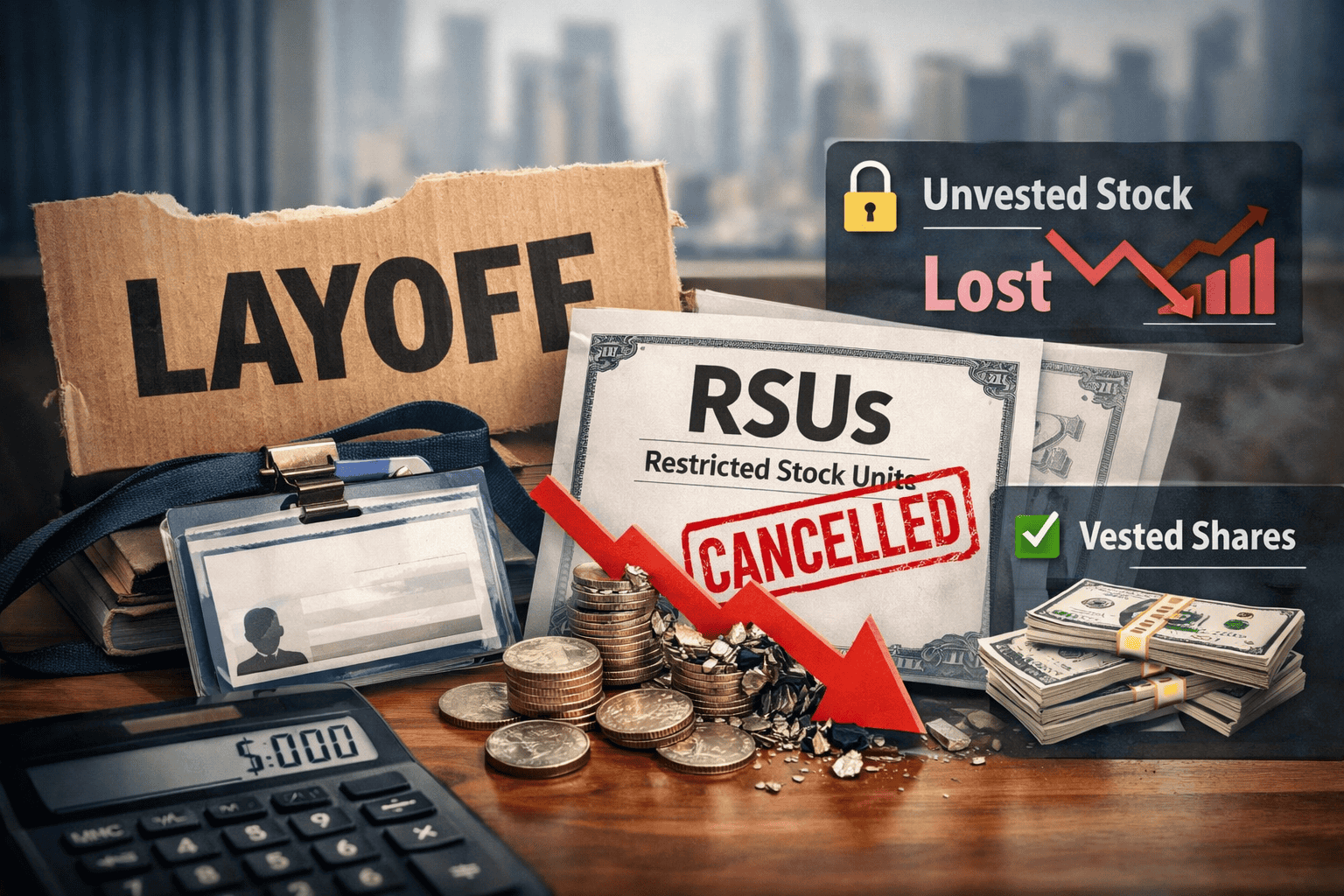
- Any unvested RSUs scheduled to release after that date are forfeited immediately
- Anything that vested before the termination date stays yours
The company’s equity plan documents — specifically the RSU award agreement you signed when you joined — govern all of this. Most employees never read them until it’s too late. That document is the first thing you should pull up the moment you get a layoff notice.
The clock that matters isn’t your last day in the office — it’s your official termination date as recorded in the equity plan system. These can differ by days or weeks, and those extra days can mean the difference between keeping or losing your next vest tranche. Confirm the exact date in writing with HR before you sign anything.
Unvested RSUs: Do You Lose Them All?
Almost certainly yes — but “almost” is doing important work in that sentence.
Unvested RSUs are conditional compensation. The entire point of the vesting structure is retention: you earn the shares by staying. Once you’re separated from the company, the condition fails, and the shares go back to the equity pool. There’s no legal obligation for the company to pay out unvested equity. It’s not your money yet in any enforceable sense.
That said, there are situations where employees do recover some unvested equity:
Accelerated Vesting Clauses
Some offer letters — particularly for senior hires, executives, and specialist roles — include “single-trigger” or “double-trigger” acceleration clauses. Single-trigger means a change of control (acquisition, merger) automatically accelerates vesting. Double-trigger requires both a change of control and an involuntary termination. These are negotiated at the offer stage, and if you didn’t get one then, you won’t get one now. But it’s worth confirming whether your original grant agreement contains any such language.
“Good Leaver” Provisions
More common in UK and European employment structures, “good leaver” clauses can provide partial vesting pro-rated to the time served. Some US startups and PE-backed companies also use them. Check your agreement explicitly — the phrase “good leaver” will appear verbatim if it applies.
Discretionary Severance Equity
Occasionally — and I mean occasionally — a company will offer a partial cash equivalent of lost unvested RSUs as part of a negotiated severance enhancement. This happens almost exclusively in mass layoff scenarios with high PR sensitivity, or for high-profile individual departures. It’s negotiable, not guaranteed.
Vested RSUs: What You Actually Keep
Anything that vested before your termination date is yours. No conditions, no clawbacks (in most standard RSU structures), no strings. Once an RSU vests, it converts to actual shares sitting in your brokerage account. A layoff doesn’t touch that.
What you should verify:
- Tax was already withheld at vesting. When RSUs vest, companies withhold shares to cover income tax on the market value at that date. Your net shares (after withholding) are yours — but don’t confuse the gross grant value with what’s actually in your account.
- Insider trading windows. If you’re a senior employee or had access to material non-public information, there may be trading restrictions even on your vested shares. These typically expire 30–90 days post-termination, but confirm with your legal or compliance team.
- Brokerage access. Your company equity is likely held in a platform like Schwab Equity Awards, E*TRADE/Morgan Stanley at Work, or Fidelity NetBenefits. Confirm your access doesn’t expire and transfer or sell your shares on your timeline — not in a panic.
What Happens to RSU Refreshers After a Layoff
This is the part that genuinely blindsides people — and the part that drives the largest financial losses in tech layoffs.
Refresher grants are additional RSU awards companies give on an ongoing basis (typically annually) to keep total compensation competitive as your initial grant depletes. If you’ve been at a company for 3+ years, your refreshers might actually represent more of your expected future comp than your original grant.
After a layoff, refreshers get hit twice:
- Unvested refresher tranches are forfeited immediately on termination, exactly like your original grant
- Future refresher grants — the ones you would have received in your next annual review cycle — are cancelled entirely. They never get issued.
Most employees mentally model their compensation trajectory assuming continued refreshers. When that trajectory gets cut off, the gap between expected and actual compensation over a 2–3 year horizon can be enormous. We’ll put exact numbers to this in the next section.
Real Scenario: The $200K Equity Loss Most Engineers Never See Coming
Take a senior software engineer at a mid-to-large tech company. She joined four years ago with a $160,000 RSU grant vesting quarterly over four years — $40,000 per year. She also received annual refresher grants of $50,000 each starting at year two (standard for strong performers).
She’s laid off 3.5 years into her tenure, two weeks before her Q4 vest.
| Equity Item | Expected Value | Outcome |
|---|---|---|
| Final initial grant tranche (Q4, Year 4) | $10,000 | Forfeited — 2 weeks short |
| Unvested Year 3 refresher (50% remaining) | $25,000 | Forfeited |
| Unvested Year 2 refresher (25% remaining) | $12,500 | Forfeited |
| Year 4 refresher (would have been issued) | $50,000+ | Never issued |
| Year 5 refresher (lost career comp trajectory) | $55,000+ | Cancelled |
Realistic total equity gap: $150,000–$200,000. That’s not counting stock price appreciation. And none of it shows up in the severance letter she receives that week.
The lesson isn’t that the company is evil. It’s that RSU forfeiture on layoff is a systematic, designed outcome — and the only protection is understanding it in advance and negotiating aggressively when the moment arrives.
Can You Negotiate RSUs Into Your Severance?
Yes. Not always successfully — but more often than people try. And most people never try.
The framing matters enormously. You’re not asking for a gift. You’re negotiating the total value of your exit package against the backdrop of what you’re leaving on the table. Reframe it that way, explicitly, in any severance conversation.
What’s Actually on the Table
| Negotiation Item | Likelihood of Success | Best Use Case |
|---|---|---|
| Extended termination date to capture next vest | Medium | When vest is within 30–60 days |
| Partial vesting acceleration | Low–Medium | Senior/executive roles, critical knowledge transfer |
| Cash equivalent of near-term unvested RSUs | Low | Mass layoffs with PR risk, specialized skills |
| Consulting arrangement covering vest dates | Medium | Where company needs transition work done |
| Enhanced salary severance in lieu of equity | Medium–High | Any layoff where you document the equity gap clearly |
How to Make the Ask
Don’t email HR first. Request a call with either your direct manager or a senior HR business partner — whoever has discretion over your package. Prepare a one-page summary of your unvested equity by value and vest date. Present it factually, not emotionally. The conversation should sound like: “My next vest tranche of $X releases on [date], which is [N] weeks away. I’d like to discuss whether the termination date can be structured to capture that, or whether we can find an equivalent solution.”
The answer may still be no. But you significantly improve your odds when you’re specific, calm, and prepared.
Here’s what most people don’t realize: HR business partners running layoff processes often have a discretionary budget of 10–20% above the standard package for senior employees who push back. They’re not going to advertise this. But a well-prepared, professional negotiation conversation is often enough to access it. If you’ve already signed the severance agreement without negotiating, you’ve likely given it up. Never sign on the first day.
Insider View: How Companies Time Layoffs Around Vesting
I’ll be blunt here, because this doesn’t get said enough: many companies — not all, but many — do time layoff announcements with equity calendars in mind. It’s not something you’ll find in any press release. But I’ve watched it happen, and anyone who’s run compensation analytics at a larger employer has seen the same thing.
The pattern: layoffs are frequently announced and executed in the weeks immediately after major vest dates (when the company’s liability has just cleared) rather than the weeks immediately before (when forfeiture risk to employees is highest). This is a feature of how equity planning and workforce planning intersect, and it can cost individual employees enormously.
What this means for you:
- If you’re in a company undergoing restructuring and your next big vest is coming up, it may be worth accelerating job search activity now — even if you keep the job, having an offer in hand gives you options
- If you’re already in a layoff situation, ask explicitly whether the termination date has any flexibility, and frame it around your vest calendar specifically
- Some employment attorneys specialize in equity disputes — if you believe the timing of your layoff was deliberately designed to avoid a significant vest, that’s worth a consultation
This isn’t universally malicious. Sometimes layoffs happen for genuine operational reasons that have nothing to do with equity timing. But the incentive to time them favorably for the company exists, and it’s naive to pretend otherwise.
Common Mistakes That Cost Real Money
Mistake #1: Signing severance paperwork on the day it’s presented. Companies love when you do this. The standard severance agreement is presented with urgency — but you almost always have 21 days to review it under the ADEA (if you’re over 40) or at minimum several business days. Use that time. Have an employment attorney review it if the equity at stake is significant.
Mistake #2: Confusing your last working day with your termination date. These can be different by weeks. If you’re placed on garden leave or a notice period, your official employment may continue past your last active day — which means some vest dates may still be capturable. Ask HR for your termination date in writing, not your “last day in the office.”
Mistake #3: Not calculating the full equity gap before negotiating. Go into any severance conversation having built a simple spreadsheet: every unvested tranche, the vest date, the number of shares, and the current stock price. Present the total. Vague references to “losing RSUs” get vague responses. Specific numbers get taken seriously.
Mistake #4: Assuming your next employer won’t compensate lost equity. Tech and finance employers do this routinely — it’s called “make-whole” compensation, and it’s a standard part of competitive recruiting at senior levels. Always disclose your unvested equity (by value and vest schedule) during offer negotiations. A good recruiter or hiring manager will factor it into the offer. A great negotiator will make them commit to covering the loss explicitly.
Mistake #5: Letting emotions drive the timeline. The anger, the shock — completely valid. But letting those emotions push you toward signing fast or avoiding the negotiation conversation because it feels uncomfortable is exactly what the other side is counting on.
Frequently Asked Questions
Do RSUs vest during a severance pay period?
Usually no. In most standard RSU agreements, vesting halts at your official termination date — which is typically the start of your severance period, not the end. You receive severance pay after employment ends, meaning you’re no longer an “active employee” for vesting purposes. The exception is if you negotiated an extended employment term (rather than severance) as part of your exit arrangement, which is worth pushing for specifically.
Can a company clawback RSUs that already vested?
In most standard RSU plans, no. Once shares vest and transfer to your account, they’re yours. The exception is if your grant agreement contains an explicit clawback clause — increasingly common in executive compensation plans and some financial services firms — which allows recoupment in cases of misconduct, restatement of financials, or specific triggering events. Read your award agreement for “clawback” or “recoupment” language.
What happens if a layoff is announced but my termination date is in the future?
Your vesting continues until your official termination date. If the company announces a layoff today but your termination date is set four weeks out, any RSUs that vest within those four weeks are yours. This is why confirming the exact termination date — in writing — is one of the first things you should do when you receive a layoff notice. Don’t assume the announcement date and the termination date are the same.
How do I ask a new employer to compensate for lost RSUs?
Be direct and document it. During offer negotiation, provide a vest schedule showing the unvested equity you’re leaving behind — share count, vest dates, and current value. Frame the request as a sign-on bonus, accelerated RSU cliff vest, or an enhanced equity grant specifically structured to offset the near-term loss. Employers in competitive talent markets (especially tech) expect and accommodate this conversation at the mid-to-senior level.
Are unvested RSUs considered part of a wrongful termination claim?
This depends heavily on jurisdiction and the specifics of your employment agreement. In the US, unvested RSUs are generally not recoverable in wrongful termination claims unless the termination itself violated contract terms or was discriminatory in a legally actionable way. If you believe your layoff was pretextual — meaning the equity timing was a motivating factor — an employment attorney can assess whether you have a viable claim. In the UK, the picture varies under unfair dismissal rules.
Do refresher RSU grants have different vesting rules than initial grants?
Typically no — refresher grants follow the same vesting structure as your original grant, usually four years with a one-year cliff or quarterly vesting. However, refresher grants issued in the same year as your layoff may have a shorter initial vest cliff, which could affect timing. Check each grant’s individual award agreement in your equity portal — Schwab, E*TRADE, or Fidelity will list each grant separately with its own schedule.
How are RSUs taxed after a layoff?
RSUs that vested before your termination date were already taxed as ordinary income at vest — the company withheld shares to cover that tax. After vesting, your shares are treated like any other stock holding: you’ll owe capital gains tax (short-term or long-term depending on holding period) when you sell. Any unvested RSUs you forfeit are not a tax event — you don’t get a deduction for the loss, and you don’t owe tax on shares you never received.
Negotiating your severance is about more than the check — it’s about the full financial picture. Read our complete guide on how to negotiate a severance package before you sign anything.
The Bottom Line on RSUs After a Layoff
Your RSUs after a layoff aren’t gone without a fight — but you have to know what you’re fighting for and move quickly. The salary loss from a layoff is obvious and immediate. The equity loss is silent, structural, and often much larger.
The professionals who come out of layoffs in the strongest financial position share three habits: they know their vest schedule cold before any negotiation conversation, they treat their termination date as a variable worth challenging rather than a fixed fact, and they use documented equity loss as leverage both with their former employer and in their next offer negotiation.
Don’t be the person who looks back and realizes you walked away from six figures because you didn’t ask the right questions in the right window. The equity plan documents are there. The negotiation conversation is available. The make-whole opportunity at your next employer is real. Use all three.

Jonathan Reed: Executive Career Strategist & Leadership Advisor | Former Partner, McKinsey & Company | Executive Coach to Amazon & Unilever Leaders | 18+ Years in Career Strategy
Jonathan Reed spent nearly two decades as a Partner at McKinsey & Company, where he advised organisations on leadership development, talent strategy, and organisational design across the US, UK, and Asia. Since leaving consulting, he has worked as an executive coach to senior leaders at Amazon, Unilever, and a clutch of high-growth scale-ups — helping them navigate promotions, career pivots, and the unwritten rules of visibility and influence at the top. Based between London and New York, Jonathan writes for HRGet.com to give working professionals an honest look at how careers actually scale — and why so many talented people stall without ever knowing why.