Here’s a number that should make you uncomfortable: most professionals leave ₹20–₹40 lakhs (or $30K–$80K) on the table over the course of their careers — not because they lack skills, but because they never learned how to negotiate salary after a job offer.
I’ve been on the HR side of thousands of these conversations. Companies build negotiation buffer into nearly every offer they extend. If you don’t ask, that buffer quietly disappears into the company’s budget.
This guide gives you the exact scripts, email templates, and decision frameworks to negotiate confidently — without sounding pushy, without risking the offer, and without leaving money behind again.
Why Salary Negotiation Is Built Into the System
Here’s the thing most people don’t realize: the first number HR gives you is almost never the ceiling.
In mid-to-senior hiring, recruiters are typically authorized to offer 10–15% above their opening number before escalating to a manager. That’s not speculation — that’s how compensation bands work across most structured organizations, from Infosys and TCS to Google and Deloitte.
When you don’t negotiate, you don’t “protect” the offer. You just hand that buffer back.
The math compounds fast. Take someone who accepts ₹25 LPA without negotiating when the company had room for ₹28 LPA. Assuming 8% annual raises, the five-year salary gap between those two starting points crosses ₹18 lakhs. That’s real money — for a 10-minute conversation you didn’t have.
For US professionals: the same dynamic applies. A $95K offer in a band that goes to $108K is extremely common in tech, finance, and consulting. Most hiring managers won’t volunteer the ceiling. They’re waiting to see if you ask.
Negotiation is not aggression. It’s professional literacy.
When to Negotiate (Timing Is Everything)
Timing your negotiation wrong is almost as bad as not negotiating at all. I’ve watched candidates blow solid offers by raising compensation at exactly the wrong moment.
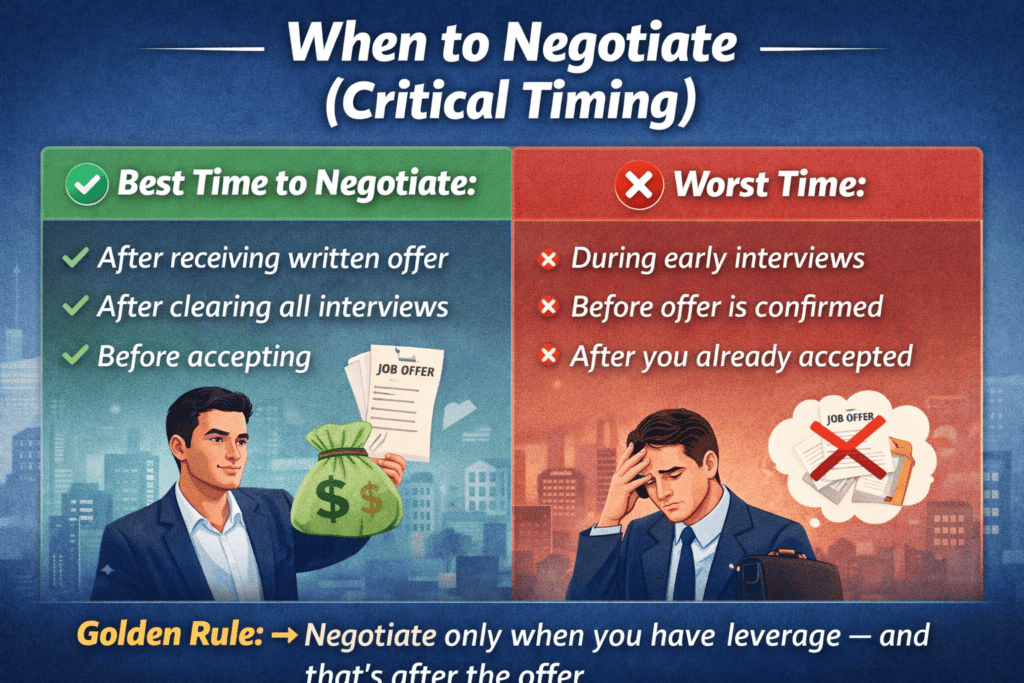
Negotiate only after you have a formal written offer in hand. That’s your leverage window. Before that point, you’re a candidate. After that point, they’ve already decided they want you — and now the power balance shifts.
The right moments:
- After receiving a written offer letter or formal email
- After all interview rounds are complete and an offer is verbally extended
- Before signing or formally accepting — this is your window
The wrong moments:
- During the first or second interview round (“What’s the salary range?” too early = red flag)
- After you’ve already said “yes” or signed — leverage gone
- Mid-interview when they ask about your expectations and you push hard instead of deflecting
A smart deflection for early-stage questions: “I’d love to understand the full scope of the role before discussing numbers — I’m sure we can find something that works for both sides.” That keeps you in the game without anchoring too low.
Before You Negotiate: The 4-Part Prep Checklist
Winging a salary negotiation is how people walk away with nothing extra. Spend 60–90 minutes on this before any conversation.
1. Know your actual market value. Not what you feel you’re worth — what the market is paying. Check Glassdoor, Levels.fyi (for tech), AmbitionBox (for India), and LinkedIn Salary. Talk to 2–3 peers in similar roles. Factor in company tier (Series A startup vs. listed MNC), location (Bangalore vs. Pune vs. Hyderabad), and experience bracket.
2. Define three numbers. Your ideal number (what you’d be thrilled with), your realistic target (what you’ll likely land), and your walk-away point (below this, you decline). Write them down. Most people negotiate vaguely because they haven’t set a real floor.
3. Build your justification. This is what separates confident negotiators from people who just “ask for more.” Your justification stack: current salary + increment percentage, any competing offers (if real — don’t bluff), your specific skills or certifications that command a premium, and market benchmark data.
4. Choose your strategy. Direct ask works well if you have a strong profile or a competing offer. Range negotiation (asking for ₹X–₹Y) is safer for most mid-level candidates. If you have a real offer from another company, that’s your most powerful card — use it honestly.
The Exact Salary Negotiation Script (Phone/Call Version)
HR calls. You have about 30 seconds to respond. Here’s exactly what to say.
Script 1 — Balanced, Works for Most Situations
“Thank you — I’m genuinely excited about this role and the team. I’ve done some homework on market benchmarks, and based on my experience, I was expecting something closer to [₹X–₹Y / X–Y]. Is there flexibility to move in that direction?”
Then stop. Don’t fill the silence.
Script 2 — When You Have a Competing Offer
“I really appreciate the offer and I’m very interested in this opportunity. I’ll be transparent — I do have another offer at around [₹X]. If we can get closer to that number, I can move forward quickly and skip the back-and-forth.”
Script 3 — Conservative Approach (Lower Risk, Lower Ceiling)
“Before I formally accept, I wanted to check if there’s any flexibility on the base salary. I’m very keen on the role — I just want to make sure the compensation aligns before we finalize.”
Pro Tip: After you state your ask, go quiet. Most negotiators instinctively rush to justify, soften, or backpedal — and that signals weakness. Make your ask, then let them respond. The silence is doing work for you.
Salary Negotiation Email Templates (Copy-Paste Ready)
Email negotiation works surprisingly well — it gives HR time to check with their manager without putting anyone on the spot. Use this as your first move if you prefer not to negotiate cold on a call.
Template 1 — Standard Negotiation (Most Candidates)
Subject: Offer Discussion — [Your Name]
Hi [HR Name],
Thank you for the offer — I’m genuinely excited about this opportunity and the team.
After reviewing the compensation, I was hoping we could explore some flexibility on the base salary. Based on my experience and current market benchmarks, I was expecting something in the range of [₹X–₹Y / X–Y].
I’m confident I can bring strong value to the role, and I’d love to align on compensation before moving forward.
Looking forward to your thoughts.
Best regards, [Your Name]
Template 2 — With a Competing Offer
Subject: Offer Discussion — [Your Name]
Hi [HR Name],
Thank you again for extending the offer — I genuinely appreciate it.
I want to be upfront: I do have another offer in the range of [₹X / $X]. While your role is my preference for [specific reason — team, product, growth], compensation is a real factor in my decision.
Is there room to revisit the offer? I’d like to move forward quickly if we can align.
Best, [Your Name]
Template 3 — Fresher or First-Time Negotiator
Subject: Offer Discussion — [Your Name]
Hi [HR Name],
Thank you so much for this opportunity — I’m very excited to be joining the team.
Before formally accepting, I wanted to check if there’s any flexibility in the compensation package. Even a modest adjustment would mean a lot and would help me start on the right note.
Thank you again for considering.
Best regards, [Your Name]
Real Scenario: What Good vs. Bad Negotiation Sounds Like
Priya is a 4-year product manager at a mid-size SaaS company in Pune. She gets an offer from a Bangalore-based Series B startup: ₹22 LPA.
The bad version: Priya calls HR and says, “Can you do better on the salary? I was hoping for more.” HR says the budget is fixed. Priya accepts ₹22 LPA.
The good version: Priya does 20 minutes of research on AmbitionBox and Glassdoor. Product managers at Series B startups in Bangalore are averaging ₹24–₹27 LPA at her experience level. She sends Template 1, citing the market benchmark, and asks for ₹26 LPA.
HR comes back with ₹24 LPA. Priya accepts — ₹2 LPA more than she would have gotten.
Over three years, assuming 10% annual raises, that gap compounds to nearly ₹7.5 lakhs. For one email.
The difference between these two outcomes isn’t personality or confidence. It’s preparation and asking.
Smart Strategies That Actually Work in 2026
The negotiation game has shifted slightly post-2023. Remote roles, slower hiring cycles, and tighter budgets in some sectors mean you need to be sharper.
Anchor high, but stay credible. Ask for 15–20% above what you’d actually accept. That gives HR room to “win” the negotiation while you still land where you want. Asking for ₹32 LPA when you’d be happy with ₹28 LPA is smart math.
Never reveal your current salary first. Let them anchor. Once you say “I’m at ₹20 LPA,” that becomes the reference point — and every offer gets built around it. In many Indian states, employers can no longer legally compel salary disclosure during hiring. Know your rights.
Think total compensation, not just base. A ₹2 LPA difference in base might be worth conceding if you can get a ₹1.5L joining bonus, a 6-month performance review, or stock options with real upside. Expand the negotiation pie.
Always ask at least once, even if they push back. Zero asks get zero results. One respectful push after a “no” is professional — not aggressive. Many “final offers” aren’t actually final.
Be likable through the whole process. This isn’t combat. You and the recruiter both want the same outcome — a signed offer. Warmth and confidence together land better results than either alone.
Common Mistakes That Quietly Kill Your Offer
Negotiating without preparation. Saying “I want more” with no market data behind it is easy to dismiss. HR is trained to handle these conversations. You should be too.
Accepting on the spot. Saying yes within minutes of receiving an offer signals that you either didn’t evaluate it or were desperate. Take 24–48 hours minimum, even if you’re thrilled.
Revealing your walk-away point. If you say “I need at least ₹20 LPA,” you’ve just told them ₹20 LPA closes you. They’ll stop there. Keep your floor private.
Over-negotiating. Pushing through multiple rounds, asking for revisions after a revised offer, or negotiating on five different components simultaneously strains the relationship before day one. Pick your top two asks and land them cleanly.
Practicing in your head, not out loud. Saying your script silently in your brain and actually saying it to a real person feel completely different. Practice with a friend, a mirror, or record yourself. The recruiter will hear the difference.
What to Do When They Say “This Is Our Final Offer”
Here’s where a lot of people fold — but shouldn’t, at least not immediately.
“Final offer” is HR language. Sometimes it’s true. Often it means “we’d rather not go higher, but we will if needed.” The only way to know is to ask once more, calmly.
“I completely understand — I appreciate you being direct. Could I ask, is there any flexibility on a joining bonus or an early performance review instead?”
That reframes the conversation. If base is genuinely locked, you’ve just opened the door to non-base compensation.
If they hold firm on everything, then evaluate the offer honestly. Ask yourself: Is the growth trajectory strong? Is the brand name worth something to my resume? Is the learning in this role worth a temporary salary compromise?
If the answer to those is yes, take it — but negotiate your first performance review date into the offer letter. If the answer is no and it’s below your minimum, walk away. A bad offer accepted under pressure costs you more than the lost opportunity.
FAQs
Can I negotiate salary after verbally accepting a job offer? Technically yes, but it’s very awkward and damages trust. Once you’ve verbally accepted, the company may have paused their search or rejected other candidates. If you genuinely need to revisit compensation, do it within 24 hours and be honest about why. After that, your leverage is effectively gone.
How much should I ask for above the offer? A 10–20% ask above the offer is reasonable for most mid-level roles. If you have a competing offer or specialized skills, 20–30% isn’t unreasonable — but you need solid justification. For freshers, even 5–8% is worth asking for.
Will negotiating make the employer rescind my offer? Almost never — if done respectfully. In 15+ years of HR experience, I’ve seen offers rescinded for negotiation exactly zero times when the candidate was professional. What gets offers pulled is aggressive demands, ultimatums, or negotiating bad faith. Polite persistence doesn’t.
Should freshers negotiate their first salary? Yes, always. Even getting ₹1,000–₹2,000 more per month adds up to ₹60,000–₹1.2 lakhs over five years, assuming no raises. More importantly, you build the habit early — because every future offer will be anchored to this one.
Is it better to negotiate salary over email or on a call? Start with email. It gives you time to phrase things correctly, and it gives HR time to check with their manager without pressure. If they want to discuss further, take it to a call. Email first, call second.
What if the company says their pay bands don’t allow flexibility? Ask about non-base options: joining bonus, accelerated review, extra leave, remote flexibility, or professional development budget. Pay bands are sometimes real constraints, but total compensation rarely is.
How long should I take before responding to an offer? 24–48 hours is the sweet spot. It signals you’re thoughtful, not desperate — and gives you time to prep. Beyond 72 hours without communication starts to create anxiety on their end. If you need more time, just say so: “Could I have until [date] to review? I want to give this proper consideration.”
You’re Closer Than You Think
Learning how to negotiate salary after a job offer isn’t about becoming a different person. You don’t need to be aggressive, slick, or naturally confident.
You need a number, a reason, and a script. That’s it.
The professionals who negotiate well aren’t the loudest in the room — they’re the most prepared. They’ve done 30 minutes of research, written down their ask, practiced saying it once, and then said it calmly when the moment came.
That can be you. This week.
Send Template 1. Use Script 1. Ask once. See what happens.
The worst realistic outcome is they say no and you’re exactly where you started. The best outcome is an extra ₹2–₹5 LPA (or $5K–$15K) — for a 10-minute conversation.
That’s a return on effort that no investment can match.
Explore next: How to Evaluate a Job Offer Beyond Just Salary — because compensation is one piece of a much bigger decision.

Organizational Psychologist & Workplace Behavior Advisor (Former consultant with Boston Consulting Group, research contributor aligned with Harvard Business Review)
Dr. Amelia Grant is an organizational psychologist specializing in burnout, toxic workplaces, leadership behavior, and employee mental resilience. She writes practical, research-backed workplace guidance for modern professionals.