If you’re only looking at the base salary number when you evaluate a job offer, you’re making a decision with incomplete information — and it’s costing you.
Here’s something I’ve watched play out dozens of times in compensation reviews: your base salary is often just 50–70% of what you actually earn. The rest sits in bonuses, stock grants, and benefits that most professionals either misread or ignore entirely. Two people with the “same $120K salary” can end up with a $40,000–$60,000 difference in real annual value — depending on what else is in their package.
After 15 years advising on compensation design at firms ranging from early-stage startups to Fortune 500s, I can tell you: the professionals who build real wealth are the ones who learn to think in total compensation, not just take-home pay.
This guide breaks down every component — base, bonus, equity, benefits — in plain language, with real numbers and the insider view that most articles won’t give you.
What Is Total Compensation?
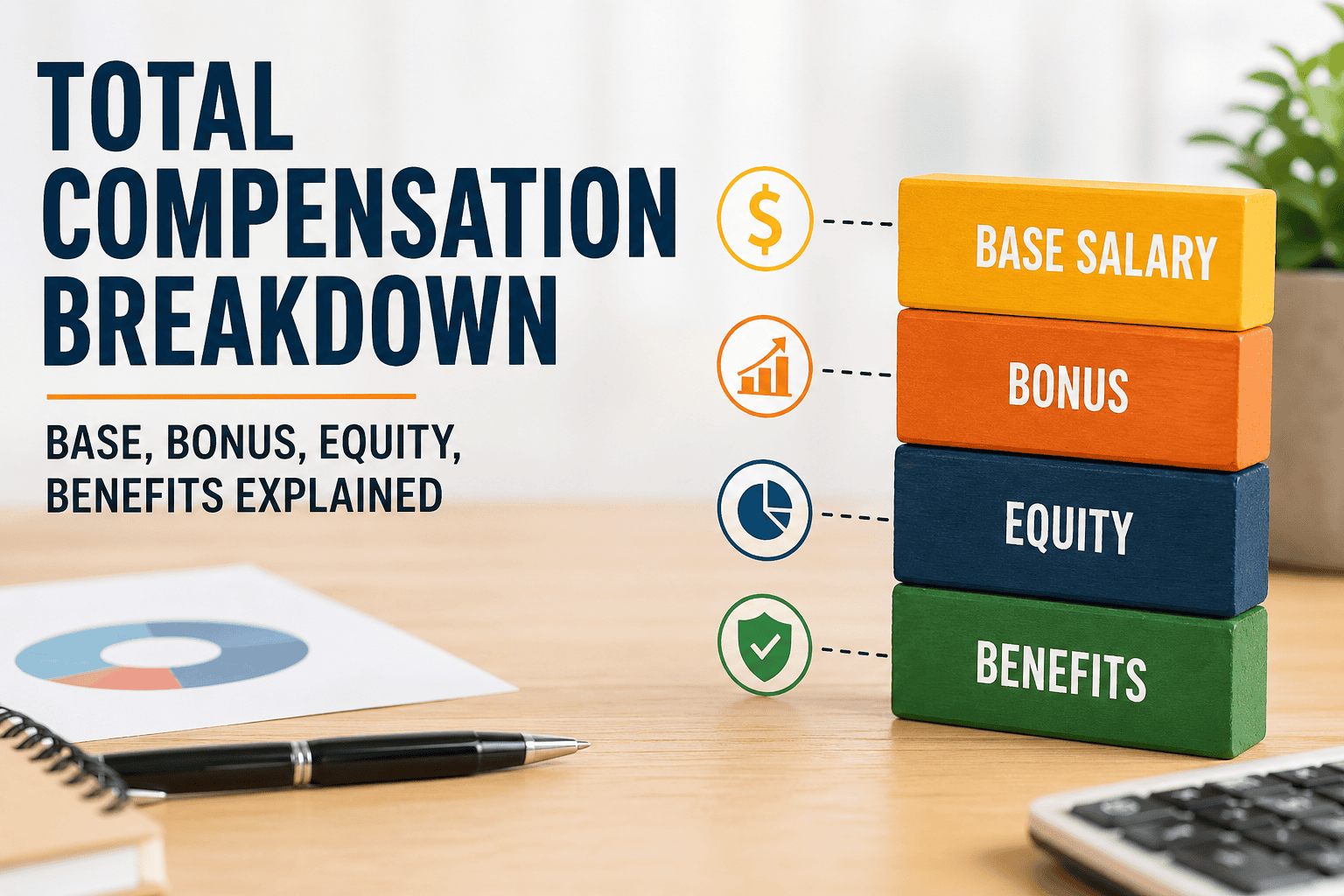
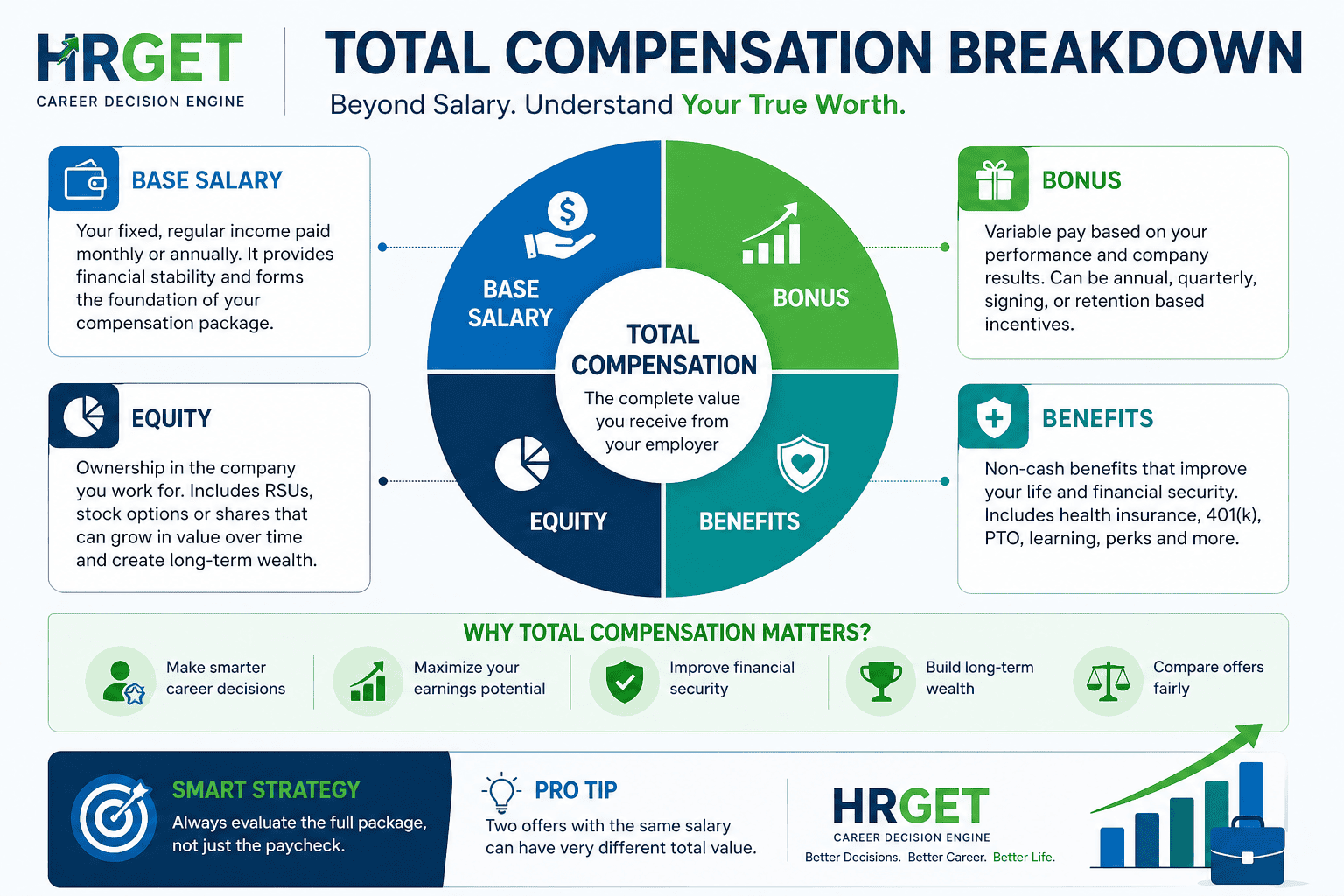
Total compensation is the complete financial value your employer provides — not just your paycheck. It’s the sum of every dollar-denominated element your employer puts on the table: your salary, your bonus potential, any equity stake, and the dollar value of your benefits.
The formula is straightforward:
Total Comp = Base Salary + Bonus + Equity + Benefits
Here’s what that looks like with real numbers for a mid-level product manager role at a US tech company:
| Component | Annual Value |
|---|---|
| Base Salary | $120,000 |
| Performance Bonus | $15,000 |
| Equity (RSUs, annualized) | $25,000 |
| Benefits (health, 401k, PTO) | $10,000 |
| Total Compensation | $170,000 |
Most job seekers stop at the first row. Financially savvy professionals analyze the last row — and negotiate every line in between.
Why Total Compensation Matters More Than Salary
The conventional assumption goes like this: higher salary equals better offer. I’ve watched this thinking cost people hundreds of thousands of dollars over the arc of a career.
A lower-base offer can substantially outperform a higher-base one across a 3–5 year horizon once you account for stock growth, performance bonuses, retirement contributions, and employer-paid health coverage. The delta isn’t small — in tech, finance, and consulting, it can easily reach $50K to $300K+ over a four-year vesting cycle.
This matters especially if you’re working in industries where equity and variable pay are standard levers. A senior software engineer at a mid-stage tech company in San Francisco earning $150K base with $80K in annual RSUs is structurally wealthier than a peer at a traditional firm earning $180K base with no equity — full stop.
💡 The Insider View: In my experience sitting on the compensation side of offer decisions, companies absolutely use the mix of base vs. equity vs. bonus to manage total budget while still appearing competitive on headline salary. If you only negotiate the number on page one of the offer letter, you’re playing by their rules.
Base Salary: The Foundation — But Not the Ceiling
Base salary is your fixed, guaranteed income — paid monthly or biweekly regardless of company performance or your individual output. It’s the number banks use for mortgage applications, the number HR benchmarks against the market, and the floor on which everything else is built.
It has real advantages: predictable cash flow, easier financial planning, and lower personal risk. Early-career professionals and anyone supporting dependents have good reason to prioritize it.
But here’s what most advice misses: base salary has a hard upside ceiling. It doesn’t scale with company growth, it’s taxed at your marginal rate with no preferential treatment, and it’s the element companies are most reluctant to move on once you’re inside. Once you’re past the manager or senior individual contributor level, treating base as your only priority starts limiting what’s possible.
For India-based professionals: base salary benchmarks vary sharply by city and function. A senior product manager in Bangalore at a product-led company can expect ₹30–50 LPA base, while the same role at a service firm in the same city might offer ₹18–28 LPA — with the service firm often making up the difference in guaranteed variable pay.
Bonus Breakdown — and the Hidden Traps Most People Step Into
Bonuses look attractive on paper. They often feel like “extra money.” The truth is more complicated — and I’ve seen them create real problems for people who didn’t read the fine print.
Performance bonuses (10–30% of base salary is typical for mid-to-senior roles) are tied to individual, team, or company performance metrics. The target number is what gets quoted in offer letters. What actually lands in your account is often 70–85% of that target in moderate years and well below 50% in down years. If a company had a bad Q4, your “20% bonus” might arrive as 8%.
Signing bonuses are one-time payments — sometimes substantial — designed to compensate you for unvested equity or bonuses you’re leaving behind at your current employer. Almost all come with a clawback clause: leave within 12–24 months and you’ll owe it back, sometimes in full. Read the repayment terms before you celebrate.
Retention bonuses are exactly what they sound like — money paid to keep you in seat for a defined period. If you leave six months early, you return it. They’re a retention tool, not a reward, and should be evaluated as a constraint on your career mobility, not pure upside.
⚠️ The Trap Most People Miss: Bonuses are not guaranteed income. When building your personal financial plan — mortgage payments, savings targets, investment commitments — base your numbers on base salary only. Treat bonuses as upside you’ll capture when it comes, not money you can count on in advance.
Practical example: You’re offered $120K base with a stated 20% bonus target. That looks like $144K. But with a realistic payout rate of 75–90%, your actual expected bonus lands between $18K and $21.6K — making your true expected cash compensation $138K–$141.6K, not $144K. The gap matters when comparing offers.
Equity Compensation: RSUs vs. Stock Options — Where Real Wealth Is Built
This is where the meaningful separation between earners and wealth-builders happens. Equity is ownership in the company — and depending on how it’s structured and whether the company performs, it can transform a “good” compensation package into a genuinely life-changing one.
RSUs (Restricted Stock Units)
RSUs are the dominant equity vehicle at established public companies and late-stage pre-IPO firms. The company grants you units that convert to actual shares over a vesting schedule — typically four years with a one-year cliff. Lower risk than options because they retain value as long as the stock price is above zero. At companies like Google, Microsoft, Amazon, or Salesforce, RSU grants for senior individual contributors often range from $100K to $400K over the vesting period.
Stock Options (ISOs and NSOs)
Options give you the right to purchase shares at a fixed strike price — the price on the day of grant. They’re common at early-stage startups because the strike price is low, and if the company exits at a much higher valuation, the upside can be extraordinary. The risk is proportional: if the company’s value stagnates or declines, options may expire worthless. Most startup employees who joined pre-Series B in 2015–2019 did well. Most who joined late-stage startups in 2021 did not.
| Feature | RSUs | Stock Options |
|---|---|---|
| Risk level | Lower | Higher |
| Upside potential | Moderate–High | Very High |
| Where common | Public/late-stage companies | Early-stage startups |
| Value if stock drops | Reduced but not zero | Can become worthless |
| Tax treatment (US) | Ordinary income on vest | AMT risk (ISOs); ordinary income (NSOs) |
One thing that rarely gets flagged in articles like this: vesting schedules are a retention mechanism, not a gift timeline. A four-year vest means the company has four years of leverage over your career decisions. Before accepting a large equity grant, ask yourself honestly whether you see yourself at this company for the full duration — and what your financial exposure looks like if you leave after year two.
Benefits: The Silent Wealth Builder Everyone Undervalues
Benefits are the most consistently undervalued component of any compensation package — especially in the US, where employer-provided health coverage alone represents a significant transfer of value that doesn’t show up in any salary comparison tool.
Here’s a conservative estimate of what a solid US benefits package is actually worth on an annual basis:
| Benefit | Estimated Annual Value |
|---|---|
| Employer-paid health insurance (family) | $10,000–$18,000 |
| 401(k) employer match (4–6%) | $5,000–$10,000 |
| PTO (20 days at $120K salary) | ~$9,200 |
| Learning & development budget | $1,500–$5,000 |
| Remote work / home office stipend | $500–$2,400 |
| Total estimated value | $26,200–$44,600 |
When you’re comparing offers, convert every benefit to an annual dollar estimate and add it to the total. Two offers with a $15,000 base salary difference can easily flip when one company covers full family health premiums and the other makes you pay 40% of them. That gap alone is worth $7,000–$10,000 in out-of-pocket cost.
For professionals in India: benefits comparison centers on different elements — HRA (House Rent Allowance), LTA (Leave Travel Allowance), gratuity eligibility after five years, EPF employer contributions, and meal/fuel allowances that reduce taxable income under the old tax regime. These can materially affect your net take-home and should always be factored into any CTC-to-in-hand calculation.
Real Scenario: The $120K Offer vs. the $100K Offer
Let me walk you through the kind of comparison I’ve seen candidates get wrong hundreds of times.
Offer A — The “Higher Salary” Option
- Base: $120,000
- Bonus target: 10% (historically pays at ~80% = ~$9,600)
- Equity: None
- Benefits: Basic — employee pays 40% of health premiums (~$4,800/yr), 3% 401k match
Realistic total comp: ~$133,400
Offer B — The “Lower Salary” Option
- Base: $100,000
- Bonus target: 15% (historically pays at ~90% = ~$13,500)
- Equity: $40K in RSUs annually (4-year vest, stable public company)
- Benefits: Full family health premium covered, 5% 401k match, $2K L&D budget
Realistic total comp: ~$167,000+
The candidate who accepts Offer A because “$120K sounds better than $100K” is leaving approximately $33,600 on the table — every single year. Over four years, that’s a $134,000 difference in accumulated compensation before investment returns on the equity are even considered.
Most people choose Offer A. The financially literate ones choose Offer B — and then negotiate to improve it further.
How to Calculate Your True Total Compensation
You don’t need a spreadsheet to do this well. You need a disciplined approach to estimating each component honestly — not optimistically.
Step 1 — Start with base salary. This is your anchor. Use your current or offered annual base before any deductions.
Step 2 — Apply a realistic bonus multiplier. Take the stated bonus target percentage and multiply it by 0.75–0.85 (a conservative payout rate for most companies in most years). Don’t model the max — model the expected.
Step 3 — Annualize equity. If you have a $120K RSU grant over four years, that’s $30K per year — assuming flat stock price. Build in a conservative growth assumption of 5–8% annually if it’s a stable public company; use zero for startup equity unless you have strong conviction about the exit.
Step 4 — Assign dollar values to benefits. Look up the actual market cost of your employer-paid health plan. Calculate the dollar value of 401k matching. Convert PTO days to a daily rate equivalent (annual salary ÷ 260 working days × PTO days).
Step 5 — Sum it up. Compare total comp across offers — not headline salary.
Total Comp = Base + (Bonus Target × Realistic Payout Rate) + (Equity Grant ÷ Vest Years) + Benefits Dollar Value
Smart Strategy to Maximize Total Compensation
This is where most salary negotiation advice stops short. It focuses entirely on base — which is, frankly, the hardest lever to move and the one HR has the least flexibility on.
Negotiate the whole package, not just the number. After receiving an offer, instead of simply asking “can you increase the base?”, ask three targeted questions: Can we improve the equity grant? Is the bonus target flexible? Is a signing bonus available to offset unvested compensation I’m leaving behind? Any one of these can be worth more than a $5K–$10K base increase.
Anchor high — but anchor to total comp, not base. When you state a number in negotiation, frame it as a total compensation figure. “I’m targeting $185K total compensation” is a much harder anchor for a recruiter to counter than “I want $130K base,” because it gives you room to win across multiple dimensions.
Understand trade-offs before you accept them. At an early-stage startup, trading $20K of base for $50K in additional equity might make sense if you believe in the company’s trajectory. At a stable mid-market firm with no equity program, that same trade puts you behind. The right answer depends entirely on the company’s stage and your personal financial situation.
Think in 3–5 year windows. The best compensation decisions I’ve seen made by candidates are always the ones that account for where equity will be in four years, not where base salary will be next month. Ask about the company’s historical stock performance, IPO timeline if private, and promotion-linked compensation reviews.
Time your negotiation correctly. The window between offer receipt and acceptance is your maximum leverage point — and it closes the moment you say yes. Use it. Companies expect negotiation, and in 2026, with pay transparency laws expanding across the US, UK, and EU, candidates have more market data than ever to support their ask.
Common Mistakes to Avoid When Evaluating Total Compensation
Focusing exclusively on base salary. As laid out above, this causes you to systematically undervalue offers that are structured to reward performance and tenure. You miss 20–40% of the actual offer value.
Overvaluing startup equity without doing the math. Statistically, the majority of startups don’t produce liquidity events that result in significant payout for employees below the VP level. Model startup equity at zero unless you have specific evidence (strong revenue growth, active acquisition interest, credible IPO runway) that justifies a higher estimate.
Ignoring vesting cliff and schedule structure. A four-year grant with a one-year cliff means you earn nothing if you leave before month 13. If you’re already at month 10 of a current job with a large unvested balance, accepting a competing offer that looks financially superior on paper might still be the wrong move when cliff timing is factored in.
Treating bonus targets as guarantees. Stated bonus percentages are targets, not minimums. In companies that have had a difficult year — or where bonus is tied to company-wide metrics rather than individual performance — actual payouts can land at 40–60% of target. Never build your annual budget around a bonus you haven’t been paid yet.
Comparing offers without converting everything to annual dollar value. The only valid comparison is apples to apples: total annual compensation, fully modeled, across every element of both offers. Every other comparison introduces bias that leads to poor decisions.
Quick Comparison: How Each Component Stacks Up
| Component | Risk Level | Upside | Predictability | Best For |
|---|---|---|---|---|
| Base Salary | Low | Low | High | Financial stability; early career |
| Bonus | Medium | Medium | Medium | High performers; variable roles |
| Equity (RSUs) | Medium–High | Very High | Low–Medium | Wealth building; mid–senior level |
| Stock Options | High | Extreme | Very Low | Risk-tolerant; startup believers |
| Benefits | Low | Medium | High | Everyone — especially families |
Frequently Asked Questions
What is considered a good total compensation package in 2026?
A strong package in 2026 combines a market-rate base salary (verifiable against sources like levels.fyi for tech or Mercer benchmarks for other industries), a bonus target of 10–20% with a reasonable payout track record, meaningful equity (especially at public or late-stage companies), and employer-paid health coverage plus 401k matching of at least 4%. The exact dollar threshold depends heavily on role, industry, and location.
Is equity better than a higher base salary?
It depends on your risk tolerance, life stage, and the quality of the equity. RSUs at a stable public company are relatively low-risk and can significantly outperform a base salary increase over a 3–5 year horizon. Stock options at an early-stage startup carry real downside risk. If you need income stability — mortgage, dependents, near-term financial obligations — prioritize base first, equity second.
How do I properly compare two job offers with different compensation structures?
Convert every element of both offers to an estimated annual dollar value: base, realistic bonus (not max), annualized equity (equity grant ÷ vest years, with a conservative growth assumption), and benefits (health premiums saved, 401k match, PTO as a daily rate equivalent). Sum each column. Only compare the totals — never individual components in isolation.
Are bonuses taxed at a higher rate than salary?
In the US, bonuses are often withheld at a flat 22% federal rate (the “supplemental wage” rate) — which can feel higher if your marginal rate is lower, or lower if your marginal rate is above 22%. At year-end, your actual tax liability is calculated on total income regardless of how it was withheld, so the effective tax treatment is roughly equivalent to salary over a full tax year.
Can I negotiate benefits in addition to salary?
Yes — and more people should. Signing bonuses, additional PTO days, remote work flexibility, and accelerated equity vesting are all commonly negotiable at mid-to-senior level roles. Large employers have less flexibility on benefits than startups, but even in structured environments, signing bonuses and PTO can often be adjusted without triggering a formal compensation band review.
What does a typical vesting schedule look like?
The most common structure is a four-year vest with a one-year cliff: you earn 0% until the 12-month mark, then 25% vests immediately (the cliff), with the remaining 75% vesting monthly or quarterly over the following three years. Some companies use a three-year vest with a one-year cliff. Acceleration clauses (double-trigger or single-trigger) can vest equity early in the event of an acquisition — always ask about this.
How does total compensation work differently in India vs. the US?
In India, total compensation is often quoted as CTC (Cost to Company), which includes employer EPF contributions, gratuity provisioning, and allowances (HRA, LTA, fuel) that may not all reach you as take-home pay. In the US, total comp typically refers to cash compensation plus equity plus benefits — without the employer statutory contributions bundled into the headline number. Always model net take-home, not CTC, when evaluating Indian offers.
The Bottom Line on Total Compensation
Here’s what I want you to walk away with: the salary number in the subject line of an offer email is marketing. The actual financial proposition is the full package — base, bonus, equity, and benefits modeled over a realistic time horizon.
Professionals who build real career wealth aren’t necessarily the ones who earned the highest base salaries. They’re the ones who learned to read an offer letter the way a CFO reads a balance sheet — looking at total value, not headline revenue.
Your next step: before you respond to your next offer, build a simple comparison model. Write down every component, assign a conservative annual dollar estimate to each, and compare totals. It takes 20 minutes and it will almost certainly change what you’re willing to accept — and what you’ll ask for.
If you’re ready to take the next step, read our guide on how to negotiate a salary offer effectively — including the exact questions to ask and the timing that gives you the most leverage.
By Eleanor Whitmore — Director of Compensation & Benefits (Ex-Mercer, PwC Clients) | New York & London | 15+ Years
Updated: April 2026

Eleanor Whitmore | Former Partner, Mercer | Advisor, World Economic Forum | 20+ Years in Global Compensation
Author bio: Eleanor Whitmore has spent over two decades shaping how the world’s leading organisations pay, retain, and reward talent. As a former Partner at Mercer and an advisor to World Economic Forum working groups on the Future of Work, she has designed compensation frameworks for Fortune 500 companies across the US, UK, Europe, and emerging markets. Based between London and New York, Eleanor writes for HRGet.com to translate boardroom-level pay strategy into actionable guidance for working professionals navigating real compensation decisions.