Here’s the uncomfortable reality most people don’t discover until it’s too late: you can collect unemployment benefits while freelancing — but only if you follow very specific rules. Break even one of them, and you could lose your benefits entirely or face a repayment demand that wipes out everything you earned.
I’ve spent 18 years advising laid-off professionals at Fortune 500 companies through restructurings. The number of people who inadvertently disqualify themselves from unemployment because of casual freelancing — a few hundred dollars here, a one-off project there — is staggering. And the frustrating part? Almost all of it is avoidable with the right knowledge.
This guide lays out exactly how the system works, what you must report, when freelancing is allowed, and how to structure your situation so you maximize income without triggering penalties. Whether you’re in the US, and whether you’re earning $50 or $1,500 a week on the side — this applies to you.
Can You Collect Unemployment Benefits While Freelancing?
The short answer is yes — but with three non-negotiable conditions attached. The system isn’t designed to punish people who pick up small gigs while job hunting. It’s designed to ensure that unemployment benefits go to people who are genuinely between jobs, not people who’ve quietly transitioned into full-time self-employment.
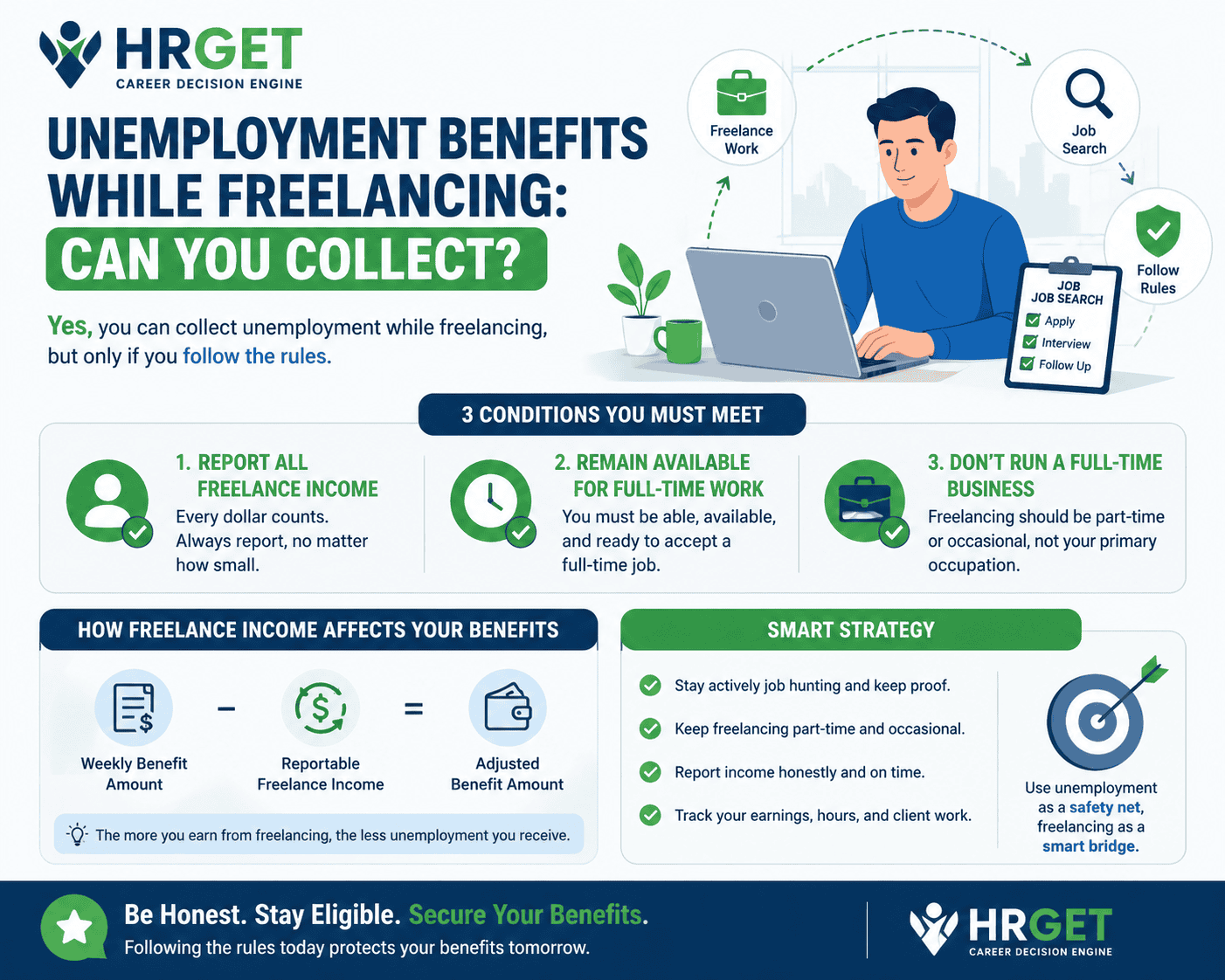
The three rules you must follow:
- Report every dollar of freelance income — no exceptions, no minimums, no “it was just a small job.”
- Remain genuinely available for full-time work — you must be willing to accept a suitable job offer and stop freelancing to take it.
- Keep freelancing clearly secondary — your activity must not look like or function as a full-time business operation.
Violate any one of these, and your state unemployment agency has grounds to deny your claim, claw back benefits already paid, and in serious cases, refer the matter for fraud investigation. The stakes are real.
What makes this tricky is that “secondary” and “full-time” aren’t defined with clean dollar thresholds in most states. It’s a judgment call — and the judgment happens to be made by an agency with the power to cut off your income. That’s why the strategy matters as much as the rules.
How Unemployment Benefits Actually Work
Unemployment Insurance (UI) in the US is a joint federal-state program administered under guidelines from the U.S. Department of Labor. Benefits are funded by employer payroll taxes — not employee contributions — which is why freelancers and contractors who were never W-2 employees typically can’t access UI in the first place.
If you were laid off from a W-2 position, you file a claim with your state’s workforce agency. Benefits are calculated as a percentage of your previous earnings, typically ranging from $200 to $700+ per week depending on your state and prior salary. In high-cost states like California or New York, weekly maximums run $450–$504. Texas caps at $563. Washington State goes up to $1,019.
Every week you receive benefits, you must certify that you are:
- Able to work — no health or personal reason prevents you from accepting employment
- Available for work — you’re not on vacation, traveling, or otherwise unavailable
- Actively seeking work — you’ve made a required number of job search contacts (varies by state, typically 2–5 per week)
- Reporting any earnings — income from any source during that certification week
It’s that fourth point where freelancing enters the picture — and where most people get themselves into trouble.
What Counts as Freelance Income for Unemployment Purposes?
The definition is broad — broader than most people expect. If money changes hands in exchange for your time or work product, it likely counts. This includes:
- Contract work from platforms like Upwork, Toptal, or direct clients
- Gig economy work — Uber, Lyft, DoorDash, TaskRabbit, Fiverr
- One-off consulting engagements, even billed hourly
- Selling services: design, copywriting, coding, accounting, tutoring
- Side business revenue — product sales, digital downloads, services
- Any self-employment income, regardless of whether you’ve filed as an LLC or sole proprietor
⚠️ There is no “minimum threshold” exemption.
Whether you earned $20 for a quick logo or $1,500 for a consulting day — every dollar must be reported during your weekly certification. States cross-check 1099 data, bank records, and platform payment data during audits. “I didn’t think it was enough to matter” is not a defense.
One nuance worth understanding: most states require you to report income in the week it was earned, not the week it was paid. So if you completed a project on Monday but the client pays you three weeks later, you still report it in the week the work was performed. Check your state’s specific rules — a handful use payment-received accounting instead.
When Freelancing Is Allowed — And When It Crosses the Line
Let me be direct about where the line sits, because I’ve seen too many smart people misread this.
✅ Generally Allowed
- Part-time or occasional gigs (under 20–25 hrs/week)
- Freelancing while actively applying for full-time roles
- Earning less than your weekly benefit amount
- Taking one-off projects with no ongoing client commitment
- Being willing to stop freelancing immediately for a job offer
❌ Likely Disqualifying
- Freelancing 35–40+ hours per week
- Declining job offers because of freelance commitments
- Marketing yourself as a business (website, LinkedIn “Open to Work” removed, business cards)
- Earning more per week than your UI benefit amount
- Signing retainer agreements or long-term contracts
The agency’s test is essentially: If a full-time job offer came in tomorrow, would you take it? If the honest answer is no — because your freelance pipeline is full, your clients are counting on you, or the income is already replacing your salary — you’ve crossed into self-employment territory in the eyes of the system.
Real Scenario: How It Plays Out in Practice
Let me walk you through a real-world situation I’ve seen play out — the details are anonymized, but the mechanics are exact.
📋 The Situation
Alex, a senior UX designer in Chicago, is laid off after 6 years. Her weekly UI benefit is $520. While job hunting, she picks up two freelance projects — one for $300 in Week 1, and another for $800 in Week 4.
Week 1 — Reports $300 freelance income:
Illinois uses a partial benefit formula. She keeps a small earnings disregard ($50 in this case), then loses $1 for every $2 earned above that. So: ($300 – $50) / 2 = $125 deducted. Adjusted benefit: $520 – $125 = $395 that week. Still collecting — just reduced.
Week 4 — Reports $800 freelance income:
($800 – $50) / 2 = $375 deducted. Adjusted benefit: $520 – $375 = $145 that week. Still qualifies, barely.
What if she earned $1,100 in a week?
($1,100 – $50) / 2 = $525 — exceeds her $520 benefit. She receives $0 in UI that week. But crucially, she doesn’t lose her claim entirely — she just gets nothing for that specific week and resumes benefits the following week when income drops.
The takeaway here is important: exceeding your benefit in one week doesn’t kill your entire claim. It just zeroes out that week. This is why timing your income strategically — which I’ll cover shortly — actually matters.
How Freelance Income Affects Your Benefit Amount — by State
Every state calculates partial benefits differently. There’s no single federal formula. The three most common approaches:
| Method | How It Works | Example States |
|---|---|---|
| Dollar-for-dollar after disregard | Small disregard ($25–$100), then 1:1 deduction | Florida, Georgia, Ohio |
| 50% deduction after disregard | Small disregard, then $0.50 deducted per $1 earned | Illinois, Michigan, New Jersey |
| Day-based counting | Benefits reduced by number of days worked per week, regardless of income amount | New York, Connecticut |
New York’s system deserves special mention — it’s the most counterintuitive. NY counts the number of days you work, not your income. Work 1 day: lose 1/4 of your weekly benefit. Work 4+ days: receive $0. This means a NY freelancer who earns $50 on a single day loses the same benefit as one who earns $800 on the same day. If you’re in New York, the goal isn’t to earn less — it’s to work fewer days per week.
California uses an earnings threshold — if your weekly earnings are less than your benefit amount, you receive the difference. Simple and relatively freelancer-friendly. Texas is stricter: earnings are deducted dollar-for-dollar after a 25% disregard.
Bottom line: always go to your specific state’s unemployment website and look up the partial benefit formula before you take on any gig work.
Smart Strategy: How to Maximize Income Without Losing Benefits
Here’s where most advice fails people — it tells them what they can’t do, but not how to actually optimize the situation. Having worked through hundreds of layoff scenarios, here’s the playbook I’d hand to a close friend.
1. Keep a documented job search — always
This is your first line of defense. Log every application, every recruiter email, every LinkedIn message to a hiring manager. Keep screenshots. If your claim is ever reviewed, this paper trail demonstrates you’re a genuine job seeker who happens to be freelancing on the side — not a self-employed person gaming the system. Most states require 2–5 job search contacts per week anyway, so this is mandatory — make it thorough.
2. Keep freelancing hours genuinely part-time
There’s no magic number, but the general benchmark I’d apply: stay under 20 hours per week. Beyond that, the activity starts to look like primary employment — especially if you’re billing consistently. Log your hours. If you’re ever audited, the records should show that freelancing is clearly the side act, not the main stage.
3. Understand your state’s partial benefit formula — then plan around it
Once you know how your state calculates partial benefits, you can make smarter decisions. For example: in a state with a 50% deduction formula, earning $200 in a week costs you $100 in benefits — a net gain of $100. That math almost always favors taking the gig. But in a dollar-for-dollar state, earning $200 wipes out $200 in benefits — net gain of $0 on the margin. Still compliant, still legal, just worth understanding before you decide whether to take a project.
4. Time large invoices strategically (where legally permitted)
If you can control when income is earned — for example, a client project that spans two weeks — structuring it to spread across multiple certification periods can prevent any single week from exceeding your benefit amount. This only works if your state uses earned-income accounting (not received). Do not manipulate invoicing dishonestly — I’m talking about genuine work scheduling, not backdating paperwork.
5. Never position yourself as “self-employed” in your certifications
The specific language you use on your weekly certification form matters. There’s a meaningful difference between “I earned $300 doing occasional freelance work while continuing my job search” and “I am self-employed.” The first is a fact about income. The second is a status declaration that, in many states, ends your eligibility on the spot. Report income accurately and completely — but describe your situation accurately too.
Common Mistakes That Get People Disqualified
I’ll be blunt — these mistakes are avoidable, but I see them constantly.
❌ Not reporting freelance income
This is fraud, full stop. States run quarterly matches against 1099 data, bank records, and platform payment reports. If you earned $250 on Upwork and didn’t report it, there’s a good chance the system finds out — and the consequence is repayment of all benefits received during the fraud period, plus a disqualification period, plus potential criminal referral for repeat offenders.
❌ Declining a job offer because of freelance work
If a recruiter calls with a suitable offer — reasonable salary, appropriate role, accessible location — and you decline because your freelance client needs you next week, you’ve just told the system you’re not actually available for work. Benefits can stop immediately, and you may be required to repay weeks of UI received while you were making that same implicit choice.
❌ Publicly marketing yourself as a business
Launching a business website, updating your LinkedIn to “Founder” or “Freelancer,” running ads, or pitching at networking events as a business owner while certifying for UI is a red flag. State agencies do monitor social media and online presence. Keep your professional positioning consistent with the job-seeker status you’re certifying.
❌ Working full-time hours at low rates
Some people think low income = low risk. It doesn’t. If you’re billing 40 hours/week at $10/hour, the income is low but the time commitment signals full-time self-employment. Many states consider hours, not just dollars. Log your hours — and keep them part-time.
❌ Assuming gig apps aren’t tracked
Uber, Lyft, Instacart, DoorDash — these platforms issue 1099s and cooperate with state data requests. The “it was just Uber for a few days” excuse has cost people thousands in clawbacks. All gig income is reportable income.
💡 Pro Tip: Make the Transition Decision Early
Here’s something I tell every client whose freelance income starts growing while they’re on UI: make the transition decision deliberately, not accidentally.
There’s a clear fork in the road — either you’re a job seeker supplementing with freelance work, or you’re a freelancer who no longer needs unemployment. The mistake is staying in the gray zone too long, escalating your freelance activity while technically still certifying, until the state makes the decision for you — usually with retroactive disqualification and a repayment demand.
If your freelance income is consistently reaching 80–100% of your previous salary, stop claiming UI and transition fully. It’s cleaner, legal, and protects you from far larger financial consequences down the road.
State-by-State: Rules Every Freelancer Must Know
Unemployment is state-administered, which means the rules that govern your situation depend entirely on where you worked — not where you live (though they’re often the same). Here’s a quick reference on the states where this question comes up most:
| State | Max Weekly Benefit (2026) | Partial Benefit Formula | Key Freelancer Note |
|---|---|---|---|
| California | $450 | Benefits reduced by earnings over 25% of WBA | Relatively freelancer-friendly; clear formula |
| New York | $504 | Day-based: 1/4 benefit lost per day worked | Limit days worked, not just income |
| Texas | $563 | Dollar-for-dollar after 25% disregard | Strict reporting; weekly adjustments applied quickly |
| Illinois | $742 | 50% deduction after $50 disregard | 50% formula favors taking small gigs |
| Florida | $275 | Dollar-for-dollar reduction | Low benefit cap; any income quickly zeroes it out |
| Washington | $1,019 | Earnings under 1.25x WBA qualify for partial | Highest cap in US; generous partial threshold |
Always verify current figures directly with your state workforce agency — benefit maximums and formulas are updated periodically. The links you need: EDD (California) at edd.ca.gov, TWC (Texas) at twc.texas.gov, NYSDOL (New York) at dol.ny.gov.
Frequently Asked Questions
Can I freelance full-time while collecting unemployment benefits?
No. Full-time freelancing means you’re no longer available for full-time employment — which is a core eligibility condition. If freelancing is your primary occupation, you’re considered self-employed, not unemployed. Benefits will be denied or terminated, and any already paid may be subject to repayment.
Do I have to report small freelance payments — like $50 or $100?
Yes, without exception. There is no minimum threshold below which income is exempt from reporting. Every dollar earned during a certification week must be reported — including cash payments, platform earnings, and barter arrangements with documented dollar values. Underreporting — even by small amounts — can be treated as fraud if it’s intentional.
Will any freelance income reduce my unemployment check?
Generally yes, but the degree depends on your state’s formula. Some states use a dollar-for-dollar reduction; others deduct 50 cents per dollar earned above a small disregard; New York deducts by day worked rather than income. In most cases, earning a small amount still results in a net financial gain — but earning more than your weekly benefit zeroes out that week’s UI payment.
Can I start an LLC or business while on unemployment?
Forming an LLC doesn’t automatically disqualify you — the legal entity itself isn’t the issue. What matters is whether you’re actively operating it as a primary occupation. If you file the paperwork but earn minimal income and continue job seeking, most states won’t penalize you. But if the LLC becomes operational and earns consistent revenue, expect scrutiny — and potential disqualification.
What happens if I forget to report freelance income on my weekly certification?
Contact your state agency immediately and correct it — before they find it themselves. Proactive correction is treated far more leniently than discovered fraud. Most states allow amendments to recent certifications. Waiting until the state audits you turns an honest mistake into a fraud flag. The repayment plus penalties can far exceed whatever benefit you received.
Does gig work like Uber, DoorDash, or Fiverr count as reportable income?
Yes. All gig platform income is reportable. These platforms issue 1099-K forms above payment thresholds and share data with state agencies under data-matching programs. The “it was just a gig” framing doesn’t create any legal exemption. Report it, deduct it from your benefit calculation, and move on.
Can I collect unemployment in both the US and another country if I freelance internationally?
US unemployment benefits are tied to your eligibility with the state where you were employed. You can’t collect from multiple jurisdictions simultaneously. However, if you’re based in the US and do freelance work for foreign clients, that income still counts as reportable US earnings — the origin of the client doesn’t change the reporting requirement.
The Bottom Line on Collecting Unemployment While Freelancing
The system isn’t set up to trap you — it’s set up to support people who are genuinely in between jobs. Freelancing while collecting unemployment benefits is not only possible, it can be a smart financial bridge during a difficult transition. But the margin for error is thin.
Report everything. Stay genuinely available for full-time work. Keep the freelancing secondary and well-documented. Know your state’s formula so you can make smart decisions about which gigs to take and when. And if your freelance income starts growing consistently, make the transition decision deliberately — before the state makes it for you.
The professionals who navigate this well treat unemployment benefits as a safety net to protect, not a system to maximize at all costs. Do that, and you can use both streams of income to land in a stronger position on the other side of the job search.
📌 Related reading: If you’re currently negotiating your exit package, don’t leave money on the table. Read our guide on how to negotiate your severance package — including how to maximize your payout before you ever file for unemployment.
By Michael Reeves — Employment & Severance Advisor | Former Senior Counsel, Littler Mendelson | Chicago & London | 18+ years advising on WARN Act, severance negotiations, and US/EU redundancy law.

Michael Reeves | Former Senior Counsel, Littler Mendelson | Severance & Restructuring Specialist | 18+ Years in Employment Law
Author bio: Michael Reeves spent nearly two decades as Senior Counsel at Littler Mendelson — one of the world’s largest employment law firms — advising on mass layoffs, corporate restructurings, and severance negotiations for Fortune 500 companies across the US and Europe. He has worked both sides of the table: structuring cost-efficient separation packages for employers and, more recently, helping employees understand exactly where their leverage lies. Based between Chicago and London, Michael writes for HRGet.com to demystify the legal and financial dimensions of layoffs — so employees stop leaving money on the table.