If you think salary negotiation in Indian IT companies is just about asking for “a little more,” you’re already losing money — and quite possibly a significant amount of it.
Here’s the truth most professionals don’t want to hear: the average IT professional in India leaves 20–40% of potential compensation on the table at every job switch. Not because companies won’t pay more. Because most candidates don’t know how to ask — or when, or with what leverage.
I’ve spent 15+ years in compensation strategy, working on both sides of the table — building salary bands for companies and coaching professionals through offers at firms from Infosys to funded product startups in Bangalore and Hyderabad. The patterns I see are remarkably consistent. And the gap between what candidates accept and what’s actually on the table? Significant.
This guide gives you the complete picture — how Indian IT compensation actually works, when to negotiate, what to say, what to avoid, and how to handle the classic “this is our final offer” move. By the end, you’ll have a clear, executable strategy you can use on your next offer.
Why Salary Negotiation Matters More in Indian IT
Indian IT compensation is structurally more flexible than most professionals realize. Government jobs operate on rigid pay commissions. Global MNCs with centralized HR in the US or Europe often have narrow bands. But Indian IT — whether it’s service companies like TCS, Wipro, or HCL, product companies like Zoho or Freshworks, or VC-backed startups — operates with far wider discretion than they let on.
Salary bands at mid-level IT roles (4–8 years experience) often span 30–60% from floor to ceiling. A Senior Software Engineer role might have an internal budget ranging from ₹16 LPA to ₹26 LPA. HR will almost always open with a number closer to the floor.
Here’s the part no one tells you: HR expects you to negotiate. When a candidate accepts the first offer without question, one of two things gets noted internally — either the candidate lacks confidence, or they don’t know their market value. Neither signals high performance. It sounds harsh, but I’ve seen compensation committees use “didn’t negotiate” as a soft data point against candidates in early performance reviews.
The flip side is equally true. A candidate who negotiates thoughtfully — with data, calm confidence, and clear reasoning — signals exactly the kind of professional most companies want to hire. You’re showing that you know your value, you communicate it well, and you don’t fold under pressure. Those are the traits companies pay premiums for.
One more thing worth flagging: the compounding effect. A ₹2 lakh difference at the offer stage doesn’t just affect this job. It becomes your baseline for the next negotiation, and the one after that. Over a 10-year career, a single confident negotiation can translate into ₹20–30 lakhs of cumulative gain. That’s not an exaggeration — it’s arithmetic.
When to Negotiate (Timing Is Everything)
Timing your negotiation wrong is almost as bad as not negotiating at all. I’ve watched candidates damage otherwise strong offers by raising compensation too early in the process — before the company had fully decided they wanted this particular person.
The single best moment to negotiate is after you’ve received a written or confirmed verbal offer, and after the company has made it clear: “We want you.” At that point, their switching costs spike. They’ve invested recruiter time, interview rounds, and internal alignment. Walking away now is expensive for them. That’s your leverage window.
Before that moment? You have almost no leverage. If you raise compensation expectations during a screening call or before clearing technical rounds, you risk being screened out on budget grounds before they’ve decided you’re worth stretching for.
The other factor — and this matters enormously in Indian IT — is whether you have a competing offer. A real, time-bound competing offer from a comparable company is the single most powerful negotiation tool available. If you have one, use it. If you don’t, don’t fabricate one. But do note that you’re “actively exploring other opportunities” — which keeps the urgency alive without dishonesty.
| Timing | Your Leverage | Right Move |
|---|---|---|
| Screening / HR round | Minimal | Deflect salary questions, stay open |
| Post-technical, pre-offer | Low-Medium | Share a broad range only if pressed |
| After offer is made | High | Negotiate — this is your window |
| After signing | Zero | You’ve locked in — negotiate next cycle |
How Indian IT Salary Structures Actually Work
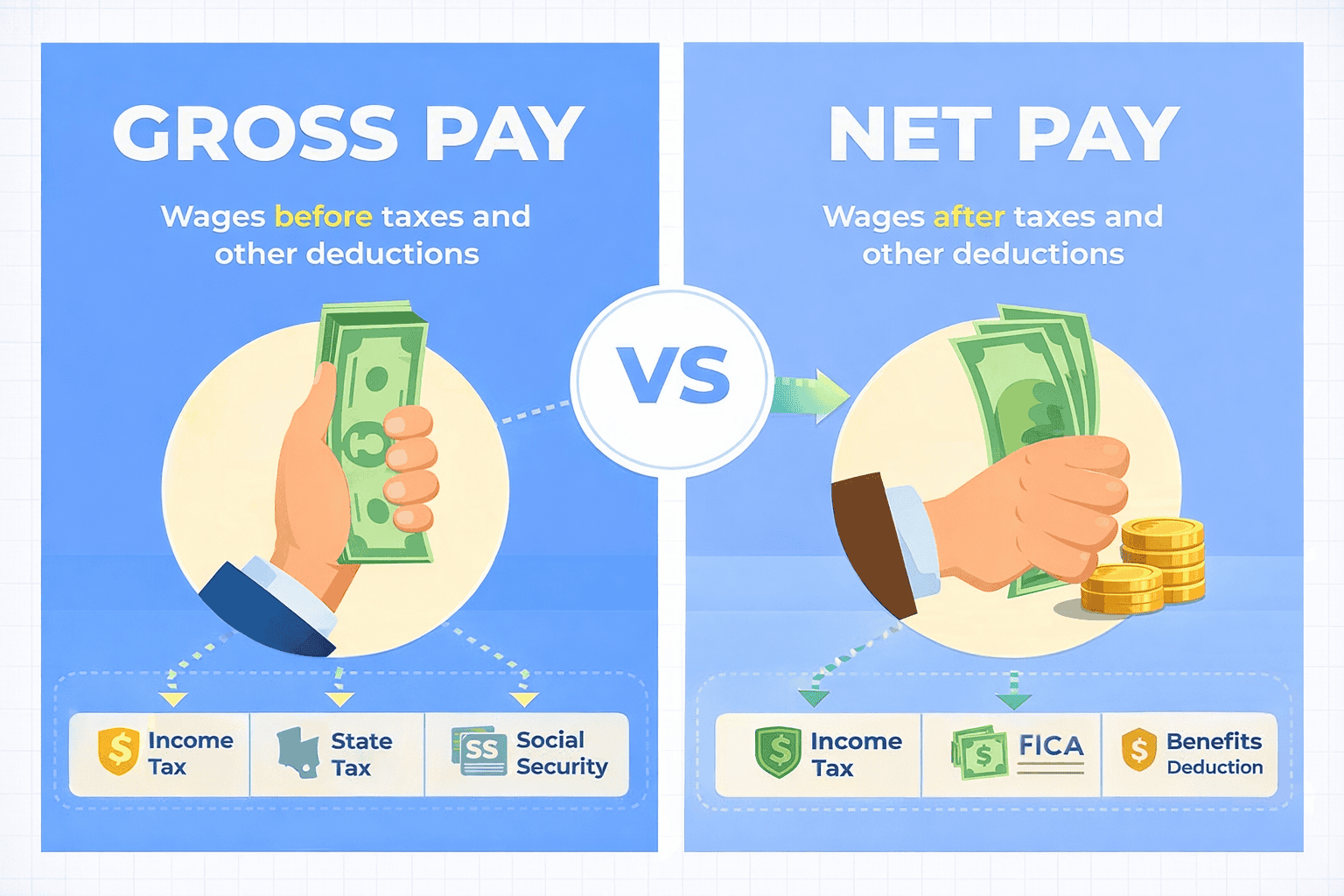
This is where most salary negotiation advice falls apart — it treats CTC as a single number, when it’s actually a package of components with very different risk profiles. If you’re negotiating blindly, you might accept a CTC increase that doesn’t actually improve your monthly take-home by much at all.
Here’s the typical breakdown in Indian IT compensation:
- Fixed Base Salary — The core. This is what hits your account monthly, regardless of company performance or your appraisal cycle. This is what you should fight hardest for.
- Variable Pay (Performance Bonus) — Usually 10–30% of CTC. Only paid on achievement of targets, and sometimes linked to company performance too. At many service firms, “100% variable payout” is rare in practice.
- Joining Bonus — One-time amount paid at joining (or in tranches). Often has a clawback clause if you leave within 12–18 months. Negotiable.
- Retention Bonus — Paid to keep you through a specific milestone. Check the vesting schedule carefully.
- ESOPs / RSUs — Common in product companies and funded startups. High upside potential, but illiquid until vest or IPO. Don’t price this as cash unless the company is very close to a liquidity event.
- Benefits (PF, Gratuity, Insurance) — Statutory components. PF (12% of basic, employer-matched) and gratuity are legally mandated. Some companies include these in CTC, effectively reducing the cash component.
The most common trick — and I use that word deliberately — is inflating CTC using variable components or benefits to make an offer look more competitive than it is. A ₹22 LPA offer with ₹5L variable is not the same as ₹22 LPA with ₹2L variable. The first gives you ₹17L fixed; the second gives you ₹20L fixed. That ₹3L difference compounds in your next negotiation.
Always ask for the CTC breakup in writing. If they hesitate, that’s a signal. Reputable companies share this without friction.
Step-by-Step Salary Negotiation Strategy for IT Professionals
Let’s get specific. Here’s how to actually execute a salary negotiation in an Indian IT context — not theory, but the actual sequence of moves.
Step 1: Establish Your Real Market Value
Don’t guess. Don’t use Glassdoor averages (they tend to skew low for India). Use a combination of: actual offers you’ve received in the past 3 months, conversations with peers at similar seniority levels, recruiter conversations (ask them directly — good recruiters will tell you the band), and LinkedIn Salary Insights for your specific role and city.
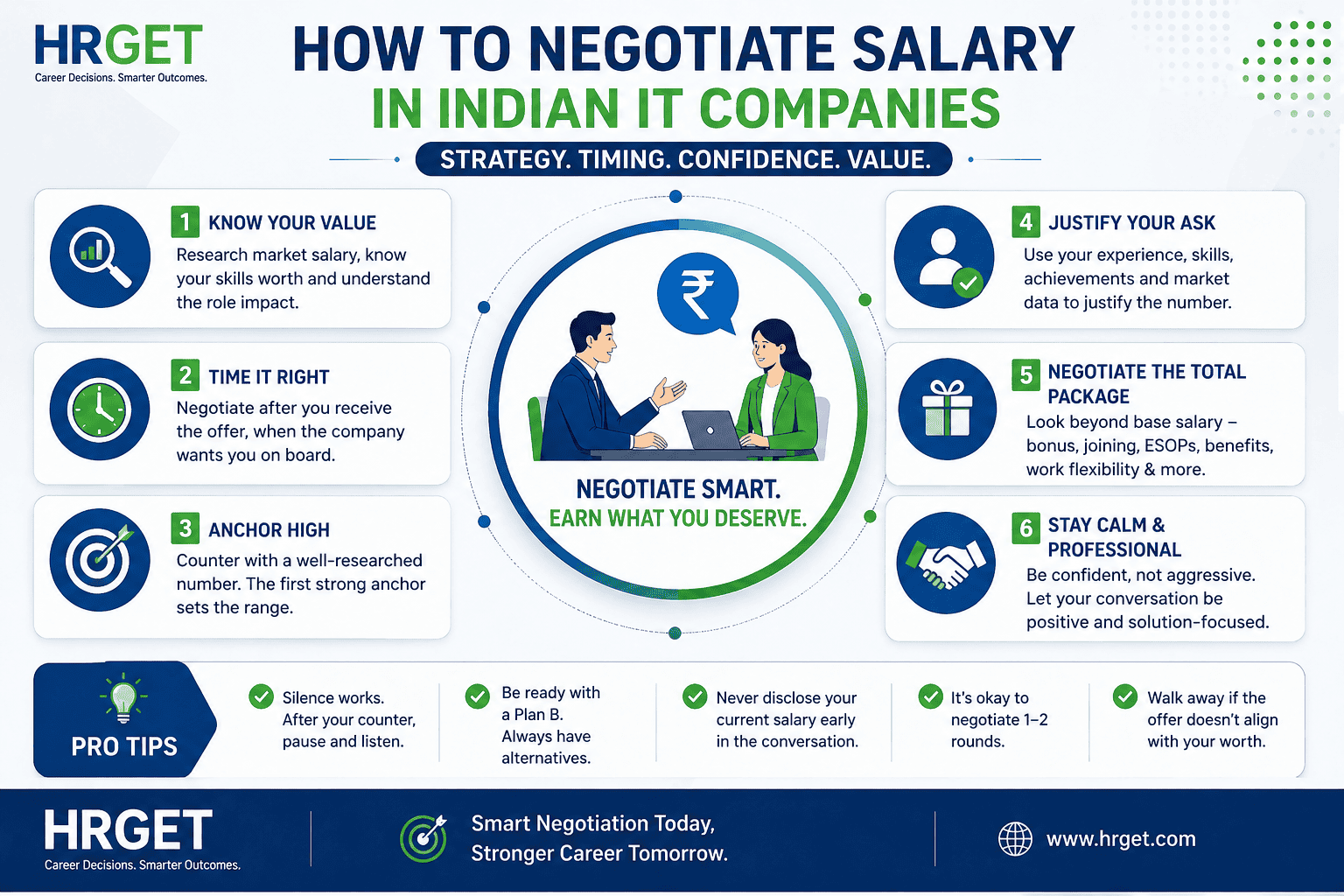
Your target should be the top 25% of the range for your role and experience — not the median. The median is what people accept when they don’t negotiate. Aim higher, and you’ll land somewhere reasonable even after they push back.
Concrete example: For a Senior Software Engineer with 6 years of experience and Java/Spring Boot expertise in Bangalore (2026 market), the range is roughly ₹18–28 LPA across tier-1 IT and product companies. The median is around ₹22 LPA. Your anchor should be ₹25–27 LPA if your skills are current and you have demonstrable impact.
Step 2: Never Reveal Your Expected Salary First
When HR asks “What are your expectations?” — this is a negotiation tactic, not small talk. Whoever anchors first, loses. If you say ₹22L and their budget was ₹26L, you’ve just capped yourself. If you say ₹28L and their max is ₹22L, you’ve potentially created an awkward situation before the negotiation even begins.
The deflection that works in India’s IT hiring context:
“I’m focused on finding the right role fit first. I’m confident we’ll align on compensation once we understand each other better. Could you share the budgeted range for this position?”
Most mid-size and large IT companies will share a range at this point. Once they do — and their range is lower than yours — you have a clear anchor to push against.
Step 3: Anchor High and Reframe the Conversation
Once you have their offer, don’t counter with a small increment. This is the most common mistake I see — someone gets ₹18 LPA and asks for ₹19.5. That signals you’re not confident in your own value.
Instead, anchor meaningfully higher and justify it. If the offer is ₹18 LPA:
“Thank you — I’m genuinely excited about this role. Based on my experience and what the market looks like for this skill set right now, I was expecting something in the ₹24–26 LPA range. Is there flexibility to revisit the number?”
You’re not being aggressive. You’re giving them a clear, data-grounded counter. Most companies will at minimum meet you partway. Some will surprise you.
Step 4: Justify With Logic, Not Personal Need
The weakest justifications are personal — “I have a home loan,” “my current expenses are high.” HR doesn’t care, and it makes you sound like you need the job, which weakens your position.
The strongest justifications are market-facing and impact-facing: “Given my experience in X domain, my track record of Y outcome, and the current demand for Z skills in this market, ₹X is where I’m aligned.” That’s a business case, not a personal appeal. It’s much harder to dismiss.
Step 5: Negotiate the Full Package, Not Just Base
If the base is genuinely fixed — sometimes it is, especially in large service companies with rigid bands — shift to the package. Smart candidates treat compensation as a multi-variable problem, not a single number.
What’s negotiable even when base isn’t: joining bonus (very common and often has more flexibility than base), notice period buyout (if your current employer requires 60–90 days, ask them to compensate partially), work-from-home or hybrid flexibility (has real financial value — saves ₹2,000–5,000/month in commute), earlier appraisal cycles (ask for a 6-month review instead of annual), and reduced variable component (convert some variable to fixed to reduce risk).
Real Scenario: Negotiation Done Right
This is a composite of situations I’ve seen play out — the names and specifics are changed, but the mechanics are real.
Candidate: Priya, 6 years experience as a Senior Data Engineer, Pune-based. Current CTC: ₹12 LPA at a mid-size service firm. Strong Python and Spark skills, recently completed a GCP certification.
Offer received: ₹18 LPA from a product-adjacent company (₹15L fixed + ₹3L variable).
What she did: Priya didn’t respond immediately. She took 48 hours — which is entirely acceptable and signals you’re evaluating seriously. She then came back with:
“I appreciate the offer and I’m genuinely excited about the platform work. I do have another offer in the ₹20–21L range, but I’m more interested in this role for the technical depth. If we could get the fixed component closer to ₹19–20L, I’d be ready to move forward quickly.”
Result: Company came back with ₹21 LPA — ₹18.5L fixed + ₹2.5L variable — plus a ₹1L joining bonus to cover her notice period gap.
That’s a ₹3L annual improvement plus ₹1L immediate cash. One conversation, 10 minutes of courage, ₹4L gained. And her base for the next negotiation is now ₹18.5L, not ₹15L. The compounding starts immediately.
Salary Negotiation Scripts That Actually Work in Indian IT
You don’t need to wing it. These scripts are field-tested in Indian IT hiring contexts. Use them verbatim or adapt them to your style — but don’t deviate too far from the structure. The structure is what makes them work.
Script 1: The Confident Counter
“Thank you for the offer — I’m genuinely interested in this role and the team. Based on my experience in [specific domain], my recent work on [relevant project/outcome], and the current market for [your skill], I was expecting something closer to ₹[your anchor]. Is there room to revisit the number?”
Script 2: Competing Offer Leverage
“I want to be upfront with you — I have another offer at ₹[X], but this role is where I’d prefer to be, both for the technology and the team. If we can close the gap even partially, I’m ready to commit.”
Script 3: When They Say “Budget Is Fixed”
“I understand — and I respect that constraint. Could we explore the joining bonus or an early appraisal at six months? I want to make this work, and I think there’s a way to structure it that works for both of us.”
Script 4: Handling the “Current Salary” Question
“I’d prefer not to anchor on current salary, since this is a different role with different scope. I’m more focused on the market rate for the responsibilities being offered. What’s the budgeted range for this position?”
Note: As of 2026, several Indian states have proposed or passed salary history ban guidelines for IT hiring, following global trends. Even where not legally mandated, you have every right to redirect the conversation to market rate rather than past salary.
Common Mistakes That Kill Your Negotiation in Indian IT
Let’s be direct. These mistakes are avoidable, and I see them constantly.
1. Accepting within 24 hours of the first offer. Unless the offer is genuinely exceptional or you’ve already done your research and anchored, accepting fast signals you either didn’t have options or didn’t know you could push. Take 48–72 hours minimum. It’s professional, not rude.
2. Asking for a small increment. Asking for ₹1–2L more on a ₹20L offer signals you’re not confident in a higher number. Counter with a meaningful anchor — something 20–30% above the offer — and let the negotiation settle in the middle. That middle is often better than your timid counter would have been.
3. Negotiating without data. “I feel I deserve more” is not a strategy. “Based on Naukri Salary Insights and two comparable offers I’ve received this month, the market rate for this role in Hyderabad is ₹X” is a strategy. Data changes the entire dynamic.
4. Confusing high CTC with high take-home. A ₹25 LPA offer with 30% variable and PF-in-CTC can easily mean ₹1.4–1.5L in-hand monthly. A ₹22 LPA offer with 10% variable and employer-paid PF might give you ₹1.55–1.6L in-hand. Always calculate the fixed component and the in-hand figure before making a comparison.
5. Getting emotional or aggressive. This is business. Stay calm, stay data-driven, stay friendly. The HR person across the table is usually on your side — they want to close the position. Work with them, not against them.
Insider View: What HR in Indian IT Actually Thinks
Here’s what most negotiation articles won’t tell you, because most of them aren’t written by people who’ve sat in compensation review meetings.
HR almost always has a buffer. The first offer is rarely the maximum. In mid-size IT companies, the recruiter’s approval authority might be ₹2–3L above the opening offer. For senior roles, the buffer is often higher and requires manager or finance sign-off — which is why you should expect 2–3 rounds of back-and-forth, not just one.
Silence is a tool. After you name your counter, stop talking. Don’t fill the gap with qualifications or walk-backs. The discomfort of silence is real, but whoever speaks first concedes first. I’ve seen candidates negotiate themselves back down in the 30 seconds after naming their number, because they got nervous and started adding “but I’m flexible, of course” before HR even responded.
External hires have structurally more leverage than internal candidates. If you’re an internal candidate asking for a promotion, you’re negotiating within a different set of constraints — compensation bands, internal equity, precedent. External hires don’t carry that baggage. Use that freedom.
Joining bonus is the easiest yes. It doesn’t change the annual CTC structure (which affects internal equity), it comes from a different budget bucket, and it helps close candidates quickly. If you’re stuck on base, pivot to joining bonus. You’ll often find the flexibility there.
What to Do If HR Says “This Is Our Final Offer”
Let me be clear: “this is our final offer” is very often a negotiation tactic, not a factual statement. I’m not saying it’s always a bluff — sometimes it genuinely is the ceiling. But in most cases, there’s still room. You just need to handle it correctly.
Option 1: Push once more, very politely.
“I appreciate you being direct. If there’s even a small amount of flexibility — even ₹1–1.5L — it would make a real difference in my decision. Is there anything at all you can do?”
This works because it’s humble, non-confrontational, and gives them an easy “yes” with a small concession. Even ₹1L more is worth 10 seconds of asking.
Option 2: Shift to non-salary levers. If the base truly cannot move, ask about joining bonus, early review at 6 months, or an additional day of WFH per week. These concessions often sit in different budget lines and can be approved when salary movement can’t.
Option 3: Walk away — but do it cleanly. If the offer genuinely doesn’t work for you, say so respectfully and leave the door open.
“I genuinely appreciate the time and the offer. Unfortunately, the compensation doesn’t work for where I am right now. I hope we can reconnect in the future — I have a lot of respect for what the team is building.”
You’d be surprised how often a “walk away” triggers a revised offer within 24–48 hours. Not always. But often enough that it’s worth doing this cleanly rather than burning the bridge.
Smart Strategy: Think Long-Term, Not Just This Offer
Here’s the one thing most candidates miss entirely: the job you’re accepting isn’t just a salary — it’s your next negotiation’s starting point.
A ₹20L offer from a company with a strong brand name (think a FAANG adjacent, a well-funded unicorn, or a globally recognized consulting firm) will open more doors and command a higher premium in your next move than ₹24L from a company no one has heard of. Brand equity is real, and it compounds.
Similarly, evaluate the appraisal history. A company with consistent 15–20% raises for strong performers is worth more than one offering a higher joining package with 6–8% annual increments. Ask the recruiter directly: “What does a strong performer’s compensation trajectory look like here over 2–3 years?”
The best salary negotiators I’ve worked with don’t optimize for the highest number on a single offer. They optimize for the highest number on the next offer — which means making smart decisions now about where to work, what to build, and what their market value story will look like 18 months from today.
FAQ: Salary Negotiation in Indian IT Companies
Is it okay to negotiate salary in Indian IT companies?
Yes — and it’s expected. Indian IT companies, whether service-based or product, routinely build buffer into initial offers. Not negotiating can actually signal a lack of confidence or market awareness. Virtually every offer at the mid-level and above has some flexibility, even if HR doesn’t volunteer that fact upfront. Negotiate once you have a formal or confirmed verbal offer in hand.
How much hike should I ask for when switching IT companies in India?
A reasonable target when switching is 30–50% above your current CTC for service-to-service moves, and 50–100% for moves into product companies or funded startups where equity (ESOPs/RSUs) may also be part of the package. These ranges reflect 2026 market norms. Your specific number should be based on your skills, the role’s scope, and what competing offers confirm — not just a percentage of current salary.
Should I reveal my current salary during IT hiring in India?
Avoid it where you can. Many employers ask for salary slips as part of the documentation process — that’s a separate issue from the negotiation conversation. In the conversation itself, redirect: “I’d prefer to discuss market rate for this role rather than anchor on where I’ve been.” If a company conditions an offer on salary history, that’s a red flag about their culture around compensation transparency.
What if I don’t have a competing offer to use as leverage?
Use market data instead. Naukri Salary Insights, LinkedIn Salary, and AmbitionBox (with appropriate skepticism — cross-reference multiple) give you usable benchmarks. You can also truthfully say you’re “actively in the process with a few other companies” if you genuinely are — you don’t need an offer in hand to signal you have options. Just don’t fabricate a specific competing number if you don’t have one.
Can an offer be withdrawn if I try to negotiate in India?
This is extremely rare for standard negotiation. Offer withdrawals happen in cases of aggressive, unreasonable demands or unprofessional conduct — not because someone asked for a higher number. As long as you’re negotiating with data, reasonable numbers, and professional tone, you’re safe. In my years working with compensation teams, I’ve never seen an offer pulled for a polite counter.
How many rounds of negotiation are normal in Indian IT?
One to two rounds is standard and completely acceptable. A third round is possible for senior roles or when both parties are genuinely close. Beyond that, you risk signaling that you’re difficult to close or that you’re using the offer purely as leverage with no genuine intent to join. Two rounds, done well, is usually enough to land the best possible outcome.
Should freshers negotiate salary for their first IT job in India?
Yes — but calibrate the ask. Fresher bands at large IT service companies (TCS, Infosys, Wipro) are largely standardized and have limited flexibility. Product companies and funded startups have more room. If you have a strong academic record, a relevant internship, or specialized skills (cloud certifications, competitive programming rankings), use that to ask for placement in the higher end of the band. Even ₹50,000–₹1L more at the start makes a difference over time.
The Bottom Line on Salary Negotiation in Indian IT
Here’s what 15 years of watching compensation conversations taught me: the professionals who earn the most aren’t always the most technically skilled. They’re the ones who know how to communicate their value clearly, time their conversations correctly, and stay composed when the stakes are high.
Salary negotiation in Indian IT companies isn’t about being aggressive. It’s about being prepared. Know your market value, understand the compensation structure, pick the right moment, and then ask — directly, confidently, with data behind you.
The worst that happens when you negotiate well? They say no. And even then, you’ve shown them exactly the kind of professional you are. That has its own long-term value.
If you want to go deeper on evaluating the full compensation picture before you negotiate, read our guide on how to evaluate a job offer beyond the CTC number — it covers the components most candidates overlook until it’s too late.

Eleanor Whitmore | Former Partner, Mercer | Advisor, World Economic Forum | 20+ Years in Global Compensation
Author bio: Eleanor Whitmore has spent over two decades shaping how the world’s leading organisations pay, retain, and reward talent. As a former Partner at Mercer and an advisor to World Economic Forum working groups on the Future of Work, she has designed compensation frameworks for Fortune 500 companies across the US, UK, Europe, and emerging markets. Based between London and New York, Eleanor writes for HRGet.com to translate boardroom-level pay strategy into actionable guidance for working professionals navigating real compensation decisions.