Hybrid work sounds like the perfect middle ground — flexibility for employees, presence when it matters, productivity without the commute tax. And yet, most hybrid work schedules are quietly failing the people they were supposed to help.
I’ve spent the last three years advising leadership teams across the US, UK, and India on how to design hybrid models that hold. What I see again and again is the same root cause: hybrid is being treated as a perk, not a system. Companies announce a “2–3 days in office” policy and call it done. Then wonder why morale tanks and productivity doesn’t budge.
This guide covers the hybrid work schedule best practices that are actually working in 2026 — backed by what I’ve seen in high-performing teams, not just survey data. Whether you’re an employee trying to protect your focus time or a manager trying to hold a team together, you’ll walk away with a model you can use Monday morning.
What Hybrid Work Really Means in 2026
Let’s reset the definition, because “hybrid” has become meaninglessly broad.
In 2026, hybrid work is no longer just “sometimes in the office.” The companies doing it well have reframed it around three principles: intentional presence, outcome-driven performance, and a clear separation of work modes — deep focus happens remotely, and collaboration happens in person.
That last point is the one most companies miss. They let employees choose their office days freely, which sounds respectful of autonomy — but it creates a situation where nobody knows when their teammates will be in. Office days become lonely desk days. Collaboration still happens on Zoom. And the whole premise of hybrid collapses.
The shift that separates good hybrid from bad hybrid is this: the best teams treat the office as a tool for a specific purpose, not a default location. Every time someone commutes in, there should be a clear, compelling answer to the question — “why does this require physical presence today?”
That’s not a minor mindset shift. It changes how you design your schedule, your meeting rhythms, your performance expectations — all of it.
Why Most Hybrid Work Models Fail
Here’s what broken hybrid actually looks like — and I’ll bet at least two of these sound familiar.
“Come In 2–3 Days” With No Structure
This is the most common version of hybrid — and the most dysfunctional. Without specifying which days or why, you end up with half the team in on Monday while the other half comes in Thursday. The office is always half-empty. You commute in and spend the day on video calls anyway. It’s the worst of both worlds.
Meetings Still Dominate Office Days
If your office day looks like: arrive, open laptop, join Zoom, leave — that’s not hybrid. That’s just a more expensive version of remote work. I’ve spoken to product managers in Bangalore and London who said the same thing: they go in on “office days” and spend 90% of the time in meetings they could have taken from home. The commute cost is real (time, money, energy) and the return is zero.
Managers Defaulting to Presence as Proof of Work
Tracking badge swipes. Watching green dots on Slack. Expecting replies within minutes regardless of time zone. This is the fastest way to destroy trust in a hybrid team — and I’ve seen it happen at companies with genuinely good intentions. The problem isn’t malice; it’s that managers weren’t retrained when the work model changed. They’re still operating like it’s 2019.
No One Knows Why the Office Exists
If your employees can’t answer “why do we come in?” with something more specific than “policy says so” — your hybrid model is already broken. Purpose gives the office value. Without it, attendance becomes resented compliance.
Best Hybrid Work Schedule Models (With Use Cases)
There’s no one-size-fits-all hybrid schedule — but there are clear patterns that work for specific team types. Here’s a breakdown of the four main models, and who each one actually suits.
| Model | Structure | Best For | Watch Out For |
|---|---|---|---|
| Fixed Hybrid | Mon–Wed in office, Thu–Fri remote | Large teams, early-stage companies | Feels rigid; hard to accommodate personal schedules |
| Flexible Hybrid | 2–3 office days, employee chooses | Senior ICs, autonomous teams | Nobody’s ever in on the same day |
| Anchor Day Model | Everyone in Tue & Thu; rest flexible | Product, engineering, cross-functional | Requires discipline and manager buy-in |
| Remote-First with Office Optional | Office for events, not daily work | Distributed and global teams | New hires lack context; culture weakens over time |
Of these four, the Anchor Day Model is emerging as the clear front-runner for teams that need both focus and collaboration. It guarantees overlap without sacrificing flexibility. Tuesday and Thursday become the days when the office actually feels like an office — energy, spontaneous conversations, real-time problem-solving. The rest of the week, you can work in a way that suits your role.
Companies like Atlassian have leaned toward remote-first; others like Apple have pushed back toward fixed schedules. What the data increasingly shows is that the anchor day approach sits at the productive middle — enough structure to create genuine value from in-person time, enough flexibility to retain talent.
Hybrid Work Best Practices That Actually Work
This is where most guides hand you a generic bullet list and call it a day. Let’s be more specific than that.
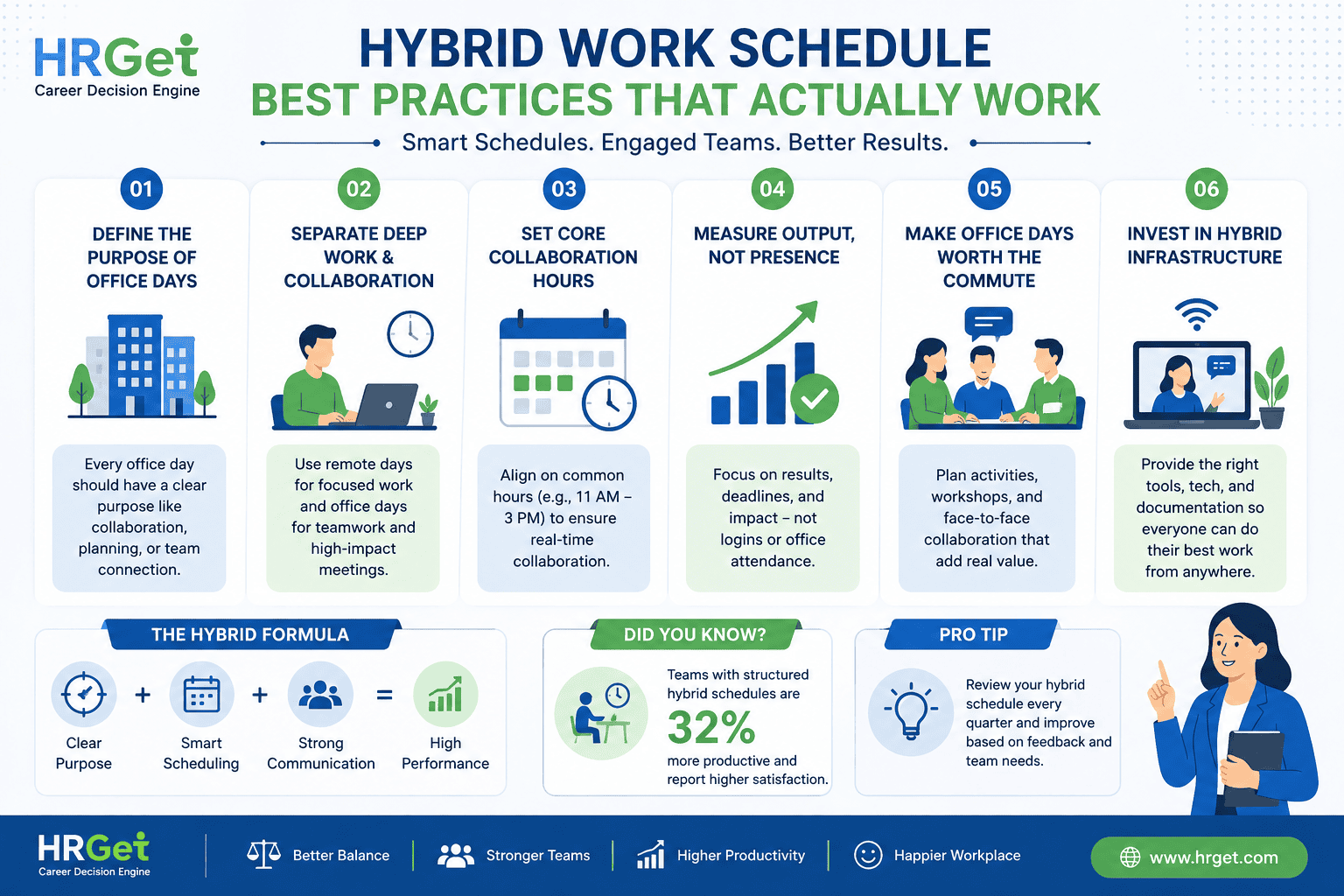
1. Define “Office Purpose” Before You Define “Office Days”
Before you set a schedule, answer this: what does physical presence unlock that remote can’t? The honest answers are usually: whiteboard brainstorming, building trust with new hires, resolving conflict between people who’ve been emailing tensely for weeks, or celebrating a win as a team.
What it’s not: status update meetings, solo coding, reading reports, or taking individual calls. If those are happening in your office, you’re spending people’s commute time on things that don’t require it. That’s a morale drain you won’t see in the data — until someone quits.
2. Separate Deep Work Days From Collaboration Days
This is the single highest-leverage change you can make. Remote days should be protected for focused, individual work — writing, analysis, coding, strategy. Office days should be reserved for things that benefit from proximity: decision-making, relationship-building, creative workshops.
When teams run both types of work on every day — meetings scattered across focus days, solo work crammed into office days — you get the cognitive whiplash that kills productivity. Cal Newport’s concept of “deep work” applies here directly: cognitive output isn’t just about hours, it’s about uninterrupted blocks. Hybrid is your chance to engineer those blocks by design.
3. Establish Core Collaboration Hours (And Protect the Rest)
For globally distributed hybrid teams, this is non-negotiable. Pick a 3–4 hour window — say, 11 AM to 3 PM across the primary time zones — where meetings can happen. Outside that window, no meetings, no real-time demands. Slack is async.
This works especially well for India-US hybrid teams, where time zone overlap is limited. An engineering team in Bengaluru and a product team in New York can realistically share 10 AM–1 PM IST (9:30–12:30 PM IST aligns with 11 PM–2 AM EST — so morning IST is often the best window). Getting this right requires explicit agreement, not assumption.
4. Measure Output, Not Presence
I know this sounds obvious in 2026 — but it still isn’t standard practice. Managers who grew up in office environments often default to visible activity as a proxy for performance. That worked when you could see someone at their desk. It doesn’t work when half your team is remote.
The shift: manage by deliverables, not hours. Set clear weekly outcomes for each team member. Track completion, not clock-in time. This doesn’t mean abandoning accountability — it means measuring what actually matters. A senior UX designer who delivers a research synthesis by Friday, regardless of which days they were in office, is performing. One who’s physically present five days a week but never ships clean work isn’t.
5. Make Office Days Worth the Commute
For anyone commuting 45–90 minutes each way, the office needs to offer something they genuinely can’t get at home. That means planning office days intentionally — team lunches, workshops, in-person feedback sessions, quarterly planning, mentoring conversations with junior staff.
If your employees consistently feel that office days are just remote days with a worse chair and a longer commute, you will lose them — to competitors who’ve figured this out. In the UK, India, and the US, hybrid flexibility is now a top-three factor in job acceptance decisions, right behind compensation and role growth.
6. Invest in the Right Hybrid Infrastructure
Remote employees become second-class citizens when the office tech is bad. If someone dialing in from home can’t hear the room, can’t see the whiteboard, or gets skipped in the discussion because the in-person dynamic takes over — you’ve created a two-tier culture.
The baseline in 2026 should include: room-quality cameras and microphones in every meeting room, a shared digital workspace (Notion, Confluence, or equivalent) where decisions are documented, and a clear async communication norm so remote employees aren’t disadvantaged. This isn’t optional infrastructure anymore — it’s table stakes for keeping hybrid teams functional.
Real Scenario: What Good vs Bad Hybrid Actually Looks Like
I worked with two product teams — similar size, similar roles, similar companies — that had completely different hybrid outcomes. Here’s what separated them.
❌ Team A — Broken Hybrid
Policy: “Come in 3 days a week.” No coordination. Mondays were ghost towns. Office days had back-to-back Zoom calls. Manager sent “quick questions” at 9 PM. No shared doc for decisions. Junior employees felt invisible on remote days — promotions kept going to the people the manager could physically see.
✅ Team B — Functional Hybrid
Anchor days: Tuesday and Thursday in office — non-negotiable, but everything else flexible. Office days were meeting-heavy (by design). Mon/Wed/Fri were focus days — no meetings before noon. All decisions documented in Confluence within 24 hours. Manager did weekly 1:1s for remote employees. Result: retention was 94% over 18 months; Team A lost 4 of 9 people.
The difference wasn’t budget or headcount. It was intentional design — and consistent execution.
Smart Strategy: Designing Your Ideal Hybrid Schedule
Whether you’re an individual contributor negotiating your schedule or a manager building a team rhythm, here’s a step-by-step approach you can implement this week.
📋 5-Step Hybrid Schedule Design
- Audit your work types. List every task you do in a typical week. Categorize each as: deep focus, collaborative, or administrative. This tells you where your time is actually going — most people are shocked.
- Map tasks to locations. Deep focus → remote. Collaborative → office. Administrative can go either way. Now you have a natural logic for which days you should be where.
- Set anchor overlap. Pick 1–2 days where your entire immediate team is in office simultaneously. These are your collaboration days. Block them. Protect them from solo work.
- Define async norms. Agree on response time expectations for Slack/email outside core hours. Write it down. Revisit after 30 days.
- Schedule a 4-week review. Hybrid schedules need calibration. What worked? What didn’t? Are office days actually more valuable than remote days? Adjust accordingly.
Common Hybrid Work Mistakes to Avoid
These are the mistakes I see most often — and they’re all fixable once you name them.
Mistake 1: Treating hybrid as a binary (office vs home) instead of a spectrum. The question isn’t “remote or office?” — it’s “what does this specific task need?” Some work genuinely benefits from a third space (café, coworking space). Rigid thinking misses that.
Mistake 2: Scheduling solo-work meetings on office days. Weekly status updates. Individual project check-ins. These can — and should — be async. Wasting collaborative office time on meetings that could have been a Loom video is a persistent team-culture killer.
Mistake 3: Proximity bias in performance reviews. Research from Stanford and others has consistently shown that remote workers get lower performance ratings and fewer promotions, not because they perform worse, but because they’re less visible. If you’re a manager, audit your last review cycle for this explicitly.
Mistake 4: Not onboarding new hires differently in hybrid. New employees need more in-person time, not the same amount as veterans. A standard 2-day hybrid schedule makes sense for someone who’s been on the team for three years — it doesn’t work for someone in their first 90 days trying to build relationships and understand unwritten norms.
Mistake 5: Letting the loudest voices set the policy. In most companies, the employees who push hardest for full remote or full office get the policy shaped around them. The silent majority — who want something reasonable and structured — end up stuck with a compromise that serves no one well.
Pro Tips: For Employees and Managers
For Employees
- Block your calendar on remote days for deep work — actually block it, not just mentally reserve it. Meetings will fill the white space otherwise.
- Make your in-office presence visible and purposeful. Use it for relationship-building — lunch with a stakeholder, a quick walk with your manager, a conversation you’ve been putting off.
- Document your wins consistently, especially on remote days. Your manager needs to see impact even when they can’t see you.
- If you’re feeling disconnected, name it. “I feel like I’m missing context from the office days” is a solvable problem — but only if you say it out loud.
For Managers
- Run a “hybrid audit” with your team every quarter — ask anonymously: Are office days worth the commute? What’s missing on remote days? What’s working well?
- Never reward presence. If someone stayed late in the office, don’t praise the hours — praise the output. You’re setting a cultural norm every time you respond to visible effort.
- Over-communicate decisions made in-office to remote team members. What feels obvious in the room is completely opaque on the outside.
- Model the schedule you want your team to follow. If you work late every night and check email on weekends, your team will feel implicit pressure to match it — hybrid or not.
FAQs: Hybrid Work Schedule Best Practices
What is the most effective hybrid work schedule in 2026?
The anchor day model — where the entire team comes in on 2 fixed days per week (typically Tuesday and Thursday) — is proving most effective for mid-sized teams. It creates guaranteed collaboration overlap while preserving 3 days of flexibility. It works especially well for product and engineering teams that need both focus time and regular cross-functional alignment.
How many days a week should hybrid employees work from the office?
Two to three days per week is the range where most teams find the right balance. Two days preserves deep-work time while maintaining enough in-person presence for culture and collaboration. More than three days starts to feel like a return-to-office mandate with a hybrid label on it — and employees notice. The exact number should depend on role type and team structure, not a blanket company policy.
How do you manage hybrid teams fairly without proximity bias?
Three things help here: documenting all major decisions in a shared space accessible to everyone, running performance reviews based on deliverables rather than visibility, and deliberately scheduling 1:1 time with remote employees — not just catching up informally with whoever walks past your desk. Proximity bias is real and well-documented; countering it requires active effort, not passive goodwill.
What’s the biggest mistake companies make with hybrid work policies?
Announcing a policy without designing the system around it. “2–3 days in office” is not a hybrid strategy — it’s a sentence. Without specifying which days, what office days are for, how remote days should be used, and how performance will be measured, you’re setting your team up for confusion and resentment. The policy is 5% of the work; the design is 95%.
Does hybrid work actually improve productivity?
When designed well, yes — meaningfully so. Research from Stanford’s Nick Bloom has consistently found that structured hybrid arrangements (not fully remote, not fully in-office) produce the highest self-reported productivity and the lowest attrition. The key word is “structured.” Unstructured hybrid, where employees don’t know expectations, shows no productivity benefit and higher stress levels.
How do I negotiate a better hybrid schedule with my manager?
Frame it around outcomes, not preference. Instead of “I want to work from home more,” say: “I’ve found my deepest work happens in uninterrupted blocks — can we agree on which days I should be in for collaboration and protect the others for focus work?” Come with a proposal, show your recent output as proof, and offer a 4-week trial with a check-in. Managers are more receptive when you’re solving their problem, not asking them to accommodate yours.
What tools are essential for a hybrid work setup?
The non-negotiables in 2026: a reliable async communication platform (Slack or Teams), a shared documentation hub (Notion, Confluence, or Google Workspace), a project management tool with visible progress tracking (Linear, Jira, Asana), and quality video conferencing in every meeting room. Beyond tools, you need norms — agreements about response times, meeting-free hours, and how decisions get documented. Tools without norms are just noise.
The Bottom Line on Hybrid Work Best Practices
Here’s what I keep coming back to after 18 years of watching work models evolve: hybrid work isn’t a location policy, it’s a performance system. The companies that treat it like the former are struggling. The ones that’ve built it like the latter are retaining great people, running leaner, and doing more with the same headcount.
If you take one thing from this: stop letting your hybrid work schedule happen by default. Design it deliberately — with a clear answer to why the office exists, what remote days are for, and how performance will actually be measured.
The best hybrid work schedule is one your whole team actually understands and buys into. That’s not a policy document — it’s a conversation. Start that conversation this week.
📌 If you’re looking to negotiate more flexibility in your current role, read our guide on how to negotiate a remote or hybrid work arrangement with your manager — including the exact framing that gets a yes.
By Jonathan Reed, Executive Career Strategist | Former Partner, McKinsey | Executive Coach at Amazon & Unilever | 18+ Years’ Experience

Jonathan Reed: Executive Career Strategist & Leadership Advisor | Former Partner, McKinsey & Company | Executive Coach to Amazon & Unilever Leaders | 18+ Years in Career Strategy
Jonathan Reed spent nearly two decades as a Partner at McKinsey & Company, where he advised organisations on leadership development, talent strategy, and organisational design across the US, UK, and Asia. Since leaving consulting, he has worked as an executive coach to senior leaders at Amazon, Unilever, and a clutch of high-growth scale-ups — helping them navigate promotions, career pivots, and the unwritten rules of visibility and influence at the top. Based between London and New York, Jonathan writes for HRGet.com to give working professionals an honest look at how careers actually scale — and why so many talented people stall without ever knowing why.