Most professionals who land a remote offer feel relieved. Smart ones feel something else — they feel leverage. If you’re trying to negotiate remote work salary, you’re already ahead of 80% of candidates who silently accept whatever comes through. The difference between those two groups? Often $10,000–$40,000 a year.
I’ve spent 15 years on the compensation side of the table — setting pay bands at multinationals, advising on remote-work pay policy during the pandemic pivot, and watching thousands of candidates leave serious money behind because they didn’t know how this game works.
This article changes that. You’ll walk away with a clear understanding of why remote pay gaps exist, exactly how to close them, and the scripts to do it — without sounding desperate or aggressive.
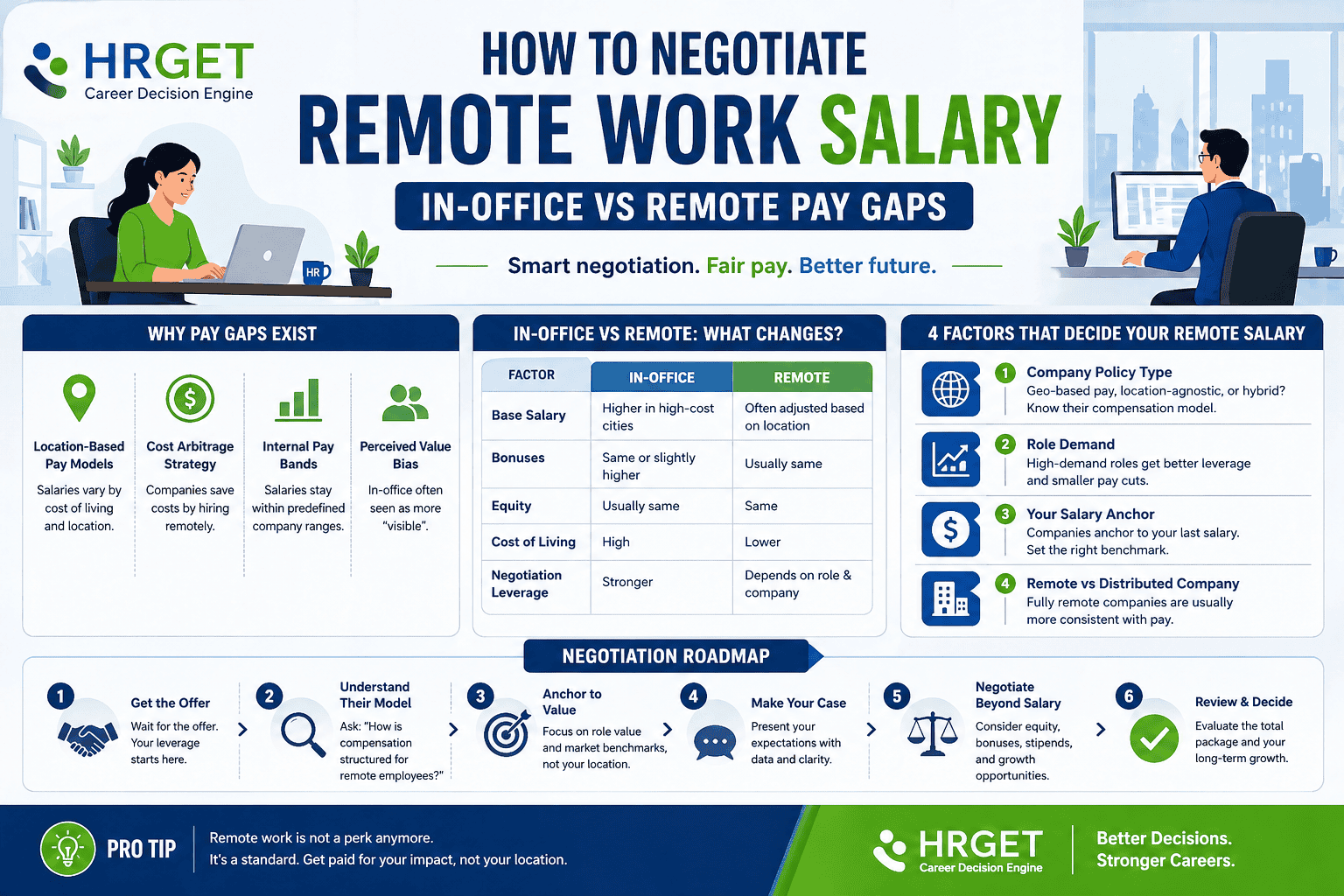
Why Remote Pay Gaps Exist
Let’s not dress this up. Companies don’t set remote salaries based on effort or loyalty. They set them based on cost structures, market positioning, and internal pay bands — and those three things don’t always work in your favor.
Here’s the honest breakdown of what’s actually driving the gap:
1. Location-Based Pay Models
The majority of mid-to-large employers in the US (and increasingly in the UK and Europe) use geographic pay tiers. Your city — or in some cases, your county — determines your salary band. A Senior Product Manager role might pay $145,000 in San Francisco, $120,000 in Austin, and $95,000 for a fully remote hire in a Tier-2 US city. The job spec is identical. The pay band is not.
2. Cost Arbitrage — The Business Incentive
Remote work was sold to companies as a talent acquisition advantage. It is. But it’s also a cost-reduction strategy. Hiring a strong engineer in Hyderabad or Porto instead of San Jose saves a company $60,000–$90,000 annually. That saving doesn’t disappear when the candidate negotiates. It just gets tested.
3. Internal Pay Band Constraints
Even a hiring manager who genuinely wants to pay you more may be blocked by their HRIS system. Compensation tools like Radford, Mercer, and Willis Towers Watson are used to set salary ranges by geography. If your location maps to Band 3 and the role tops out at $110K in Band 3, that’s often where the conversation ends — unless you know how to push it.
4. Perceived Visibility Bias
This one’s uncomfortable, but real. Some organizations — particularly those still transitioning from a traditional office model — equate physical presence with value. Remote employees are perceived as “lower maintenance,” and that perception quietly translates into lower initial offers. It’s not fair. It is, however, something you need to negotiate around.
Understanding which of these four forces is driving your offer is the first step. It changes your entire strategy.
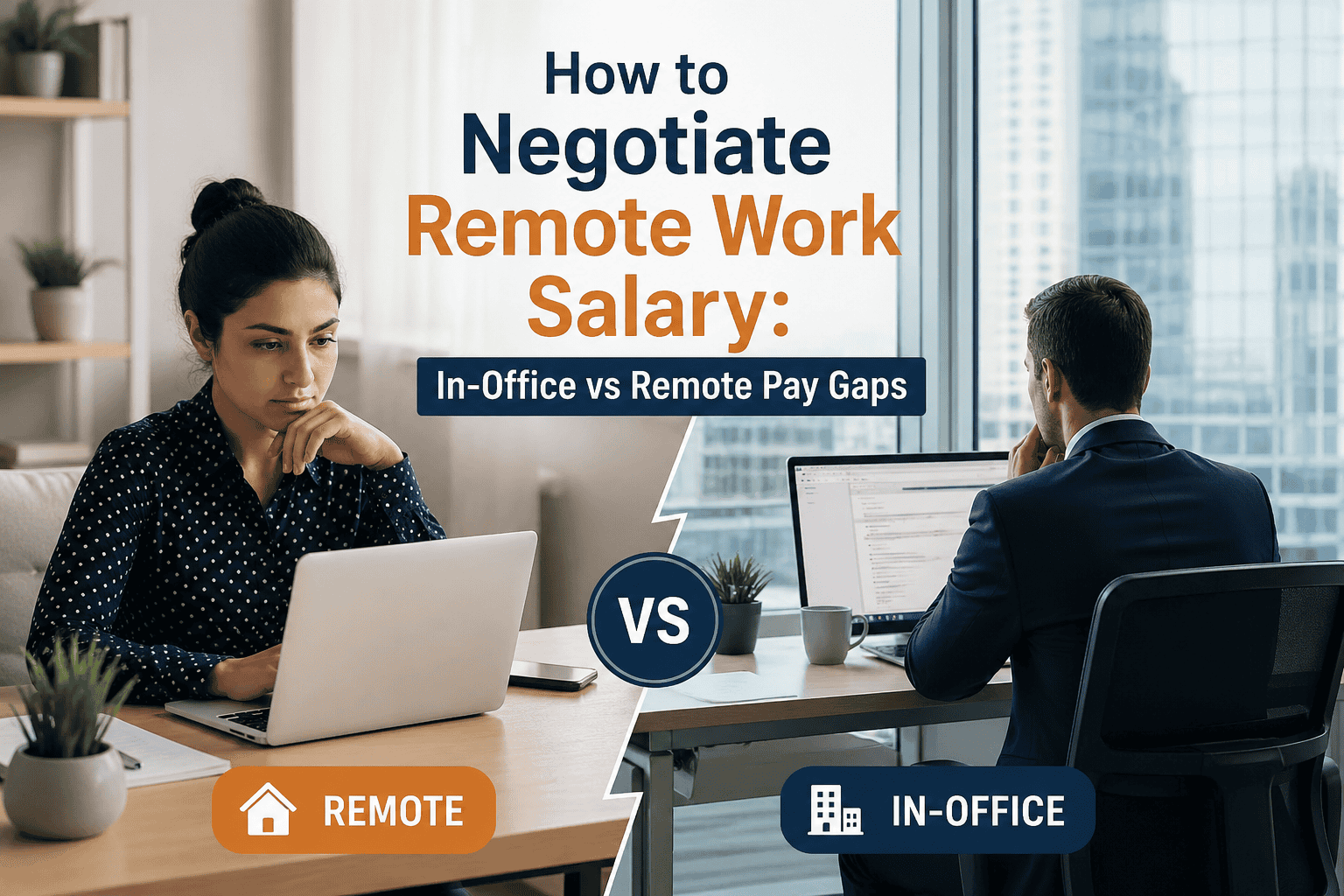
In-Office vs Remote Salary: What Actually Changes
The remote vs in-office pay debate gets muddier than people realize, because it’s not just about base salary. Here’s a clear breakdown of what typically shifts — and what doesn’t.
| Factor | In-Office | Remote |
|---|---|---|
| Base Salary | Higher in high-cost metros | Often geo-adjusted downward |
| Annual Bonus | Same or marginally higher | Usually the same % |
| Equity / RSUs | Usually same grant value | Usually same grant value |
| Benefits / Health | Standard employer plan | Same (may vary by state) |
| Remote / WFH Stipend | Rare | Negotiable ($50–$200/mo) |
| Negotiation Leverage | Stronger (visible, local) | Role-dependent — can be strong |
Here’s the thing most candidates miss: the gap isn’t always in base salary. Sometimes the base is fine — and you’re leaving money on the table because you didn’t push for a $5,000 sign-on, a remote stipend, or an accelerated review cycle. Those line items add up fast.
Insider Take
Remote work is often framed as a trade-off: “You get flexibility, we save on overhead.” Your job in every negotiation is to break that equation — and get paid for the role, not your zip code.
The 4 Hidden Factors That Decide Your Remote Salary
Most people walk into a remote salary negotiation blind. They know their number, they know the job title, and that’s about it. But the levers that actually control your outcome are underneath the surface — and if you don’t understand them, you’re negotiating in the dark.
1. The Company’s Pay Philosophy
Not all companies handle remote pay the same way. There are three models in practice:
- Geo-based pay — Your salary depends on where you live. Moving to a lower-cost area could trigger a pay cut.
- Location-agnostic pay — Same role, same pay, regardless of city. Companies like GitLab and Automattic operate this way.
- Hybrid adjustment — Most common. A salary range exists nationally, and your location places you somewhere within it.
Your first question before any negotiation: “Is compensation structured around location, or around the role’s market value?” That answer tells you exactly what’s possible.
2. Role Demand in the Market
High-demand skills compress location adjustments. If you’re a machine learning engineer, a cybersecurity architect, or a senior product leader, companies know they’re competing for you with every other employer in the market — including fully remote, location-agnostic ones. That competition gives you negotiation power that a candidate in a lower-demand role simply doesn’t have.
In 2026, roles in AI/ML, data engineering, and enterprise SaaS sales consistently carry the most remote negotiation leverage. If you’re in one of these areas, use it.
3. Your Current Salary Anchor
I’ll be honest — this one trips people up constantly. Companies anchor to your last salary, whether they admit it or not. If you state a number that’s low or vague (“around $90K”), that becomes the ceiling of their imagination. Always anchor to the role’s market value, not your history. And if you’re asked for your current comp, lead with total compensation — base plus bonus plus equity — not just base.
4. Remote-First vs Office-First Company Culture
There’s a meaningful salary difference between companies that are remote by design and those that are remote by necessity. At a company like Stripe, Shopify, or a born-remote startup, remote pay is normalized and treated fairly. At a legacy financial institution or manufacturing conglomerate that went remote post-2020, you’re still fighting an organizational bias that sees remote as a concession — and that often reflects in the initial offer.
Real Scenario: Same Role, Completely Different Salary
📋 Scenario: Mid-Size US Tech Company — Senior Software Engineer
- Candidate A — New York City, in-office: $185,000
- Candidate B — Austin, hybrid: $158,000
- Candidate C — Fully remote, mid-size US city: $118,000
- Candidate D — Fully remote, Bangalore: $85,000–$100,000
Same job description. Same interview process. Same performance expectations. The variance is entirely a function of location and how aggressively each candidate negotiated.
Candidate C — the fully remote US hire at $118K — was initially offered $105K. They negotiated to $118K using market data from Levels.fyi, pushed back on the location adjustment rationale, and asked for a $7,500 sign-on when base movement stalled. That’s a $20,500 swing from a 20-minute conversation.
Candidate D, working from Bangalore, had a trickier path. But they negotiated their equity grant from 200 RSUs to 350, and locked in a 9-month performance review rather than the standard 12. The total value difference over two years was significant — even if the base salary gap with US counterparts remains real.
The lesson isn’t that the gap disappears. It’s that the gap is always negotiable on at least one dimension.
How to Negotiate Remote Work Salary: Step-by-Step
Here’s the exact process I’d walk a candidate through. Don’t skip steps — each one sets up the next.
Step 1: Wait for the Offer Before Negotiating
This sounds obvious, but candidates jump in too early constantly. Your leverage is at its peak the moment they say “we’d like to make you an offer.” Before that moment, you’re speculating. After it, you’re negotiating from strength. Don’t disclose salary expectations before the offer unless absolutely forced — and even then, give a range anchored to the upper end.
Step 2: Decode Their Pay Model
Before pushing back on a number, ask: “Can you help me understand how compensation is structured for remote employees? Is it location-adjusted, or tied to the role’s national benchmark?”
This single question does two things. It signals you’re informed. And it reveals whether you’re fighting a geographic pay band or just a conservative first offer — which determines your entire approach.
Step 3: Anchor to Role Value, Not Your Location
The worst thing you can do is frame your negotiation around where you live. The moment you say “I know I’m in a cheaper city…” you’ve handed them the justification for a lower number. Instead, anchor to what the role delivers. Frame everything around scope, impact, and market rate for the skill set — not your cost of living.
Step 4: Counter with Market Data
Pull benchmarks from Levels.fyi (tech roles), Glassdoor, LinkedIn Salary, or Radford/Mercer surveys if you have access. Reference them directly: “Comparable senior product roles in this industry are ranging from $130K–$155K based on market data I’ve reviewed.” Data neutralizes the emotion from both sides and gives the hiring manager something concrete to bring back to their compensation team.
Step 5: Use Competing Offers — or Signal You Have Options
Nothing moves a compensation conversation faster than alternatives. If you have a competing offer, use it plainly: “I have another offer in the $X–$Y range, and I’d prefer to join your team if we can get closer to that number.” If you don’t have a competing offer but are actively interviewing, it’s fair to say you’re evaluating several opportunities without fabricating specifics.
Step 6: Expand the Negotiation Beyond Base
If base salary hits a wall, don’t stop. Remote job compensation has more levers than a typical in-office role. Push for:
- Sign-on bonus — $5,000–$15,000 is a reasonable range for mid-to-senior roles and doesn’t affect their ongoing salary bands
- Additional equity — RSU grants are often more flexible than base, especially at startups and public tech companies
- Remote work stipend — $50–$200/month for internet, equipment, or co-working space
- Accelerated performance review — A 6 or 9-month review with a committed salary discussion is often achievable and worth $5K–$15K in year one
- Flexible PTO or additional leave — Quantifiably valuable even if it doesn’t show on a pay stub
Scripts You Can Actually Use
Don’t wing it. These aren’t corporate templates — they’re lines that work because they’re confident without being aggressive, and they give the other person a graceful path to yes.
Script 1 — Pushing Back on a Location Adjustment
“I understand the role has geographic bands built in, but given the scope of responsibilities and the market value for this skill set, I’d like to discuss whether there’s room to align the offer closer to the role’s national benchmark rather than a specific city tier.”
Script 2 — Standard Counter Offer
“I’m genuinely excited about this role and the team. Based on the market data I’ve reviewed and the scope of what you’re asking me to own, I was expecting something in the $X–$Y range. Is there room to move in that direction?”
Script 3 — When Base Is Fixed but You’re Not Done
“I appreciate you working on the base. If that number is the ceiling on base right now, I’d like to explore whether we can address the gap through a sign-on bonus or an accelerated 6-month review with a salary discussion built in.”
Script 4 — Creating Urgency Without Pressure
“This role is my top choice. If we can bridge the gap on compensation — even partially — I’m ready to move forward. I want to make this work.”
Smart Strategies Most People Miss
Negotiate Before Disclosing Your Location
This is one of the highest-leverage moves available to remote candidates, and almost no one uses it. If you can get a verbal agreement on salary range expectations before HR asks “and where are you located?” — do it. Once you disclose a Tier-2 city, their system often auto-adjusts. Lock in the number first. Disclose location after.
Frame Everything as Market Data, Not Personal Need
Hiring managers respond to market language. “I need $130K because my rent is high” is a personal problem. “Comparable roles in enterprise SaaS are ranging from $125K–$145K nationally” is a data point they can bring to their VP of HR. Give them the ammunition to advocate for you internally.
Target the Upper Third of the Band
Companies never open with their top number. The first offer is designed to leave room. If you know — or can estimate — the salary band for a role, aim for the upper 30–35% of it. That’s where strong candidates with leverage land. Starting there in your counter gives you room to “meet in the middle” and still win.
Lock In a Review Timeline in Writing
If you can’t move the salary today, move the timeline. Ask — and get in writing — a specific compensation review date tied to performance milestones. A phrase like “6-month salary review with a target increase of $X upon achieving [goal]” protects your upside and shows you’re thinking like a professional, not just chasing a number.
Common Mistakes That Kill Your Remote Salary Negotiation
❌ Mistakes to Avoid
- Accepting the first offer — First offers are not final offers. Accepting without countering signals you didn’t know to negotiate.
- Framing yourself as “lucky to work remotely” — That language signals low leverage and invites a low number. Remote work is a standard model now, not a privilege.
- Leading with cost of living — When you argue based on where you live, you implicitly endorse geographic pay cuts. Never introduce this frame. Let them do it, then push back on it.
- Getting emotional or ultimatum-heavy — Pressure without logic backfires. Always pair your ask with market reasoning.
- Not understanding the company’s pay model — Walking in blind means you can’t distinguish between “this is genuinely the top of our band” and “we haven’t tested your flexibility yet.”
- Stopping after base salary — If you’ve only negotiated base, you haven’t finished negotiating. Total remote job compensation includes equity, bonus, stipend, and review timelines.
When to Accept vs When to Walk Away
Not every gap is worth fighting over indefinitely. Here’s a practical framework for the final decision:
✅ Accept If…
- Offer lands within 10–15% of your target
- Equity or performance bonus closes the gap
- Company has a clear, fast promotion track
- You secured a 6-month review commitment
- The total compensation package — real take-home after savings from no commute — stacks up
❌ Walk Away If…
- Salary is 20%+ below market with zero flexibility
- Company refuses any form of counter discussion
- Their pay model systematically discounts remote work
- No performance review cycle for the first 18+ months
- You have a competing offer at a meaningfully better number
💡 Pro Tip
When you’re doing the math on remote vs in-office, don’t just compare salary lines. Calculate your net gain: no commute cost, no business wardrobe spend, possible relocation to a lower-tax state or country. A $120K remote role in Raleigh, NC can genuinely outperform a $140K in-office role in Manhattan once you factor in state income tax, rent delta, and transit costs. Smart candidates run this math before they negotiate — because sometimes the “lower” offer is actually the better deal.
The HR Insider View: What’s Really Happening on the Other Side
I want to be direct about something most negotiation articles skip entirely: hiring managers expect you to push back. If you accept a first offer without a single counter, experienced recruiters will sometimes wonder if they offered too much. The system is built with negotiation buffer in it.
At the companies I’ve worked with and advised, it’s standard practice to leave 8–15% headroom between the first offer and the approved ceiling. That buffer exists precisely because candidates negotiate. When you don’t, the company keeps it.
Also — and this matters for remote roles specifically — the hiring manager rarely controls the geographic pay band. Their compensation team does. So when they say “this is the number for your location,” that’s often a genuine constraint, not a bluff. Your job is to give them the business case to escalate to their comp team for an exception. Market data, competing offers, and framing around role value are the three things that move comp teams. Personal need is not one of them.
Frequently Asked Questions
Can you negotiate salary for a remote job?
Yes — and you should. Remote job compensation is just as negotiable as any other offer, often more so because there are more levers available: sign-on bonus, equity, stipend, review timeline. The fact that a role is remote doesn’t reduce your negotiation power. For high-demand roles, it may actually increase it, since the talent pool is theoretically global but the competition is real.
Do companies pay less for remote employees?
Many do, particularly traditional companies using geo-based pay models. Fully remote-first companies like GitLab or Automattic tend to use location-agnostic or standardized national pay. The gap is real, but it’s not universal — and it’s almost always partially negotiable if you approach it with the right framing and market data.
Should I disclose my location before salary negotiations?
Not if you can avoid it. Lock in salary expectations before revealing your city whenever possible. Location disclosure can trigger an automatic geo-adjustment before you’ve had a chance to establish value. If you’re asked directly and early, give your city but immediately pivot to the role’s national market rate rather than accepting a location anchor without pushback.
How much can I negotiate on a remote salary?
Realistically, 5%–20% above the first offer is achievable in most mid-to-senior level remote roles. The range depends on your leverage: competing offers, role demand, and the company’s pay philosophy. For high-demand technical roles — AI/ML, senior engineering, enterprise sales — experienced candidates regularly move offers 15–25%, especially when total compensation including equity and bonus is factored in.
Is remote work worth taking a lower salary?
Sometimes — but run the real math first. Compare take-home income after factoring in commute costs, wardrobe, city vs. suburb rent, and state income tax. A $115K remote role in Austin, TX can realistically net more than a $135K in-office role in New York. Total compensation and quality of life gains matter. Don’t accept a lower salary by default — negotiate first, then make the calculation.
What if the company says the salary is non-negotiable?
“Non-negotiable” is almost always a position, not a fact. Even when base salary is genuinely fixed by HR policy, sign-on bonuses, equity grants, remote stipends, and accelerated review cycles usually are not. Shift the conversation to total remote job compensation and you’ll almost always find room. If there’s truly zero flexibility on any dimension, treat that as useful information about the company’s culture before you accept.
What salary negotiation tools are best for remote benchmarking?
Levels.fyi is the gold standard for tech roles. LinkedIn Salary and Glassdoor provide good broader market benchmarks. For India-US comparable roles, check AmbitionBox alongside Glassdoor. For UK and EU compensation, Totaljobs Salary Checker and Jobted provide useful regional data. Always cross-reference two or three sources before walking into a negotiation — one data point is anecdote; three is a pattern.
Stop Leaving the Gap on the Table
Remote work has permanently changed the salary landscape — but not always in your favor. Companies have built geographic pay structures designed to capture cost savings from distributed hiring. If you don’t actively push back, those savings come directly out of your paycheck, year after year.
The candidates who successfully negotiate remote work salary aren’t the most aggressive. They’re the most prepared. They understand the company’s pay model. They anchor to market value, not personal need. They use data, not emotion. And they know the negotiation doesn’t end with base salary — it ends when every lever has been tested.
Run the full math on your offer. Counter once with confidence. Expand beyond base if needed. And never treat flexibility as a trade-off that requires payment in the form of a lower paycheck.
For a deeper look at structuring your counter-offer strategy, read our guide on how to negotiate a salary offer — with scripts and real-world examples.

Eleanor Whitmore | Former Partner, Mercer | Advisor, World Economic Forum | 20+ Years in Global Compensation
Author bio: Eleanor Whitmore has spent over two decades shaping how the world’s leading organisations pay, retain, and reward talent. As a former Partner at Mercer and an advisor to World Economic Forum working groups on the Future of Work, she has designed compensation frameworks for Fortune 500 companies across the US, UK, Europe, and emerging markets. Based between London and New York, Eleanor writes for HRGet.com to translate boardroom-level pay strategy into actionable guidance for working professionals navigating real compensation decisions.