

The Promotion Reality Most People Miss
Here’s the uncomfortable truth about how to get promoted at work faster: most people are doing it wrong — and they don’t even know it. They’re working harder, staying later, and quietly hoping someone in a corner office eventually notices.
I’ve sat in hundreds of promotion calibration meetings across three continents. I’ve watched high performers get passed over and average performers leap two levels in 18 months. After nearly two decades advising executives at firms like McKinsey, Amazon, and Unilever, I can tell you with certainty: promotions are not rewards for effort. They’re business decisions. And if you don’t understand how those decisions are made, you’ll wait far longer than you need to.
This guide gives you a clear, repeatable framework — four levers that actually move the needle. No office politics theater. No vague advice about “being more visible.” Just the system that works.
Why Hard Work Alone Won’t Get You Promoted
A promotion happens when three conditions align simultaneously:
- You’re already operating at the next level — not just doing your current job well
- Leadership sees and believes it — not just your direct manager
- There’s a business justification — budget, team need, or strategic moment
Miss any one of these — you wait. Most employees obsess over condition #1 and completely neglect the other two. That’s the gap. Smart professionals optimize all three, deliberately and in parallel.
Here’s what nobody tells you: in most mid-to-large companies — whether you’re a product manager in Bangalore earning ₹22 LPA or a senior analyst in London on £65,000 — your promotion is decided in a room you’re not in. A calibration panel. A stack-ranking session. A budget review meeting. Your job is to make sure the people in that room can defend you without you being there.
The 4-Lever Promotion Framework That Actually Works
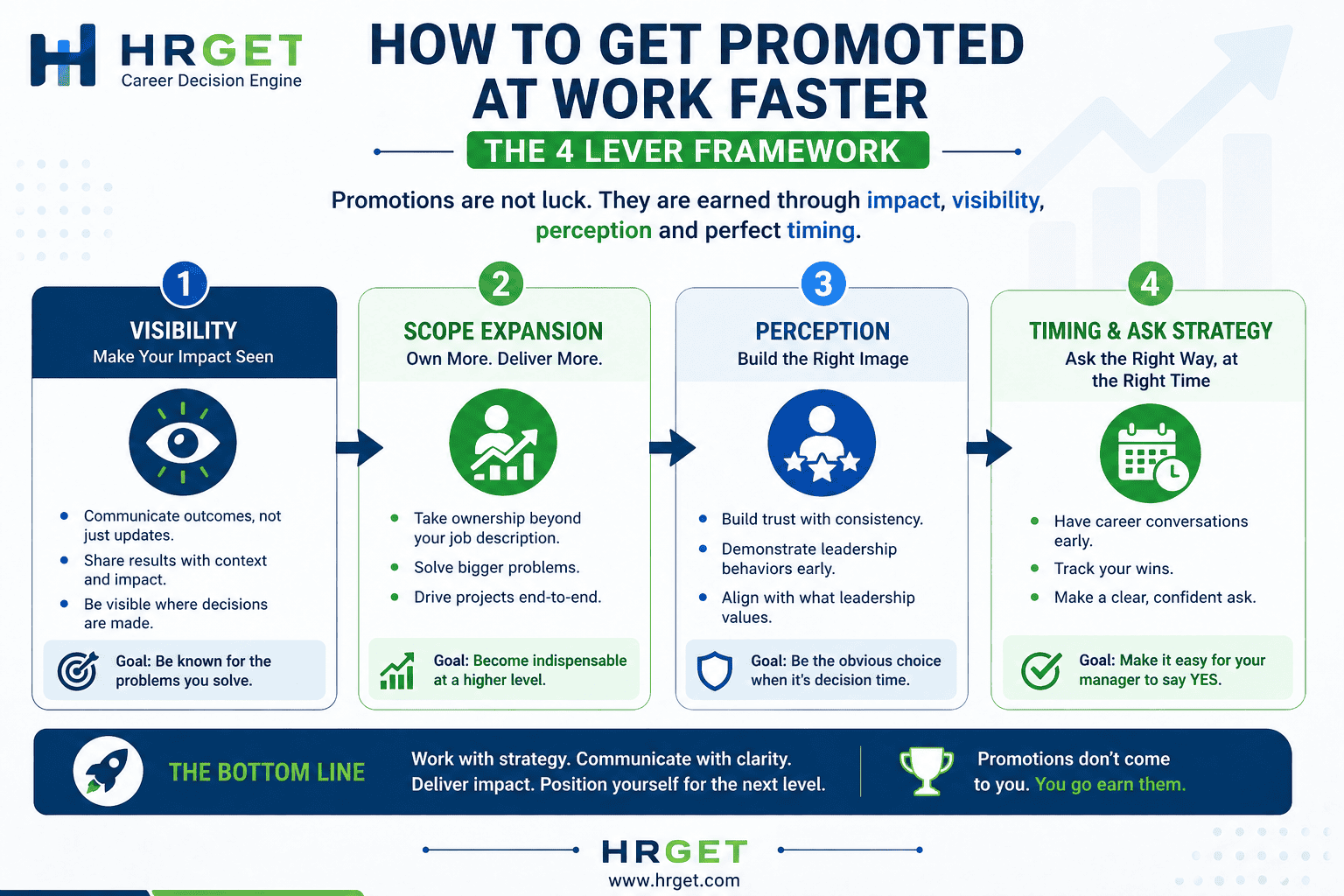
Every professional I’ve coached who moved fast — from IC to manager, manager to director, or director to VP — did so by pulling four levers in concert. Let me walk you through each one.
| Lever | What It Means | Most People’s Mistake |
|---|---|---|
| Visibility | Leadership knows your impact | Equating visibility with talking more |
| Scope | Owning bigger problems, not more tasks | Doing more work instead of better work |
| Perception | How leadership interprets your trajectory | Assuming work speaks for itself |
| Timing | When and how you initiate the ask | Waiting for annual review season |
Lever 1: Visibility That Drives Promotion Decisions
Visibility isn’t about talking more in meetings. I’ve seen plenty of loud, low-impact people get passed over year after year. Real visibility means decision-makers can articulate your value without you in the room.
Ask yourself two questions: Does your VP know the specific problems you solve? Could they describe your impact in one sentence? If the answer to either is “probably not” — you’re invisible, even if you’re delivering excellent work.
How to build real visibility — three moves that work
1. Translate effort into outcome language. Stop saying “I completed the migration project.” Start saying “I led the migration that cut processing time by 30% and unblocked three downstream teams.” Same work. Completely different signal. Managers promote narratives they can defend — give them the language.
2. Send strategic updates, not status reports. A bi-weekly message to your manager — three bullets covering results, risks, and next moves — keeps you top of mind without being annoying. This habit alone has accelerated more promotions than any single performance review I’ve witnessed.
3. Solve problems publicly, not just privately. When you flag a risk in a cross-team meeting, propose a solution in a leadership review, or write a post-mortem that gets circulated — you’re building visibility capital. Speak when it adds value. Not to fill airtime.
Insider view: Managers don’t promote based on effort. They promote based on narratives they can confidently defend to their own leadership. Your job is to make that narrative effortless for them.
Lever 2: Scope Expansion — Own Problems, Not Just Tasks
Working harder is not the same as being promotion-ready. I’ve seen this trap claim brilliant people for years. They’re putting in 60-hour weeks, delivering everything asked of them, and wondering why a peer with 50-hour weeks gets promoted first. The answer is almost always scope.
The mental shift that changes everything: stop asking “what tasks can I complete?” and start asking “what problems can I own end-to-end?” These are not the same question.
| Performance Level | Typical Behavior | What Leadership Sees |
|---|---|---|
| Average | Completes assigned work on time | Reliable. Replaceable. |
| Strong | Improves existing processes proactively | Valuable. Possible promotion candidate. |
| Promotion-Ready | Owns critical problems end-to-end, drives cross-team outcomes | Already operating at the next level. |
How to expand your scope without burning out
Identify the gaps nobody owns. Every team has broken processes, unclear accountability zones, or cross-functional friction points. These aren’t just problems — they’re your runway. A data analyst who quietly fixes a reporting gap that’s been frustrating sales for six months has just done something a director would recognize.
Volunteer for high-visibility problems, not random work. The distinction matters enormously. Taking on more low-stakes tasks just makes you busier. Taking on one high-stakes problem that’s visible to senior leadership moves you forward. Be strategic about what you raise your hand for.
Drive outcomes independently. If your manager still needs to check your work constantly, coordinate on your behalf, or make key decisions you could be making — you’re not signaling readiness. The less dependency you need, the more promotion-ready you look. This is especially true in India, where tech companies in Bangalore, Hyderabad, and Pune consistently promote people who can own global scope without hand-holding.
The rule of thumb: If your manager still needs to “manage” you heavily — explain, escalate, or shield you — you’re not yet operating at the level above. That’s not a criticism. It’s just honest feedback on where to focus next.
Lever 3: Perception Management — The One Most Smart People Skip
This is where the most technically gifted professionals consistently trip. They believe — honestly and understandably — that their work speaks for itself. It doesn’t. Not in a company of 200 people. Not in a company of 2,000.
Leadership doesn’t see everything you do. They see summaries, signals, reputation, and who shows up in key moments. Promotion decisions are filtered through perception — even at companies that pride themselves on being data-driven. This isn’t cynicism. It’s just how organizations process information at scale.
Performance ≠ Perception. You need both. And perception is the one you can shape.
Three ways to build the right perception at work
Become known for one specific thing. “The person who fixes production fires under pressure.” “The person who gets cross-team alignment done when everyone else has given up.” A clear identity inside your organization is worth more than a long list of competencies on a performance review. Pick your lane. Own it visibly.
Show leadership behaviors before you have the title. Volunteer to run a meeting. Write the team strategy doc. Mentor a junior colleague. These aren’t extras — they’re data points leadership uses to evaluate readiness. If you wait until you have the title to act like a leader, you’ve got the causality backwards.
Have an explicit conversation about promotion criteria. Don’t guess. Ask your manager: “What would promotion to [next level] look like for someone in my role? What gaps do you see in me right now?” This conversation is uncomfortable for many people — especially those from cultures where direct asks feel presumptuous. But it’s the only way to align your effort with what actually moves the needle.
Quick test: If leadership had to put someone forward for promotion today, would your name come up naturally — or would someone need to advocate specifically for you? If the honest answer is the latter, you have a perception gap. Close it before your next review cycle.
Lever 4: Timing and Ask Strategy — Stop Waiting, Start Driving
Even strong performers with excellent visibility and real scope can delay their own promotion by mishandling the timing and framing of the ask. I’ve seen this more times than I can count — someone who’s clearly ready, but either waits too long or signals their intent so vaguely that management doesn’t prioritize it.
Look — managers are busy. They’re managing their own performance, their team’s headcount, and their budget. Promoting you is not their top priority unless you make it one. That’s not a flaw in the system. It’s just reality.
How to ask for a promotion — the conversation that actually works
Pre-align early — don’t ambush. Raise the topic 3–6 months before you want the promotion to happen. A simple, direct statement works: “I want to target promotion in the next cycle. What gaps should I close to make that realistic?” This gives your manager time to plan, advocate, and prepare the business case on your behalf.
Track and share your progress visibly. Document your achievements — not just for the annual review, but in real-time. After every major milestone, a quick note to your manager keeps the record current and prevents your contributions from being forgotten when calibration season hits.
Make a clear, direct ask when the time is right. “Based on the progress we discussed over the past quarter, do you see me ready for promotion? If not, what’s still missing?” This is not aggressive. This is professional. And it forces a concrete answer instead of the vague encouragement that keeps people stuck for years.
Real Scenario: Same Skills, Completely Different Outcomes
Let me describe two people I worked with at a mid-sized tech company. Both were senior engineers, both technically strong, both had positive performance reviews for two consecutive years.
Priya delivered everything asked of her. Meticulous work. Rarely missed a deadline. Stayed in her lane, kept her head down, and assumed her output would speak for itself. She was well-liked. She was also still a Senior Engineer after three years.
Marcus owned the on-call escalation process that had frustrated the team for months. He documented the fix, presented it to the VP of Engineering, and got three teams to adopt it. He started sending bi-weekly updates to his skip-level manager. He had a direct conversation with his manager nine months before review season. He was promoted to Staff Engineer in the next cycle.
Was Marcus smarter? No. Was he a better engineer? Arguably not. But he understood the system. He optimized for all four levers — not just the performance lever that everyone defaults to.
Smart Strategy: The 90-Day Promotion Plan
If you want to get promoted faster, you need structure — not just intent. Run your promotion effort like a project, with milestones and accountability. Here’s the 90-day plan I recommend to the leaders I coach.
Days 1–30: Diagnose and align. Have an explicit conversation with your manager about promotion criteria. Ask what gaps you need to close. Identify the one or two high-impact initiatives that are most visible to senior leadership. Resist the temptation to take on six things — go deep on two.
Days 31–60: Execute and expand. Own your chosen initiatives end-to-end. Start sending strategic updates. Look for scope expansion opportunities — a broken process, a team coordination gap, something that’s been on the backlog forever. Share measurable impact as it accumulates, not just at review time.
Days 61–90: Position and ask. Build your promotion case — a concise summary of what you’ve owned, what changed because of it, and how you’re already operating at the next level. Revisit the conversation with your manager. Make the ask explicitly. At this point, you’re not asking for a favor. You’re presenting evidence and seeking confirmation.
The key insight: Don’t wait for annual review season to think about promotion. Run promotion cycles like product sprints — 90 days, focused, with clear deliverables and checkpoints. This is how fast-movers in 2026 actually operate.
Common Mistakes That Kill Promotion Chances
These aren’t rare mistakes. They’re the default — and I say that without judgment, because nobody teaches this stuff formally.
Waiting silently. No visibility, no promotion. Full stop. If leadership can’t see your impact, it doesn’t matter how real it is.
Overworking without strategy. Effort signals commitment. Impact signals readiness. They’re different things, and only one of them drives promotion decisions.
Playing it safe. Sticking to comfortable, low-risk work keeps you out of trouble but also keeps you invisible. Difficult, high-stakes problems are where promotion narratives are built.
Ignoring manager alignment. Even if you’re doing the right things, misalignment with your manager’s priorities means you’re optimizing for the wrong outcomes. Misalignment doesn’t just slow you down — it can actively work against you in calibration.
Being “reliable but invisible.” This is the most dangerous trap of all, because it feels like success. You’re performing well. You’re meeting expectations. But meeting expectations is, by definition, not exceeding them — and exceeding is what promotion requires.
Pro Tips From Someone Who’s Sat in the Calibration Room
A few things I’ve learned from being on the other side of promotion decisions that most career articles won’t tell you:
Promotions are budget decisions first, merit decisions second. Your manager may want to promote you but face a headcount constraint or a compensation band ceiling. Understanding this means you can ask better questions — “Is there a budget constraint I should know about?” — and respond strategically rather than feeling blindsided.
Your manager’s credibility is on the line when they advocate for you. If they push for your promotion and it doesn’t pan out — or if you underperform after it — they wear that. Make their advocacy easy: give them clear evidence, specific examples, and a compelling case they can repeat verbatim.
Internal branding matters more than most people admit. In calibration rooms, people are described by their reputation, not their job description. “She’s the one who turned around the APAC rollout.” “He’s the go-to for anything touching the data pipeline.” These identities — built over months — carry enormous weight when names are being discussed.
The professionals who get promoted fastest are usually the ones who make promotion a professional project, not a personal hope. They set goals. They track progress. They ask for feedback. They adjust. They treat it as a skill to develop — because it is.
FAQ: How to Get Promoted at Work Faster
How long should I stay in a role before expecting a promotion?
The typical baseline is 12–24 months in most corporate environments. But high performers who actively work the four levers above — visibility, scope, perception, and timing — can realistically compress that to 9–12 months. The timeline is less about tenure and more about demonstrated readiness at the next level. If you’re already operating above your current grade, document it and start the conversation sooner.
Should I directly ask my manager for a promotion?
Yes — and the sooner you stop hinting indirectly, the faster things move. Indirect signals (“I’ve been here two years now…”) are easy to misread or ignore. A direct, professional conversation — “I want to target promotion in the next cycle; what do I need to demonstrate?” — creates accountability, aligns expectations, and gives your manager a concrete reason to advocate for you with their own leadership.
What if my manager is actively blocking my promotion?
You have three realistic options: escalate tactically by building visibility with skip-level managers; transfer to a different team where your contribution will be evaluated fresh; or leave for a role at another company where you’re hired into the next level. Often, an external jump delivers a 15–25% salary increase alongside the title change. If your manager is a genuine blocker — not just slow — staying put indefinitely rarely changes the outcome.
Is switching companies a faster path to promotion?
Often, yes. External hires are typically brought in at the level they interview for — meaning you can skip a step that would take 18 months internally. Research consistently shows that people who change companies every 3–4 years grow their compensation and title faster than those who stay in the same organization for 8–10 years. That said, internal promotions build institutional knowledge and relationships that external moves don’t replicate easily.
Can introverts still get promoted quickly?
Absolutely — but they need to compensate for natural silence with structured, intentional visibility. Written updates, well-prepared presentations, and concise stakeholder communications are tools that work just as well as verbal charisma. Some of the fastest-promoted leaders I’ve coached were introverts who became exceptionally deliberate about when and how they made their impact visible. Introversion is not a liability. Invisibility is.
What matters more for promotion — skills or visibility?
Skills get you qualified for promotion. Visibility gets you selected. You need a threshold level of both — but the bottleneck is almost always visibility, not skills. Most people who are passed over are not insufficiently skilled. They haven’t made their skill and impact legible to the people making the decision. Fix visibility before assuming you need more credentials or certifications.
How important is internal networking for getting promoted?
Critical — and often underestimated. Promotions in most organizations are rarely isolated decisions made by one person. Cross-functional peers, skip-level managers, and project stakeholders all contribute to the informal reputation that feeds calibration panels. A strong advocate outside your direct team — someone who can say “I’ve worked with this person and they perform at the next level” — carries significant weight in a room you’re not in.
Stop Waiting. Start Moving.
Getting promoted at work faster is not about working longer hours or collecting compliments. It’s about understanding — and actively working — the system that governs promotion decisions. Visibility, scope, perception, and timing. Four levers. All within your control.
If you apply even 50% of this framework consistently over the next 90 days, you’ll be ahead of the vast majority of your peers — because most of them are still hoping someone notices. You’ll be doing the work of making yourself impossible to overlook.
Once you’re in promotion conversations, the next battle is compensation. Read our guide on how to negotiate your salary after a promotion to make sure the title change comes with the pay increase you’ve earned.

Jonathan Reed: Executive Career Strategist & Leadership Advisor | Former Partner, McKinsey & Company | Executive Coach to Amazon & Unilever Leaders | 18+ Years in Career Strategy
Jonathan Reed spent nearly two decades as a Partner at McKinsey & Company, where he advised organisations on leadership development, talent strategy, and organisational design across the US, UK, and Asia. Since leaving consulting, he has worked as an executive coach to senior leaders at Amazon, Unilever, and a clutch of high-growth scale-ups — helping them navigate promotions, career pivots, and the unwritten rules of visibility and influence at the top. Based between London and New York, Jonathan writes for HRGet.com to give working professionals an honest look at how careers actually scale — and why so many talented people stall without ever knowing why.