I’ve sat across the table from hundreds of professionals — engineers, product managers, finance leads — who had stock options sitting in their grant agreement and genuinely had no idea what they were holding. Some left six-figure gains on the table because they didn’t understand vesting. Others exercised at exactly the wrong time and got hit with a tax bill they weren’t prepared for.
Employee stock options are one of the most powerful — and most misunderstood — parts of modern compensation. Get them right, and you could add hundreds of thousands of dollars (or crores in INR, for my readers in India’s tech hubs) to your long-term wealth. Get them wrong, and you could lose real money while thinking you were getting a great deal.
This guide cuts through the jargon. By the end, you’ll know exactly what kind of options you have, how vesting actually works, where the tax landmines are, and — most importantly — how to make a smart decision about them.
What Are Employee Stock Options?
An employee stock option is exactly what it sounds like: an option — not an obligation — to buy shares in your company at a fixed price, called the strike price (also called the exercise price). That price is set on the day the option is granted, typically at the fair market value of the stock at that time.
Here’s why that matters. Let’s say your company grants you options with a strike price of $10 per share. Three years later, the stock is trading at $50. You can still buy at $10 — and immediately have $40 of value per share. That $40 difference is called the spread, and it’s your gain.
With 1,000 options, that’s a $40,000 potential gain. With 10,000 options at a fast-growing startup, do the math yourself — the numbers can get serious quickly.
But two things stand between you and that money: vesting and taxes. We’ll get to both in detail. First, let’s settle the ISO vs NSO question, because it shapes everything else.
ISOs vs NSOs: The Real Difference for Your Wallet
Most articles gloss over this distinction. That’s a mistake. The type of option you hold determines your entire tax strategy — and the wrong move can cost you tens of thousands of dollars.
Incentive Stock Options (ISOs)
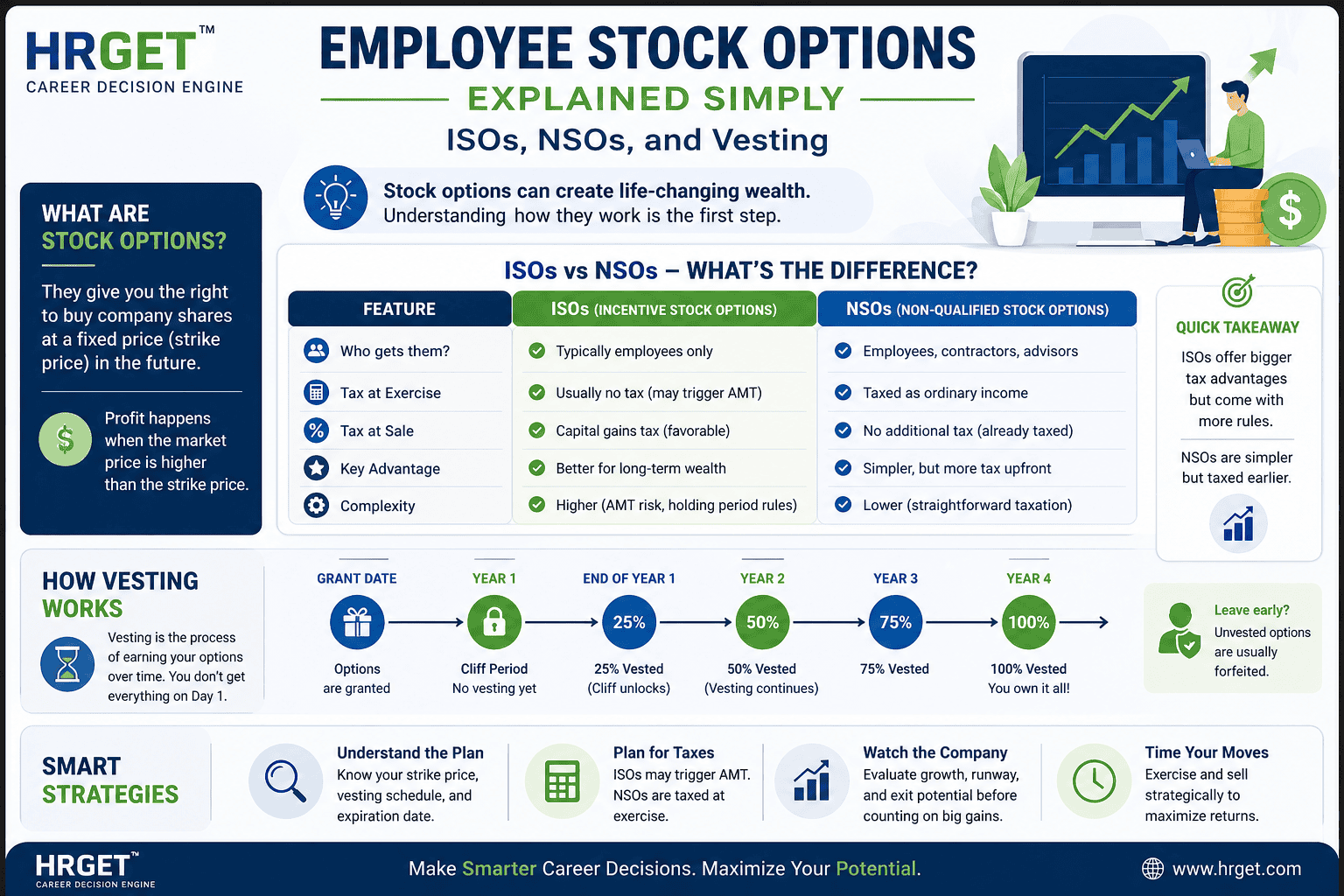
ISOs are reserved for W-2 employees only — contractors and advisors don’t qualify under IRS rules. The key advantage: when you exercise ISOs, you don’t owe regular income tax at that moment. The tax clock starts ticking only when you sell the shares.
If you hold the shares for at least two years from the grant date and one year from the exercise date, your gains qualify as long-term capital gains — taxed at 0%, 15%, or 20% depending on your income bracket. Compare that to ordinary income tax rates of up to 37% in the US, and you can see why ISOs are considered the premium option type.
There’s a catch, though — and it trips up a lot of people. Exercising ISOs can trigger the Alternative Minimum Tax (AMT). The spread between your strike price and the fair market value at exercise is an AMT preference item. This means you could owe tax on paper gains even if you haven’t sold a single share. I’ve seen engineers at pre-IPO companies exercise their ISOs at peak valuations, watch the stock drop, and still owe the IRS a six-figure AMT bill. That’s not a hypothetical — it happened widely after the 2000 dot-com crash and again after several 2021-era SPAC flameouts.
Non-Qualified Stock Options (NSOs)
NSOs are simpler and more broadly issued — employees, contractors, board members, and advisors can all receive them. The downside: you pay ordinary income tax on the spread at the moment of exercise, regardless of whether you sell.
If your strike price is $5 and the stock is worth $40 at exercise, you’re taxed on $35 per share as if it were salary. For someone exercising 5,000 shares, that’s $175,000 of taxable income added to your W-2 for that year — which could push you into a higher bracket and create a tax event larger than your annual salary.
NSOs are not better or worse than ISOs — they’re just different tools with different levers. NSOs are actually cleaner to plan around because the tax happens immediately and the math is predictable. The complexity with ISOs comes from having to think two or three moves ahead.
| Feature | ISOs | NSOs |
|---|---|---|
| Who qualifies | Employees only | Employees, contractors, advisors |
| Tax at exercise | No (but AMT may apply) | Yes — ordinary income tax |
| Long-term capital gains eligible | Yes (with holding requirements) | Partial — only post-exercise appreciation |
| Tax planning complexity | High | Low to moderate |
| Risk of surprise tax bill | High (AMT exposure) | Low (tax is known at exercise) |
How Vesting Actually Works — And Why It Changes Your Career Decisions
Here’s the thing people forget when they’re excited about an offer: you don’t own all those options on Day 1. Vesting is a schedule that determines when you actually earn the right to exercise each portion of your grant.
The most common structure in US tech companies — and increasingly in Indian startups — is a 4-year vesting schedule with a 1-year cliff. Here’s what that means in practice:
- Year 1 (the cliff): You vest nothing until your one-year anniversary. On that date, 25% of your total grant vests all at once.
- Years 2–4: The remaining 75% vests monthly or quarterly in equal installments over the following three years.
So if you were granted 4,000 options on January 1, 2024, here’s your actual timeline:
- January 1, 2025: 1,000 options vest (the cliff)
- February 1, 2025 onward: ~83 options vest per month for 36 months
- January 1, 2028: Fully vested — all 4,000 options yours to exercise
Leave before the cliff — say, at month 11 — and you walk away with zero. That’s why job offers with “equity” need to be evaluated carefully alongside your realistic intention to stay. Vesting isn’t just an HR formality; it’s a retention mechanism with real financial teeth.
Some companies, particularly in growth stages, offer performance-based vesting — where a portion of your grant vests only if the company hits revenue or valuation milestones. Read those terms carefully. “We’ll grant you 20,000 options” sounds great until you realize 10,000 of them are tied to a Series C that never closes.
Real Scenario: What a Stock Option Package Actually Looks Like
Let me walk you through a realistic situation — the kind I’ve advised professionals through many times.
The offer: A Series B startup offers a senior product manager 8,000 ISOs at a strike price of $3.50, on a 4-year vest with 1-year cliff. The company’s most recent 409A valuation (the IRS-compliant fair market value assessment for private companies) pegged the stock at $3.50 — so the options are at-the-money on grant day.
Three years later: The company raises a Series D at a $400M valuation. Back-of-napkin math puts the implied stock price around $18 per share. Our product manager has now vested 75% of their grant — 6,000 options. The spread is $14.50 per share.
The math: 6,000 × $14.50 = $87,000 in potential pre-tax gains, assuming they can exercise and sell.
But — and this is the part no one talks about — the company is still private. There’s no market to sell those shares. To realize any of that $87,000, they need either an IPO, a secondary sale program, or an acquisition. If our product manager leaves at year three, they have a 90-day exercise window. Exercising all 6,000 ISOs would cost them $21,000 in cash (6,000 × $3.50 strike), and could trigger AMT on the full $87,000 spread. Without a liquidity event on the horizon, that’s $21,000+ out of pocket with no guaranteed return date.
This is not a horror story — it’s just the reality of private company equity. The upside is real. So is the illiquidity risk. Know what you’re actually holding before you make career decisions based on paper wealth.
Taxes on Stock Options: Where Most People Lose Real Money
I’ll be direct here: stock option taxation is where I’ve seen smart, well-paid professionals make their worst financial decisions. Not because they’re careless — because the rules are genuinely counterintuitive.
The AMT Trap for ISO Holders
The Alternative Minimum Tax exists as a parallel tax system designed to ensure high earners pay a minimum level of tax. When you exercise ISOs, the spread — even though it’s not regular taxable income — is counted as an AMT preference item under IRC Section 56.
The dangerous scenario plays out like this: you exercise a large ISO tranche in a year when the stock price is high. You intend to hold for the long-term capital gains treatment. Then the company’s valuation drops — or worse, the company implodes. You now own shares worth a fraction of what you paid tax on, and the IRS still wants its AMT payment based on the valuation at exercise. You can carry forward an AMT credit to offset future tax, but that helps little if your stock is underwater and you needed that cash for living expenses.
One way to reduce AMT exposure: exercise ISOs earlier in the year, while the stock’s 409A valuation is still low — ideally right after a new valuation is set following a funding round. This is called an early exercise strategy, and some companies allow it. Pair that with an 83(b) election filed within 30 days, and you can lock in your cost basis at grant-date value. A CPA who specializes in equity compensation (not your general accountant — find someone who specifically works with startup employees) can model this out for your situation.
NSO Tax: Know Your Number Before You Click Exercise
NSO taxation is blunter but more predictable. At exercise, your employer withholds payroll taxes on the spread — typically Federal income tax, Social Security (up to the wage base), Medicare, and state income tax where applicable. The spread is reported on your W-2 as additional wages.
For a senior engineer in California exercising NSOs with a large spread, the combined marginal rate can hit 50%+ (37% federal + 13.3% California state). Exercise $200,000 of NSO spread and you might net $100,000 after taxes. That’s still good — but it’s not $200,000. Build that expectation into your planning before you exercise, not after.
For readers in India: ESOPs (the local equivalent of stock options) are taxed differently. At exercise, the spread is treated as a perquisite — taxed as salary income at your applicable slab rate (up to 30% + surcharge + cess). When you sell the shares, any further gain is treated as capital gains — STCG at 15% if held under a year, LTCG at 10% (above ₹1 lakh) if held longer. Budget 2024 changes tightened these rules; verify with a CA before exercising.
Smart Strategy: How to Actually Maximize Your Stock Options
Most articles stop at “understand your options.” That’s not enough. Here’s what you actually do with that knowledge.
Step 1: Evaluate Equity Realistically in Job Offers
When you’re comparing offers, don’t let equity numbers dazzle you into accepting a lower base salary. The right mental model: treat equity in a Series A or earlier startup as a lottery ticket — real potential, but not money you can spend. Only when a company has a clear path to liquidity (imminent IPO, acquisition interest, secondary markets) should equity weigh heavily against guaranteed cash compensation.
A good benchmark for evaluating equity: ask the recruiter for the company’s fully diluted share count. Divide your grant by that number to get your ownership percentage. Then apply a realistic exit valuation. If the company tells you they’re valued at $100M and projects a $500M exit, your 0.1% stake is theoretically worth $500K at exit — before dilution from future fundraising rounds, which almost always shrink early employees’ percentages.
Step 2: Time Your Exercise Strategically
For ISOs, the best time to exercise is often early — when the 409A valuation is low and the spread is small or zero. This minimizes both your cash outlay and AMT exposure. If you’re joining a company shortly after a funding round, ask HR what the current 409A valuation is. If it matches your strike price, early exercise with an 83(b) election could be a powerful move.
For NSOs, spread your exercises across multiple tax years when possible. Exercising all your NSOs in a single year can stack all the income in one tax year, potentially pushing you into higher brackets unnecessarily. If you have flexibility, exercise a portion in Q4 of one year and the rest in Q1 of the next — you spread the tax impact across two returns.
Step 3: Know Your Post-Termination Exercise Window
This is the most commonly missed detail. The standard post-termination exercise window for stock options — especially ISOs — is 90 days from your last day of employment. Miss that window and your options expire worthless, regardless of how much they’re worth.
Some companies — particularly more employee-friendly startups — have extended this to 2, 5, or even 10 years. Carta and similar equity management platforms have pushed for this as a standard. When evaluating an offer or considering leaving a company, always confirm your exercise window in writing. Ask HR specifically: “What is my post-termination exercise window, and is it different for ISOs vs NSOs?” Get it in the grant agreement, not just a verbal assurance.
5 Common Mistakes Employees Make With Stock Options
I’ve watched all of these happen. Some are recoverable. Some aren’t.
Mistake 1: Counting unvested options as part of your net worth. Until options vest and you’ve exercised them, they’re potential — not assets. I’ve met professionals who made home-buying decisions based on unvested equity. That’s financially dangerous, particularly at early-stage companies.
Mistake 2: Quitting before the cliff. Leaving at month 10 of a 12-month cliff costs you 100% of your grant to date. If you’re planning to leave, do the math. Sometimes staying two more months is worth $30,000 in vested options.
Mistake 3: Missing the 90-day exercise window. After leaving a company, the clock starts immediately. People get distracted with job searches and forget. Set a calendar alert the day you leave: “Exercise options deadline.” Then figure out whether it’s worth exercising — but at least make the decision consciously.
Mistake 4: Exercising without a tax plan. Never exercise a significant option grant without first modeling the tax impact. Run the numbers, ideally with a CPA. For ISOs specifically, know your AMT exposure before you click confirm.
Mistake 5: Accepting “big equity” in exchange for a below-market salary at a company with no liquidity path. If the company has no clear route to an IPO or acquisition, you may be working for cash you’ll never see. Equity without a liquidity event is just a number on paper.
When Stock Options Are Actually Worth the Risk
Not all equity packages are created equal. Here’s a practical framework for evaluating whether yours is worth betting on.
Higher probability of real value: Company has raised Series B or later from credible VCs. Revenue is growing at 2x+ year-over-year. Leadership has successfully exited companies before. There’s an active M&A market in the sector or IPO conversations are underway. Your strike price is a meaningful discount to the current 409A valuation (i.e., you have in-the-money options from day one).
Lower probability of real value: Pre-seed or seed stage with no revenue. Large equity grant offered to compensate for a salary that’s 30%+ below market. Multiple co-founder departures. Industry is contracting. The company keeps pushing back its “we’re planning to IPO soon” timeline year after year.
Look, some of the biggest fortunes from startup equity came from situations that looked risky — early Google employees, early Amazon warehouse managers, early Infosys engineers who held their ESOPs through the volatility. But those were exceptions. The base rate for early-stage startup equity paying out meaningfully is low. Build your career and financial plan on salary, and let equity be the upside — not the plan.
FAQ: Employee Stock Options
What happens to my stock options if I leave the company?
Unvested options are forfeited immediately upon resignation or termination. Vested options typically must be exercised within 90 days of your last day — this is the standard post-termination exercise window, though some companies offer extended windows of 2–10 years. Check your grant agreement for the specific terms. If you miss the window, the options expire regardless of their value.
Can employee stock options become completely worthless?
Yes, in three scenarios: the company fails and closes, the stock price stays permanently below your strike price making exercise irrational (these are called “underwater” options), or you fail to exercise before the expiration date. Private company options carry additional illiquidity risk — even if the company is doing well, you can’t sell shares without a formal liquidity event like an IPO or acquisition.
Should I exercise my stock options immediately after they vest?
Not necessarily. For ISOs, exercising early (even before vesting, if your plan allows) can reduce AMT exposure and start the holding period clock for long-term capital gains treatment. For NSOs, there’s rarely a tax advantage to exercising early — you’ll owe income tax on the spread whenever you exercise. The key factors are your tax situation, the company’s liquidity outlook, and whether you have cash to fund the exercise without financial strain.
What is a good employee stock option package for a senior role?
For a senior individual contributor (L5–L6 equivalent) at a Series B US startup, a typical range is 0.05%–0.25% of fully diluted shares. For Director or VP-level roles, 0.1%–0.5% is more common. The raw number of options matters less than the ownership percentage and the implied value at a realistic exit. Always ask for fully diluted share count alongside your grant to calculate your actual stake.
Are ISOs always better than NSOs for employees?
ISOs offer better tax treatment in the ideal scenario — long-term capital gains rates instead of ordinary income. But they come with AMT risk that can create unexpected tax liabilities even on paper gains. NSOs are simpler to plan around because the tax event is predictable. For many employees at pre-IPO companies, the AMT risk on ISOs deserves serious modeling before assuming they’re the better choice.
How do I calculate the real value of my stock options?
For private companies: take the most recent 409A valuation (or implied share price from the last funding round), subtract your strike price to get the spread, multiply by your vested shares. Then apply a liquidity discount — most equity advisors recommend discounting private company option value by 50–80% to account for illiquidity, dilution risk, and exit uncertainty. For public company options, use the current market price directly.
What is an 83(b) election and should I file one?
An 83(b) election is a tax filing you can make within 30 days of an early exercise — buying shares before they’ve fully vested. By filing, you elect to pay tax now based on the current (low) value rather than later when the shares may be worth much more. It’s a powerful strategy for ISO holders who exercise early at a low 409A valuation. The 30-day deadline is absolute — missing it is a permanent, uncorrectable mistake.
Making Smart Decisions With Your Employee Stock Options
Here’s what I want you to walk away with: employee stock options are not a bonus. They’re a financial instrument with a specific structure, a specific tax profile, and a specific set of decisions attached to them. Treating them casually — or ignoring them because they feel complicated — is how people leave real money on the table.
Know whether you hold ISOs or NSOs. Track your vesting schedule like it’s a bank account. Understand the tax event that exercise triggers — and plan for it with a CPA who specializes in equity. Don’t quit before the cliff without doing the math. And never let equity paper over a below-market salary at a company without a credible path to liquidity.
The 10% of stock option holders who actually build meaningful wealth from equity aren’t lucky — they’re informed. This guide gives you the framework. The rest is execution.
Evaluating a full compensation package, not just the equity piece? Read our guide on how to evaluate a job offer — total comp, equity, and what most people overlook.

Eleanor Whitmore | Former Partner, Mercer | Advisor, World Economic Forum | 20+ Years in Global Compensation
Author bio: Eleanor Whitmore has spent over two decades shaping how the world’s leading organisations pay, retain, and reward talent. As a former Partner at Mercer and an advisor to World Economic Forum working groups on the Future of Work, she has designed compensation frameworks for Fortune 500 companies across the US, UK, Europe, and emerging markets. Based between London and New York, Eleanor writes for HRGet.com to translate boardroom-level pay strategy into actionable guidance for working professionals navigating real compensation decisions.