
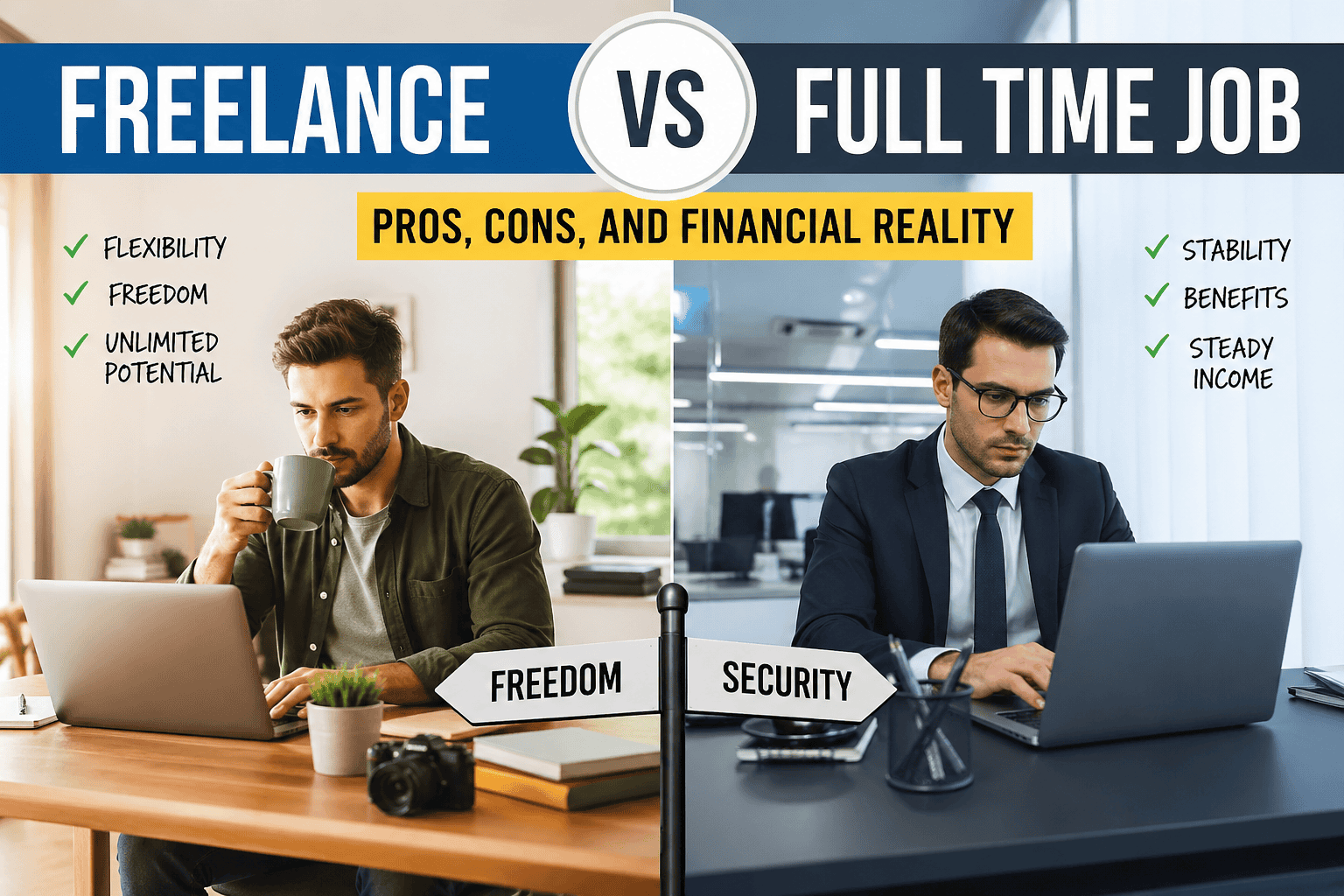
Every year, I talk to professionals who’ve made the freelance vs full time job switch — and gotten it completely wrong. Not because freelancing is bad or jobs are traps. But because they compared the two using the wrong numbers, at the wrong career stage, for the wrong reasons.
The truth? This decision isn’t about freedom versus stability. It’s about income model versus income potential, risk tolerance versus career compounding, and — most critically — what stage you’re actually at.
I’ve coached executives who left ₹80 LPA roles to freelance and built ₹2 crore businesses. I’ve also seen mid-level managers quit too early, burn through savings in eight months, and quietly slink back to job boards. The difference was almost never skill. It was strategy.
This guide gives you the financial breakdown, real scenarios, and a clear framework to make the right call — whether you’re in Mumbai, London, or Austin.
What “Freelance vs Full Time Job” Actually Means (Beyond the Obvious)
Before you can compare them, you need to understand what you’re actually comparing. Most people think the difference is employment paperwork. It’s not.
Freelancing is a revenue model where you are the business. You sell skills directly to clients — billed per project, per hour, or on retainer. You carry the sales, delivery, admin, and risk. You have no fixed employer, no guaranteed paycheck, and no career ladder handed to you.
A full-time job is an income model with structured constraints. You trade time and output for a fixed salary, benefits, and a defined growth path. The company absorbs your market risk in exchange for your compliance with their structure.
Here’s what most people miss: a job isn’t “safe” in the way we romanticise it anymore. In 2026, the average professional tenure at a single company sits under four years in the US and is declining rapidly in India’s tech sector too. Layoffs at companies like Intel, Google, and TCS over the past 18 months have proven that “permanent employment” is mostly a feeling, not a contract.
Freelancing, meanwhile, isn’t “risky” in the way people fear — not if you treat it like a business from day one. The real risk is going in without a financial cushion, without a client pipeline, and without a pricing strategy. That’s not freelancing being risky. That’s poor preparation.
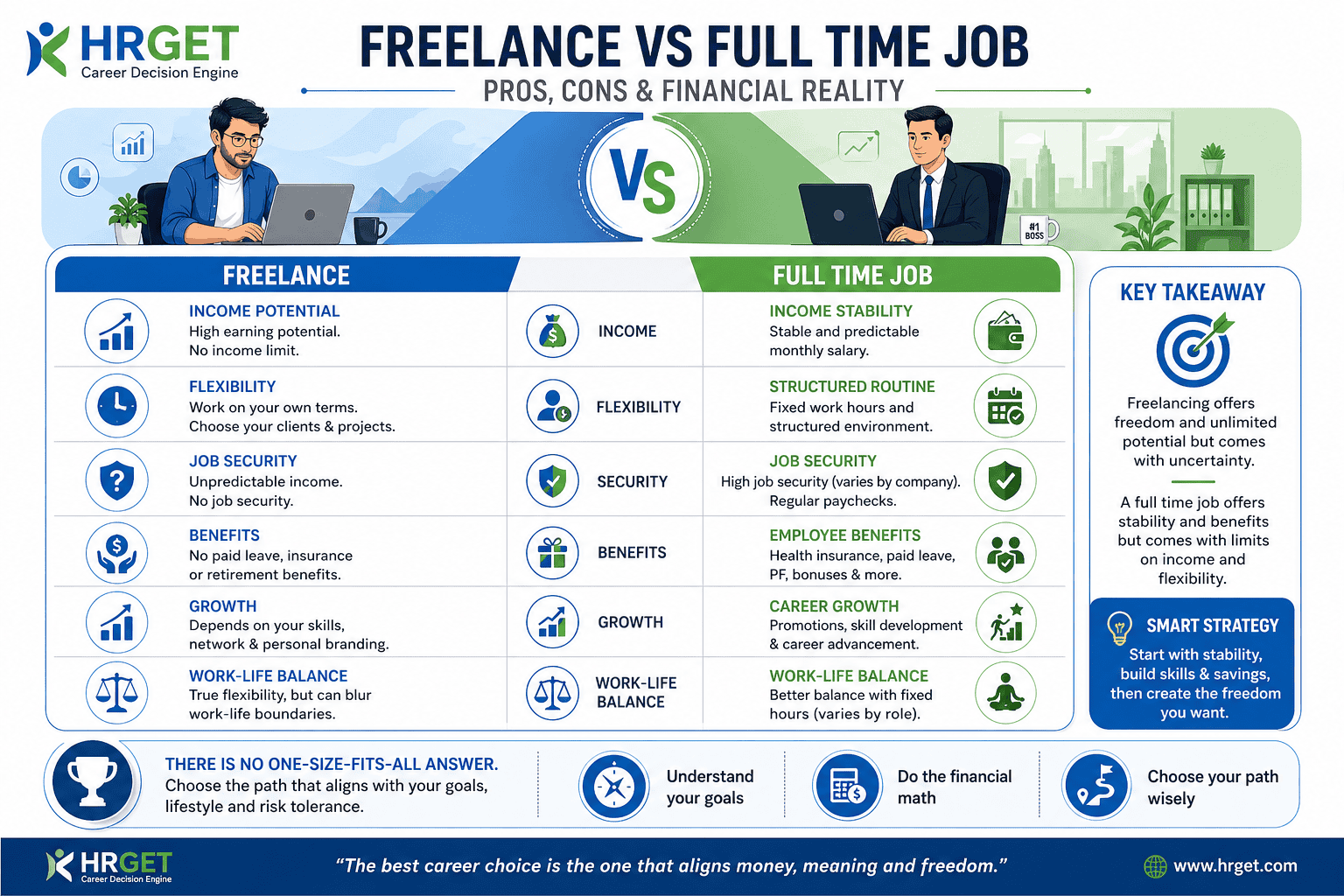
Freelance vs Full Time Job: Quick Comparison Table
Let’s get the overview on paper first, then go deeper on each dimension.
| Factor | Freelancing | Full-Time Job |
|---|---|---|
| Income Stability | Unpredictable month-to-month | Fixed & reliable |
| Income Ceiling | Uncapped (scales with clients/rates) | Capped by salary bands |
| Benefits | None — you fund everything | Insurance, PF/401(k), paid leave |
| Work Hours | Flexible but often longer initially | Fixed, with overtime expectations |
| Career Growth | Self-directed — fast or stagnant | Structured path with benchmarks |
| Tax Complexity | Higher — GST, advance tax, deductions | Employer handles TDS/payroll tax |
| Long-Term Wealth | Higher upside if you scale beyond hours | Steady compounding via equity & bonuses |
The table tells the surface story. But the real decision lives in the numbers below.
The Financial Reality: What You Actually Take Home
This is where most people get genuinely misled — and it costs them years of bad decisions.
Scenario A — Full-time salary: ₹25 LPA in India (or $120K in the US). Sounds straightforward. But here’s what that actually looks like after taxes:
- India: After 30% income tax slab + 12% PF contribution → effective take-home is roughly ₹14–16L annually, or ₹1.15–1.35L/month
- US: After federal + state income tax (combined ~28–32%) → take-home is roughly $80–86K annually, or ~$6,700–$7,200/month
Now add the benefits you’re not paying for: health insurance worth $6,000–$18,000/year in the US, or group mediclaim + gratuity in India. Factor in paid leave (15–21 days), employer PF contributions, and sometimes ESOP grants. The true compensation package on a ₹25 LPA role in a mid-size Indian firm is closer to ₹29–31 LPA in total value.
Scenario B — Freelance income: ₹2L/month billed average (or $8,000–$10,000/month in the US). Looks better, right?
Here’s the part most articles skip. That ₹2L isn’t your take-home. Subtract:
- GST obligations (if turnover exceeds ₹20L) or self-employment tax in the US (15.3% on net earnings)
- Platform fees if using Upwork, Toptal, or similar (5–20%)
- Tools, software, internet, home office — easily ₹8,000–15,000/month
- Unpaid time: client calls, proposals, invoicing, accounting — roughly 15–20% of work hours
- Downtime months: even experienced freelancers face 1–2 slow months annually
After real adjustments, you’re working with 60–70% of billed income at best. That ₹2L/month becomes ₹1.2–1.4L net. Which is — you guessed it — roughly equivalent to the full-time job.
I’ll be direct: freelancers chronically overestimate their effective income by 25–35%, especially in the first two years. That gap is what causes the “I thought this would be more lucrative” moment around month 14.
💡 The Real Comparison Rule: Never compare gross freelance billing to gross salary. Compare net adjusted freelance income (after tax, tools, downtime, unpaid admin) to total compensation (salary + benefits + equity). That’s the honest number.
Real Scenario: Same Skill, Two Very Different Outcomes
Let me give you a concrete example I see often — a mid-level software engineer with 5 years of experience and solid full-stack skills.
Path A — Full-time at a product company (Bengaluru):
- CTC: ₹32 LPA (base ₹26L + ₹4L variable + ₹2L mediclaim + ₹1.2L PF)
- Take-home: ~₹1.7L/month after TDS
- Work: ~9–10 hours/day, 5 days/week
- Year 3 bonus: ₹3–5L if performance is strong
- ESOP grant: 800 units vesting over 4 years (current value: ~₹8L)
Path B — Freelance (same engineer, primarily US clients via Toptal):
- Rate: $55–65/hour (realistic for 5 years experience)
- Billable hours: 100–120/month (after client gaps, admin, unpaid calls)
- Gross: ~$6,000–7,800/month
- After platform fee (10%), taxes (30%), tools (₹12K/month): net ~₹2.8–3.3L/month
- But: 2 slow months/year average → annualised net income: ~₹30–35L
So the freelancer actually earns more — slightly — in good conditions. But the full-timer has ESOP upside, a structured promotion path (Senior Engineer → Tech Lead in 18–24 months, pushing CTC to ₹55–65 LPA), and zero income anxiety.
Here’s the thing — in year five, the full-timer who got promoted twice and cashed out ESOPs may have built more wealth than the freelancer who stayed at the same rate. Career compounding is real, and it’s one of the most underestimated variables in this decision.
Pros of Freelancing That Actually Matter (Not the Instagram Version)
I’m not here to sell you on freelancing — but these advantages are real when the conditions are right.
Uncapped income potential. No salary band. No waiting for an annual review to approve a 12% hike. If you raise your rate from $60/hour to $90/hour and add one more client, your income jumps 50% in a quarter. That’s impossible in a traditional job structure. Senior content strategists in the US charging ₹5,000–8,000/hour (or $80–120/hour) to B2B SaaS companies routinely earn ₹80L–1.2 crore annually without managing a single employee.
Skill monetisation without politics. In a full-time job, you often have to wait — for budget, for headcount, for a manager to recognise your contribution. In freelancing, the market decides immediately. If your Python automation work saves a client $30,000 in annual labour costs, you can charge accordingly. There’s no HR band telling you what that work is “worth.”
Geographic arbitrage. This one is particularly powerful for India-based professionals. If you’re billing US or UK clients at international rates while living in Pune or Hyderabad, your purchasing power is dramatically higher than a local hire. A $60/hour rate from a US client translates to ~₹5,000/hour. Even at 80 billable hours/month, that’s ₹4L — several times what an equivalent Indian company would pay.
Portfolio diversification. Working with 4–6 clients simultaneously means no single employer can “lay you off.” Your risk is distributed. Compare that to a full-time role where one bad quarter — or one new management team — can erase your income overnight.
Cons of Freelancing Most People Ignore Until It’s Too Late
Look, the travel photos and laptop-on-beach lifestyle don’t show you what month six of a freelance dry spell feels like. Let me fill that gap.
Income volatility is psychologically brutal. You can earn ₹5L in March and ₹40,000 in April. Even experienced freelancers with strong pipelines face this. The mental toll of not knowing what next month looks like — especially when you have EMIs, rent, or dependents — is something most freelancing advocates severely understate.
The benefits gap is larger than you think. In the US, a decent health insurance plan for a family costs $1,200–$2,000/month on the open market. That’s $14,000–$24,000/year you’re paying out-of-pocket that your employed counterpart gets partially or fully subsidised. In India, group mediclaim, gratuity, and PF contributions from your employer can represent ₹3–5L in annual value. When you go freelance, you’re not just losing a salary — you’re absorbing all of that cost yourself.
Freelancing is a job disguised as a business — until you scale. This is the one I push back on most. If you’re trading your time for money as a solo freelancer, you haven’t escaped the employment model. You’ve just become a one-person employer with worse job security. True business leverage comes when you build systems: a team, productised services, or passive income streams. Most freelancers never get there — they stay in the time-for-money trap at a higher hourly rate.
Client concentration risk. I’ve seen freelancers generate 80% of their income from a single anchor client — only to have that contract cancelled in a restructuring. When that happens, they don’t have a “client” problem. They have a business model problem. Diversification is a discipline, and most solo freelancers neglect it when things are good.
Underrated Advantages of Full-Time Employment in 2026
Nobody talks about these anymore — and that’s a problem, because they’re genuinely valuable.
Career compounding is real wealth. A senior manager at a mid-size tech company with a ₹50 LPA package, strong performance ratings, and a vesting ESOP schedule can see their total wealth grow by ₹15–25L in a single good year — through promotions, variable payouts, and stock appreciation. That kind of compounding doesn’t happen linearly; it accelerates once you hit leadership levels. Freelancers who never build equity or seniority leave this compounding entirely on the table.
You learn faster inside the right organisation. Working inside a well-run company — with senior mentors, cross-functional teams, budget ownership, and business exposure — accelerates your strategic thinking in ways no freelance project can replicate. The first 7–10 years of a career are particularly valuable for this. I’ve watched consultants who freelanced straight out of college struggle with the same skills that their employed peers developed naturally by working inside complex organisations.
Brand equity transfers. Five years at McKinsey, Google, Goldman Sachs, or even a well-regarded Indian company like CRED, Zepto, or Zomato builds a credential that follows you for decades. That brand opens doors — to better clients if you eventually freelance, to board positions, to fundraising conversations. Most freelancers accumulate client logos but not the kind of institutional credibility that major employers provide.
Stability enables better personal financial decisions. A predictable paycheck means you can take a home loan at favourable rates, plan family milestones, and invest consistently. I’m not minimising this — financial predictability is a real quality-of-life advantage that people deeply undervalue until they don’t have it.
Career Growth Impact: Freelance vs Full-Time Over 10 Years
This is the long game — and it’s where the decision gets genuinely nuanced.
A full-time employee at a respected company compounds differently over a decade. They get promoted, they take on P&L ownership, they get exposed to strategy, hiring, and leadership — all of which command premium rates later whether they stay employed or eventually move into consulting or freelancing. The brand, the network, the title progression — these are career assets that appreciate over time.
A freelancer’s growth trajectory is entirely self-directed. The danger is that without deliberate effort, you end up doing the same kind of work at year 10 that you were doing at year 3 — just at a higher rate. Skill depth increases, but strategic breadth often doesn’t. And when you eventually want to step into leadership, advisory, or board-level work, the lack of organisational track record can be a real obstacle.
The freelancers I’ve seen build genuinely impressive 10-year careers are those who treated their first 5–7 years of employment as an investment — building domain expertise, leadership credibility, and a network — and then transitioned to high-value consulting or fractional executive work. That sequencing tends to dramatically outperform both “freelance from day one” and “employed forever” as strategies.
Smart Strategy: When to Choose Freelancing vs a Full-Time Job
Here’s my honest framework, built from watching hundreds of professionals navigate this decision.
Choose a full-time job if:
- You’re under 5 years into your career — the learning environment is irreplaceable
- You’re entering a new domain or industry — structured training accelerates the curve
- You have financial dependencies (loan EMI, family, children) that require predictable income
- You want leadership experience — you can’t become a people manager as a solo freelancer
- You’re at a company with meaningful ESOP potential — that upside is worth staying for
Choose freelancing if:
- You have 5+ years of deep, demonstrable expertise in a high-demand skill
- You’ve already built a pipeline of 2–3 clients willing to pay premium rates
- You have a financial buffer of at least 9–12 months of living expenses
- You’re willing to treat it as a business — with pricing strategy, pipeline management, and client diversification
- Your freelance income has already exceeded your salary by 1.5x for at least 3 consecutive months
The smartest approach (what I actually recommend):
Phase 1 — Keep your job. Start freelancing as a side engagement for 6–12 months. Use your employer’s stability to test the market without betting your livelihood on it. Many employment contracts allow this with disclosure — check your agreement.
Phase 2 — Validate before you leap. Only transition when freelance income is consistently 1.5–2x your salary for at least two consecutive quarters. Not “I had one great month.” Consistent.
Phase 3 — Scale deliberately. Once full-time freelancing, your goal within 12–18 months should be building leverage: a productised service, a small team, or retainer clients rather than hourly billing. That’s how you exit the time-for-money ceiling.
Common Mistakes That Wreck Both Paths
I’ll make this fast — each of these has cost people I know real money and real time.
1. Comparing gross numbers, not net reality. ₹3L/month freelance billing vs ₹25 LPA salary isn’t even close to an apples-to-apples comparison once you account for tax, benefits, tools, and downtime. Do the net calculation before you feel smug or disappointed about either number.
2. Quitting without a runway. You need at least 9–12 months of living expenses in liquid savings before transitioning to full-time freelancing. Not in FDs. Not “I’ll figure it out.” Cash accessible within 48 hours. This isn’t pessimism — it’s the discipline that separates successful freelance transitions from cautionary tales.
3. Underpricing to win clients early. The most expensive habit early-stage freelancers develop is competing on price. When you charge ₹500/hour for work that commands ₹3,000/hour in the market, you don’t attract budget-conscious premium clients — you attract difficult, demanding, low-value clients who still won’t refer you. Price for the value you deliver, not the fear you feel.
4. Ignoring the tax calendar. Freelancers in India need to file advance tax in four instalments annually (June, September, December, March). Many don’t, and end up with an unexpected ₹1–3L tax liability in March that wrecks their cash flow. In the US, quarterly estimated tax payments to the IRS are mandatory for self-employed professionals. Treat tax like a bill — set aside 25–30% of every payment the day it arrives.
5. Staying employed out of fear alone. Full-time employment has real advantages — but if you’re seven years into a role where you’re not growing, not building equity, and not learning anything new, “stability” isn’t the right word for what you have. Stagnation is its own kind of career risk. Sometimes the scarier choice is the more rational one.
Frequently Asked Questions
Is freelancing more profitable than a full-time job?
It can be — but only if you maintain consistent, premium-rate clients and manage your tax and overhead properly. Most freelancers don’t outperform their employed counterparts until year two or three, after they’ve built a reliable pipeline and priced their work correctly. Early on, the gap is often smaller than it looks.
Can I freelance while working a full-time job?
Yes, and this is the smartest transition path available. Review your employment contract first — most allow outside work with disclosure, but some include IP or non-compete clauses. Start with 1–2 clients in evenings or weekends to validate your market rate, build a portfolio, and test your capacity before making any permanent changes.
How much should I earn before quitting my job to freelance full-time?
Your freelance income should consistently be at least 1.5–2x your current salary for two consecutive quarters before you resign. Additionally, have 9–12 months of living expenses in accessible savings. Not one good month — consistent income across different clients. That combination is the minimum rational threshold for transition.
Which is better for long-term wealth: freelancing or a full-time job?
Full-time employment builds wealth steadily through compounding — promotions, ESOP vesting, and employer-matched retirement contributions. Freelancing creates higher income potential but requires you to self-fund retirement, insurance, and investment separately. The highest long-term wealth outcomes typically come from professionals who used employment to build skills and brand, then transitioned to high-value freelancing or consulting.
What skills are best suited for high-income freelancing in 2026?
In 2026, the highest-earning freelance verticals are AI/ML engineering, full-stack development (especially with cloud infrastructure skills), UX/product design, cybersecurity consulting, B2B content strategy, and performance marketing. Common to all: they’re specialised, outcome-oriented, and command rates that reward expertise over volume.
Is freelancing sustainable as a long-term career in India?
Yes — increasingly so. The shift toward remote work has opened up global client access from Tier 1 Indian cities at scale. But long-term sustainability requires building systems: retainer clients rather than one-off projects, a personal brand that attracts inbound work, and eventually productised offerings or a small team. Solo hourly work alone will always hit a ceiling.
Does a gap in full-time employment hurt your career if you were freelancing?
Not if you frame it correctly. “Freelancing” or “independent consulting” on a CV is not a gap — it’s a choice. The issue arises when professionals can’t demonstrate tangible outcomes from that period. If you have client names, measurable results, and a clear narrative for why you made the shift, most hiring managers in 2026 will view it as experience, not absence.
Final Verdict: Which Wins in 2026?
Neither — unconditionally. That’s the honest answer, and anyone telling you otherwise is selling something.
The freelance vs full time job debate is really a question of timing, risk tolerance, and career stage. If you’re earlier in your career, building skills, or have significant financial obligations — a well-chosen full-time role still offers compounding advantages that are genuinely hard to replicate solo. If you’re skilled, experienced, financially cushioned, and disciplined enough to run your freelance career like a business — the income and flexibility upside is real.
The smartest play? Use employment strategically to build the expertise, brand, and financial buffer that makes freelancing genuinely powerful — rather than jumping ship because you’re frustrated with your manager and scrolling too many #laptoplifestyle reels.
Make the freelance vs full time job decision based on your numbers, your career stage, and a clear plan — not on someone else’s highlight reel.
📖 Related Reading: If you’re weighing whether to take a lateral move instead of pushing for a promotion, this decision involves many of the same risk-reward trade-offs. Read our guide on Lateral Move vs Promotion: Which Career Path Builds Wealth Faster on HRGet.com.

Jonathan Reed: Executive Career Strategist & Leadership Advisor | Former Partner, McKinsey & Company | Executive Coach to Amazon & Unilever Leaders | 18+ Years in Career Strategy
Jonathan Reed spent nearly two decades as a Partner at McKinsey & Company, where he advised organisations on leadership development, talent strategy, and organisational design across the US, UK, and Asia. Since leaving consulting, he has worked as an executive coach to senior leaders at Amazon, Unilever, and a clutch of high-growth scale-ups — helping them navigate promotions, career pivots, and the unwritten rules of visibility and influence at the top. Based between London and New York, Jonathan writes for HRGet.com to give working professionals an honest look at how careers actually scale — and why so many talented people stall without ever knowing why.