

By Jonathan Reed — Executive Career Strategist & Leadership Advisor | Former Partner, McKinsey & Company | London / New York
If you’ve ever thought, “Why am I paying U.S. rent when I can work from Portugal, Bali, or Spain for half the cost?” — you’re not alone.
In 2026, more Americans than ever are going remote-first. But here’s the uncomfortable truth most travel blogs won’t tell you: working remotely from another country without the right visa is risky, often illegal, and can get you banned from re-entry.
That’s where digital nomad visas come in. I’ve advised senior professionals through career pivots, international relocations, and remote work transitions for nearly two decades. The decision of which country to base yourself in is far more consequential than most people treat it. This guide cuts through the noise — no generic “travel lifestyle” content, just practical, decision-making advice to help you pick the right digital nomad visa country for your situation.
Table of Contents
What Is a Digital Nomad Visa (And Why It Matters)
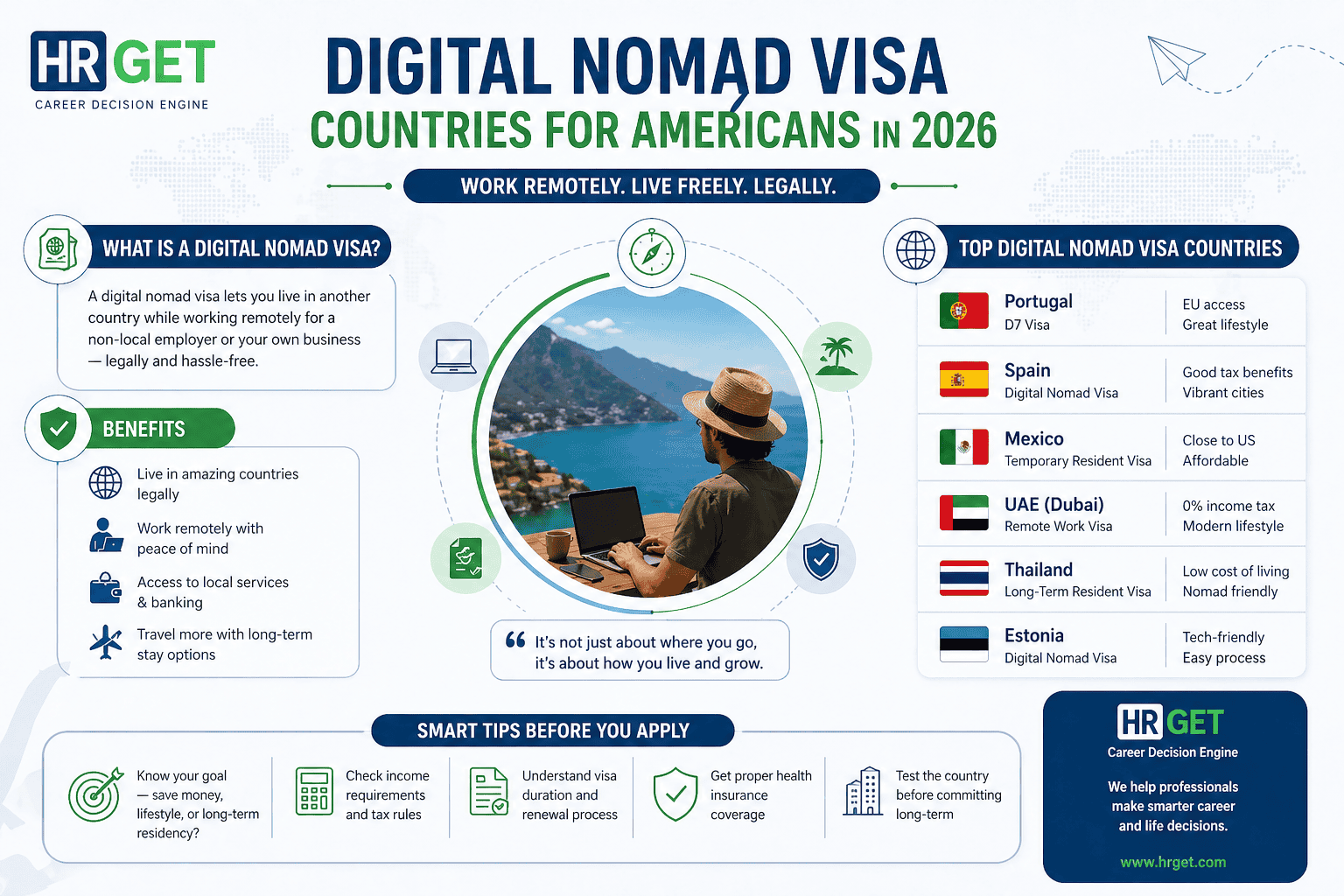
A digital nomad visa allows you to legally live in another country while working remotely for a foreign employer or your own business. You don’t pay local income taxes in most cases, you’re not working for a local company, and you’re not taking jobs from residents.
Here’s why it matters, practically speaking:
- You avoid visa violations that could result in deportation or entry bans
- You get legal temporary residency — not just a tourist stamp
- You can open local bank accounts, sign rental leases, and stay long-term
- Some countries offer meaningful tax benefits — in a few cases, zero income tax
Most Americans get this wrong. They assume a tourist visa covers remote work. In many countries — including popular spots like France, Indonesia, and Japan — it doesn’t. You’re technically working without authorization. Enforcement has tightened significantly since 2024, with several European countries issuing fines and short-term bans.
The good news: by 2026, over 50 countries have formalized remote work visa programs. You have real options — and the right choice depends on your income, lifestyle, timeline, and tax goals.
Best Digital Nomad Visa Countries for Americans in 2026
Let’s break this down by what actually matters: cost, lifestyle, taxes, and ease of process.
🇵🇹 Portugal — D7 / Digital Nomad Visa
Portugal remains one of the most compelling EU options for Americans — not just for quality of life, but because it’s one of the few countries offering a genuine path to permanent residency and citizenship after five years.
The D7 “passive income” visa and the newer Digital Nomad Visa (launched 2022, refined since) both work for remote workers earning abroad. You’ll need to demonstrate roughly $3,000/month in stable income, show proof of accommodation, and pass a basic background check.
| Factor | Detail |
|---|---|
| Income Req. | ~$3,000/month |
| Cost of Living | Medium (Porto cheaper than Lisbon) |
| Tax Benefit | NHR regime (flat 20% for qualifying income) |
| Processing Time | 2–4 months (consulate-dependent) |
| Best For | Long-term EU base + citizenship pathway |
Watch out: Lisbon has gotten expensive — a one-bedroom apartment in the city center now runs €1,500–€2,200/month. Porto and the Algarve are significantly more affordable. If EU citizenship is your 5-year goal, Portugal is still the clearest path for an American.
🇪🇸 Spain — Digital Nomad Visa (Startup Law)
Spain’s Digital Nomad Visa, introduced under the 2022 Startup Law and now well-established in 2026, has quietly become one of Europe’s best setups for American remote workers. The Beckham Law — technically the “Special Tax Regime for Impatriates” — can cap your Spanish tax rate at 24% flat for the first six years, versus the standard rate that can hit 47%.
You’ll need proof of at least $2,500/month income, a clean criminal record, and private health insurance. Processing at the Spanish consulate in New York or Miami typically takes 6–10 weeks.
Spain works exceptionally well for remote workers earning $60K–$120K. Barcelona and Madrid have thriving nomad infrastructure — fast internet, excellent coworking, and a social scene that actually makes long-term living enjoyable. The bureaucracy is real, but manageable with a local gestor (admin consultant) who typically charges €300–€500 for the process.
🇲🇽 Mexico — Temporary Resident Visa
Mexico doesn’t have a dedicated “digital nomad visa,” but the Temporary Resident Visa (Residente Temporal) effectively functions as one — and it’s arguably the easiest for Americans to obtain. The income threshold is roughly $2,600/month or demonstrated savings of ~$43,000.
Mexico City, Oaxaca, Mérida, and Puerto Vallarta have all developed significant nomad communities. A comfortable one-bedroom apartment in Roma Norte, CDMX runs $800–$1,200/month. Fast fiber internet is widely available in major cities.
The honest caveat: Safety varies significantly by neighborhood and city. Mexico City’s established expat zones (Condesa, Roma, Polanco) are safe and walkable; other areas require more local knowledge. For first-time international remote workers, it’s the lowest-friction option available.
🇦🇪 UAE — Dubai Remote Work Visa
Dubai’s Remote Work Visa is a 1-year, renewable program requiring $3,500/month minimum income, proof of employment or business ownership, and private health insurance. The headline benefit: 0% personal income tax.
Here’s the thing — as an American, you still owe U.S. taxes on worldwide income regardless of where you live (more on this in the tax section). So the “0% tax” benefit is less transformative for Americans than it sounds for citizens of other countries. That said, Dubai genuinely delivers on infrastructure: fast internet, world-class healthcare, and near-zero time zone disruption for teams in India and Europe.
It’s expensive — expect $3,500–$6,000/month all-in for a comfortable setup in Dubai Marina or Downtown. Best suited for high-earning remote workers ($150K+) who want premium infrastructure and don’t mind trading cultural immersion for efficiency.
🇹🇭 Thailand — Long-Term Resident (LTR) Visa
Thailand introduced its Long-Term Resident (LTR) visa in 2022 specifically to attract remote workers and digital professionals. It’s a 10-year, renewable visa requiring $80,000 in annual income or $40,000/year with $250,000 in assets. The income bar is higher than most alternatives — but it also comes with significant perks: 17% flat income tax rate, fast-track immigration, and a 90-day reporting waiver.
For budget-conscious nomads, Thailand’s older tourist visa + METV combination still functions as a workaround — though it’s legally grey and increasingly scrutinized. Chiang Mai, Bangkok, and Koh Lanta remain top-tier nomad hubs with low living costs (a comfortable lifestyle runs $1,500–$2,500/month).
Best for: Senior professionals and high earners who want Southeast Asia’s cost advantage without constant visa runs.
🇪🇪 Estonia — Digital Nomad Visa (The Original)
Estonia launched the world’s first digital nomad visa in August 2020. In 2026, it’s still one of the most straightforward to apply for: €3,504/month minimum income, valid for up to 12 months. The application is largely online and processes quickly — often within 2–4 weeks.
Estonia is a particularly strong option for tech professionals — the country’s e-Residency program and digital government infrastructure make admin tasks genuinely painless. Tallinn has a growing coworking scene. Cost of living is modest by EU standards. The downside: weather is brutal from October to March, and it’s not exactly a “lifestyle” destination the way Spain or Portugal is.
Top Digital Nomad Visa Countries Compared
| Country | Income Req. | Cost of Living | Tax Benefit | Ease (Americans) | Best For |
|---|---|---|---|---|---|
| 🇵🇹 Portugal | ~$3,000/mo | Medium | Moderate (NHR) | Medium | EU path + long-term |
| 🇪🇸 Spain | ~$2,500/mo | Medium | Good (Beckham Law) | Medium | Lifestyle + tax savings |
| 🇲🇽 Mexico | ~$2,600/mo | Low | Low | Easy | First-time nomads |
| 🇦🇪 UAE | ~$3,500/mo | High | Excellent (0% local) | Easy | High earners, infra-first |
| 🇹🇭 Thailand (LTR) | $80K/year | Very Low | Low (17% flat) | Complex | Senior/budget-conscious |
| 🇪🇪 Estonia | €3,504/mo | Medium | Moderate | Easy (mostly online) | Tech professionals |
| 🇨🇷 Costa Rica | $3,000/mo | Low-Medium | Low (US taxes apply) | Easy | Nature + work-life balance |
| 🇬🇷 Greece | €3,500/mo | Low-Medium | 50% tax discount (year 1) | Medium | EU base, low cost |
| 🇧🇦 Barbados | $50K/year | Medium-High | Low | Easy | Caribbean lifestyle |
| 🇮🇩 Indonesia (Bali) | $2,000/mo | Very Low | Low | Medium | Budget + culture |
Real Scenario: Choosing the Right Country
I’ll share a composite scenario based on situations I’ve seen repeatedly in the past two years.
Marcus, 34, Senior Product Manager at a U.S. SaaS company: Remote role paying $130K/year. Tired of San Francisco rent ($3,200/month for a one-bed). His company allows full remote. He wants 12–18 months abroad, is open to Europe, and cares about quality healthcare.
His shortlist after the basics: Portugal or Spain. Here’s how the decision broke down:
- Portugal D7: €1,000/month apartment in Porto, good English, slower visa process (3 months), NHR tax benefits for year 2+, genuine path to EU citizenship.
- Spain DNV: €1,200/month in Valencia, Beckham Law saving ~$15K/year in Spanish taxes, faster processing (6–8 weeks), better nightlife and weather.
Marcus chose Spain — specifically Valencia — because the faster processing mattered and the Beckham Law tax saving was real and immediate. He’s still there 14 months later.
The lesson: your income level, timeline, and whether you want EU citizenship long-term determines the right country more than anything else.
Income Requirements & Taxes Explained for Americans
Here’s what most “digital nomad” content skips entirely: Americans are taxed on worldwide income. The U.S. is one of only two countries (with Eritrea) that taxes its citizens regardless of where they live or work. This changes the tax math significantly compared to British, Australian, or German nomads.
That said, you have two main tools to reduce your U.S. tax burden:
- Foreign Earned Income Exclusion (FEIE): In 2026, you can exclude up to approximately $126,500 of foreign-earned income from U.S. federal taxes — if you qualify via the Physical Presence Test (330+ days abroad) or Bona Fide Residence Test. This is administered via IRS Form 2555.
- Foreign Tax Credit (FTC): If you pay taxes in your host country, you can use those taxes as a credit against your U.S. tax liability. This prevents true double taxation in countries that do charge income tax.
Practical example: If you earn $100K/year as a remote product manager and spend 11 months in Portugal, the FEIE alone could eliminate your U.S. federal income tax on that income entirely (since $100K is under the exclusion limit). You’d still owe Portuguese taxes unless covered by NHR.
My strong advice: Hire a tax professional specializing in U.S. expat taxes before you leave. Firms like Greenback Tax Services or Bright!Tax specifically handle this. The fee (~$500–$1,500/year) is worth every dollar compared to an IRS penalty.
How to Apply for a Digital Nomad Visa: Step-by-Step
The process varies by country, but the core framework is consistent. Here’s how to approach it:
- Choose your country based on the decision framework in the next section — don’t skip this step.
- Check current requirements on the official government/consulate website. Requirements shift yearly; don’t rely on blog posts from 2023.
- Gather your documents: Proof of income (3 months of payslips or bank statements, or a business income letter), valid U.S. passport (6+ months validity), clean criminal background check (FBI apostille for EU applications), health insurance policy covering your host country, and proof of accommodation (lease or hotel booking for initial months).
- Apply at the consulate for your target country in the U.S. (most EU countries require an in-person appointment). Book early — waits of 4–8 weeks for consulate slots are common in 2026.
- Arrive and register locally. Once approved and on the ground, you’ll typically need to register with local authorities within 30–90 days (varies by country). Portugal requires a SEF appointment; Spain requires registration at the local Padron office.
- Open a local bank account — this makes rent payments, local bills, and daily life significantly easier. Requirements vary; Revolut or Wise as a bridge account helps during the transition.
Total timeline from decision to departure: expect 2–4 months minimum for EU destinations, 4–6 weeks for Mexico or UAE.
Smart Strategy: How to Choose the Best Country for You
Don’t choose a country based on a YouTube video of someone sipping coffee in Lisbon. Run it through these four filters:
- Income filter: Can you comfortably meet the minimum requirement? If you’re earning $60K/year, Dubai ($42K/year minimum) is technically achievable but leaves no cushion. Portugal’s $36K/year threshold is more comfortable at that income level.
- Timeline filter: Staying 6 months? Go simple — Mexico or Barbados. Planning 2+ years? Spain or Portugal’s citizenship pathway changes the calculus entirely.
- Tax filter: Run the FEIE math first. If you earn under $126,500 and qualify for the Physical Presence Test, U.S. federal taxes may effectively be zero regardless of host country — making the local tax regime less critical.
- Lifestyle filter: Be honest with yourself. Tallinn is great if you want efficient, tech-forward infrastructure. Bali is great if you want culture and cheap living. They’re not interchangeable just because both technically offer remote work visas.
I’ve watched too many people choose a country based on aesthetics and end up miserable because the time zone wrecked their work schedule, or the healthcare system frustrated them during a minor emergency. Run the filters. Then choose.
Common Mistakes Americans Make With Digital Nomad Visas
- Assuming tourist visas allow remote work. Bali’s popular “B211A” tourist visa doesn’t. Neither does France’s tourist stamp. You may never get caught — but if you do, re-entry bans can run 3–10 years.
- Not telling your employer. Most U.S. remote employers don’t have payroll/tax setups in foreign countries. Working abroad without telling HR can trigger unexpected payroll tax obligations for your employer — and some companies will terminate remote arrangements as a result. Have the conversation before you book flights.
- Skipping U.S. state tax obligations. Depending on your state, you may still owe state income taxes even while abroad. States like California and New York are aggressive about claiming residents. Check with a CPA before assuming your state tax obligation ends when you leave.
- Underestimating processing time. Spain and Portugal consulate appointments for East Coast cities can book out 6–10 weeks in advance. Plan accordingly or your departure date will slip.
- Not maintaining a U.S. address. You’ll need one for banking, IRS correspondence, voter registration, and driver’s license maintenance. A family member’s address or a mail forwarding service (Earth Class Mail, Traveling Mailbox) handles this.
Pro Tips Most People Miss
A few things that don’t show up in most guides:
- Get an FBI background check with apostille early. For EU visas, you need an FBI Identity History Summary with Hague Apostille. The FBI’s processing time alone is 12–14 weeks via mail. Use a channeling agency (like IdentoGO) to cut it to 3–4 weeks, but budget for this upfront.
- Check your employer’s “work from anywhere” policy fine print. Many companies say “remote friendly” but have policies that restrict working from certain countries, particularly those with GDPR conflicts, trade restrictions, or payroll complications. GDPR compliance issues come up most often with employers processing EU citizen data.
- Time zone matters more than you think. A $3K/month rent savings in Southeast Asia becomes complicated if you’re on a Pacific Time work schedule — that’s 2 AM to 10 AM calls for a Bali-based American. Spain, Portugal, and Morocco (GMT±1–2) are far more manageable for U.S. East Coast teams.
- Visit before committing. If you can take a 3-week exploratory trip before filing the visa application, do it. Several of my clients have crossed Spain off their list after realizing the language barrier was more challenging in daily life than expected. Others discovered they loved Porto far more than Lisbon. A reconnaissance trip saves you months of friction.
Frequently Asked Questions
Which digital nomad visa country is easiest for Americans to get?
Mexico’s Temporary Resident Visa is the easiest overall — low income threshold, minimal paperwork, and proximity to the U.S. makes logistics simple. Estonia’s digital nomad visa is the easiest EU option, with a mostly online process and fast turnaround. For visa-free travel up to 90 days, countries like Barbados and Costa Rica have streamlined welcoming processes.
Do Americans pay U.S. taxes while on a digital nomad visa?
Yes. The U.S. taxes citizens on worldwide income regardless of residence. However, the Foreign Earned Income Exclusion (FEIE) lets you exclude up to approximately $126,500 (2026 figure) of earned income from federal taxes if you qualify via the Physical Presence Test (330+ days abroad). You may also use the Foreign Tax Credit to offset taxes paid to your host country.
Can I work on a tourist visa in most countries?
No — in most countries, working remotely on a tourist visa is technically unauthorized. Enforcement varies widely: it’s rarely an issue in Mexico or Bali for short stays, but EU countries (France, Germany, Netherlands) take it more seriously. With dedicated digital nomad visas now widely available, the risk isn’t worth taking for a stay beyond 30–60 days.
What income do you need for a digital nomad visa?
Most programs require $2,500–$3,500/month in provable income. Mexico and Spain sit at the lower end (~$2,500/month); UAE and Estonia require closer to $3,500/month. Thailand’s LTR visa requires $80,000/year. “Income” is typically demonstrated via employment contracts, payslips, business bank statements, or freelance contracts — usually 3 months of documentation.
Which countries offer tax benefits on a digital nomad visa?
Spain’s Beckham Law (24% flat tax), Portugal’s NHR regime (flat 20% on certain income), Greece’s 50% income tax discount for new residents, and UAE’s 0% personal income tax are the strongest options. For Americans specifically, the FEIE often provides greater savings than local tax regimes for earners under $126,500 — making host-country tax benefits secondary in many cases.
Can I bring my family on a digital nomad visa?
Most programs allow dependents (spouse + children) as part of the application, typically requiring a higher income threshold. Portugal’s D7 adds roughly €760/month per dependent to the income requirement. Spain’s DNV allows dependent family members at no additional income increase. Always confirm the current dependent policy directly with the consulate — these terms update frequently.
What’s the best digital nomad visa country for high earners?
For Americans earning $150K+, UAE offers the clearest combination of 0% local income tax and premium infrastructure. Spain’s Beckham Law is compelling for earners in the $80K–$150K range. Portugal’s NHR regime works well for those with investment or passive income above the FEIE threshold. Always model your specific situation with a qualified U.S. expat tax advisor before deciding.
The Bottom Line on Digital Nomad Visa Countries
The best digital nomad visa country for Americans isn’t Portugal or Spain or Mexico — it’s whichever country aligns with your income, timeline, tax position, and lifestyle priorities. Anyone who tells you otherwise is selling you the destination, not the decision.
What I’ve seen repeatedly in 18 years of advising career transitions: the people who plan this properly — who sort out the visa, the tax strategy, and the employer conversation before they leave — have transformative experiences. The ones who wing it spend months stressed about legal status and tax obligations instead of actually enjoying the move.
Run the four filters. Talk to a U.S. expat tax advisor. Have the conversation with HR. Then go.
If you’re weighing this alongside a major career transition — a job change, a layoff, or negotiating a remote arrangement with a new employer — read our guide on how to negotiate your severance or remote work terms before you make the leap. The two decisions are more connected than most people realize.

Jonathan Reed: Executive Career Strategist & Leadership Advisor | Former Partner, McKinsey & Company | Executive Coach to Amazon & Unilever Leaders | 18+ Years in Career Strategy
Jonathan Reed spent nearly two decades as a Partner at McKinsey & Company, where he advised organisations on leadership development, talent strategy, and organisational design across the US, UK, and Asia. Since leaving consulting, he has worked as an executive coach to senior leaders at Amazon, Unilever, and a clutch of high-growth scale-ups — helping them navigate promotions, career pivots, and the unwritten rules of visibility and influence at the top. Based between London and New York, Jonathan writes for HRGet.com to give working professionals an honest look at how careers actually scale — and why so many talented people stall without ever knowing why.