
You’ve just been handed a voluntary separation package (VSP) — and it feels like a trap wrapped in a generous subject line.
Your manager says it’s a “great opportunity.” HR calls it “completely voluntary.” Your colleagues are quietly asking each other if they’re taking it. And you’re sitting there with a deadline, a dollar figure, and absolutely zero clarity on what the right move actually is.
I’ve been on both sides of this conversation. As an employment and severance advisor who spent 18 years counselling Fortune 500 employees through restructurings — and before that as senior counsel at Littler Mendelson — I’ve watched people make this decision brilliantly and disastrously. The ones who get it right aren’t always the smartest people in the room. They’re the ones who slow down and think it through.
This guide gives you the exact decision framework I use with clients. No guessing. No emotion. Just a clear-eyed evaluation of whether this VSP is your best move — or a costly mistake.
What Is a Voluntary Separation Package?
A voluntary separation package is an employer-initiated offer for employees to leave the company by choice — usually in exchange for financial incentives designed to soften the exit.
A standard VSP typically includes some combination of:
- Severance pay — paid as a lump sum or salary continuation for a fixed period
- Benefits extension — continued health, dental, or vision coverage beyond your last day
- Retirement incentives — especially in US companies targeting older workers under ERISA-compliant programmes
- Outplacement support — career coaching, résumé help, job placement services
- Waiver of non-compete clauses — less common but worth asking about
Here’s the key legal distinction: a VSP is not a layoff. You’re not being terminated. You’re being invited to leave — and by signing, you’re typically waiving your right to sue the company for wrongful termination or discrimination. That waiver is why you need to treat this offer with the same seriousness you’d give any legal contract. Because that’s exactly what it is.
In the US, if you’re 40 or older, the Older Workers Benefit Protection Act (OWBPA) mandates you receive at least 21 days to consider a VSP offer and 7 days to revoke it after signing. Younger employees have no federal minimum — your window could be 72 hours. Read your offer letter carefully.
Why Companies Offer VSPs — and What They’re Not Saying
Let me be direct about something most articles dance around: companies don’t offer voluntary separation packages out of generosity.
They offer them because it’s strategically cheaper and legally cleaner than forced layoffs. When enough employees self-select out, the company avoids WARN Act obligations (which require 60-day notice before mass layoffs), sidesteps potential age discrimination claims, and eliminates the PR damage of public headcount cuts.
VSPs are almost always targeted, even when they appear open to everyone. Companies quietly design the incentives to be most attractive to their highest-cost employees — typically senior staff with 10+ years of tenure and salaries in the upper quartile. If you fit that profile and a VSP lands in your inbox, understand: the company would prefer you take it.
⚠️ The Uncomfortable Truth
If a VSP is offered company-wide and not enough people accept it, layoffs often follow anyway — usually with worse terms. The VSP is frequently the better financial deal. But “better than a layoff” and “right for you specifically” are two very different questions.
Should I Take a Voluntary Separation Package? (The Quick Answer)
I know you came here wanting a straight answer. Here it is — with the caveat that context matters enormously.
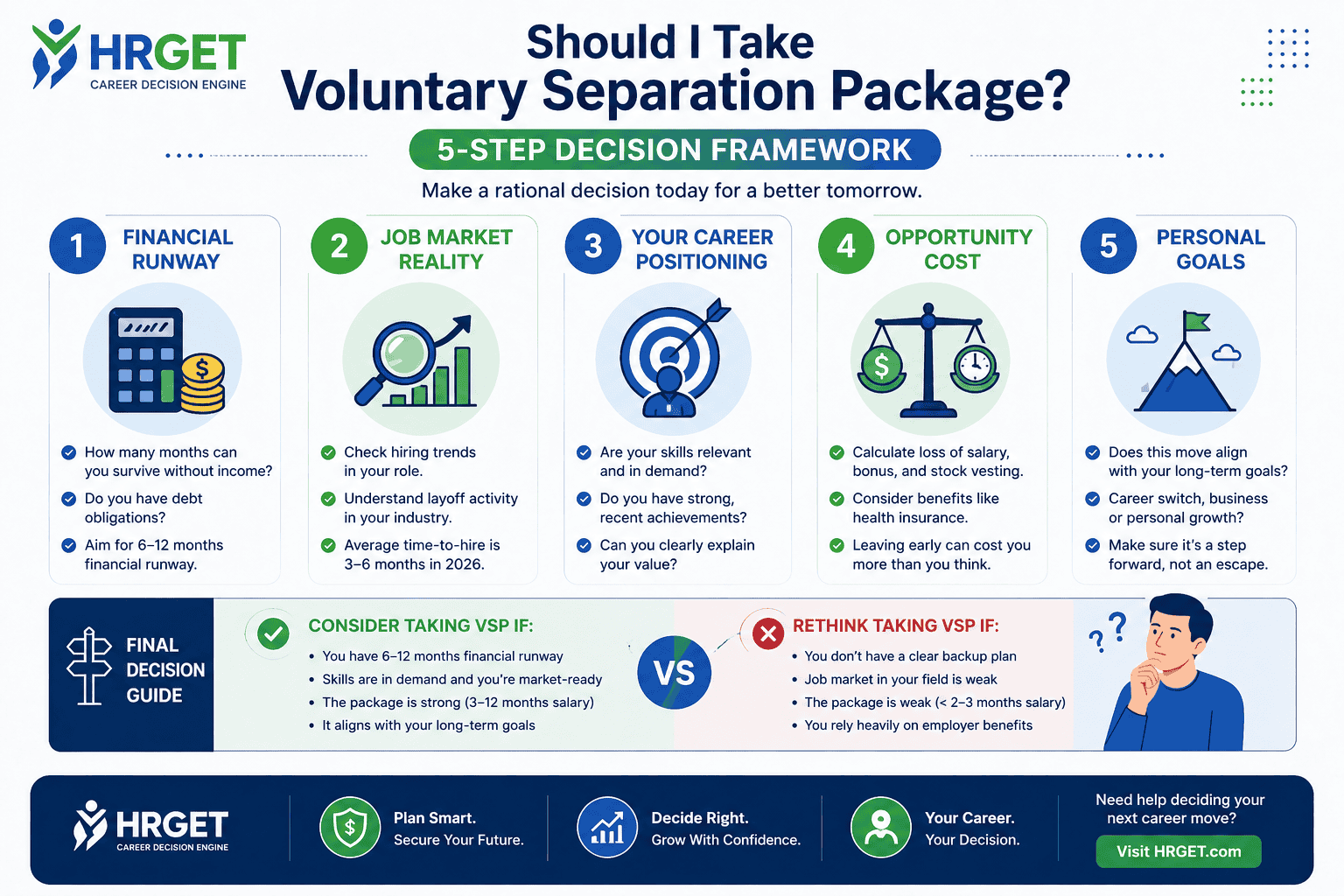
You should seriously consider taking the VSP if:
- You already planned to leave within the next 6–12 months
- Your savings cover at least 6–9 months of fixed expenses, independent of the payout
- Your skills are current and your professional network is active
- The package is genuinely substantial — 4+ months of total compensation or more
- The business trajectory makes involuntary cuts likely within 12 months anyway
You should pause — or decline — if:
- You have no clear backup plan and no active job search underway
- Hiring in your function or sector is slow right now
- You’re close to a vesting cliff, bonus payout, or promotion decision
- The package is thin — under 2 months’ salary with limited benefits extension
- You’re making this call primarily because you’re burned out and need an exit
That last point deserves more attention than it usually gets. Burnout is real, and I’m not dismissing it. But burnout is a reason to talk to a therapist and negotiate a leave of absence — not necessarily a reason to sign away your income. Let’s go deeper.
The 5-Step VSP Decision Framework
Most people evaluate a VSP by looking at one number: the severance payout. That’s the wrong starting point. The correct framework evaluates five interdependent variables — and your decision should only move forward when all five are accounted for.
Step 1: Calculate Your True Financial Runway
Before you look at what the company is offering, calculate what you actually need. Take your total fixed monthly obligations — rent or mortgage, EMIs, insurance premiums, utilities, food, childcare — and divide your current liquid savings by that number. That’s your baseline runway in months, without any VSP income.
Now add the net VSP payout (after tax — more on this shortly) and recalculate. The combined runway tells you how long you can realistically sustain a job search without financial panic.
The minimum threshold I advise clients to target: 9 months total runway. Why 9? Because in 2026, even strong mid-career candidates in competitive sectors are averaging 4–6 months to land a role. Add buffer for negotiation time and notice periods, and 9 months is your floor. 12+ months is comfortable.
If your combined runway falls below 6 months, this is a financial stress trade, not a strategic career move. You’d be leaving on the company’s timeline, not yours.
Step 2: Assess the Job Market Honestly
Here’s where most professionals get overconfident. You’ve had a successful career. Recruiters have reached out in the past. You feel employable — and you probably are. But “employable” and “quickly re-employed at equivalent compensation” are meaningfully different in 2026.
Check hiring velocity in your specific function right now. Not your industry broadly — your function. A tech company shedding finance headcount while engineering hiring booms is very different from across-the-board cuts. Look at LinkedIn job postings in your title and seniority band over the last 60 days. Check layoff trackers like Layoffs.fyi for your sector. Ask yourself honestly: in the last 12 months, have you had inbound recruiter interest? Have those conversations been for roles at your current level or below it?
If the honest answer is “the market is soft for my profile right now,” that doesn’t mean you can’t take the VSP. It means your runway calculation in Step 1 needs to be more conservative — assume 8 months to land, not 4.
Step 3: Evaluate What You’re Actually Giving Up
The severance number on paper often looks larger than it is once you account for what you’re walking away from. Before signing, map out the full picture of what stays on the table if you leave now versus waiting.
| What You Lose by Leaving Now | How to Quantify It |
|---|---|
| Unvested RSUs / stock options | Shares × current share price — this can be ₹10–50L+ or $20K–$150K+ |
| Annual bonus (if mid-cycle) | Pro-rata estimate of your target bonus payout |
| Employer-funded retirement contributions | Any unvested 401k match or pension contributions |
| Health insurance replacement cost | COBRA in the US averages $600–$1,800/month for family coverage |
| Potential internal promotion or raise | Harder to quantify — but factor it in if a review cycle is 30–90 days out |
If your unvested stock tranche hits in 90 days and represents three months of salary, that’s effectively a 3-month reduction in your real VSP value unless the company offers vesting acceleration — which you can negotiate.
Step 4: Audit Your Career Positioning
This step is uncomfortable — but it’s where decisions get made well or poorly. Ask yourself these questions honestly, not aspirationally.
Are your technical skills current, or have you been coasting on institutional knowledge for the last few years? When did you last complete a project you could describe compellingly in an interview? Do you have recent, specific achievements — revenue driven, cost reduced, teams built — that translate to market value? If you left tomorrow, could you articulate your value proposition in 90 seconds to someone who doesn’t know your company?
If your honest answers are shaky, the VSP decision doesn’t disappear — it just changes shape. You might still take it, but you use the first two months of your runway to actively upskill before job searching, rather than assuming your network will carry you.
Step 5: Weigh Personal Goals — Honestly, Not Romantically
VSPs genuinely work well for people with a concrete plan beyond the exit. Starting a business. Transitioning to consulting. Relocating for a spouse’s career. Taking a deliberate sabbatical with a re-entry date already mapped out. These are valid, financially plannable reasons to take a VSP even if the market is imperfect.
What doesn’t work: “I want a break.” “I’m tired of this place.” “I’ll figure it out.” I’m not being harsh — I’ve heard these from genuinely talented people who then spent eight months in a difficult emotional limbo, burning savings and confidence simultaneously.
If you’re burned out, acknowledge it. Then separate the burnout question from the VSP question. Can you take a medical leave? Negotiate reduced hours? Move to a different team? Solve for the burnout first, and then evaluate the package with a clearer head.
Real Scenarios: When VSP Works vs When It Backfires
✅ Scenario A — The Strategic Exit
Priya, 42, Senior Director at a mid-size tech firm. 13 years in, strong savings covering 14 months of expenses, and already in late-stage conversations with two companies. VSP offered: 9 months salary plus 90-day benefits extension.
What she did: Negotiated the benefits extension to 6 months and secured vesting acceleration on 60% of her unvested stock. Accepted the VSP. Landed her next role in 11 weeks at a 22% salary increase. The VSP effectively paid her to run a job search.
❌ Scenario B — The Emotional Decision
James, 36, Product Manager, two kids, EMI on a recent home purchase. Burned out, frustrated with his manager, and convinced he’d land something in 60 days. VSP: 3 months salary, no benefits extension. He had 4 months of personal savings.
What happened: Job search took 7 months. He exhausted savings by month 5, accepted a lateral move at 8% lower pay just to stabilise, and carried the financial stress into his new role. The VSP accelerated his exit without improving his outcome.
⚖️ Scenario C — The Strategic Wait
Daniel, 45, Finance Director. VSP offered with 5 months salary. He suspected deeper cuts were coming. He declined, watched 120 colleagues accept, waited three months. When involuntary layoffs hit his department, his redundancy package under UK employment law came to 8 months’ pay plus full notice period.
Lesson: Sometimes the best VSP decision is to decline it and wait for a potentially better statutory or contractual severance deal. This only works if you’ve correctly read the signals — and if layoffs do eventually materialise.
Financial Breakdown: Is Your Package Actually Good?
Stop looking at the headline number. What matters is the net, post-tax value — and how that maps against your specific cost structure. Here’s how to break it down properly.
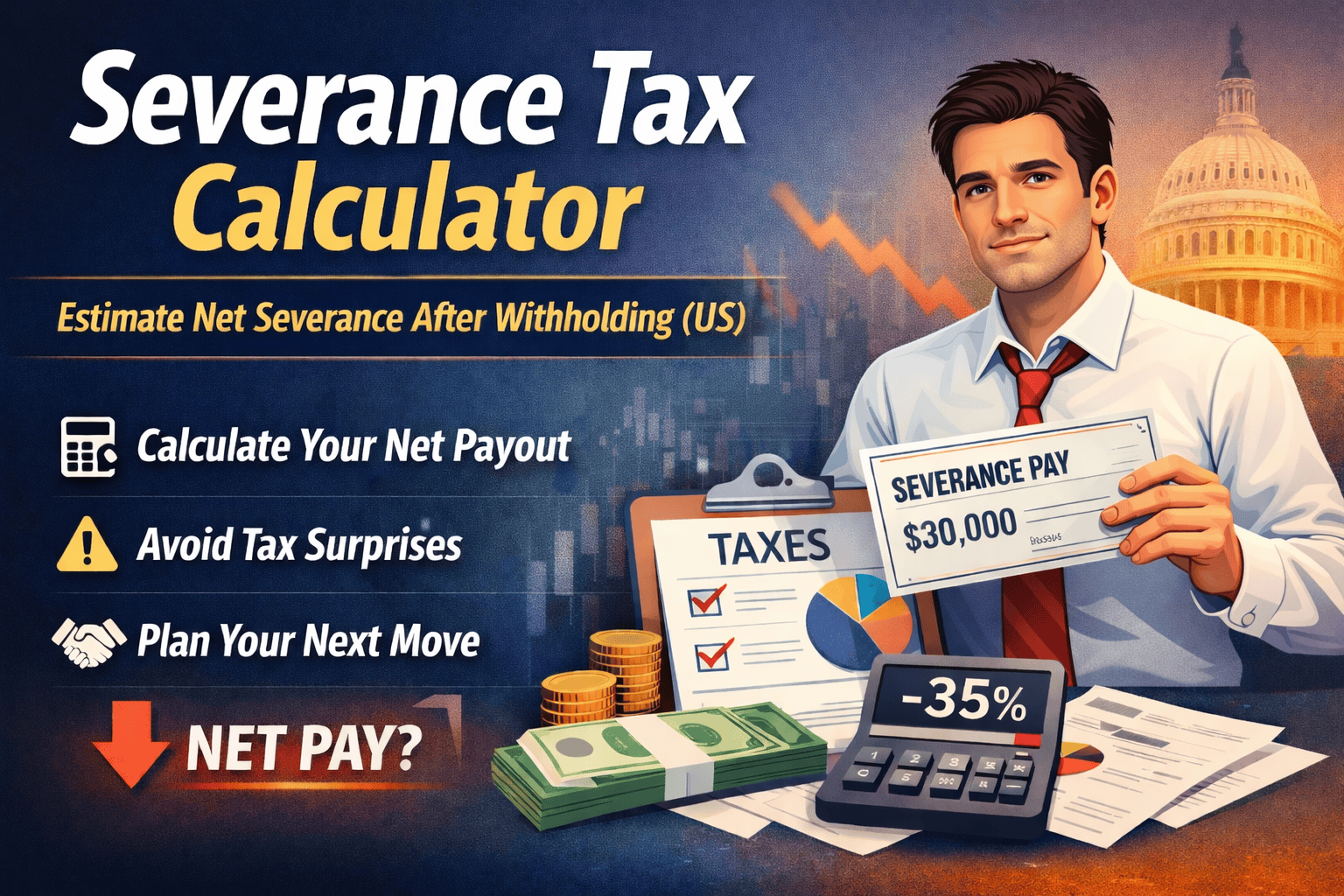
Severance taxability: In the US, severance payments are generally treated as ordinary income and subject to federal income tax, state income tax, Social Security, and Medicare. A $60,000 lump sum can net you $38,000–$44,000 depending on your tax bracket and state. In India, gratuity is exempt up to ₹20 lakhs under the Payment of Gratuity Act, but ex-gratia severance above that threshold is taxable. The UK has a £30,000 tax-free allowance on genuine redundancy payments, with amounts above that subject to income tax.
What makes a VSP genuinely strong versus average:
| Package Level | Severance Months | What to Expect |
|---|---|---|
| Weak | 1–2 months | Below market — negotiate or decline |
| Average | 3–5 months | Acceptable for strong candidates in active markets |
| Strong | 6–9 months | Worth serious consideration — gives real search runway |
| Excellent | 10–12+ months | Rare — reflects seniority, company policy, or successful negotiation |
These benchmarks apply to base salary equivalents. If your package includes health benefits continuation, outplacement services valued at $3,000–$8,000, and COBRA coverage, add those to the real value calculation.
Hidden Risks Most People Don’t Factor In
Beyond the obvious financial considerations, there are four risks that consistently blind-side even experienced professionals who’ve thought this through carefully.
The negotiation leverage gap. One of the most durable pieces of career advice remains accurate: it’s easier to get hired when you’re already employed. Recruiters and hiring managers are subtly (sometimes not so subtly) more interested in candidates who appear to be actively choosing to move rather than looking because they’re between roles. Taking a VSP removes that positioning. This doesn’t disqualify you — but it means your outreach, LinkedIn presence, and interview narrative need to be sharper from day one.
The résumé gap question. A 4–8 month gap in 2026 is less stigmatised than it was a decade ago, particularly post-pandemic. But you’ll still get asked about it. “I left as part of a company-wide voluntary separation programme” is a clean, factual answer. What you want to avoid is a gap that stretches past 12 months — that’s where the questions get harder.
The psychological underestimation. I’ve worked with senior professionals who left structured, high-identity roles and were genuinely shocked by how destabilising the transition was. Three weeks of decompression is normal. Three months of drift without structure or momentum is a risk to both your wellbeing and your interview performance. If you take the VSP, treat the first two weeks as recovery and weeks three onward as a structured job search campaign — with weekly targets and accountability built in.
The WARN Act / statutory minimum misunderstanding. If you’re in the US and your company is conducting a mass layoff (100+ employees, 50 or more losing jobs at one site within 30 days), you may be entitled to 60 days’ pay under the WARN Act regardless of whether you take the VSP or not. Accepting a VSP waives your right to WARN Act damages if those conditions apply. Get clarity before you sign — this is worth a 30-minute call with an employment attorney.
Smart Strategy: How to Negotiate Your VSP Before You Sign
Most people treat the VSP offer as fixed. It rarely is. Companies are running a cost-benefit calculation, and experienced employees who would prefer to leave quietly — without employment claims or escalations — have more leverage than they realise.
Here’s what’s actually negotiable, and how to approach each item:
1. Additional severance weeks. Start by asking for more. A straightforward “I’d like to discuss the severance terms before making my decision” is enough to open the conversation. Companies expect some pushback from senior employees. Request 2–4 additional weeks, framed around your tenure and the transition time you’ll need to properly hand off responsibilities. Many employers will split the difference.
2. Benefits extension. If the package offers 30 days of continued health coverage, push for 90. In the US, COBRA continuation rights kick in after separation, but the cost is on you — averaging $600–$1,800/month for families. Every month of employer-paid continuation is real money. In India, negotiate continued coverage under the group health policy through the end of the calendar year if possible.
3. Bonus pro-ration. If you’re separating mid-fiscal year, ask for a pro-rated bonus payment. This is more commonly granted when the separation is framed as a mutual arrangement rather than performance-driven. If you’ve been told your role is eliminated — not your performance — you have grounds to request this.
4. RSU / stock vesting acceleration. This is less common but absolutely worth requesting, especially if you have a cliff vesting within 90–180 days. Frame it as avoiding a cliff penalty on a departure driven by the company’s decision, not yours. Some companies will accelerate a partial tranche to close the deal cleanly.
5. Outplacement services and reference agreements. If outplacement isn’t in the initial offer, request it — or request an equivalent cash allowance. And get your reference terms in writing. Confirm who will be named as your reference, what they’ll confirm, and that your departure will be framed as a voluntary separation (not a termination) in any future employer verification.
Pro Tip: Time Your Negotiation Request Carefully
Don’t request changes on the day you receive the offer — it reads as reactive. Ask for 48–72 hours to review the terms, then come back with a single, clear counter in writing. One well-structured email carrying two or three specific asks lands better than a back-and-forth conversation where you’re visibly negotiating in real time.
Common Mistakes That Derail VSP Decisions
After 18 years in this space, I’ve seen the same avoidable errors surface repeatedly. Here are the ones that cost people the most.
Deciding because your colleagues are deciding. VSPs create social pressure. When half the floor is apparently taking it, there’s a quiet implication that staying signals poor judgment or disloyalty. Ignore the social dynamic entirely. Your financial situation, career stage, and market positioning have nothing to do with your colleague’s. Their decision is data about them — not guidance for you.
Ignoring the tax hit until after you sign. The post-tax calculation is the only number that matters. A $50,000 lump sum at a 32% effective federal rate, plus state tax, can net you $31,000–$36,000. Plan accordingly before you assess whether the offer is sufficient.
Overestimating how fast you’ll land. Confidence is useful in a job search. Overconfidence is expensive. Build your runway calculation assuming a search that takes 6 months, even if you expect to land in 3. If you land in 3, you’ve got unexpected cushion. If you don’t, you haven’t made a financial error.
Leaving days or weeks before a vesting event. I’ve seen this happen with people who are so emotionally ready to leave that they don’t check the calendar. Two weeks before a quarterly vest is not the time to sign a VSP. Ask HR to adjust the separation date, or ask for vesting acceleration to cover the shortfall.
Not consulting an employment attorney. A one-hour consultation with an employment lawyer costs $200–$500. If your package is worth $40,000–$200,000 in total value, that’s a 0.25%–1.25% investment to verify you’re not waiving rights you’re entitled to. It’s worth it — particularly if you have any suspicion your role was targeted based on age, race, gender, or other protected characteristics.
Final VSP Decision Checklist
Before you sign anything, run through these questions. If you can’t check all of them — genuinely, not wishfully — pause the decision until you can.
☐ My total financial runway (savings + net VSP payout) covers at least 9 months of fixed expenses
☐ I’ve calculated the after-tax value of the severance — not just the gross number
☐ I know exactly what I’m forfeiting in unvested stock, pro-rated bonus, and benefits
☐ I’ve researched hiring trends in my role and geography in the last 60 days
☐ I have a structured plan for my first 30 days post-separation — not a vague intention
☐ I’ve attempted to negotiate at least one component of the package
☐ I’ve had the package reviewed by an employment attorney or HR advisor
☐ I’m making this decision based on my financial and career position — not based on emotion, peer pressure, or company urgency
Frequently Asked Questions
Is voluntary separation better than being laid off?
Not always. VSPs give you control over timing and sometimes a better payout than a standard involuntary severance formula. But if layoffs are coming anyway, waiting may yield statutory redundancy entitlements or WARN Act pay that exceed the VSP offer. Evaluate the specific numbers before assuming the voluntary route is the financially superior one.
Can I negotiate a voluntary separation package after receiving the offer?
Yes — and you should. Most companies have flexibility on severance weeks, benefits duration, bonus proration, and outplacement services. Senior employees with strong tenure have the most leverage. Ask for time to review, then submit a written counter-proposal. Even extracting one additional month of salary or 60 extra days of health coverage is a meaningful win.
How long do I have to decide on a voluntary separation package?
In the US, employees 40 and older must receive at least 21 days to consider a VSP offer and 7 days to revoke after signing, under the Older Workers Benefit Protection Act. Younger employees have no federal minimum — timelines vary by company policy. In the UK and India, check your contract terms. Whatever the deadline, use every available day before deciding.
Will taking a VSP show up on my employment record or affect references?
It won’t show up as a termination on your employment record — it’s a separation by mutual agreement. However, confirm in writing how the company will characterise your departure in reference checks. Request that your HR file reflects a “voluntary separation” and get confirmation of what your official last-employer reference will say, ideally including a named reference contact rather than leaving it to a generic HR line.
Can I collect unemployment benefits after taking a voluntary separation package?
This depends on your state or country. In the US, voluntary resignation typically disqualifies you from unemployment insurance — but a VSP is generally treated as an involuntary separation for UI purposes because the company initiated the programme. Most states will allow you to claim benefits. Verify with your state unemployment office, as rules vary. In the UK, a genuine redundancy (even if voluntary) typically qualifies for Jobseeker’s Allowance after any severance “waiting period” is factored in.
Should I wait to see if layoffs happen instead of taking the VSP?
Sometimes. If you have strong evidence that involuntary cuts are coming and the statutory severance formula (or your employment contract) would yield a better payout, waiting can make financial sense. The risk is misjudging the timeline or finding yourself in a smaller, less favourable second round of cuts. This is a bet on your ability to read internal signals — and it only works if you’re genuinely prepared to stay another 6–12 months.
The Bottom Line on Voluntary Separation Packages
Here’s the honest answer to the question you came here with: whether you should take a voluntary separation package depends almost entirely on factors that have nothing to do with the company’s offer and everything to do with your personal financial position, your career momentum, and your clarity about what comes next.
The professionals who navigate VSPs well are the ones who treat the decision as a financial and strategic analysis — not an emotional one. They calculate their actual runway, audit what they’re forfeiting, negotiate before they accept, and sign only when the math genuinely works in their favour.
If you’re not yet at that level of clarity, don’t let an artificial deadline force your hand. Ask for the full review period you’re entitled to. Run the numbers. Talk to someone who’s been through it. The decision to accept a voluntary separation package is irreversible once made — take it only when you’re certain it improves your future, not just your present.
If you’ve already decided you want to leave and the VSP offer is on the table, make sure you’re getting everything you’re entitled to. Read our guide on how to negotiate a severance package before you sign anything.

Michael Reeves | Former Senior Counsel, Littler Mendelson | Severance & Restructuring Specialist | 18+ Years in Employment Law
Author bio: Michael Reeves spent nearly two decades as Senior Counsel at Littler Mendelson — one of the world’s largest employment law firms — advising on mass layoffs, corporate restructurings, and severance negotiations for Fortune 500 companies across the US and Europe. He has worked both sides of the table: structuring cost-efficient separation packages for employers and, more recently, helping employees understand exactly where their leverage lies. Based between Chicago and London, Michael writes for HRGet.com to demystify the legal and financial dimensions of layoffs — so employees stop leaving money on the table.