Let me be direct: the salary hike percentage in India 2026 is expected to average around 9.1% — a marginal improvement over last year’s actual 8.9%. But if you take that headline number at face value without looking at where your industry sits, you’ll either underestimate what you’re owed or set expectations that HR simply won’t meet.
After 15 years working across compensation strategy at firms like Mercer and advising PwC clients on salary benchmarking across India, here’s what I know: the same 9% national average hides salary growth stories that range from 6.6% to 10.2% depending entirely on the sector you’re in.
In this article, you’ll find the complete industry-by-industry salary hike data for 2026, a breakdown by employee level, and a negotiation strategy that actually works — not the generic “just ask confidently” advice you’ve already heard.
What Is the Average Salary Hike Percentage in India 2026?
The projected average salary hike in India for 2026 is 9.1%, based on Aon’s 2025–26 India Salary Increase Survey, which covered over 1,400 organisations across 45 industries. This is a small but meaningful uptick from the 8.9% actual increase recorded in 2025. WTW (Willis Towers Watson) similarly projects India’s salary growth to hold around 9% for 2026, citing continued demand in technology, digital transformation, product development, and AI-led business functions.
The practical question is not what the average is — it’s what the average means for your specific situation. Here’s how to read any salary hike number you receive:
| Hike Percentage | What It Usually Signals |
|---|---|
| 0% – 4% | Business pressure, performance issue, or role stagnation |
| 5% – 7% | Below average — typical for average performers or slow-growth sectors |
| 8% – 10% | Market-aligned hike for India in 2026 |
| 11% – 15% | Strong hike — usually for high performers or in-demand roles |
| 16%+ | Exceptional — promotion, retention case, or job-switch premium |
Most employees make the mistake of comparing their hike only with friends. That is not enough context. You should benchmark your hike against: your industry average, your performance rating, your role’s scarcity in the market, your company’s financial condition, how your current salary compares to external market pay, and whether your hike includes a promotion component or is a pure annual increment.
A 9% hike can be excellent for one employee and genuinely disappointing for another — depending entirely on the above factors.
Industry-by-Industry Salary Hike Breakdown for 2026
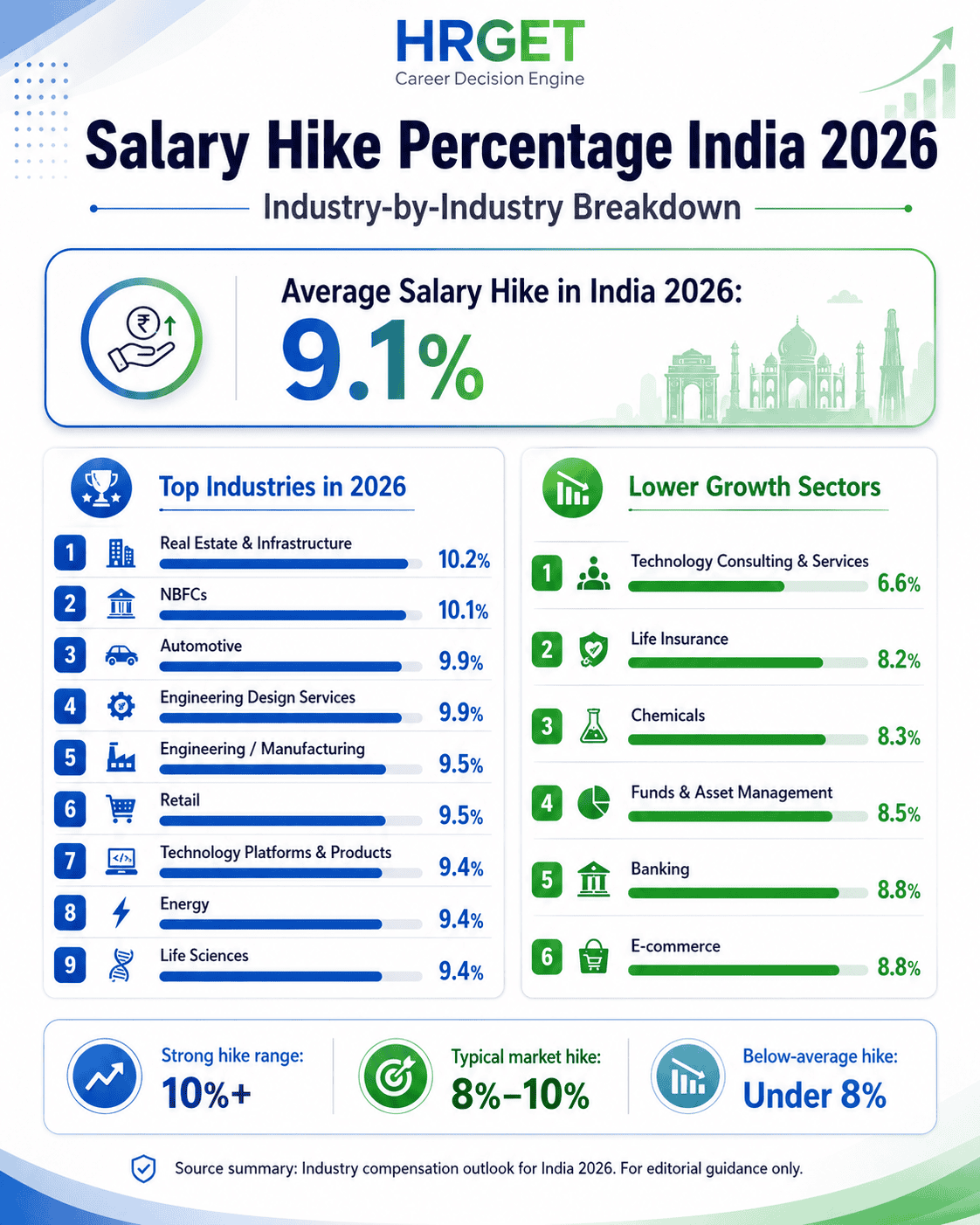
The table below reflects Aon’s 2025–26 salary increase data for India. These are the numbers your HR team is looking at when they set your appraisal budget.
| Industry | Actual 2025 | Projected 2026 |
|---|---|---|
| Overall India | 8.9% | 9.1% |
| Automotive / Vehicle Manufacturing | 9.8% | 9.9% |
| Banking | 8.4% | 8.8% |
| Chemicals | 8.5% | 8.3% |
| E-commerce | 8.7% | 8.8% |
| Energy / Oil / Gas / Power | 9.3% | 9.4% |
| Engineering Design Services | 10.0% | 9.9% |
| Engineering / Manufacturing | 9.4% | 9.5% |
| FMCG | 8.9% | 9.1% |
| Funds and Asset Management | 9.7% | 8.5% |
| Global Capability Centres (GCCs) | 9.2% | 9.3% |
| Life Insurance | 8.2% | 8.2% |
| Life Sciences | 9.3% | 9.4% |
| NBFCs | 9.7% | 10.1% |
| Real Estate / Infrastructure | 10.5% | 10.2% |
| Retail | 9.0% | 9.5% |
| Technology Consulting & Services | 7.0% | 6.6% |
| Technology Platform & Products | 9.2% | 9.4% |
Source: Aon 2025–26 India Salary Increase Survey. Data covers 1,400+ organisations across 45 industries.
Two numbers stand out immediately. Technology consulting and services is projected at just 6.6% — well below the national average. Meanwhile, real estate/infrastructure and NBFCs both sit above 10%. If you work in IT services and someone you know in real estate talks about a 10% hike, this table explains why.
Highest Salary Hike Industries in India 2026
1. Real Estate and Infrastructure — Around 10.2%
Real estate and infrastructure lead the hike table for 2026. India’s infrastructure investment cycle remains active — highways, metro rail, data centres, commercial developments, and affordable housing are all driving sustained demand for skilled professionals at every level.
Companies in this sector are competing for project managers, civil and structural engineers, construction finance professionals, infrastructure sales teams, legal and compliance professionals, and commercial real estate specialists. The pipeline isn’t slowing down, and companies know retention is expensive.
Pro Tip
If you’re in real estate or infrastructure and your hike came in below 8%, don’t accept “market is slow” as a justification. Your sector is projected above the national average. Push back with this data.
2. NBFCs — Around 10.1%
Non-Banking Financial Companies are the quiet outperformers in the 2026 salary landscape. NBFCs are growing fast across lending, digital finance, credit underwriting, risk analytics, collections strategy, and distribution — and they are competing hard for talent that banks used to absorb.
Here’s what most people miss: it’s not just finance roles that are in demand. NBFCs are also aggressively hiring for technology, data science, cybersecurity, digital product, and regulatory compliance. If you’re in banking, fintech, or insurance and want stronger salary movement in 2026, NBFCs deserve serious consideration.
Smart Strategy
NBFC roles often pay a 15%–25% premium over equivalent bank roles for the same function, especially in credit and technology. A lateral move here can outperform two years of annual increments at your current employer.
3. Automotive and Vehicle Manufacturing — Around 9.9%
Automotive and vehicle manufacturing is projected at 9.9% in 2026, driven primarily by India’s EV transition, global supply chain diversification, and manufacturing expansion by domestic and international OEMs. This isn’t traditional auto anymore — it now spans embedded systems, battery technology, automation, digital manufacturing, and connected mobility.
The highest hike potential within this sector goes to EV engineers, mechanical design engineers, embedded systems engineers, battery technology specialists, supply chain professionals, quality engineers, and plant operations managers. If you’re in automotive but stuck in a generic administrative or support role, it may be worth positioning internally toward the EV and automation side of the business.
4. Engineering Design Services — Around 9.9%
Engineering design services hold firm at 9.9% in 2026 — marginally below their 10.0% actual in 2025, but solidly above the India average. This sector benefits from global outsourcing tailwinds, with companies in the US, Europe, and Japan routing product engineering, industrial design, simulation, and R&D work to India.
Employees with the strongest hike potential: CAD/CAE engineers, product design engineers, simulation specialists, aerospace design professionals, automotive design engineers, and embedded product engineers. Generic engineering experience won’t command a premium here — specialised technical capability does.
5. Engineering and Manufacturing — Around 9.5%
Engineering and manufacturing are projected at 9.5% in 2026, benefiting from India’s manufacturing push, the China+1 supply chain strategy, industrial automation, and PLI (Production Linked Incentive) schemes across multiple sectors. There’s real momentum here.
That said, not every manufacturing employee will see 9.5%. The hike premium goes to white-collar technical roles — process improvement, automation, safety, quality, industrial engineering, plant leadership — rather than routine administrative or support functions. Know which side of that line your role sits on before you walk into appraisal.
6. Retail — Around 9.5%
Retail at 9.5% surprises many people. The sector has transformed significantly. Modern organised retail now encompasses omnichannel sales, category management, supply chain, retail analytics, store expansion, customer experience, private labels, and digital commerce. These are sophisticated, high-margin capabilities — and companies are paying for them accordingly.
Frontline roles may see more modest increments. But high-performing sales, operations, category, and analytics professionals in retail can negotiate strongly, especially in large-format, quick-commerce, and D2C-led companies.
7. Technology Platform and Product Companies — Around 9.4%
Technology platform and product companies are projected at 9.4% — a healthy number that stands in sharp contrast to IT services. This distinction matters enormously for technology professionals.
A software engineer in a product company and a software engineer in an IT services firm may both call themselves “tech professionals,” but their salary hike cycles are operating in completely different environments. Product companies pay more aggressively for AI engineers, backend engineers, product managers, data scientists, platform engineers, security engineers, and cloud infrastructure experts.
In 2026, “tech” is not one salary market. Know which sub-market you’re actually in.
Lowest Salary Hike Industries in India 2026
1. Technology Consulting and Services — Around 6.6%
This is the number that has Indian IT professionals paying attention. Technology consulting and services is projected at only 6.6% in 2026, down from a 7.0% actual in 2025. That’s a meaningful drop, and it’s already below the national average by a significant margin.
High performers, employees with niche skills, and promotion cases can still beat this average. But the sector-wide signal is clear: compensation growth is being managed cautiously. The pressures are real — global client budget tightening, automation eating into billable work, slower discretionary tech spending, bench management challenges, and AI tools raising productivity expectations without equivalent headcount reduction.
Practical Advice
If you’re in IT services and your role is generic (application support, manual testing, basic SDLC), your 2026 hike will likely be near or below average. The path to better compensation growth runs through cloud architecture, AI/ML, cybersecurity, enterprise architecture, data engineering, or product-facing technical roles.
2. Life Insurance — Around 8.2%
Life insurance is projected at 8.2% for 2026 — below the national average, though not dramatically so. The sector isn’t weak; salary budgets are simply more disciplined. Employees in actuarial, digital distribution, analytics, bancassurance, and sales leadership roles tend to see better outcomes than back-office and admin functions.
3. Chemicals — Around 8.3%
Chemicals are projected at 8.3% in 2026 — below the national average, though still decent in absolute terms. If you’re in this sector, your negotiation leverage comes less from citing industry benchmarks and more from quantifying your personal contribution to safety performance, regulatory compliance, process improvement, cost reduction, or productivity gains.
4. Funds and Asset Management — Around 8.5%
This is one of the more notable declines in the table: funds and asset management drops from a 9.7% actual in 2025 to a projected 8.5% in 2026. The pullback is noticeable. That said, employees with strong performance records in portfolio analytics, client acquisition, quantitative research, risk, or institutional sales still have real leverage to outperform the sector average.
Salary Hike by Employee Type: Fresher, Mid-Level, Senior
Industry averages give you the ceiling. Your employee level tells you where you realistically fit within that range.
Freshers: What to Expect
Freshers typically see annual hikes in the 5%–10% range depending on company performance and skill progression. But here’s the honest truth — obsessing over increment percentages as a fresher is a misdirection of energy.
A 10% hike on a ₹4 lakh base salary is ₹40,000 per year. A well-timed job switch from ₹4 lakh to ₹6 lakh is a 50% jump. The math is clear. The best strategy for freshers is to build marketable technical skills aggressively in the first 12–24 months, then evaluate whether a role move makes more financial sense than waiting for another annual increment cycle.
Mid-Level Employees: The Highest-Stakes Category
Mid-level professionals — typically in the 3–8 year experience range — feel the most appraisal-season frustration. You’re experienced enough to know you’re valuable, but often not senior enough to influence budgets or have direct access to the decision-makers.
Expected ranges for mid-level employees in 2026, based on industry benchmarks and performance distribution:
| Performance / Situation | Expected Hike Range |
|---|---|
| Average performer | 6% – 9% |
| Strong performer | 10% – 14% |
| Promotion case | 15% – 25% |
| Job switch (in-demand skill) | 20% – 40% |
This is the stage where negotiation matters most — and where most people wait too long to act. If you start the negotiation conversation the day your hike letter arrives, you’re already late. The conversation needs to happen weeks before the appraisal cycle closes.
Senior Employees and Managers: Where the Math Shifts
Senior professionals are often surprised to find their hike percentage lower than their junior colleagues. That’s not always a bad sign — it’s how senior compensation structures work. At that level, companies manage total compensation through performance bonuses, stock grants, retention bonuses, long-term incentive plans, and leadership scope expansion rather than large base salary bumps.
Consider this example:
| Employee | Current CTC | Hike % | Absolute Increase |
|---|---|---|---|
| Junior Engineer | ₹8 LPA | 12% | ₹96,000/yr |
| Senior Manager | ₹40 LPA | 7% | ₹2,80,000/yr |
The senior manager’s 7% is larger in rupee terms by nearly 3x. If you’re senior and frustrated by a lower percentage, shift your focus to total compensation — and negotiate bonuses and variable components more aggressively than base salary.
Why Two Employees in the Same Company Get Different Hikes
This is the question I hear constantly from professionals who feel their hike wasn’t fair. You and your colleague joined the same year, same grade, same team — and your increments are different. Here’s how that happens.
Performance rating band: Most companies distribute their salary budget according to a bell curve. The top 15%–20% of performers get disproportionately higher hikes. If your rating is “meets expectations” versus “exceeds expectations,” the hike difference can be 4–8 percentage points depending on company policy.
Current salary versus market rate: HR teams use external market benchmarking data (from firms like Aon, Mercer, and WTW) to identify who is underpaid versus overpaid relative to the market. Employees who are underpaid relative to their grade’s market range often receive “catch-up” increments. Those already above market may receive smaller hikes even with strong performance ratings.
Role criticality and replaceability: If your role has a niche skill set that is difficult to replace, your manager has more incentive to flag you for a higher hike — even if your performance rating is similar to a colleague’s. Roles in AI, cybersecurity, cloud, and data are commanding this premium right now.
Retention risk: If you have an offer in hand — or your manager suspects you might be looking — the calculus changes. Companies quietly use compensation as a retention lever for employees they consider flight risks.
Manager advocacy: This one people underestimate. Your hike is proposed by your direct manager in most organisations, then approved up the chain. A manager who advocates strongly for you — with specific business impact, not vague praise — will get you a better outcome than one who submits a standard recommendation.
Real Scenario: Is a 9% Hike Good or Bad?
Real Scenario — Rohan, Senior Software Engineer, Bangalore
Rohan has 6 years of experience at an IT services firm. His 2026 appraisal delivered a 9% hike, taking his CTC from ₹18 LPA to ₹19.62 LPA. His first reaction: “This seems okay.”
But here’s the context his appraisal letter doesn’t include. His industry — technology consulting and services — is projected at only 6.6% for 2026. So relative to his sector average, Rohan’s 9% is actually a strong result. He received it because his rating was in the top performance band and he has cloud migration experience, which his company flagged as critical.
Meanwhile, Rohan’s friend Priya works at a real estate firm in a finance controller role. She received a 10.5% hike on ₹22 LPA. Priya earned her increment in a sector projected at 10.2%, so her outcome is broadly in line with market.
The lesson: Rohan outperformed his sector average by 2.4 points. Priya got a market-average hike. Neither is better than the other without context. The only benchmark that matters is how your hike compares to your industry’s projection, adjusted for your performance band.
Smart Strategy to Negotiate a Better Hike in 2026
Most salary negotiation advice is generic to the point of being useless. Here’s what actually moves the needle in the Indian corporate context.
Start the conversation 6–8 weeks before appraisal season closes. Budget allocations in most large Indian companies are finalised well before letters go out. If you’re having the conversation after the letter arrives, you’re negotiating for an exception — which is harder to get than a planned allocation.
Build a business case, not a personal plea. The argument “I’ve been here four years and I deserve more” doesn’t move HR. The argument “I led the implementation of X, which resulted in Y outcome, and based on Aon’s latest benchmarking data, my role is currently priced at the P40 level relative to market” does. Specificity is leverage.
Know your market rate before you walk in. Use platforms like AmbitionBox, LinkedIn Salary Insights, Glassdoor India, and Naukri Salary tools to benchmark your role in your city. If your current CTC is below the P50 (median) for your role and experience, that’s a factual negotiation point — not an opinion.
Make your manager your advocate, not your audience. In most Indian organisations, your direct manager proposes your hike. Help them make the case for you by giving them specific, documentable wins they can cite in the system. A one-page “impact summary” handed to your manager three weeks before appraisal is not a small gesture — it’s a strategic move.
If the hike is final and disappointing, negotiate the package, not just the salary. Variable pay percentage, joining bonus conversion, remote work flexibility, learning budget, title change, or an off-cycle review at six months — these are all negotiable after the salary number is locked.
Pro Tip
Never use a competing offer as a bluff. In India’s mid-to-large corporate environment, HR managers talk — and a bluff that gets called leads to a worse outcome than the original hike you were given. Only use an offer if you genuinely have one and are prepared to leave.
Common Mistakes Employees Make During Appraisal Season
Mistake 1: Waiting for the appraisal letter to start the conversation. By the time letters are issued, budgets are closed. The window for meaningful influence is 4–8 weeks before the letter arrives.Mistake 2: Comparing hikes only with colleagues, not with market data. Your colleague got 11%. But if their role is in a higher-demand skill tier than yours, the comparison is meaningless. Benchmark against the market, not the person sitting next to you.Mistake 3: Conflating industry average with personal entitlement. The 9.1% national average is a planning benchmark for companies. It doesn’t mean every employee deserves 9.1%. Your hike will reflect your performance band, role criticality, and current-to-market pay gap — not the headline number.Mistake 4: Emotional negotiation instead of data-driven negotiation. “I feel I deserved more” is a conversation that ends quickly. “Based on market benchmarking, my role is below P50 for Bangalore and my performance was rated in the top band — can we discuss a mid-year correction?” is a conversation that HR can actually action.Mistake 5: Ignoring total compensation in favour of just base salary. A ₹1 lakh base salary increase and a ₹1 lakh performance bonus are financially equivalent. But many employees only push on base. Variable components, ESOPs, retention bonuses, and benefits have real monetary value worth negotiating.FAQ: Salary Hike Percentage India 2026
What is the average salary hike in India in 2026?
The average salary hike in India for 2026 is projected at approximately 9.1%, according to Aon’s India Salary Increase Survey covering over 1,400 organisations across 45 industries. This is marginally higher than the 8.9% actual increase recorded in 2025. WTW also projects India’s salary growth to remain near 9% in 2026.
Which industry has the highest salary hike in India in 2026?
Real estate and infrastructure leads with a projected 10.2% salary hike, closely followed by NBFCs at 10.1%, and automotive and engineering design services both at around 9.9%. These sectors are benefiting from India’s infrastructure cycle, NBFC credit expansion, EV manufacturing growth, and global engineering outsourcing demand.
Why is the IT services salary hike low in 2026?
Technology consulting and services is projected at only 6.6% in 2026 — well below the national average. Key drivers include global client budget pressure, slower discretionary IT spending, automation reducing billable work volume, bench management costs, and increased productivity expectations from AI tools. High performers and niche-skill employees can still outperform the sector average.
Is a 9% salary hike good in India in 2026?
A 9% hike is considered market-aligned for India in 2026, as the national average is projected at 9.1%. Whether it’s good for you specifically depends on your industry average, performance band, and how your current salary compares to the external market rate for your role. In IT services (projected at 6.6%), a 9% hike is actually strong. In real estate (projected at 10.2%), it’s slightly below average.
What salary hike can a fresher expect in India in 2026?
Freshers in India can typically expect annual hikes in the 5%–10% range in 2026. However, salary percentage matters less at this stage than building marketable skills quickly. A job switch after 12–24 months in a high-demand domain can result in a 30%–50% salary increase — far outpacing any incremental hike within the same company.
How do GCCs compare for salary hikes in India 2026?
Global Capability Centres (GCCs) are projected at 9.3% in 2026 — above the national average and significantly above IT services. GCCs are expanding rapidly in India and competing actively for technology, data, analytics, finance, and product talent. For professionals in these roles, GCC opportunities often offer both better salary growth and improved career exposure compared to traditional IT services firms.
What is the best way to negotiate a salary hike in India in 2026?
The most effective approach is to start the conversation 6–8 weeks before appraisal letters are issued, build a documented business impact case rather than a personal appeal, benchmark your salary against external market data using platforms like AmbitionBox or LinkedIn Salary, and work through your direct manager as your advocate. If the base salary is final, negotiate variable pay, retention bonuses, or a mid-year review as alternatives.
What Your 2026 Hike Actually Tells You
The salary hike percentage in India 2026 is expected to average 9.1% — but as you’ve now seen, that number tells only half the story. Real estate and NBFCs are delivering 10%+. IT services is stuck at 6.6%. The gap between the top and bottom sectors is nearly 3.6 percentage points, which in rupee terms on a ₹20 lakh CTC amounts to over ₹70,000 in annual take-home difference.
The more important number is not the national average. It’s your industry average, your performance band, and the gap between your current salary and what the market would pay you elsewhere today. That gap is your real negotiation leverage — and it’s more powerful than any percentage your appraisal letter quotes.
If you haven’t benchmarked your salary against external market data before this appraisal cycle, that’s your first step. If you have, you now have the industry data to frame the conversation with precision.
For a step-by-step approach to making that conversation work, read our guide on how to negotiate a salary increment in India — including specific scripts that work with Indian HR managers.

Eleanor Whitmore | Former Partner, Mercer | Advisor, World Economic Forum | 20+ Years in Global Compensation
Author bio: Eleanor Whitmore has spent over two decades shaping how the world’s leading organisations pay, retain, and reward talent. As a former Partner at Mercer and an advisor to World Economic Forum working groups on the Future of Work, she has designed compensation frameworks for Fortune 500 companies across the US, UK, Europe, and emerging markets. Based between London and New York, Eleanor writes for HRGet.com to translate boardroom-level pay strategy into actionable guidance for working professionals navigating real compensation decisions.