Here’s the truth: work from home in India is no longer just a “company benefit.” In 2026, it sits at the intersection of labour law, employment contracts, working hours, salary protection, data security, and employee rights — and most employees still don’t fully understand where they stand.
Most people think WFH means: “My manager approved it, so I’m safe.” That’s only half the picture. A proper work from home policy in India should define who qualifies, how attendance is tracked, whether overtime applies, who pays for equipment and internet, and whether a company can unilaterally force everyone back to office.
I’ve spent two decades advising companies and employees on employment law across India, the UK, and Europe. What I’ve seen lately is a sharp increase in WFH-related disputes — and almost all of them stem from one root cause: nothing was properly documented when the arrangement started.
This guide explains the legal and practical side of WFH in India for 2026 — for private-sector employees, IT/ITES workers, HR teams, startups, and anyone navigating a hybrid arrangement.
Important: This is an educational HR and labour-law guide, not personal legal advice. For specific disputes, consult a qualified employment lawyer registered under the Bar Council of India.
Is Work From Home Legal in India in 2026?
Yes — work from home is entirely legal in India. But the critical question is whether it’s properly documented. That distinction matters enormously when something goes wrong.
WFH is typically governed by a combination of your employment contract, appointment letter, company HR policy, standing orders (where applicable), the relevant state Shops and Establishments rules, the four Labour Codes, IT and data security policies, and the company’s internal attendance and leave framework.
The central principle is simple: working from home does not suspend the employment relationship. Whether you’re working from your flat in Bengaluru, your hometown in Bihar, a co-working space in Pune, or across a city boundary in the NCR — you remain a full-time employee with all associated rights and obligations.
Your protections around wages, leave, overtime, social security contributions, harassment, confidentiality obligations, and termination rules remain fully intact. Location changes the venue of work, not the legal framework governing it.
In official government communication around labour reforms, the Press Information Bureau has noted that flexible and remote work arrangements for the IT and service sector now have a formal legal foundation through the Model Standing Orders and related policy guidance. This is a significant shift. Before 2020, WFH was largely treated as an informal, manager-level concession. In 2026, it is increasingly recognised as a structured employment model that must be properly governed.
What Indian Labour Laws Say About WFH
India does not have a single “Work From Home Act.” This is where most employees get confused. Instead, WFH is handled through multiple overlapping legal and policy layers.
1. Industrial Relations Code and Model Standing Orders
The draft Model Standing Orders for the service sector formally recognised work from home as a legitimate work arrangement. For the IT sector specifically, working hours may be set as per the agreement or conditions of appointment between employer and worker. This matters because IT and ITES companies — which employ millions of India’s white-collar workforce — now have a clear framework to reference.
The practical takeaway: your WFH rights depend heavily on what is written in your appointment letter, HR policy, and employer-worker agreement. If your company has a documented WFH policy, that document becomes critical evidence in any dispute. If the arrangement was purely verbal, you are exposed.
2. Occupational Safety, Health and Working Conditions Code (OSH Code)
The OSH framework is important because working from home does not make working hours disappear. Government guidance under this code establishes that employees should not work more than 8 hours a day and 48 hours a week, with overtime provisions triggered by work beyond prescribed limits.
In practice, this means a company cannot treat remote work as unlimited work. An instruction like “you’re at home anyway, so be available from 8 AM to 11 PM” is neither legally safe nor defensible as a formal policy position.
3. Code on Social Security
WFH does not affect your entitlement to EPF, ESI, gratuity, maternity benefit, or other statutory contributions where they apply. A remote employee is still an employee. The Code on Social Security framework extends protection across organised, unorganised, gig, and platform work categories — so any attempt to reclassify a full-time employee as a “contractor” simply because they work from home would be a serious legal risk for the employer.
Key rule: a company cannot reduce statutory benefits solely because your work location shifted from office to home.
4. State Shops and Establishments Laws
Most office employees in India are covered by their state’s Shops and Establishments legislation. This governs working hours, weekly holidays, leave, overtime, women working late shifts, and employment conditions. Because these laws differ by state, a WFH policy for offices in Bengaluru, Hyderabad, Mumbai, Gurgaon, Pune, Chennai, or Noida may require separate local compliance checks — especially for companies hiring remote employees across multiple Indian states.
WFH Legal Framework at a Glance
| Legal Layer | What It Governs for WFH | Key Employee Implication |
|---|---|---|
| Model Standing Orders | Eligibility, IT sector work hours | Written policy is your protection |
| OSH Code | Max hours, overtime, safety | 8 hrs/day, 48 hrs/week cap applies |
| Code on Social Security | EPF, ESI, gratuity, maternity | Cannot be reduced for WFH employees |
| State S&E Laws | Leave, OT, weekly offs, women’s shifts | Varies by state — check local rules |
| Employment Contract | WFH clause, location, eligibility | Most enforceable document you hold |
Can an Employer Deny Work From Home?
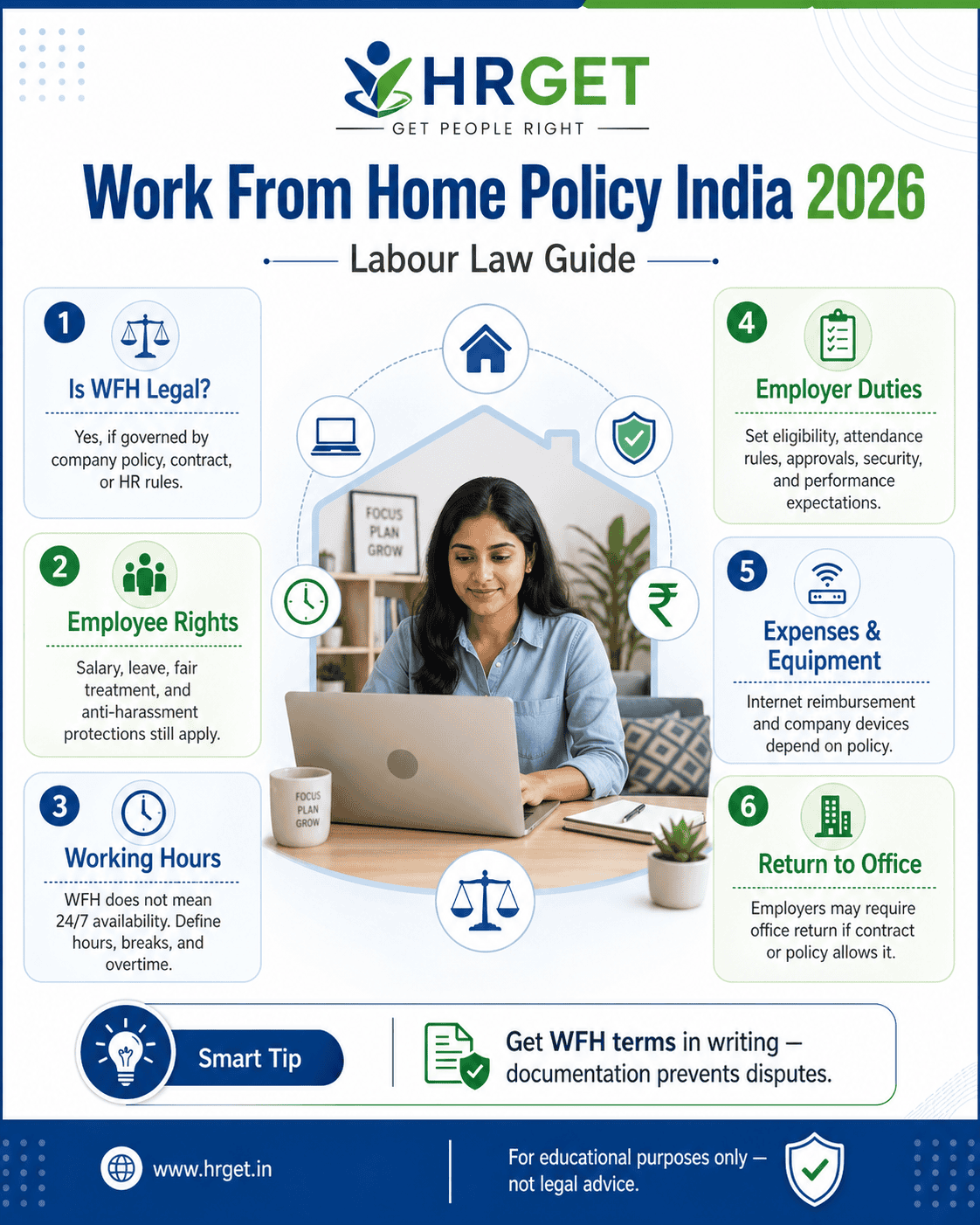
Yes — in most cases, an employer can deny WFH. Here’s the honest answer many employees don’t want to hear: WFH is not an automatic legal right in India for every employee. It is normally a work arrangement, which means the company can set its own eligibility rules.
A company may restrict WFH to certain roles (software engineers, support staff on approved shifts), certain performance bands, post-probation employees, or employees who handle no physical or confidential documents. These are legitimate business decisions.
However, denial becomes legally risky when it’s discriminatory, inconsistent, or contrary to what was promised at hiring. The employer should be able to explain, in writing, why one employee in a role is denied WFH while another in an identical role and performance band is approved.
The exceptions where denial may be challengeable include: your contract explicitly guarantees WFH; the role was offered and accepted as permanently remote; denial is based on a protected characteristic (disability, medical condition, maternity); or the employer is applying the policy selectively and arbitrarily.
Smart Strategy
How to Request WFH Professionally
Don’t ask for WFH emotionally. Frame it as a business proposal. Instead of: “Commuting is exhausting and I work better at home,” try:
“My role is output-driven. I can maintain current delivery metrics, attend all required meetings, and remain available during core hours. I’m requesting three WFH days per week against measurable expectations — I’m happy to document and review monthly.”
That reads like a business case, not a favour request. It shifts the conversation from permission to agreement.
Can a Company Force Employees Back to Office?
Yes — generally, a company can require employees to return to office if employment terms and business requirements support it. But there are real limits to this power, and the return instruction needs to be reasonable, documented, consistent with employment terms, communicated with adequate notice, non-discriminatory, and sensitive to approved medical or accommodation cases.
Where it becomes complicated: if you were hired as a “permanent remote” employee and the company now suddenly demands relocation, the original offer letter and appointment letter become the most critical documents in your possession.
Real Scenario
The Jaipur-to-Bengaluru Problem
Arjun joined a Bengaluru-based product company while living in Jaipur. His offer letter clearly stated: “Location — Remote, India.” Fourteen months in, HR sent a company-wide email: all employees must report to the Bengaluru office within 30 days.
Can they enforce this? Possibly — but not automatically. The answer depends on whether the contract mentions remote work as permanent, whether it contains a location-change clause, whether relocation costs are being offered, and whether the policy is being applied uniformly or selectively.
What Arjun should do: request written clarification from HR, review every clause in his appointment letter, and consult an employment lawyer before resigning in frustration.
Working Hours, Overtime, and Availability Rules
This is the biggest abuse area in Indian WFH. Many employees working remotely are not underworked — they’re over-available. They log in at 9:30 AM, attend back-to-back calls until 7 PM, reply to Slack at 10 PM, and still get told they’re “not visible enough.” That’s not flexibility. That’s boundary collapse — and it has legal implications.
The OSH Code framework is clear on the general principle: no more than 8 hours per day and 48 hours per week, with overtime protections applying to work beyond those limits. A proper work from home policy in India should specify standard working hours, core collaboration windows, overtime approval processes, late-night meeting rules, response-time expectations, and time-zone guidelines for global teams.
The absence of these definitions is precisely what enables managers to treat remote work as 24/7 availability. A well-drafted WFH policy closes that gap.
Pro Tip
Keep a simple personal log of your login time, logout time, late-night calls, weekend work, and any manager instructions sent outside working hours. Don’t weaponise this log on day one — but if there’s ever a dispute about workload, overtime, burnout, or a performance action, that documentation becomes your strongest asset.
Salary, Allowances, Internet, and Equipment
Can a company reduce your salary because you work from home? Generally, no — not unilaterally. If you’re performing the same role with the same responsibilities, a location change does not justify a salary cut. However, certain allowances may legitimately shift.
| Allowance / Benefit | Likely WFH Outcome | What to Check |
|---|---|---|
| Transport / Conveyance | May stop during full WFH | HR policy, appointment letter |
| Meal Card / Canteen | Policy-dependent | Company WFH policy document |
| Internet Reimbursement | Should be added by employer | WFH policy, monthly limit, process |
| Laptop / Equipment | Usually company-provided | Asset ownership, return policy |
| City Compensatory Allowance | May change if location changes | Contract, location clause |
| EPF / ESI / Gratuity | Cannot be reduced | Statutory — non-negotiable |
There is no universal legal mandate requiring every Indian employer to reimburse home internet costs — but from a sound HR-policy standpoint, companies should at minimum clarify their position: whether it’s reimbursed, the monthly cap, the submission process, and whether mobile data backup is covered.
On equipment: a strong WFH policy should clearly state who owns the laptop, monitor, headset, keyboard, and any security tokens — and what happens when employment ends. Employees should never casually use company devices for personal projects, freelance work, or family use. That can escalate quickly into a misconduct issue.
Employee Rights During Work From Home
Working from home does not mean working outside the law. Here are the core rights that WFH employees in India retain — and that cannot be stripped away by an informal arrangement or verbal understanding.
Right to Salary as Per Employment Terms
If you worked the agreed hours and delivered your work, you should be paid according to your contract. An employer cannot treat WFH as unpaid availability or make informal deductions based on “output not visible.”
Right to Leave
WFH does not eliminate your leave entitlement. If you’re sick, caregiving, grieving, or genuinely unavailable, you need leave — full stop. Any manager who says “you’re at home anyway, why do you need sick leave?” is not just out of line — they’re out of step with the legal framework. Government guidance on labour codes confirms that leave entitlements, including carry-forward and encashment provisions, continue for eligible employees regardless of work location.
Right Against Harassment
Workplace harassment can — and does — happen remotely. Abusive video calls, humiliating group messages, late-night pressure, inappropriate comments on appearance, gendered remarks in chat channels, repeated personal calls, exclusion from meetings as retaliation, and misuse of monitoring data are all forms of conduct that can attract consequences under the Prevention of Sexual Harassment (POSH) Act and other workplace conduct frameworks. “It happened online” is not a defence.
Right to Fair Performance Evaluation
WFH employees should not be penalised purely for lack of physical visibility. Performance should be evaluated on outcomes, quality of work, deadlines, stakeholder feedback, and role expectations — not on who sits closest to the manager or how often they appear in the office corridor. “Proximity bias” is a real phenomenon, and HR teams need clear policy language to guard against it.
Employer Responsibilities in a WFH Policy
A serious organisation does not run WFH on WhatsApp approvals and manager discretion. A properly drafted WFH policy protects both employer and employee — and in a dispute, it’s the document both sides will reach for first.
Eligibility and approval: The policy should clearly state which roles are eligible, whether the arrangement is temporary, hybrid, or permanent, who approves it (manager, HR, or business head), and under what circumstances WFH can be withdrawn.
Record maintenance: Remote work still requires proper records — attendance, working hours, leave, payroll, asset allocation, security access logs, and written policy acceptance. This becomes especially important during labour inspections, exit disputes, salary claims, or any performance management process.
Security obligations: WFH introduces real data risks — client data leakage, unauthorised device use, home Wi-Fi vulnerabilities, family members accessing company systems, use of personal email for work, and local storage of confidential files. Employers should explain security expectations in plain, actionable language — not just a generic “follow IT policy” clause.
Data Security, Monitoring, and Privacy
Remote work has significantly increased employee monitoring in India. Companies may legitimately track login and logout times, VPN usage, device activity on company systems, email logs, project management activity, call recordings (in relevant roles), and screen activity in regulated environments. These are generally acceptable with proper disclosure.
Where it becomes problematic: webcam surveillance without consent, monitoring personal devices, accessing personal email or non-work accounts, continuous screen recording beyond what the role requires, or using monitoring data for punitive purposes unconnected to work performance.
Under the Digital Personal Data Protection Act, 2023 (DPDPA), employers collecting and processing employee data must have a clear lawful basis, inform employees of the data being collected, and ensure proportionate use. A WFH monitoring policy that hasn’t been updated post-DPDPA is a compliance risk.
The practical rule: if a company wants to monitor employees, the policy should explain what is monitored, why, which devices are covered, whether personal devices are included, how long data is stored, who can access it, and how employees can raise concerns.
Employee Reminder
Do not assume “home” means “private” when using a company-issued laptop. On company devices and company networks, assume activity may be logged, files may be audited, and communications on work platforms may be reviewable. Keep personal browsing, freelance work, and family use off company equipment entirely.
Real Scenario: When WFH Becomes a Legal Problem
Case Study
The Performance Improvement Plan That Wasn’t
Priya, a senior product analyst at a mid-sized fintech in Pune, had been working remotely for 18 months under an informal verbal arrangement approved by her manager. After her manager changed, the new manager placed her on a Performance Improvement Plan (PIP), citing “low visibility” and “irregular attendance” — even though her deliverables were consistently on time.
When she reviewed her employment documents, she found no written WFH policy, no formal approval letter, and no attendance tracking system — just a series of WhatsApp messages from her previous manager. The company argued her “attendance” was irregular because she hadn’t been checking in on the office HRMS.
The lesson: the absence of a documented WFH framework turned a straightforward performance dispute into a complex legal grey zone. Both sides lacked clarity. Both sides were exposed.
I’ve seen versions of this scenario play out more times in the last two years than in the previous decade combined. The common thread is always the same: a work arrangement that felt comfortable and informal for months became the central contested fact in a termination or harassment complaint.
What a Strong WFH Policy Should Include
A well-drafted WFH policy for an Indian employer in 2026 should cover these core elements. This is the checklist I recommend HR teams use before going live with any remote or hybrid policy.
| Policy Section | What It Should Address |
|---|---|
| Eligibility | Roles, seniority, probation status, performance criteria |
| Approval Process | Who approves, documentation required, duration, renewal |
| Working Hours | Core hours, overtime rules, response expectations, time zones |
| Attendance Tracking | How presence is recorded — HRMS, daily check-in, output-based |
| Salary & Allowances | What changes, what doesn’t, internet reimbursement rules |
| Equipment & Ownership | Company vs personal assets, return on exit, damage liability |
| Data Security | VPN use, prohibited actions, data handling, DPDPA compliance |
| Monitoring | What is tracked, how, consent, DPDPA obligations |
| Withdrawal Conditions | Performance, business need, notice period for policy change |
| Grievance Process | How employees raise WFH-related concerns, escalation path |
Common Mistakes Employees Make
In 20 years of employment law practice, these are the employee mistakes I see most often in WFH situations — and every one of them was preventable.
1. Assuming verbal approval is enough. A manager saying “sure, work from home” on a call or over WhatsApp is not a policy. It binds neither the company nor any future manager. Always get the arrangement confirmed in writing — even an email thread is better than nothing.
2. Not tracking hours worked. When an overtime dispute or burnout complaint arises, employees who kept no record of hours worked are in a weak position. A simple spreadsheet or even screenshots of your calendar is valuable evidence.
3. Using company devices for personal use. Freelance projects, personal downloads, family browsing — none of this should happen on a company laptop. It creates both a security risk and a misconduct exposure.
4. Ignoring the attendance system. Many companies have HRMS or attendance tools that employees on WFH stop using. If your company uses one, use it consistently. Gaps in the attendance record can later be used to build a case of “irregular attendance.”
5. Not reading the WFH policy document. Many employees receive a policy document during onboarding, never read it, and are then surprised by its contents during a dispute. If your company has a written WFH policy, read it carefully — especially the withdrawal and exit provisions.
Common Mistakes Employers Make
1. Running WFH on informal approval chains. Manager-level verbal approvals with no HR documentation create inconsistency, bias risks, and legal gaps. Every WFH arrangement should generate a formal record.
2. Failing to update employment contracts. If an employee transitions from office-based to permanent remote, the appointment letter and contract should be updated. An outdated contract that says “work location: Bengaluru office” creates confusion when the employee has been working from Jaipur for two years.
3. Treating monitoring as a substitute for management. Screen-activity tracking, keystroke logging, and constant check-in demands are not management. They generate data but build no trust. They also create DPDPA compliance obligations that many companies haven’t addressed.
4. Applying WFH inconsistently across comparable roles. If two employees in the same role, same team, and same performance band are treated differently on WFH eligibility without documented justification, the company is exposed to allegations of favouritism or discrimination.
5. Not updating the WFH policy post-DPDPA. The Digital Personal Data Protection Act, 2023 imposes obligations on how employee data is collected, stored, and processed. A WFH monitoring policy drafted in 2020 or 2021 almost certainly needs a compliance review.
FAQs on Work From Home Policy India
Is there a specific law governing work from home in India?
No single statute governs WFH in India. It is regulated through a combination of the four Labour Codes, Model Standing Orders for the service sector, state Shops and Establishments laws, the DPDPA 2023 for data matters, and your specific employment contract and company HR policy. Your written documents are the most enforceable layer.
Can my employer cut my salary if I work from home permanently?
Generally, no — not unilaterally. If your role and responsibilities remain unchanged, the employer cannot reduce your basic salary solely because your location changed to home. Some location-linked allowances like conveyance or city compensatory allowance may be revisited, but statutory components and agreed fixed pay cannot be cut without mutual consent and documentation.
Does the 8-hour workday rule apply to WFH employees in India?
Yes. Under the Occupational Safety, Health and Working Conditions Code framework, the general standard of 8 hours per day and 48 hours per week applies. Overtime provisions are triggered for work beyond those limits. Remote work does not exempt employees or employers from these norms — it simply shifts where the work happens, not how many hours it should take.
Can my employer monitor me while I work from home in India?
Yes, with limits. Employers may monitor login times, VPN activity, device usage on company systems, and work platform activity. However, monitoring must be proportionate, disclosed to employees, and connected to a legitimate business purpose. Under the DPDPA 2023, employees must be informed of what data is collected and why. Covert webcam surveillance or monitoring of personal devices without consent is not permissible.
If I was hired as a “permanent remote” employee, can my company force me back to office?
Not automatically. If your offer letter, appointment letter, or employment contract explicitly states “remote” as your work location and contains no location-change or transfer clause, a sudden return-to-office mandate creates a potential constructive change to employment terms. You should request written clarification, document your original terms, and consult a labour lawyer before taking any action.
Does the POSH Act apply to workplace harassment during WFH?
Yes. The Prevention of Sexual Harassment Act defines “workplace” broadly and covers virtual work environments. Harassment via video calls, messaging platforms, email, or any digital work channel can attract POSH provisions. The Internal Complaints Committee is required to investigate complaints regardless of whether the conduct occurred physically or virtually.
Is internet reimbursement mandatory for WFH employees in India?
There is no universal statutory mandate requiring all Indian employers to reimburse internet costs for WFH employees. However, strong HR practice — and basic fairness — suggests companies should at minimum clarify their policy in writing: whether it’s reimbursed, the monthly cap, and how claims are processed. Employees can and should ask HR to confirm this in writing before accepting a WFH arrangement.
What You Should Do Right Now
Here’s the single most important takeaway from this entire guide: a work from home policy in India is only as strong as the documents behind it. Verbal approvals, WhatsApp messages, and informal manager nods create arrangements — they don’t create protection.
If you’re an employee currently working from home without a written policy, request one in writing. If your arrangement was always verbal, ask HR to confirm the terms by email. If you were hired as a remote employee, review your offer letter today — not when the conflict arrives.
If you’re an HR leader or employer, the 2026 landscape is clearer than it was three years ago, but it also carries more obligations — particularly around DPDPA compliance, OSH Code working-hour norms, and the Model Standing Orders framework for the service sector. An outdated WFH policy is a liability, not just an administrative gap.
The professionals who navigate WFH well — whether as employees or employers — are the ones who treat it as a formal employment arrangement from day one, not an informal favour waiting to expire. For more on how these protections interact with your broader employment terms, read our guide on employee rights during the notice period in India.
V
Victoria Hale
Employment Law Partner · Former Partner, Freshfields Bruckhaus Deringer
Victoria has 20+ years of experience in employment law across the UK, EU, and India. Her practice covers FLSA, EU labour protections, wrongful termination, non-compete disputes, executive exits, and workplace compliance. She advises Fortune 500 companies and senior professionals navigating complex employment transitions.

Victoria Hale | Former Partner, Freshfields Bruckhaus Deringer | Employment Law Specialist | 20+ Years Advising Multinationals & Executives
Author: Victoria Hale spent over two decades as an Employment Law Partner at Freshfields Bruckhaus Deringer — one of the world’s most prestigious Magic Circle law firms — advising multinational corporations and senior executives on some of the most complex employment disputes in the US and Europe. Her practice covered wrongful termination litigation, executive exits, non-compete enforcement, FLSA compliance, and cross-border workforce restructuring under EU labour law. Now based between London and New York, Victoria writes for HRGet.com to close the gap between legal theory and how employment law actually plays out in the real world — for employees who need to know their rights before it’s too late.