
Most professionals believe that setting boundaries at work is a risk they can’t afford. Say no to your manager? Decline a meeting? Push back on a deadline? Surely that’s career suicide.
Here’s what I’ve actually seen in 15 years of organizational psychology work — across BCG consulting engagements, leadership development programs at companies like Unilever, and hundreds of one-on-one executive coaching sessions: the professionals who don’t set boundaries are the ones quietly burning out, getting overlooked for promotions, and eventually leaving jobs they actually liked.
The fear is understandable. But it’s wrong. And this guide is going to show you exactly how to set boundaries at work without hurting your career — in fact, while actively building it.
What “Setting Boundaries at Work” Actually Means
Let’s kill the biggest misconception first.
Boundaries at work are not about saying no to everything. They’re not about being difficult, uncooperative, or “not a team player.” That framing — which, frankly, some managers use to keep people compliant — misrepresents what healthy professional limits actually look like.
Real workplace boundaries are about how your time, energy, and focus get allocated. They are, at their core, a prioritization tool.
Strong boundaries look like this in practice:
- Blocking two hours of deep-focus time each morning and protecting it from ad-hoc requests
- Pushing back on an unrealistic deadline with a counter-proposal (not a flat refusal)
- Declining a low-value meeting and sharing your notes asynchronously instead
- Not responding to Slack messages at 10 p.m. — and communicating that expectation clearly
Weak boundaries, on the other hand, look like this:
- Saying yes out of anxiety, then resenting it later
- Staying late not because the work demands it, but because you’re afraid of being judged
- Letting other people’s disorganization become your emergency
The goal isn’t to do less. The goal is to do the right work — visibly, well, and sustainably. That’s what actually gets you promoted.
Why Not Setting Boundaries Quietly Kills Careers
I want to be direct about something most career advice glosses over: the people who say yes to everything don’t get rewarded. They get taken for granted.
Here’s what overwork without boundaries actually produces:
Invisible overwork. You’re doing the work of 1.5 people, but because you never push back, leadership assumes the workload is manageable. No recognition, no additional headcount, no compensation adjustment.
Lower output quality. When you’re stretched across too many tasks, your best work suffers. The senior product that you should have owned with full focus becomes one of seven things you delivered at 70%.
A “reliable executor” label — not a leadership label. The fastest path to stagnation is becoming the person everyone dumps work on because they know you’ll do it. You look busy. Not strategic. Not promotable.
I’ve seen this pattern play out with mid-level professionals in Mumbai, London, and Chicago — the geography doesn’t change the dynamic. High performers who don’t learn to protect their focus plateau faster than average performers who do.
The uncomfortable truth? Not setting boundaries is what actually hurts your career long-term. It just does it slowly enough that most people don’t notice until they’re exhausted and stuck.
Why Most Professionals Fail at Setting Limits
Most people don’t have a boundary problem. They have a fear problem. And fear takes a few specific forms at work.
Fear of being seen as unhelpful. Early-career conditioning taught you that being available and agreeable was how you got recognized. That was probably true at 24. At 34, it’s holding you back.
No clarity on priorities. If everything feels urgent, you default to yes. Without a clear sense of what actually matters this quarter, you have no basis for saying “this isn’t my priority right now.” And without that basis, every request feels equally valid.
Poor communication skills around pushback. There are two failure modes here. The first is saying nothing — you accept the request, stew about it, deliver late or at poor quality, and quietly build resentment. The second is saying no bluntly, which reads as resistance and damages relationships unnecessarily.
Cultural workplace conditioning. This is especially pronounced in India’s Tier 1 tech and consulting industries, and in US finance and law — sectors where 60-hour weeks were historically normalized and “dedication” was measured in hours logged, not outcomes delivered. That culture is shifting in 2026, but the behavioral habits it created haven’t fully caught up.
Recognizing which of these applies to you is step one. Because the fix is different for each one.
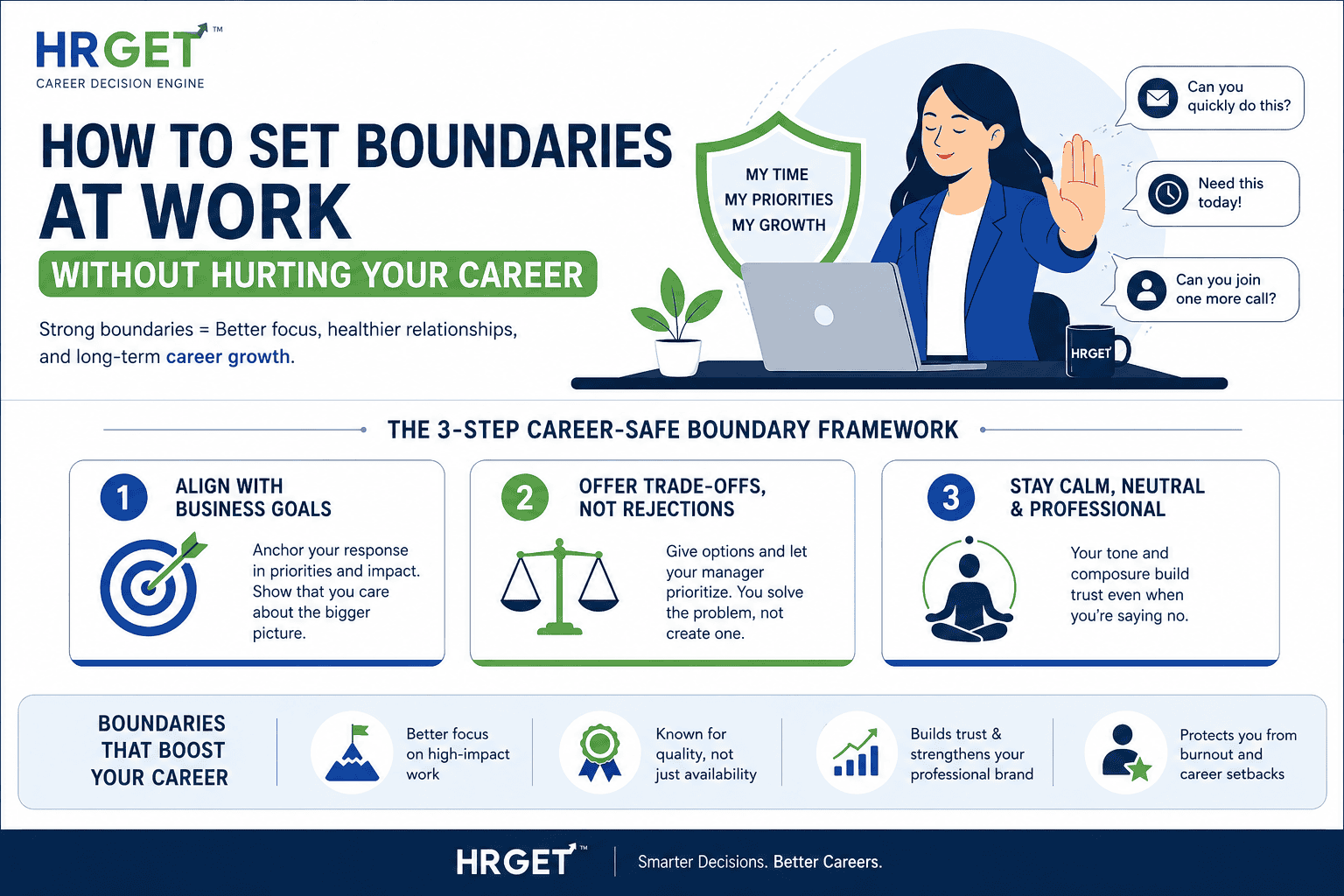
How to Set Boundaries at Work Without Hurting Your Career: The 3-Step Framework
Look, “just say no” is terrible advice. It’s the kind of thing that sounds empowering in a self-help book and gets you a difficult reputation at your actual job. What works is a structured approach that ties your limits to business outcomes — not personal preferences.
Here’s what I teach in leadership coaching sessions:
Step 1: Anchor Every Response in Business Impact
Before you push back on anything, frame your response around outcomes — not around your capacity or comfort. This single shift changes how your boundary is received.
❌ “I’m too busy right now.”
The first version sounds like avoidance. The second sounds like a senior professional thinking about the business.
Step 2: Always Offer a Trade-off, Never Just a Refusal
Never just say no. Always present a decision for your manager to make. This is the move that separates professionals who set boundaries effectively from those who create friction.
Practical example: “I can take this on, but Task A will slip by two days. Which would you like me to prioritize?”
What this does: it shifts the decision responsibility to the person with authority. It signals that you’re thinking about priorities, not avoiding work. And it prevents you from becoming the scapegoat when something gets delayed — because you documented the trade-off in advance.
Step 3: Tone Is 70% of the Battle
The words matter. The tone matters more. A boundary delivered with frustration, anxiety, or defensiveness reads as a complaint. The same boundary delivered with calm confidence reads as maturity.
Avoid emotional language. Avoid over-explaining. And absolutely avoid the trap of offering a 10-minute justification for a decision that warrants two sentences. Over-explaining signals insecurity — it makes you look like you’re seeking approval rather than communicating professionally.
Real Scenarios: Word-for-Word Scripts for 5 Situations
Theory is fine. Scripts are better. Here are the five situations that come up most often — and exactly what to say in each one.
Scenario 1: Manager Assigns Work When You’re Already Overloaded
Situation: You’re maxed out on two deliverables. A new task lands on your desk.
✅ What to say: “I’m currently at capacity with [Project A] and [Project B]. If this new task is the priority, I can shift focus — but one of those will need to move. How would you like me to prioritize?”
This works because you’re not refusing. You’re surfacing a real constraint and asking for direction. Most managers, when confronted with the actual trade-off, will either deprioritize the new task or get you support.
Scenario 2: Too Many Meetings Killing Your Productivity
Situation: Your calendar is back-to-back and actual work isn’t getting done.
✅ What to say: “I’ve noticed my calendar is quite full, and it’s starting to impact my delivery timelines. Can we look at which meetings I should be attending versus which I can contribute to asynchronously?”
Note the framing: you’re raising a delivery risk, not complaining about meetings. That reframe matters enormously in how leadership receives the message.
Scenario 3: Constant After-Hours Messages
Situation: Your manager or team pings you at 9 p.m. expecting immediate responses.
✅ What to say (proactively, before the pattern solidifies): “I want to set expectations around response times — I’ll be offline after 7 p.m. on weekdays. For anything urgent, please flag it as high priority and I’ll address it first thing in the morning.”
Setting this expectation proactively, early in a role, is far easier than trying to roll it back after you’ve established yourself as available at all hours. More on timing below.
Scenario 4: A Colleague Keeps Offloading Their Work
Situation: A peer keeps asking you to pick up their tasks, and it’s becoming a pattern.
✅ What to say: “I’d genuinely like to help, but I’m at capacity right now. If this needs to get done urgently, we might need to loop in [manager] to figure out how to redistribute.”
Bringing in the manager sounds risky — but it’s actually protective. It documents the pattern and prevents you from silently absorbing others’ workload indefinitely.
Scenario 5: An Unrealistic Deadline
Situation: You’ve been asked to deliver something by Friday that realistically needs ten days.
✅ What to say: “Given the scope here, delivering by Friday risks the quality of the output. A more realistic timeline would be Wednesday of next week — that gives me the time to do this properly. Does that work, or is there flexibility on scope?”
You’re not saying it can’t be done. You’re naming the quality trade-off and offering a solution. That’s a very different conversation.
Smart Strategy: How Professional Limits Actually Accelerate Your Career
Here’s the part most boundary advice completely misses. Done right, limits at work don’t just protect you from burnout — they actively signal promotability.
You become known for quality, not volume. High performers aren’t the people doing the most tasks. They’re the people whose work consistently moves the needle. When you protect your focus, your output quality improves — and that’s what gets noticed in performance reviews.
You signal senior-level thinking. Prioritization, trade-off management, and intelligent pushback are literally leadership competencies. When you demonstrate them at the mid-level, you’re showing leadership readiness. Most managers I’ve worked with notice this — even if they don’t explicitly articulate it.
You avoid the burnout trajectory. Burnout doesn’t announce itself. It accumulates over 12–18 months of chronic overwork, and by the time it shows up in your performance metrics, it’s already damaged your reputation. The professionals who set sustainable limits early stay in the game longer — and with more energy for the work that actually matters.
| Employee A: No Boundaries | Employee B: Strategic Boundaries |
|---|---|
| Says yes to everything | Pushes back with trade-offs |
| Always busy, rarely impactful | Focused on high-priority deliverables |
| No clear ownership | Known for specific, visible outcomes |
| Reliable executor label | Strategic thinker label |
| Stuck at same level | On the promotion track |
In my experience, Employee B gets promoted. Nearly every time. The busyness of Employee A is visible to everyone except the people doing the work.
Common Mistakes That Make Workplace Boundaries Backfire
If you do this wrong, it will affect your career. Let’s be honest about the failure modes.
Being too blunt or direct. “I can’t do this” or “That’s not my job” are conversation-enders. They signal inflexibility, not strategic thinking. Even when you’re right, the delivery matters. Reframe every refusal as a decision about priorities, not a refusal of effort.
Saying yes, then complaining. This is one of the most reputation-damaging patterns I see. You agree to the task, then privately grumble to colleagues, deliver late, or do it resentfully. It destroys trust faster than a clean “no” ever would. If you say yes, own it fully.
Over-explaining. You don’t need a 10-minute defense of why you can’t take on more work. Two sentences, framed around priorities and outcomes, is enough. Over-explaining reads as insecurity and invites negotiation on every point you raise.
Setting limits too late. Waiting until you’re in full burnout to push back means your tone will be emotional and your track record will already show the effects. The time to establish expectations is in the first 30–60 days of a role — not month seven when you’re exhausted and resentful.
Being inconsistent. Sometimes saying yes to after-hours messages, sometimes not. Sometimes pushing back on deadlines, sometimes absorbing them silently. Inconsistency confuses people and makes your behavior unpredictable. Consistency — even if your limits are firm — actually builds more trust than unpredictable flexibility.
The HR Insider View: What Managers Actually Notice
Let me tell you what hiring managers and HR partners are actually observing — because it’s not what most employees think.
Professionals who set limits are seen as leadership candidates. When someone consistently anchors their pushback in business impact, manages trade-offs clearly, and communicates with confidence rather than anxiety — that’s a leadership trait. I’ve seen this exact behavior flagged in succession planning conversations. Not as “difficult.” As “ready.”
How you say no matters more than that you say it. HR partners are not tracking who declines tasks. They’re tracking patterns of behavior, communication quality, and judgment. A well-framed limit signals judgment. A poorly framed one signals immaturity or aggression. Same decision, completely different perception.
Top performers protect their time aggressively. This isn’t anecdotal — it’s a consistent pattern across high-output teams. The people consistently in the top quartile of performance reviews block focus time, decline low-value meetings, and are intentional about where their energy goes. They’re not working harder than their peers. They’re working more selectively.
Documenting your workload protects you. If you’re at capacity and someone assigns more, document the trade-off in writing — even a brief email: “As discussed, I’ll deprioritize X to take on Y.” This creates a paper trail that protects you in performance reviews and prevents revisionist history about what you agreed to.
One thing I’ll add that most articles won’t tell you: in cultures where overwork is normalized (certain Indian IT services firms, US investment banks, UK Magic Circle law firms), you may face more friction here than in tech companies or multinationals with explicit well-being frameworks. Read your environment honestly. The strategy is the same — the calibration of how firmly to push is contextual.
Pro Tip: Set Limits Early in a Role — Not Later
This is the single most important tactical advice I can offer, and almost no one does it.
Whatever behavior you establish in your first 60 days becomes your baseline expectation. If you respond to messages at midnight in week one, you’ve just set the expectation that midnight responses are available. That expectation is very hard to walk back in month four without creating friction or confusion.
Set your work style expectations early. Communicate them proactively. “I’m at my best with two focused morning hours — I block those for deep work.” “I wrap up at 6:30 and respond to non-urgent messages the next morning.” These aren’t complaints. Said early, with confidence, they’re simply professional operating parameters.
The professionals who struggle most with limits at work are usually the ones who waited — who were flexible for too long and now face the much harder task of reshaping expectations that are already baked into how their team relates to them.
Setting Boundaries at Work Is a Career Strategy, Not a Risk
If you’ve been holding back from setting limits because you’re afraid of how it’ll look — I understand the instinct. It’s a reasonable fear. But it’s based on a misread of what actually drives career success.
The truth is that how to set boundaries at work without hurting your career isn’t a question of whether to do it. It’s a question of how to do it — with clarity, confidence, and a consistent anchor in business outcomes. That’s the version that gets you recognized. That’s the version that opens doors.
Start with one change this week. Identify one meeting you shouldn’t be in, one task that isn’t your priority, or one after-hours expectation that needs a reset. Apply the framework. See how it lands. Nine times out of ten, you’ll find that the conversation you were dreading turned out to be completely fine — and that you’ve started building the reputation of someone who thinks like a leader.
Want to go deeper? Read our guide on how to deal with a toxic boss — because sometimes the boundary problem isn’t the workload, it’s the manager.
Frequently Asked Questions
Will setting boundaries at work make me look uncooperative?
Not if the framing is right. When you tie your limits to business priorities — “I want to protect quality on Project X” — rather than personal preference, most managers read it as mature and strategic. The delivery matters as much as the decision. Frame everything around outcomes, not workload complaints, and the perception shifts entirely.
How do I set boundaries with a difficult or demanding manager?
Lead with data and priorities, not feelings. Document your current workload clearly — tasks, deadlines, dependencies — and present it visually if you can. Then ask for direction: “Given this workload, which should I prioritize?” You’re not resisting; you’re asking for management input. Most reasonable managers respond well to this. Unreasonable ones are a separate problem entirely.
Can saying no at work hurt my chances of promotion?
Poorly communicated limits can — but strategic ones often help. Leaders are expected to prioritize, manage trade-offs, and push back intelligently. When you demonstrate these skills at a mid-level, you signal readiness for more senior responsibility. The risk is how you do it, not that you do it.
What if my company culture genuinely expects overwork?
Then you have a real decision to make. You can set limits carefully and strategically within that culture — which some professionals do successfully — or you can recognize that the environment itself is unsustainable and start planning a move. What you shouldn’t do is absorb the overwork indefinitely while hoping it changes. In 2026, burnout attrition is one of the most expensive talent problems companies face, and the data increasingly supports employees who enforce sustainable working conditions.
How do I stop automatically saying yes to every request?
Build a pause into your response habit. Instead of answering immediately, say: “Let me check what’s on my plate and get back to you by end of day.” That gap — even 30 minutes — gives you time to assess whether the request aligns with your actual priorities. Over time, this becomes a reflex that replaces the automatic yes response.
Is it okay to not respond to work messages after hours?
Yes — but communicate your availability proactively rather than just going silent. Setting a clear expectation (“I’m generally offline after 7 p.m. and will respond first thing tomorrow”) is far more effective than simply not responding. It avoids ambiguity, manages your manager’s expectations, and frames the limit professionally rather than as avoidance.
How do I deal with the guilt of saying no at work?
Reframe the logic: saying no to a low-priority request is saying yes to the high-priority work that actually moves your career forward. Guilt is usually tied to the belief that being helpful means being available for everything. But the most helpful thing you can do — for your team and yourself — is to be excellent at the work that matters most, not mediocre at everything.
When is the best time to start setting limits in a new job?
In the first 30 to 60 days — before patterns solidify. Whatever behavior you establish early becomes the baseline expectation for how you operate. If you wait six months, you’re trying to undo habits people have already formed about your availability and workload tolerance. Start as you mean to go on, communicated with confidence from the start.

Organizational Psychologist & Workplace Behavior Advisor (Former consultant with Boston Consulting Group, research contributor aligned with Harvard Business Review)
Dr. Amelia Grant is an organizational psychologist specializing in burnout, toxic workplaces, leadership behavior, and employee mental resilience. She writes practical, research-backed workplace guidance for modern professionals.