If you’ve just been put on a PIP (Performance Improvement Plan), here’s the uncomfortable truth most HR guides won’t say out loud: in a large number of companies, a performance improvement plan isn’t really a support tool. It’s a formal signal that your job is at risk — and in many cases, the decision has already been made before you even signed the document.
But that doesn’t mean you’re out of options.
Handled correctly, a PIP can either help you recover your standing at work — or give you a controlled, strategic exit that protects your reference and your next opportunity. This guide covers both paths with zero fluff: what a PIP actually is, why companies really use them, and exactly what you should do next.
What Is a PIP (Performance Improvement Plan)?
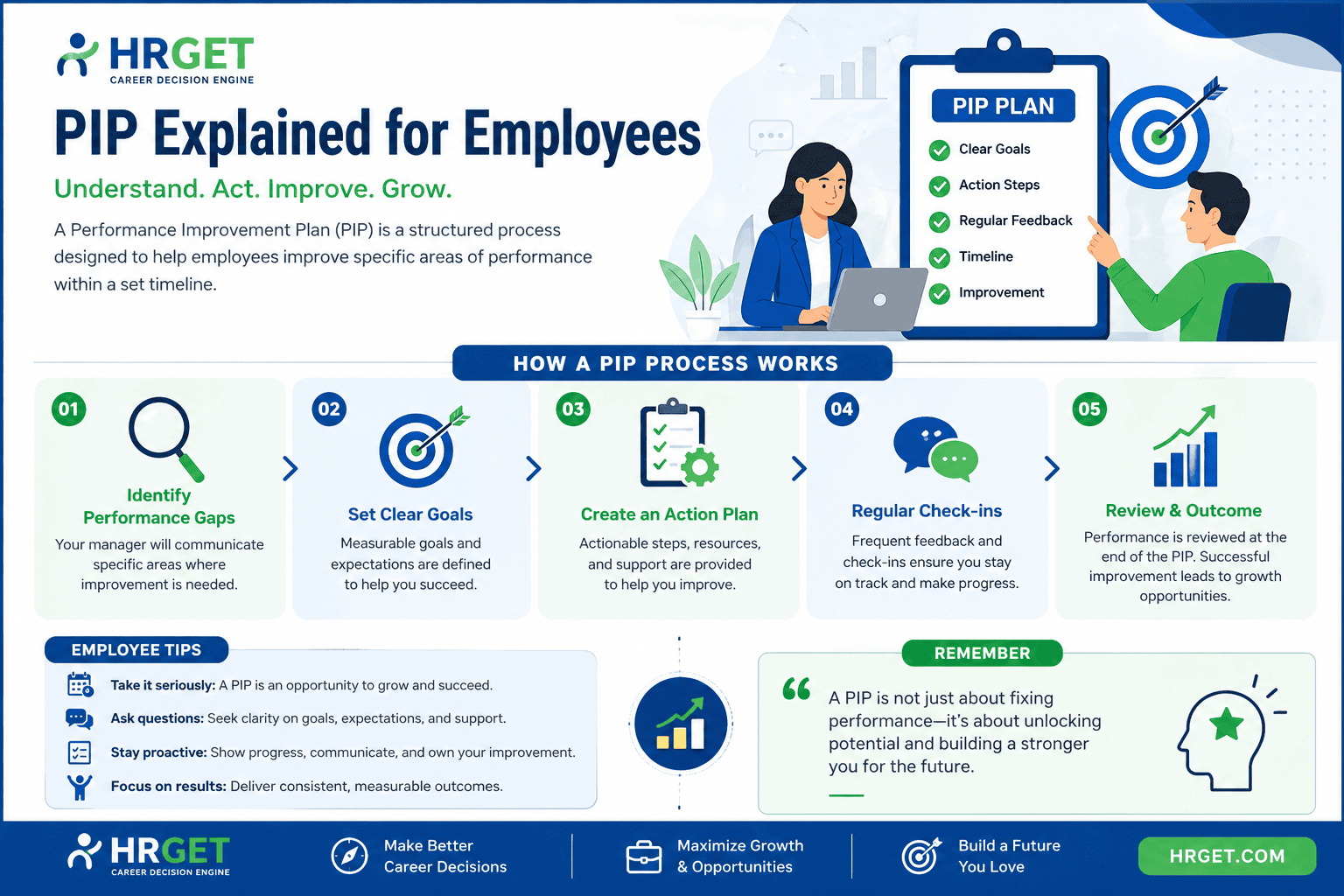
A Performance Improvement Plan is a formal HR document issued by your employer that outlines specific performance concerns, sets measurable expectations for improvement, defines a timeline (typically 30 to 90 days), and states the consequences if those expectations aren’t met — which is usually termination.
On paper, a PIP is framed as a structured opportunity to get back on track. In practice, it’s doing two things simultaneously: giving you a defined window to improve, and building a paper trail that protects the company legally if they proceed with termination.
That dual function is worth understanding before you react. A PIP isn’t just HR paperwork — it’s a legal and HR risk-management tool. In theory, it’s supportive. In a lot of real-world cases, it’s pre-termination documentation with a 60-day runway attached.
I’ve seen both versions play out. The ones who handle it well are the ones who understand which version they’re actually in — early.
Why Companies Put Employees on a PIP
Most people assume a PIP is purely about underperformance. That’s true in some cases — but far from all of them. After years of watching how HR processes actually work inside organizations, here’s a more honest breakdown of why PIPs get issued:
Genuine performance issues — missed deadlines, consistently low output, quality problems, or poor communication that’s been flagged multiple times. This is the version HR talks about publicly.
Role misfit — you’re capable, but not for this specific role, this specific team, or this specific manager’s expectations. The job evolved and the expectations changed, and the gap widened without anyone addressing it directly.
Manager misalignment — sometimes a PIP is less about your performance and more about a breakdown in the manager-employee relationship. Unclear expectations, lack of support, or a personality clash that HR doesn’t want to mediate can all end up documented as “performance” issues.
Organizational politics and budget cuts — this one doesn’t get talked about enough. PIPs are sometimes used as quiet layoff tools when a company wants to eliminate a role or reduce headcount without the optics of a formal redundancy process. If you’re on a team being restructured and you receive a PIP without a meaningful prior warning conversation, this is worth considering.
Documentation before firing — in at-will employment states in the US, companies can technically terminate without cause. But most HR and legal teams prefer documented process, especially for senior employees or anyone in a protected class. A PIP creates that documentation trail.
Here’s the thing most HR articles won’t tell you: a PIP is often more about reducing company legal risk than it is about genuinely helping you succeed. That’s not cynicism — it’s just how the process works in practice. Knowing this is actually useful, because it tells you how to respond.
Is a PIP a Warning or a Termination Step?
The honest answer: it’s both, and which one it actually is depends heavily on context.
In the best case, a PIP is a genuine intervention. Your manager is frustrated but still invested. The goals are specific, achievable, and supported. You improve. You stay. A minority of PIPs — particularly in smaller companies or with certain managers — genuinely do function this way.
In the more common case at large tech companies, financial firms, and multinationals, a PIP is a managed exit with a defined end date. At companies like Amazon, Meta, or Google, informal data shared by employees and HR professionals consistently shows that PIP success rates — meaning the employee stays and the PIP is formally closed — can be surprisingly low. The exact numbers vary and are never published officially, but the pattern is well-documented in HR circles.
The signal to watch for: if the PIP arrives without any meaningful prior feedback conversation, if your manager seems disengaged during the process, or if the goals feel deliberately vague or unachievable — these are indicators that the decision has already been made and the paperwork is catching up.
That said, context really does matter. Some managers genuinely want to help. Some PIPs are issued because a well-meaning HR department requires it before any termination, regardless of the manager’s intent. Reading the situation accurately is the first step to responding correctly.
What a Typical PIP Looks Like
A standard performance improvement plan will include five core components. Knowing these helps you evaluate whether your PIP is reasonable — or a setup.
| PIP Component | What It Should Say | Red Flag Version |
|---|---|---|
| Problem Areas | Specific, documented issues with dates and examples | Vague language like “attitude” or “not meeting expectations” |
| Measurable Goals | Clear metrics: “Deliver X by date Y” or “Score above Z on feedback” | Subjective targets: “show more initiative” or “better communication” |
| Timeline | 30, 60, or 90 days — standard and stated clearly | Unusually short timelines (under 30 days) with no rationale |
| Support Offered | Weekly check-ins, training access, or named mentor | No support listed; you’re left to figure it out alone |
| Outcome Clause | Clear statement: failure results in termination or reassignment | Ambiguous language that leaves consequences open-ended |
If the goals in your PIP are vague or keep shifting, that’s a significant red flag. Goals that can’t be objectively measured give your employer near-unlimited discretion to say you “failed” — regardless of what you actually delivered.
Real Scenario: How PIPs Actually Play Out
Let me walk you through three patterns I’ve seen — because most people reading this right now are somewhere inside one of them.
The Recoverer. Priya, a senior analyst at a mid-sized consulting firm, received a PIP after a rough quarter with three missed deliverables. Her manager was direct about what needed to change. Priya asked for a clarification meeting, got specific on the targets, sent written weekly updates, and delivered two ahead of schedule. Six months later, she was assigned to a high-visibility project. PIPs do end this way — when the goals are real, the manager is invested, and the employee executes relentlessly and visibly.
The Confused Fighter. Marcus, a product manager at a tech company, received a PIP with goals that changed at every check-in. He worked 12-hour days and met most of the stated targets — but the goalposts kept moving. By week eight, the feedback was that his “communication style” was still a concern, despite no specific examples. He was let go at day 87. This is the most common PIP outcome: someone who works hard but can’t win because the game was never designed to be won.
The Strategic Exit. James, a finance director, saw the dynamics clearly within the first week of his PIP. Budget cuts were coming. His manager was new and had different priorities. He performed his PIP duties professionally, said nothing controversial, and spent the other part of his time updating his resume, activating his network, and landing interviews. He resigned on day 45 with a new offer in hand, with his reference intact and his head held high. This is the most underrated PIP outcome — and more people should plan for it deliberately.
Most people fall into the middle scenario without meaning to. The smart move is to read your situation early and consciously choose Scenario A or Scenario C — not drift into Scenario B by default.
Can You Survive a PIP? (Brutally Honest Answer)
Yes — but the conditions have to be right. Here’s an honest framework for assessing your actual odds.
You have a real chance of surviving a PIP if your manager is still genuinely invested in your success, the goals are specific and objectively measurable, your past performance was strong before a recent downturn, and the core issue is a fixable skills or process gap — not a behavioral or political one.
Your odds drop significantly if your manager has clearly lost trust and is disengaged during check-ins, the feedback you’re receiving is vague or keeps shifting, you’re being excluded from key meetings or projects you were previously part of, or there are team dynamics or budget pressures that suggest the role itself is being eliminated.
Here’s the hardest truth about PIPs: most are decided before they start. The formal 30 or 90-day process is largely about compliance and documentation, not deliberation. That doesn’t mean you shouldn’t try — it means you should try with your eyes open, while also preparing a Plan B in parallel.
What To Do Immediately After Being Put on a PIP
The first 72 hours after receiving a PIP are the most important. This is where people either set themselves up to recover — or make mistakes they can’t walk back.
Step 1: Get absolute clarity on the goals. Before you do anything else, schedule a meeting with your manager and ask three direct questions: “What does success look like at the end of this period — specifically?” “What are the non-negotiable targets I must hit?” “How exactly will progress be measured, and by whom?” Document the answers in writing. Send a follow-up email summarizing what was agreed. This protects you legally and removes ambiguity that can be used against you later.
Step 2: Over-communicate your progress. Don’t assume your manager is tracking your wins. Send written weekly updates. Keep them short, factual, and metric-focused. “Completed X on Monday. Y delivered to stakeholder ahead of schedule. Z in progress, on track for Friday.” Make your improvement impossible to ignore or dispute.
Step 3: Fix the actual root problem — not just the symptoms. Working harder isn’t the same as working differently. If the real issue is prioritization, fix your prioritization system. If it’s communication, change how and how often you communicate. If it’s output quality, add a review step before submitting work. Identify the root cause and address that specifically — not just volume or effort.
Step 4: Start your job search quietly, even if you want to stay. This isn’t defeatist — it’s strategic. Having options gives you leverage and reduces the emotional pressure that often leads to poor decisions during a PIP. A competing offer also gives you a negotiating position if you want to discuss exit terms. Start reaching out to your network, update your LinkedIn (carefully), and run interviews in parallel with your PIP performance.
Step 5: Document everything. Save every email, every piece of feedback, every deliverable with a timestamp. If things go south and termination follows, this documentation is your first line of protection — whether you’re challenging the outcome, seeking severance, or managing a future reference conversation.
Smart Strategy: Fight or Exit?
This is the decision most people avoid making explicitly — so they end up making it badly by default.
Choose to fight if: you trust your manager and believe they’re genuinely invested in your success; the role is valuable to you long-term and worth the effort; the issues cited in the PIP are real and fixable within the timeline; and the organizational environment isn’t actively working against you.
Choose to exit if: trust with your manager is broken and unlikely to rebuild; the feedback keeps shifting and the goalposts are moving; you’re being excluded from work or information that would help you succeed; or you have a gut feeling — backed by evidence — that the decision has already been made.
The hybrid strategy is actually the most sensible approach for most people: perform like you’re staying, prepare like you’re leaving. Deliver against the PIP targets professionally and visibly. Simultaneously activate your job search, update your materials, and run interviews. This gives you genuine optionality — either the PIP resolves and you stay on stronger footing, or you exit with a job already lined up and your reference intact.
What you don’t want to do is get so emotionally invested in “winning” the PIP that you neglect your outside options — and then end up terminated with nothing lined up and no leverage.
Common Mistakes That Accelerate Termination
These are the patterns I see most often — and they consistently make a difficult situation worse.
Arguing instead of adapting. Being right about something — an unfair expectation, a vague goal, a manager who wasn’t clear — does not save your job. The time to dispute process is before the PIP or in a formal HR conversation. During the PIP, arguing comes across as defensive and uncooperative, and it almost always accelerates the exit.
Failing to document your own progress. If your improvement isn’t in writing, it effectively didn’t happen in the HR record. Don’t rely on your manager to acknowledge your wins. Create your own paper trail — weekly updates, completed deliverables, stakeholder feedback — and keep copies outside your work email.
Working harder but not differently. More effort applied to the same behavior pattern rarely moves the needle during a PIP. Managers and HR are looking for demonstrable behavior change — a different approach, a different communication style, different output quality. Doing the same things with more intensity usually doesn’t register as meaningful improvement.
Missing the political signals. PIPs don’t happen in a vacuum. Pay attention to who else is being managed out, whether your team is being restructured, and whether there are budget pressures that make your position financially inconvenient. These signals often tell you more about your actual situation than the PIP document itself.
Waiting too long to start your job search. This is probably the single most common and most costly mistake. Most people wait until the PIP ends — either successfully or not — before thinking about the outside market. By then, you’ve lost weeks you could have used to land interviews, and you’re negotiating from a position of urgency rather than choice.
Pro Tips From HR Insiders
A few things that HR professionals actually say about PIPs — behind closed doors — that rarely make it into the official guides:
A PIP is as much about perception as it is about performance. Managers and HR aren’t just watching your output — they’re watching how you show up. Defensiveness, disengagement, or open frustration during check-ins are often what seal the outcome, even when the actual work numbers are improving.
Early wins matter disproportionately. If you’re going to survive a PIP, you need to show meaningful improvement in the first two to three weeks — not just by the deadline. A strong first showing signals that the intervention is working and gives your manager a narrative to take upward. A slow start, even if things improve later, rarely gets reframed positively.
If your manager goes quiet, that’s a bad sign. Regular, engaged feedback from your manager during a PIP usually indicates they’re still hoping for a good outcome. Minimal interaction, canceled check-ins, or curt responses typically mean the decision has already been made and they’re waiting out the clock.
Consistency beats brilliance during a PIP. One outstanding project doesn’t undo three weeks of missed targets. What HR and managers want to see during a PIP period is steady, reliable, visible improvement — week over week. Boring consistency is more valuable here than a single impressive moment.
FAQs About Performance Improvement Plans
Is a PIP a sign I will be fired?
Not automatically — but it significantly raises the risk. A PIP is a formal warning that your employment is at risk if performance doesn’t change. In many large companies, PIPs do precede termination in the majority of cases, though this varies widely by organization, manager, and the nature of the issues cited. Treat it seriously regardless of the framing you receive.
Should I resign during a PIP?
Only in two situations: you already have another offer in hand, or the situation is clearly unsalvageable and staying longer will damage your reference or mental health. Resigning voluntarily typically disqualifies you from unemployment benefits in the US, and from redundancy pay in the UK and India. Before resigning, explore whether a negotiated exit with severance is possible instead — it often is, especially if you’ve documented your performance during the PIP period.
Can I negotiate the terms of a PIP?
Yes — and you should. You’re entitled to ask for clarification on any goal that isn’t specific or measurable. You can request adjusted timelines if the original ones are unrealistic given your workload. You can ask for named support resources — a mentor, training program, or specific tool access. Frame all requests professionally and in writing. Getting clarity early protects you and demonstrates good faith engagement with the process.
Does a PIP show up on background checks or affect future jobs?
A PIP itself is an internal HR document and does not appear on standard background checks. It won’t show up on employment verification reports. Where it can affect you is in reference calls — if a former manager is asked directly about your performance and mentions the PIP, it can colour the conversation. This is why managing your exit well (leaving professionally, on your own terms if possible) matters as much as the PIP itself.
How long does a PIP typically last?
The most common PIP lengths are 30, 60, or 90 days — with 30-day PIPs generally used for more urgent or clear-cut situations, and 60 to 90-day plans for more complex performance issues. In India, PIPs at large multinationals often run 60 to 90 days. In the UK, informal performance management periods can run even longer before a formal PIP is issued. The timeline should be proportional to the complexity of the goals.
Can HR override a manager’s PIP decision?
Rarely, and only in specific circumstances — typically if there’s a clear process violation or if the PIP appears to be discriminatory (targeting a protected class). In standard situations, HR’s role is to support and document the manager’s decision, not to reverse it. Escalating to HR can be useful for ensuring the process is followed correctly, but expecting HR to advocate for you against your manager’s assessment is usually misplaced.
Should I tell recruiters or interviewers I’m on a PIP?
No. A PIP is an internal HR process and you have no obligation to disclose it during a job search. If asked why you’re looking, keep it neutral and forward-focused: “I’m looking for a role where I can grow in X direction” or “I’m exploring opportunities that align better with where I want to take my career.” Don’t lie — but you don’t need to volunteer information that will bias an interviewer before they’ve evaluated you on your merits.
What a PIP Really Means for Your Career
Here’s the bottom line: a performance improvement plan is a career turning point, not just an HR formality. It forces a decision — either by you, or by the company — and the worst thing you can do is treat it passively.
The people who come out of PIPs well — whether they stay or they leave — are the ones who read the situation clearly within the first week, define their strategy deliberately (fight, exit, or hybrid), execute on it with discipline, and keep building their options outside the company in parallel.
If you’re facing termination at the end of a PIP, understanding your severance rights is the next critical step. Read our guide on how to negotiate a severance package — because how you exit matters as much as the performance improvement plan itself.

Emily Carter is a career coach and former McKinsey talent advisor with 15+ years of experience helping professionals navigate career transitions, promotions, and high-stakes job decisions. She has advised professionals across consulting, technology, finance, and corporate leadership roles on offer negotiations, career positioning, and long-term growth strategy.
Role: Career Coach & Ex-McKinsey Talent Advisor: Focuses on helping professionals make smarter career moves—switching jobs, negotiating offers, and long-term career growth. She blends structured thinking with real-world coaching insights.