
Organizational Psychologist & Workplace Behavior Advisor | Former BCG Consultant, HBR Research Contributor | London / Boston | 15+ Years
Office politics is one of those things nobody teaches you, but everyone expects you to understand. You may be great at your job — delivering on time, helping others, staying out of drama — and still wonder why the loudest person gets promoted, why certain people are always protected, or why decisions are made before the official meeting even starts.
Here’s the truth: office politics is not optional.
The real choice is not whether you participate. The real choice is whether you participate blindly, bitterly, or strategically. This office politics survival guide is for professionals who want to grow without becoming fake, manipulative, or morally exhausted. You don’t need to sell your soul to succeed at work — but you do need to understand how influence, perception, relationships, and power actually work inside organizations.
Table of Contents
- What Office Politics Really Means
- Why Office Politics Feels So Unfair
- The Golden Rule: Stay Ethical, Not Naive
- How to Read the Political Map at Work
- Build Influence Before You Need It
- Protect Your Reputation Without Self-Promotion Drama
- How to Deal With Political Coworkers
- What to Do When Your Boss Plays Favorites
- How to Speak Up Without Becoming a Target
- Common Office Politics Mistakes to Avoid
- Real Scenario: The Quiet High Performer Who Got Ignored
- Smart Strategy: The 5-Part Survival Framework
- Pro Tips to Navigate Without Losing Yourself
- When Office Politics Becomes Toxic
- Final Advice: Play the Game Without Becoming the Game
- FAQs About Office Politics
What Office Politics Really Means
Office politics is the informal system of influence inside a workplace. It’s not about gossip, though gossip can be part of it. It’s about the invisible mechanics behind who moves forward and who gets stuck.
At its core, workplace politics determines:
- Who gets heard in meetings
- Who gets access to leadership
- Who gets protected during mistakes
- Who receives credit for work
- Who is seen as “leadership material”
- Which projects get visibility
- Which opinions quietly shape decisions
Most people think office politics means manipulation and backstabbing. Sometimes it does. But at its core, it’s simply about people, power, perception, and priorities.
Every workplace has politics because every workplace has limited rewards: promotions, salary hikes, leadership attention, high-value projects, flexibility, and job security. When resources are scarce, influence matters. That does not mean you need to become a game-player. It means you need to stop assuming that good work automatically speaks for itself.
Key Insight
Good work needs translation. Good work needs visibility. Good work needs sponsorship. That is where smart, ethical office politics begins.
Why Office Politics Feels So Unfair
Office politics feels unfair because most professionals are taught a very simple career formula: work hard → deliver results → get recognized → get promoted. But real workplaces don’t operate that cleanly.
A more realistic formula looks like this:
Work hard → deliver results → make results visible → build trust → align with priorities → get advocated for → grow.
The missing pieces are where politics enters. You may be doing excellent work, but if your manager doesn’t understand the impact, senior leaders don’t know your name, or your contributions aren’t connected to business priorities, your career growth will stall — quietly and unfairly.
Meanwhile, someone else may seem less competent but better connected. They speak confidently. They frame their work well. They build relationships with decision-makers. They understand what leadership actually cares about. That doesn’t always mean they’re corrupt. Sometimes they’re simply better at career navigation.
Here’s the uncomfortable truth: being talented is not enough if the people with power don’t understand your value.
The Golden Rule: Stay Ethical, Not Naive
You don’t need to lie, flatter, manipulate, or betray people to survive office politics. But you also can’t afford to be naive. Understanding the difference between these two positions is central to this office politics survival guide.
| Being Ethical Means… | Being Naive Means… |
|---|---|
| You don’t spread false information | You assume everyone is fair |
| You don’t steal credit from others | You trust every private conversation |
| You don’t sabotage coworkers | You believe your manager sees all your impact automatically |
| You don’t pretend loyalty while harming people privately | You avoid all networking because it feels fake |
| You don’t compromise your core values for short-term gain | You stay silent while others shape the narrative around you |
| You speak up through proper channels when something is wrong | You think avoiding politics keeps you safe — it doesn’t |
Avoiding politics often makes you more vulnerable, not less. The goal isn’t to become political in a dirty way. The goal is to become politically aware. That means understanding the room, knowing who influences decisions, communicating your value clearly, and protecting yourself from unnecessary damage.
How to Read the Political Map at Work
Every workplace has an official org chart and an unofficial power map. The org chart shows titles. The power map shows influence — and the two rarely match perfectly.
Sometimes the most influential person isn’t the most senior person. It might be the long-tenured employee who knows how everything works, the executive assistant who controls access, or the technical expert whose opinion quietly shapes decisions. To navigate office politics, you need to start observing before reacting.
Who actually influences decisions?
In meetings, notice whose opinion changes the direction of the discussion. Whose objections slow things down? Whose endorsement makes a proposal suddenly more viable? That person has real influence, regardless of their title.
Who gets early information?
Some people always seem to know about changes before everyone else — reorganizations, leadership priorities, project shifts. That means they’re connected to important information channels. Build those channels for yourself over time.
Who is trusted by leadership?
Trust is political currency. A trusted person may not always be the most brilliant, but leaders rely on their judgment. If you want to grow, understand what makes that person trusted — and build those same qualities deliberately.
Which teams are currently powerful?
Power shifts based on business priorities. In one year, sales may dominate. In another, product, engineering, finance, or compliance may become central. Your career strategy should reflect where the organization is investing its attention right now — not where it was investing three years ago.
What does leadership actually reward?
Some companies reward innovation. Some reward loyalty. Some reward cost-cutting or speed or risk avoidance. Don’t assume your personal definition of “good work” matches leadership’s definition. Find out. Ask. Observe what gets celebrated in all-hands meetings.
Build Influence Before You Need It
Most people build relationships only when they need something. That’s too late. Influence works best when it’s built before a crisis, a promotion cycle, a conflict, or a major decision. You build influence by being useful, consistent, and trustworthy — not fake, not flattering, just genuinely useful.
Help people without becoming their assistant
Support colleagues when it makes sense. Share context. Offer clarity. Connect people. But don’t become the person who absorbs everyone else’s work without credit. There’s a meaningful difference between being collaborative and being used.
Build cross-functional relationships
Your manager matters enormously, but your manager should not be the only person who understands your value. Build healthy relationships with peers, adjacent teams, HR partners, senior stakeholders, and people who depend on your work. Career growth often happens when multiple voices can say, “Yes, I’ve worked with them. They’re solid.”
Understand other people’s goals
Office politics becomes significantly easier when you understand what others are trying to achieve. Your finance partner cares about cost control. Your sales lead cares about speed. Your engineering manager cares about stability. When you frame your ideas in terms of their goals, you become easier to support — and harder to dismiss.
Be reliable in small things
Influence is built through repeated signals. Replying clearly. Following through. Not overpromising. Giving early warnings. Owning mistakes. Making others look informed. These small behaviors create trust faster than any big speech or impressive project launch.
Protect Your Reputation Without Self-Promotion Drama
Many professionals hate self-promotion because it feels arrogant. But there’s a clear difference between bragging and making your impact visible. If you don’t tell the story of your work, someone else may tell it incorrectly — or simply not tell it at all.
Use impact language
Instead of: “I worked on the report.”
Say: “I built the report that helped leadership identify three cost-saving areas before the quarterly review.”
Instead of: “I helped the team.”
Say: “I helped unblock the team by clarifying ownership and reducing approval delays by nearly two weeks.”
Impact language connects your work to outcomes — and outcomes are what leadership cares about.
Send smart updates
A good update is not a diary. It’s a decision-support tool. Keep it short and structured: what changed, why it matters, what risk exists, what help is needed, and what outcome was achieved. This makes you visible without sounding desperate or self-congratulatory.
Keep a win document
Maintain a private record of your achievements throughout the year. Include projects delivered, problems solved, revenue impact, cost savings, process improvements, stakeholder praise, and metrics before and after. Most people forget their own achievements until performance review season — by then, it’s too late to tell the story clearly.
How to Deal With Political Coworkers
Political coworkers are not all the same. Some are simply ambitious. Some are strategic. Some are insecure. Some are genuinely toxic. You need to correctly identify the type before deciding how to respond — the wrong response to the wrong type can make things significantly worse.
The credit taker
This person repeats your idea in a meeting as if it were theirs. Don’t react emotionally in the room. Instead, calmly anchor the record: “Thanks for building on the point I raised earlier — to add more detail, my recommendation is…” This is professional, clear, and leaves no ambiguity about the origin of the idea.
The gossip networker
This person collects information and trades it socially. Be polite, but don’t feed them sensitive opinions. Anything you say will likely travel. Use neutral responses: “I haven’t looked at it closely.” or “I’d rather understand the full context first.”
The meeting performer
This person sounds impressive in meetings but does little actual work. The best defense is documentation. Clarify owners, deadlines, and deliverables in writing after every key conversation. Performance without execution becomes much harder to hide when accountability is visible.
The silent blocker
This person agrees publicly but resists privately. For silent blockers, ask direct but calm questions: “Is there a concern we should address before moving forward?” or “What would make you comfortable supporting this?” Bring hidden resistance into the open without attacking them personally.
What to Do When Your Boss Plays Favorites
Favoritism is one of the hardest forms of office politics because your manager controls your rating, visibility, project access, and growth opportunities. It can feel like the entire game is rigged before you even play.
First, be honest with yourself. Is it truly favoritism, or is the other person doing something you’re not? Maybe they communicate better. Maybe they take higher-visibility work. Maybe they ask for opportunities while you wait quietly. Understanding the real dynamic is essential before deciding how to respond.
Don’t complain emotionally
Saying “You always favor them” rarely helps and makes you look reactive. Instead, ask for objective growth criteria. Try: “I want to understand what it would take for me to be considered for similar opportunities. What specific skills or outcomes should I build over the next quarter?” This shifts the conversation from emotion to standards.
Ask for equal access to opportunities
You can say: “I’d like to be considered for upcoming high-impact projects. Can we discuss what kind of work would position me for the next level?” This is assertive without sounding accusatory — and it creates a documented conversation trail.
Build visibility beyond your boss
If your manager is biased or insecure, your reputation needs more than one channel. Develop relationships with stakeholders, skip-level leaders, and cross-functional partners. Do good work in places where others can see it and report on it.
Document important conversations
If favoritism turns into unfair treatment, exclusion, retaliation, or discrimination, documentation matters. Keep notes on dates, decisions, expectations, feedback, and outcomes. Don’t weaponize it — but use it to stay clear and protect yourself if the situation escalates.
How to Speak Up Without Becoming a Target
Speaking up at work is important, but how you speak determines whether you’re heard or dismissed. The politically smart professional doesn’t avoid truth — they package truth in a way people can receive it.
Avoid public humiliation
If you challenge someone in a way that embarrasses them, they’ll focus more on defending their ego than solving the problem. Instead of “This plan makes no sense,” try: “I see one risk we may want to address before committing.” Same concern — very different emotional reaction.
Use business language, not personal judgment
Instead of “Finance is blocking everything,” say: “The approval process is adding two weeks to delivery. Can we align on a faster path for low-risk items?” Business language keeps the discussion objective and positions you as a problem-solver, not a complainer.
Offer options, not just criticism
Leaders grow tired of people who only point out problems. A stronger pattern is: “I see a risk. Here are two possible ways to reduce it.” This makes you useful and forward-looking — not difficult to manage.
Know when to go private
Some feedback should never be given in a large meeting. If the issue is sensitive, political, or tied to someone’s credibility, raise it privately first. That protects the relationship and significantly increases the chance of real change.
Common Office Politics Mistakes to Avoid
Mistake 1: Thinking hard work is enough
Hard work matters. But invisible hard work has limited career value. You need outcomes, visibility, and advocates — not just effort.
Mistake 2: Trusting everyone too quickly
Be friendly with many people. Be deeply trusting with very few. Professional trust should be earned through consistency, discretion, and behavior under pressure — not just pleasantness during easy times.
Mistake 3: Sharing frustration with the wrong person
Venting feels good for five minutes. Then it can become a career risk. Before sharing frustration, ask yourself: “Would I be comfortable if this reached the person I’m talking about?” If not, be careful.
Mistake 4: Avoiding senior people
Many employees avoid senior leaders because they feel intimidated or don’t want to appear presumptuous. But senior leaders are humans with business problems. If your work helps solve those problems, learn how to communicate with them directly and confidently.
Mistake 5: Becoming the office therapist
If everyone comes to you to complain, you’ll become emotionally overloaded and politically exposed. Support people — but don’t become the storage unit for everyone’s negativity. That role costs more than it returns.
Mistake 6: Fighting every battle
Not every unfair comment deserves a war. Choose battles based on impact, pattern, and risk. A politically mature professional knows when to respond, when to document, when to let it go, and when to escalate.
Real Scenario
The Quiet High Performer Who Got Ignored
An employee named Priya consistently delivers high-quality work. She helps teammates, fixes problems quietly, and stays completely out of office drama. She’s exactly the kind of professional every team claims it wants.
Another colleague, Arjun, delivers decent work but gives crisp updates, builds relationships with stakeholders, and regularly frames his contributions in terms of business impact. He’s visible, articulate, and deliberate about how he’s perceived.
At promotion time, Arjun gets the bigger role. Priya feels betrayed. From her view, the company rewarded politics over performance. From leadership’s view, Arjun seemed more ready because they understood his work, saw his influence, and trusted his communication.
Priya’s mistake wasn’t being quiet. Her mistake was assuming that quiet excellence would be automatically discovered.
The better strategy? Priya should have shared monthly impact updates, asked her manager directly about promotion criteria, built stakeholder relationships outside her immediate team, presented her work in business terms, collected documented evidence of outcomes, and asked for visible ownership opportunities.
That’s not selling out. That’s making sure reality is visible.
Smart Strategy
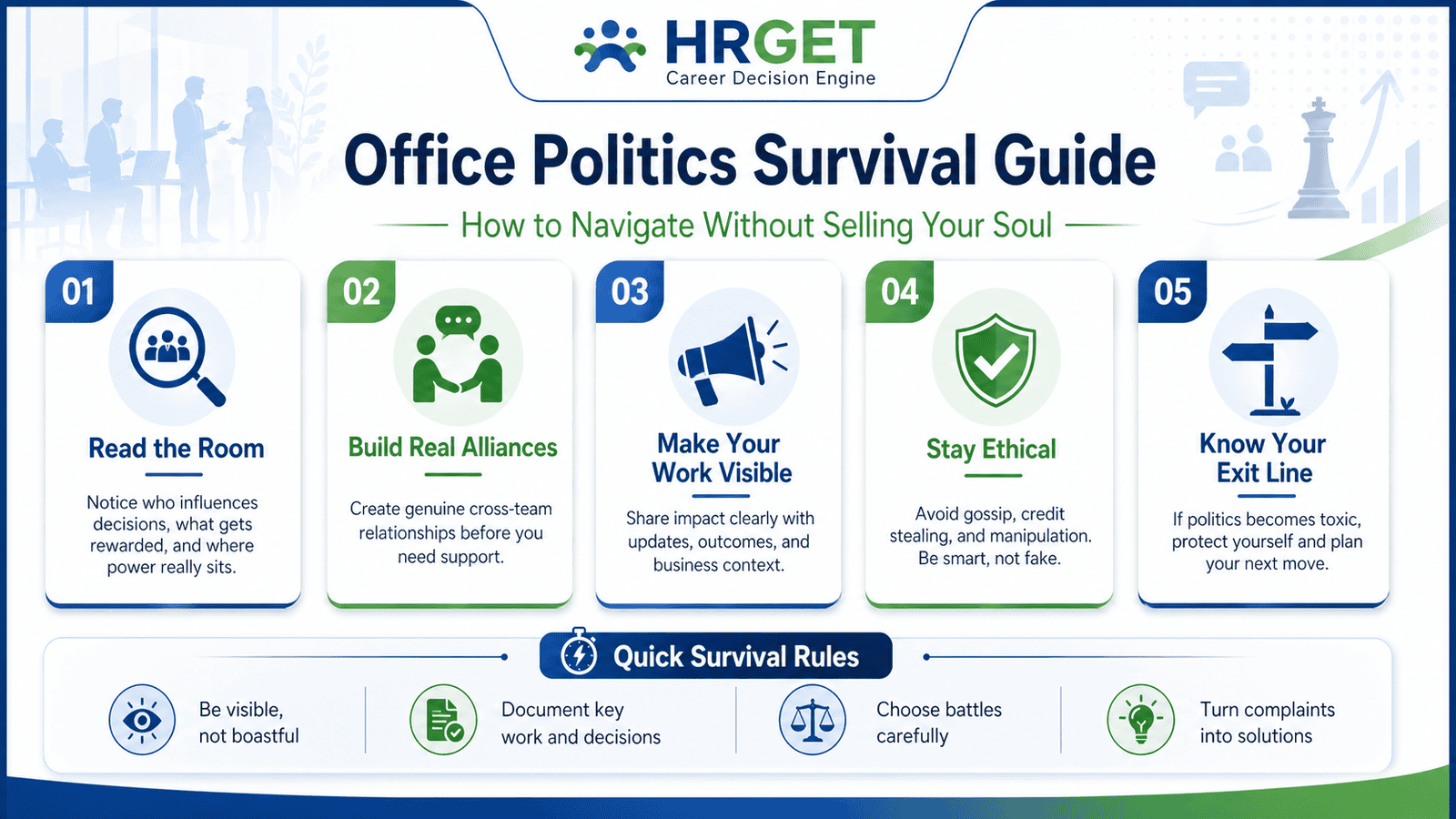
The 5-Part Office Politics Survival Framework
- Observe before reacting. Before judging the workplace, study it. Who has influence? What gets rewarded? Which behaviors are risky? Which people are trusted? Observation gives you power before you need to use it.
- Build genuine alliances. Don’t network only upward. Build relationships with peers, juniors, cross-functional partners, and senior stakeholders. A strong reputation is distributed across many people — not dependent on any single one.
- Communicate your impact. Don’t wait for performance review season. Make your work visible through updates, demos, stakeholder notes, and measurable outcomes throughout the year.
- Stay clean in conflict. Don’t gossip, exaggerate, or attack. Be factual. Be calm. Keep records. Use business language. Escalate only when the pattern is serious and documented.
- Know your exit threshold. Sometimes the smartest political move is leaving. If the environment rewards dishonesty, punishes transparency, blocks growth, or damages your mental health, shift your goal from survival to exit planning.
Pro Tips to Navigate Office Politics Without Losing Yourself
Pro Tip 1: Be warm, but not loose
You can be friendly without oversharing. Keep your personal frustrations, salary details, manager complaints, and career plans limited to people you truly trust — not people you simply like.
Pro Tip 2: Praise publicly, disagree carefully
Public appreciation builds goodwill faster than almost anything else. Public disagreement should be thoughtful, business-focused, and respectful — not an opportunity to appear smart at someone else’s expense.
Pro Tip 3: Never surprise your manager unnecessarily
Managers deeply dislike being blindsided. If a senior stakeholder may ask about your work, make sure your manager already has full context. This builds trust and reduces insecurity — two things that make your working relationship much smoother.
Pro Tip 4: Turn complaints into proposals
Instead of saying “This process is broken,” say “This process is creating delays. I suggest we test a simpler approval flow for low-risk requests.” Solutions create influence. Complaints just create noise.
Pro Tip 5: Don’t confuse silence with safety
If people are shaping a negative narrative around you and you say nothing, silence can look like agreement. Correct misinformation calmly and early — waiting too long makes the correction much harder to land.
Warning Signs
When Office Politics Becomes Toxic
Normal office politics involves influence, relationships, and competing priorities. Toxic office politics involves fear, manipulation, retaliation, discrimination, bullying, or systematic unfairness. These are meaningfully different situations requiring different responses.
Watch for: people punished for speaking honestly; credit stealing that’s common and ignored; promotions based solely on loyalty; managers using fear as a control mechanism; HR that protects the company instead of investigating fairly; cliques that actively isolate others; and ethical concerns that are consistently buried rather than addressed.
If you are in this kind of workplace, don’t romanticize resilience. You need a practical plan — documenting incidents, finding internal allies, speaking with HR carefully, consulting an employment lawyer if your rights are involved, and updating your resume in parallel. Your career is too valuable to spend years trying to win a rigged game.
Final Advice: Play the Game Without Becoming the Game
Office politics is not going away. Every organization has power dynamics. Every team has personalities. Every promotion process involves judgment calls. Every leadership group has preferences, fears, and hidden incentives. You can’t control all of it — but you can control how prepared you are.
You can build real relationships. You can communicate your impact clearly. You can protect your reputation through consistent behavior. You can choose your battles wisely. You can refuse to gossip, sabotage, or manipulate.
The goal of this office politics survival guide isn’t to turn you into the most political person in the office. It’s to help you become the person who understands the system well enough to succeed without losing self-respect.
Not “avoid politics.” Not “become ruthless.” But this:
Stay ethical. Stay aware. Stay visible. Stay useful. And never let workplace politics turn you into someone you wouldn’t respect outside the office.
📌 Related Reading: If your situation has crossed into genuinely harmful territory, read our guide on how to deal with a toxic boss at work — including when to escalate, when to document, and when to plan your exit strategically.
FAQs About Office Politics
1. Is office politics always bad?
No. At its basic level, office politics simply means understanding influence, relationships, decision-making, and workplace priorities. It becomes harmful when people use manipulation, gossip, favoritism, or sabotage to get ahead — but navigating politics ethically is a professional skill, not a moral failure.
2. How do I survive office politics if I am an introvert?
Introverts can navigate workplace politics effectively by building fewer but deeper relationships, preparing thoughtful meeting inputs in advance, sending clear written updates, and making their impact visible through documented outcomes rather than constant socializing. Quality of connection matters more than quantity.
3. How can I promote myself without sounding arrogant?
Focus on impact, not ego. Instead of claiming you’re great, explain what problem you solved, what result improved, and why it mattered to the team or business. Impact language reads as informative and useful — not self-promotional — because it’s framed around outcomes, not personal praise.
4. What should I do if someone takes credit for my work?
Stay calm and re-anchor your contribution professionally. In the moment, say: “Thanks for expanding on the point I raised earlier — to add more context…” Going forward, document ownership through written updates and project summaries sent before meetings, so the record is established proactively.
5. Should I tell HR about office politics?
Go to HR when the issue involves harassment, discrimination, retaliation, policy violations, or serious misconduct. For standard workplace politics, first try documentation, honest manager conversations, stakeholder alignment, and careful communication. HR is a resource for escalation — not a first stop for navigational challenges.
6. How do I handle a politically powerful coworker?
Don’t attack them directly unless necessary. Understand their influence, keep all communication documented, avoid giving them sensitive information, and build your own credibility with multiple stakeholders. A distributed reputation is much harder to undermine than one that depends on a single relationship.
7. Can office politics affect my salary and promotions?
Yes, significantly. Salary growth and promotions are influenced not only by performance but also by visibility, trust, demonstrated business impact, stakeholder feedback, and leadership perception. This is precisely why ethical self-advocacy — making your value clear through consistent communication — is a core career skill in 2026.
8. When should I leave a politically toxic workplace?
Consider leaving when the workplace repeatedly rewards manipulation, blocks your growth despite genuine effort, damages your mental health, punishes honesty, or shows no realistic path toward fair treatment. Survival is a useful strategy only when the environment is still worth surviving in.

Organizational Psychologist & Workplace Behavior Advisor (Former consultant with Boston Consulting Group, research contributor aligned with Harvard Business Review)
Dr. Amelia Grant is an organizational psychologist specializing in burnout, toxic workplaces, leadership behavior, and employee mental resilience. She writes practical, research-backed workplace guidance for modern professionals.