

Most people hit a wall with a toxic boss and jump straight to “just quit.” I’ve heard it dozens of times in my practice, and I’ll be honest — it’s almost always the wrong first move.
Here’s what no one tells you: quitting too early costs you money, leverage, and career momentum. You leave on their terms, not yours. And if you land in a worse situation — which happens more often than people expect — you’re now stuck without the institutional knowledge, the network, or the resume wins you could have secured by staying strategically.
But staying without a plan? That’s a different kind of damage — slow, grinding, and often invisible until it’s too late.
This guide is for the professional who’s past the “is my boss toxic?” question and needs a real answer to what comes next. You’ll walk away with a step-by-step framework to handle a toxic boss strategically — protecting your mental health, your professional reputation, and your next move — without burning the bridge on the way out.
What Is a Toxic Boss (Really)?
Before strategy, you need clarity. Not every difficult manager is toxic — and mislabeling one leads to bad decisions.
A difficult boss might have a demanding style, high standards, or poor communication. Frustrating? Yes. Toxic? Not necessarily.
A toxic boss consistently exhibits patterns that harm your wellbeing, performance, or career. Look for:
- Public humiliation or criticism — calling out mistakes in team settings, undermining you in front of peers
- Micromanagement with zero trust — questioning every decision, requiring approvals for routine tasks
- Credit theft and blame-shifting — taking wins publicly, deflecting failures onto the team
- Unrealistic expectations with no support — impossible deadlines, zero resources, and then holding you accountable for failure
- Passive-aggressive or manipulative communication — silent treatment, vague threats, weaponized ambiguity
The distinction that matters most: occasional bad days are normal; consistent harmful patterns are toxic.
Why this matters before anything else: Your strategy depends entirely on what type of toxicity you’re dealing with. A micromanager requires a completely different playbook than an emotional manipulator. Diagnose first. React second.
Why Quitting Immediately Is Almost Always a Mistake
Let’s be direct. Leaving without a plan can damage your career in ways that outlast the toxic boss.
Here’s what happens when you react instead of position:
- Your negotiating power evaporates. Hiring managers offer less to candidates who left without another offer lined up — sometimes 15–20% less than a candidate who transitioned employed.
- Resume gaps trigger questions in interviews, and “personal reasons” rarely satisfies a senior recruiter.
- You may land somewhere worse. Panicked job searches lead to poor vetting. I’ve seen professionals trade a toxic boss for a toxic culture.
- Your salary trajectory takes a hit. Every unplanned exit resets your leverage for the next negotiation.
Smart professionals don’t react — they position. The goal isn’t escape. The goal is to stabilize the current situation, extract remaining value (skills, projects, visibility, references), and execute your next move from a position of strength.
That’s what the rest of this guide is about.
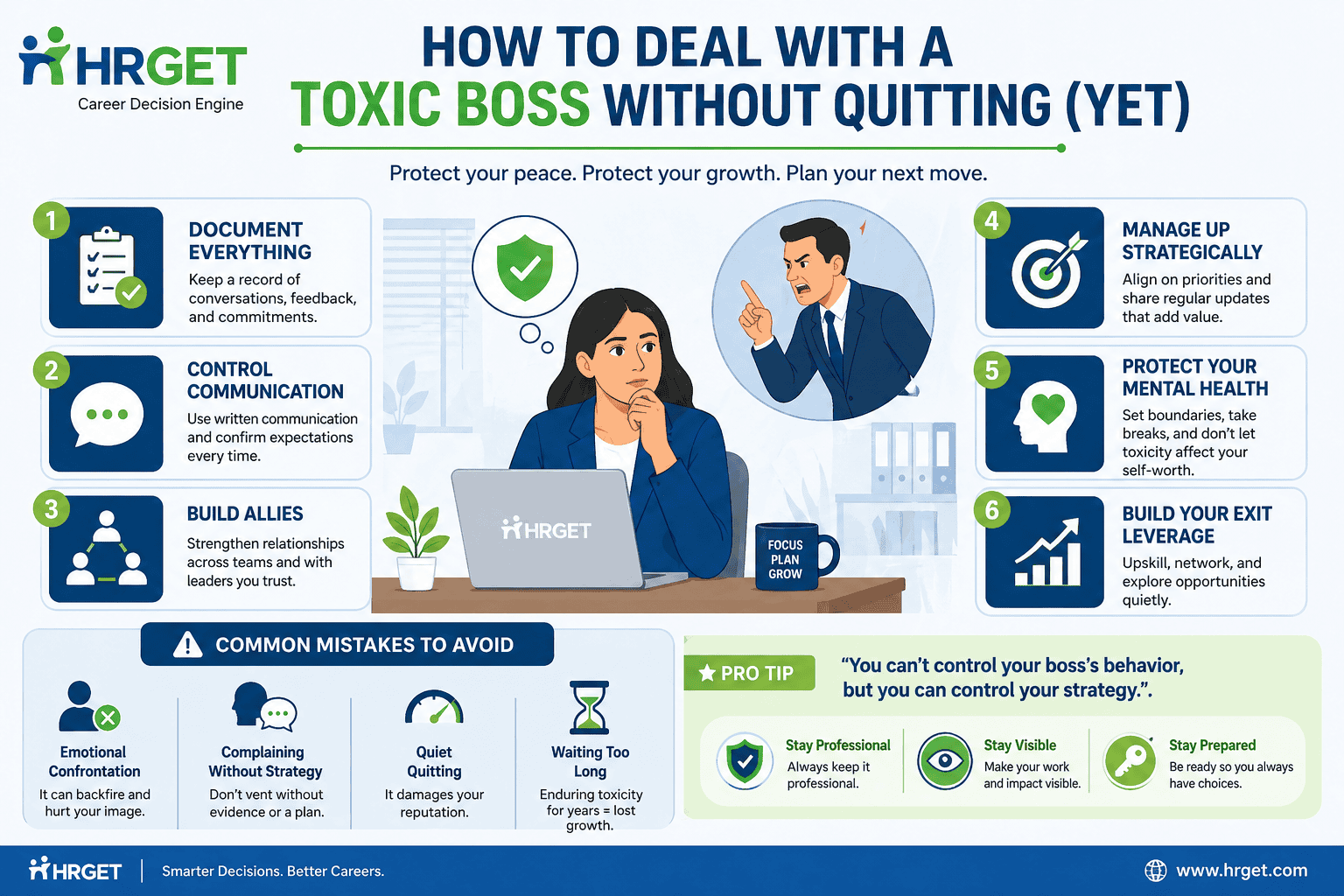
Step-by-Step Strategy to Deal With a Toxic Boss
Step 1 — Diagnose the Type of Toxicity
Not all toxic bosses behave the same, and your tactics need to match the pattern. Here are the four most common types I see in practice:
| Boss Type | Signature Behavior | Core Counter-Strategy |
|---|---|---|
| Control Freak | Constant check-ins, zero autonomy | Proactive weekly updates; preempt before they ask |
| Credit Stealer | Takes wins publicly, deflects blame | Build visibility with skip-levels; document outcomes |
| Emotional Manipulator | Uses guilt, fear, or favouritism | Written communication only; grey-rock emotional responses |
| Incompetent Leader | Creates chaos through poor decisions | Align on priorities formally; document confusion and escalation |
Your strategy from this point depends heavily on which box your boss falls into — or whether they straddle two.
Step 2 — Start Documenting Everything
This is the most important tactical move you can make, and most people wait too long to start.
Keep a private, timestamped log — not in your work laptop, ideally in a personal document or notes app — that tracks:
- Key conversations (date, who was present, what was said)
- Instructions that changed with no explanation
- Criticism that was unfair, disproportionate, or public
- Promises made and broken
- Any behavior that felt discriminatory, retaliatory, or harassing
Why does this matter? Documentation protects you during formal escalation, gives you clarity when emotional memory distorts reality, and is essential if you ever go to HR or an employment tribunal.
Pro Tip: Write like a lawyer, not a victim. “On 14 April, during the team standup, my manager stated X publicly in front of seven colleagues” carries far more weight than “my boss always embarrasses me.” Facts. Dates. Witnesses. Specifics.
Step 3 — Control Communication Before It Controls You
Most professionals react emotionally in the moment, then regret it. Here’s the better approach.
Shift as much communication as possible to written channels — email, Slack, project management tools. After any verbal instruction, send a follow-up confirmation:
“Just to confirm our conversation — you’d like X delivered by Friday EOD, with Y as the priority. Let me know if that’s changed.”
This does two things simultaneously: it reduces their ability to rewrite history, and it creates a paper trail that shows you as organized and professional — not reactive.
Summarize every key meeting in an email within an hour. It feels excessive. It’s not. It’s protection.
Step 4 — Manage Up Deliberately
You don’t need to like your boss. You need to manage them.
Managing up means understanding what your boss actually needs — their anxieties, their KPIs, their political pressures — and structuring your communication to reduce friction. Counterintuitive? Yes. Effective? Absolutely.
- Send a brief weekly update before they ask — control freaks calm down dramatically when they feel informed
- Start every project by aligning explicitly: “What does success look like for you on this?”
- Frame your wins in terms of their metrics, not yours
This isn’t flattery. It’s strategic friction-reduction while you prepare your next move.
Step 5 — Build Internal Allies Beyond Your Boss
A toxic boss is dangerous primarily because they may control your narrative inside the organization. Break that dependency.
Invest deliberately in:
- Skip-level relationships — your boss’s manager, senior leaders in adjacent teams
- Cross-functional collaboration — volunteer for projects that expose your work to other departments
- Visible contributions — present in all-hands meetings, contribute to internal channels, publish internally
Your professional reputation should never rest entirely on one person’s opinion of you. Build a distributed reputation across the organization — it’s both a safeguard and an exit ramp.
Step 6 — Protect Your Mental Bandwidth Ruthlessly
This is where most people break down before they can execute any strategy.
Working under a toxic boss is cognitively exhausting. You’re constantly threat-monitoring, second-guessing, and emotionally recovering. That leaves less bandwidth for the actual work that will get you out.
Practical protection tactics:
- Don’t respond to non-urgent messages instantly — it trains your nervous system that every ping is a crisis
- Separate work criticism from personal worth — their bad management is not feedback on your value as a professional
- Create hard stops on your workday; recovery time is part of strategy
- If symptoms of burnout or anxiety are appearing, speak to a mental health professional — this isn’t soft, it’s smart
In my work with professionals across the UK and US, the ones who navigate toxic bosses most successfully are the ones who protect their mental capacity first. The strategy only works if you’re functional enough to execute it.
Step 7 — Start Building Exit Leverage Quietly
Even if leaving isn’t imminent, options create power. The moment you have a competing offer — even one you don’t take — your posture in the current role shifts completely.
- Update your resume now — not when you’re desperate
- Reconnect with your professional network proactively
- Apply selectively to roles that represent genuine upgrades
- In the US: ensure your LinkedIn is set to “Open to Work” (recruiters only) to avoid visibility to your current employer
Options aren’t just a backup plan. They’re psychological leverage that will change how confidently you operate every single day.
Real Scenario: What Actually Works
Situation: Rahul, a mid-level product engineer at a mid-size tech firm in Bengaluru, had a manager who changed project priorities nearly every week, blamed the team publicly when deadlines slipped, and micromanaged every technical decision.
The instinct: Quit. Several colleagues already had. Rahul started looking — but stopped when he received an offer 8% below his current CTC, from a company with a 3.1 Glassdoor rating.
What he did instead:
- Started documenting every priority change in a private log with dates and email references
- Began sending a structured Friday summary email: what was delivered, what was pending, what changed
- Built a strong working relationship with the product managers his team served — they became his advocates
- Stopped arguing in the moment; used clarification questions instead
- Kept applying quietly, with better positioning this time
Result: Within three months, the documentation trail gave him credibility when the issue escalated to HR. More importantly, one of the product managers championed him for an internal transfer to a cross-functional team. He didn’t quit — he outmaneuvered. He left the toxic dynamic on his own terms, at the same salary band, with a better team and better prospects.
Smart Strategies Most People Miss
1. Use Clarification Questions as a Defence Mechanism
Instead of reacting to unreasonable demands or contradictory instructions, ask neutral clarification questions:
- “Can you help me understand the priority here given what was agreed last week?”
- “What changed from the earlier direction? I want to make sure I’m aligned.”
This forces accountability without emotional confrontation. It’s professionally neutral, genuinely hard to object to, and it subtly signals that you’re documenting the inconsistency. Many toxic bosses pull back when they realize someone is paying close attention.
2. Control Perception, Not Just Performance
Here’s something most HR literature glosses over: in a toxic boss situation, doing great work is not enough. If your boss controls the narrative about your work, your performance becomes invisible or distorted — regardless of what you actually delivered.
The fix is strategic visibility. Share updates broadly but naturally — not in a way that looks like you’re going around your manager, but in a way that makes your contributions visible across the organization. Highlight outcomes, not effort. “Our team reduced onboarding time by 30%” hits differently than “I worked really hard on the onboarding project.”
3. Stop Trying to “Fix” Your Boss
This is a trap I see constantly — especially among high-performing, conscientious professionals. They believe if they just communicate better, or understand the boss’s perspective, or demonstrate enough value, the behavior will change.
It rarely does. You are not their therapist, coach, or organizational development consultant. Your goal is to manage the impact of their behavior, minimize the damage, and maximize your own position. Nothing more, nothing less.
Common Mistakes That Backfire
❌ Emotional Confrontation
Calling out toxic behavior aggressively — even when you’re completely right — almost always backfires. The power imbalance, the lack of documented evidence in the moment, and the emotional framing all work against you. Even if colleagues privately agree with you, few will back you publicly in the heat of it.
❌ Venting to HR Without Documentation
Going to HR to “make a complaint” before you have documentation is a significant risk. HR’s primary obligation is to the organization, not to you. Without evidence, complaints often create retaliation risk rather than resolution. Always build your paper trail first.
❌ Quiet Quitting
Pulling back to minimum effort feels like reclaiming control — but it damages your own reputation, not theirs. You lose the leverage your performance gives you, and you hand the toxic boss ammunition to manage you out on paper. Don’t let their behavior determine your professional standard.
❌ Waiting Too Long Without Reassessing
Some professionals endure toxic environments for years under the belief that things will eventually improve, or that loyalty will be recognized. Check in with yourself every 90 days: Is the strategy working? Am I still building value? Is my health holding? If the answers are consistently no, the calculation has changed.
When You Should Actually Quit
Staying strategically is smart — but not unconditionally. There are situations where the calculus tips decisively toward leaving, and you need to be honest with yourself when that point arrives.
Leave if any of the following are true:
- Your mental health is seriously affected — persistent anxiety, sleep disruption, dread about going to work. These are not “soft” signals; they are clinical warning signs that the environment is causing active harm.
- Ethical or legal lines are being crossed — you’re being asked to falsify data, participate in discriminatory practices, or ignore legal compliance. No role is worth that exposure.
- Internal transfer is not possible — some organizations genuinely offer no escape route. If the structure is too flat or too small, the exit may have to be external.
- The pattern continues despite sustained strategic effort — you’ve applied the playbook for 3–6 months with no meaningful change. At some point, continued endurance is just endurance — with no upside.
Staying is only worth it if there’s a clear upside — skills you’re still building, a timeline you’re managing toward, or leverage you’re waiting to use. Once that’s gone, the math changes.
Exit Strategy: If You Decide to Leave, Do It Right
Don’t just resign. Execute a deliberate exit.
Step 1 — Secure an Offer Before You Move
Unless the situation involves immediate harm, never leave without a confirmed offer. Employed candidates receive better offers, face fewer questions, and negotiate from strength. In the US and India, the gap between “employed applicant” and “gap on resume” is still real in most mid-to-senior hiring processes.
Step 2 — Time Your Exit Intelligently
If you have any control over timing, leave after delivering a key project (strong last impression), and ideally before a performance review cycle that might be tainted by your manager’s narrative. Your notice period is your final professional moment in that organization — handle it with professionalism regardless of how you feel.
Step 3 — Control Your Narrative in Interviews
When asked why you’re leaving, keep the framing on growth and opportunity — never on your manager. “I’m looking for a team where I can take on broader ownership” is far more compelling than any variation of “my boss was terrible.” Interviewers will always wonder if the problem was you. Give them no reason to.
The Bigger Picture
A Toxic Boss Is a Career Stress Test — And You Can Pass It
Every professional who learns to manage difficult personalities, control communication under pressure, and build reputation independently — gains a set of skills that compounds across decades. The professionals I’ve worked with who handled a toxic boss situation well almost universally describe it as a turning point. Not because the boss changed, but because they did.
Frequently Asked Questions
Should I report my toxic boss to HR?
Only if you have clear, documented evidence and have thought through the potential consequences. HR’s primary function is to protect the organization — not the individual employee. Without documentation, complaints often create retaliation risk without any meaningful resolution. Build your paper trail first; escalate second.
Can a toxic boss permanently damage my career?
Only if they fully control your professional visibility and you allow it. The antidote is deliberate reputation-building beyond your immediate team — with skip-level managers, cross-functional peers, and external networks. A single manager’s opinion loses power the moment others form their own view of your work.
How long should I try to manage a toxic boss before leaving?
Three to six months of genuine strategic effort is a reasonable window. That’s enough time to know whether documentation, managing up, and visibility-building are shifting the dynamic. If conditions haven’t improved after six months — and your health is declining — the calculus has changed. Reassess at 90-day intervals.
Is it okay to emotionally detach from work during this period?
Emotional distance is a legitimate and healthy protective response — but it has limits. The goal is to stop personalizing your boss’s behavior, not to disengage from your own performance standards. Let them be difficult. Don’t let their behavior determine the quality of your work.
What if my boss is subtly toxic — not obviously abusive?
Subtle toxicity is often harder to navigate than overt behavior, because there’s nothing obviously reportable. Focus on documentation precision — specific language used, specific decisions made, specific patterns over time. And prioritize written communication above all else, so there’s always a record of what was actually said versus what gets reframed later.
Should I confront my toxic boss directly?
Only in very specific circumstances — when you have documented evidence, when your ask is specific and bounded (“I’d like us to agree that feedback stays in 1:1s, not team settings”), and when you can deliver it in a calm, professional frame. Emotional confrontation in the moment, without preparation, almost never produces a good outcome.
Can an internal transfer solve the problem?
Frequently yes — and it’s an underrated option. An internal transfer lets you keep your seniority, your institutional knowledge, your tenure benefits, and often your salary. In larger organizations especially, it’s safer and faster than an external job search. The key is to build the relationships that make a transfer possible before you need one.
The Winning Move Is in Between
Most people facing a toxic boss make one of two mistakes: they quit too early and lose leverage, or they stay too long and lose themselves. Neither is strategic.
The path through this is deliberate — diagnose the pattern, document everything, manage communication, build visibility beyond your boss, and protect your mental capacity while quietly building your options. Stay — but with a strategy. And when you do leave, leave on your terms, not because you were pushed into it.
That’s how you deal with a toxic boss without letting them define what comes next in your career.
📌 Related reading on HRGet.com: Signs of a Hostile Work Environment — and What You Can Actually Do About It

Organizational Psychologist & Workplace Behavior Advisor (Former consultant with Boston Consulting Group, research contributor aligned with Harvard Business Review)
Dr. Amelia Grant is an organizational psychologist specializing in burnout, toxic workplaces, leadership behavior, and employee mental resilience. She writes practical, research-backed workplace guidance for modern professionals.