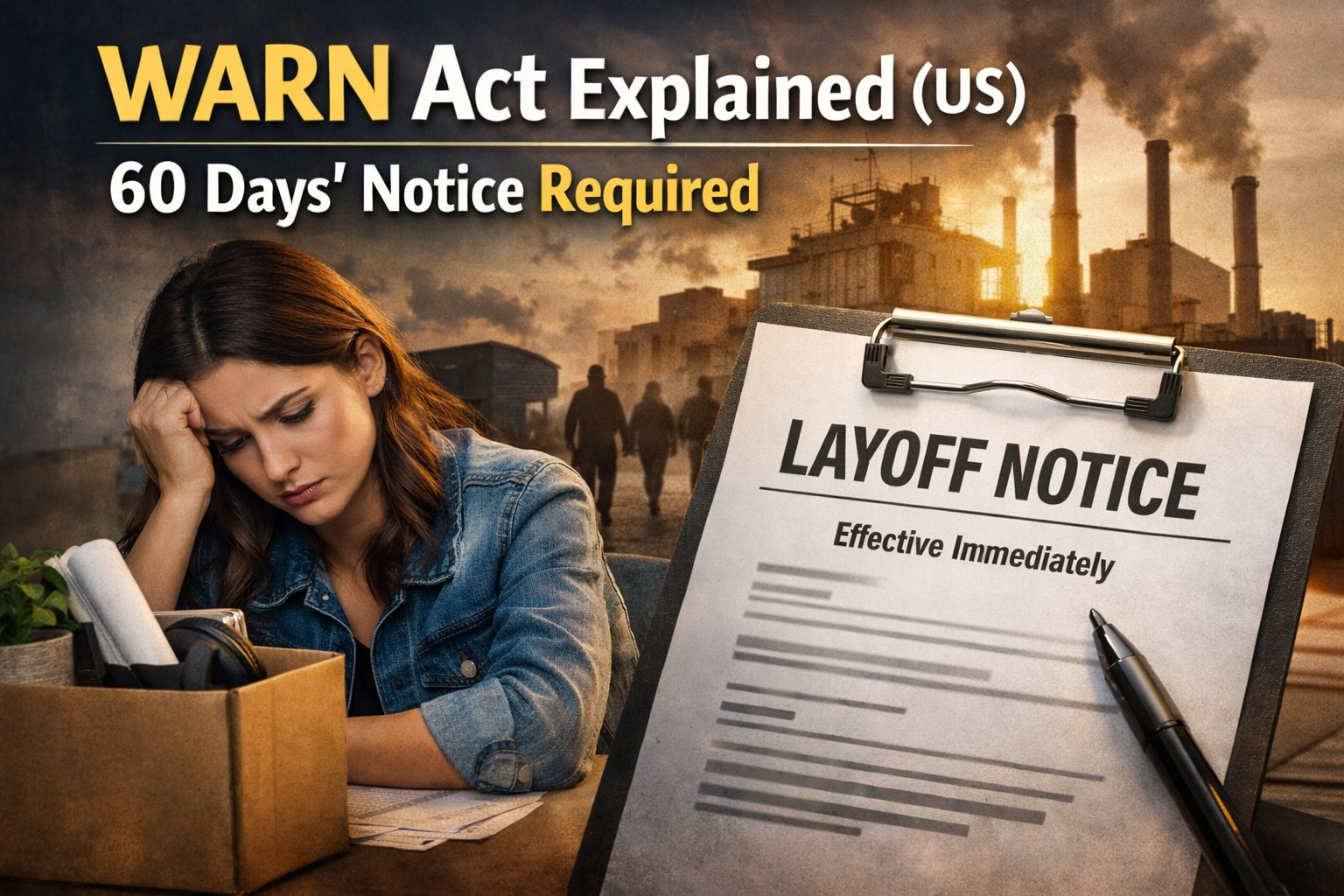
Getting laid off without a single day’s warning is a gut punch — financially and emotionally. No time to job hunt. No time to adjust your budget. Just a Tuesday afternoon meeting that ends your paycheck. What most employees don’t realize is that the WARN Act — the Worker Adjustment and Retraining Notification Act — may have legally required your employer to give you 60 days’ notice before that happened.
I’ve spent 15 years on the HR side of these conversations. I’ve watched companies navigate WARN obligations carefully — and I’ve seen others try to paper over violations with rushed severance checks. If you’ve recently been laid off, or if your company is rumbling with restructuring talk, this guide is the one you need to read before you sign anything.
By the end of this article, you’ll know exactly when the 60-day notice requirement applies, what you’re legally entitled to if it was ignored, and the four steps you should take right now to protect your claim.
What Is the WARN Act?
The Worker Adjustment and Retraining Notification Act — universally shortened to the WARN Act — is a federal US labor law enacted in 1988. Its core requirement is simple: certain employers must give at least 60 calendar days’ written advance notice before conducting a mass layoff or plant closure that affects a significant portion of their workforce.
The law was designed to do something basic but important — give workers time. Time to update their resume while still employed, time to arrange health insurance coverage before the gap hits, and time to plan their finances before the income stops. Without it, companies could (and did) eliminate hundreds of jobs overnight with zero warning.
The WARN Act is enforced through federal district court litigation. There’s no government agency that proactively investigates violations — which means if your employer ignored it, you have to be the one to pursue it. That’s exactly why understanding the rules matters.
The WARN Act is a federal baseline. Around a dozen states — including California, New York, New Jersey, and Illinois — have passed their own “mini-WARN” laws with stricter thresholds or longer notice periods. You may qualify under state law even if the federal law doesn’t apply to your situation.
When Does the 60-Day Notice Requirement Apply?
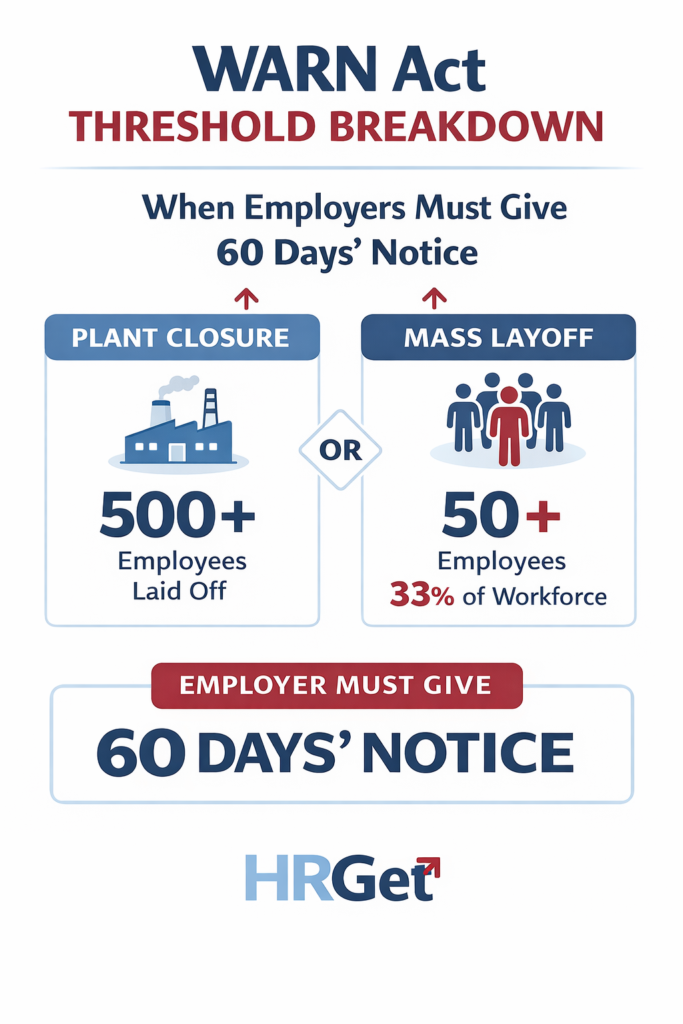
Here’s the actual trigger — and this is where most summaries get vague. The WARN Act’s 60-day notice requirement kicks in under two distinct scenarios: a plant closing and a mass layoff. They have different thresholds, and you need to know which one applies to your situation.
Plant Closing
A plant closing under WARN means the permanent or temporary shutdown of a single employment site — or one or more facilities within a site — that results in employment loss for 50 or more employees during any 30-day period. This doesn’t have to be a factory. It applies to offices, call centers, distribution hubs, and retail locations too.
Mass Layoff
A mass layoff is a workforce reduction that doesn’t involve a full site closure. WARN requires notice if the layoff during any 30-day period affects either:
- 500 or more employees at a single site, regardless of the percentage, OR
- 50 to 499 employees — but only if those employees represent at least 33% of the total active workforce at that location
That 33% threshold trips a lot of people up. A company laying off 150 people from a 1,000-person site (15%) likely doesn’t trigger WARN. The same 150 layoffs at a 400-person site (37.5%) almost certainly does.
Some employers split large layoffs into waves — 50 people in March, 60 in April — specifically to stay under WARN thresholds. Federal law has an aggregation rule: if multiple rounds of layoffs happen within 90 days and collectively hit the threshold, WARN may apply to all of them. Don’t assume phased layoffs are automatically exempt.
Who Is Covered — Employees and Employers
WARN doesn’t protect every worker, and it doesn’t apply to every employer. Getting clear on both sides of this equation will tell you quickly whether you have a viable claim.
Which Employers Must Comply?
The WARN Act applies to private-sector employers with 100 or more full-time employees, or 100 or more employees who together work at least 4,000 hours per week (excluding overtime). That last clause matters — a company with 120 part-time employees clocking 25 hours each per week falls under WARN because 120 × 25 = 3,000 hours, which is under the threshold. Do the math for your specific situation.
Nonprofit organizations are largely covered. Federal, state, and local government entities are not — though many states have separate notice requirements for public employers.
Which Employees Are Protected?
You’re a covered employee if you’ve worked for the employer for at least 6 of the last 12 months and average 20 or more hours per week. The law intentionally excludes:
- Independent contractors and temps (even if they’ve been on-site for years)
- Employees who work fewer than 20 hours per week on average
- Employees who have worked for the company for less than 6 months in the past year
- Business partners or franchise owners working at the site
Ask yourself: Have I worked here 6+ months? Do I average 20+ hours weekly? Is my employer a private company with 100+ full-time staff? If you answered yes to all three, you’re very likely a covered employee.
WARN Act Exceptions: The Loopholes Employers Use
Here’s where it gets adversarial. The WARN Act includes three exceptions that allow employers to shorten or eliminate the 60-day notice period — and these exceptions are frequently abused. I’ve personally reviewed termination packages where the “unforeseeable business circumstances” defense was so thin it bordered on laughable. Know these, because your employer’s legal team certainly does.
1. Unforeseeable Business Circumstances
This exception applies when the layoff is caused by a sudden, dramatic, and unexpected event that the employer could not have reasonably foreseen — think a major client abruptly canceling a contract that represented 40% of revenue. The key word is sudden. Gradual revenue decline, planned restructuring, or a known acquisition don’t qualify, no matter how the company frames it.
2. Faltering Company (Plant Closings Only)
This defense — available only for plant closings, not mass layoffs — lets employers argue they were actively seeking capital or business that would have prevented the closure, and that announcing WARN notice would have undermined those efforts. Courts scrutinize this heavily. The company must prove it had a realistic chance of obtaining the funding and that WARN notice would have sabotaged it.
3. Natural Disasters
Floods, earthquakes, storms, and similar natural disasters can excuse the notice requirement if the layoff was a direct result. This one is fairly straightforward and rarely contested.
Even when an exception applies, the employer is not fully off the hook. They must still give as much notice as practicable, explain the reason for the shortened notice in writing, and describe which exception they’re claiming. If they didn’t send that written explanation, the exception may not hold up in court.
Real Scenarios: What Actually Happens
Let’s make this concrete. Abstract rules are useful, but seeing how WARN plays out in realistic situations is where the understanding clicks.
The Tech Overnight Layoff
A mid-size SaaS company with 850 employees terminates 310 people in a single day after a funding round falls through. The HR team cites “unforeseeable business circumstances” and offers two weeks of severance.
WARN analysis: 310 ÷ 850 = 36.5% — well above the 33% threshold. The 60-day notice requirement was triggered. Whether the “unforeseeable” exception holds depends on how long the funding discussions had been ongoing. If the company had been in negotiations for months, the argument weakens considerably. Affected employees should consult an employment attorney before signing that severance agreement.
The Retail Chain Closure
A regional retail chain closes 18 stores simultaneously. Each store has between 12 and 20 employees. Total affected: roughly 270 workers.
WARN analysis: This is where the “single site of employment” definition matters. If each store is treated as a separate employment site, none of them individually hits the 50-employee plant-closing threshold. However, courts have sometimes aggregated nearby locations. This is genuinely a gray zone — and exactly the kind of case where a free consultation with an employment lawyer is worth your time.
The Startup Shutdown
A Series B startup with 82 employees runs out of runway and shuts down. No notice given.
WARN analysis: Federal WARN doesn’t apply — the company falls under the 100-employee threshold. But if this company was based in California (Cal-WARN kicks in at 75 employees) or New York (WARN applies to 50+ employees), those state laws may have been violated. Always check your state’s mini-WARN rules before concluding you have no case.
What You’re Owed If Your Employer Violated WARN
If your employer failed to provide the required 60-day notice and no valid exception applies, the damages available under the WARN Act are specific and significant. Courts don’t award punitive damages or emotional distress — but what they do award is real money.
For each day of violation (up to 60 days), a covered employee may be entitled to:
- Back pay — based on your regular rate of compensation, including overtime you would have earned
- Benefits compensation — including the value of health insurance coverage, pension contributions, and other employment benefits you lost during that period
Civil penalties of up to $500 per day for each day of violation can also be assessed against the employer — these go to local government, not directly to you, but they create pressure to settle.
If your base salary was $72,000/year ($6,000/month) and your employer gave zero notice, your potential WARN back pay claim is approximately $12,000 — two months of wages. Add the value of health coverage (often $600–$900/month for an individual plan), and the total claim could reach $13,200 to $13,800. That’s money worth pursuing.
One important nuance: if your employer offered any severance pay, the court may offset your WARN damages by the amount of severance received — unless the severance agreement explicitly stated it was separate from WARN obligations. This is yet another reason not to sign severance paperwork the same week you’re laid off.
Smart Strategy: Four Steps to Protect Your Claim
If you think WARN may have been violated in your layoff, here’s the tactical play. Time matters here — there’s a two-year statute of limitations on federal WARN claims, and some state mini-WARN laws have shorter windows.
Save your termination email, any written communication about the layoff, and the exact date you were notified. Note how many colleagues were let go and on what dates. This establishes the timeline you’ll need to calculate whether WARN thresholds were met.
California, New York, New Jersey, Maryland, Iowa, Tennessee, and several other states have WARN-equivalent laws with lower thresholds or longer notice requirements. Look up your state’s Department of Labor website or search “[your state] WARN Act requirements” before concluding that the federal rules don’t apply.
Most severance agreements include a clause waiving your right to sue the company. You typically have 21 days to review a severance offer (45 days if it involves a group reduction) under the Age Discrimination in Employment Act. Use that time. A signed severance waiver can eliminate your WARN claim entirely.
Most employment lawyers offer free initial consultations and take WARN cases on contingency, meaning they only get paid if you win. Organizations like the National Employment Law Project (NELP) can also provide guidance. A 30-minute call can tell you definitively whether you have a case.
Common Mistakes Employees Make After a Layoff
Layoffs are disorienting. When you’re processing the shock, it’s easy to make moves that quietly close the door on your legal options. These are the four I see most often.
Signing severance the day of the layoff. Employers sometimes create artificial urgency — “this offer expires Friday” — hoping you’ll sign before consulting anyone. You almost always have more time than they imply. Use it.
Assuming the layoff was legal because it was large. Scale doesn’t confer legality. A 500-person layoff without proper notice is a bigger WARN violation, not a smaller one. Large companies actually have more WARN exposure, not less.
Failing to track who else was let go. The WARN Act’s thresholds are triggered by headcount, not just your individual situation. If you lost touch with colleagues after the layoff, connecting with them — even briefly — can help establish whether the numbers crossed the legal threshold.
Waiting too long to act. The two-year federal statute of limitations sounds generous, but WARN claims involving multiple employees are often consolidated into class actions. Missing the window to join an existing case is a real risk if you delay. Act within the first few months if possible.
If you’re simultaneously evaluating your severance package, read our guide on negotiating severance after a layoff — including how to push back on terms before you sign.
Frequently Asked Questions About the WARN Act
Does the WARN Act apply to remote workers?
Yes, but the “single site of employment” question gets complicated for remote workers. The Department of Labor has issued guidance suggesting that remote employees may be grouped under the site where their supervisor is based, or under a primary worksite designated by the employer. If a mass layoff hits remote workers across the country, WARN thresholds could be triggered at those reference locations even if no one worked physically on-site.
Can I sue my employer under the WARN Act?
Yes. Employees can file a lawsuit individually or as part of a class action in federal district court. There is no administrative agency you need to file with first — you can go directly to court. Most employment attorneys handle WARN cases on contingency, so you typically pay nothing upfront. The statute of limitations is two years from the date of the WARN violation.
Does severance pay count as WARN compensation?
Not automatically. Severance and WARN back pay are legally separate obligations. However, if the severance agreement explicitly states it’s being provided “in lieu of WARN notice,” a court may offset your WARN damages by the severance amount. This is one reason to have an attorney review your severance agreement — the wording matters significantly.
What if my employer laid people off in phases to avoid WARN?
Federal WARN has an aggregation rule. If layoffs occur within a 90-day window and collectively cross the threshold, they can be treated as a single qualifying event — even if no single round triggered WARN on its own. Courts do examine employer intent in these situations. A pattern of phased layoffs that conveniently stays just below the threshold on each round raises a red flag legally.
Does the WARN Act apply to independent contractors?
No. The WARN Act protects employees, not independent contractors. Even long-term contractors who work exclusively for one company are excluded if they’re classified as contractors. That said, if you were misclassified — functioning as a full-time employee in all practical respects but paid as a contractor — that misclassification itself may be a separate legal issue worth exploring with an employment attorney.
My employer gave only 2 weeks’ notice. Can I still claim WARN damages?
Yes. WARN requires 60 days, not 14. If the 60-day threshold was triggered and no valid exception applies, you may be entitled to back pay and benefits for the remaining 46 days — even if you received some notice. Partial notice reduces the damages period but doesn’t eliminate the claim. Run the math: 46 days of wages and benefits can still add up to thousands of dollars depending on your salary.
Are nonprofit organizations covered by the WARN Act?
Most are. Private, non-governmental nonprofits that meet the 100-employee threshold are generally subject to WARN Act requirements. The main exemption is for government entities at the federal, state, or local level — those are not covered by the federal WARN Act, though state-specific notice laws may still apply to public employers in certain jurisdictions.
What is a “mini-WARN” law and does my state have one?
Mini-WARN laws are state-level statutes that mirror the federal WARN Act but often with stricter rules — lower employee thresholds, longer notice periods, or broader definitions of covered workers. As of 2026, states with notable mini-WARN laws include California (75-employee threshold, 60-day notice), New York (50 employees, 90-day notice), New Jersey (100 employees, 60-day notice), and Illinois (75 employees, 60-day notice). Check your state’s Department of Labor website for current rules.
WARN Act Quick Reference Table
| Situation | Federal WARN Applies? | Notes |
|---|---|---|
| 500+ employees laid off at one site | ✔ Yes | Clearly triggered regardless of workforce % |
| 50–499 layoffs = 33%+ of workforce | ✔ Yes | Both headcount and percentage thresholds must be met |
| Full site closure affecting 50+ employees | ✔ Yes | Plant closing trigger — separate from mass layoff rule |
| Employer has fewer than 100 employees | ✘ No | Check state mini-WARN; California threshold is 75 |
| Layoffs split across 90+ days to stay under threshold | ⚠ Maybe | Aggregation rule may still trigger WARN |
| Sudden disaster causes immediate shutdown | ⚠ Maybe | Natural disaster exception may apply if causal link is clear |
| Layoffs of independent contractors only | ✘ No | WARN covers employees, not contractors |
| Part-time employees averaging under 20 hours/week | ✘ No | Below the hours threshold for covered employee status |
The Bottom Line on the WARN Act
Most people assume a layoff is just bad luck — an unfortunate business decision that you accept and move on from. That assumption costs workers thousands of dollars every year. The WARN Act exists specifically because Congress recognized that employers hold enormous power in these moments, and workers need a legal floor.
If your layoff was sudden, affected a large group, and came with little or no notice — you may have a legitimate WARN Act claim, and you owe it to yourself to find out. Don’t sign severance paperwork before you understand your rights. Don’t assume the company’s HR team told you everything you need to know. And don’t wait: the clock on your claim starts the day of the layoff.
Get your documentation in order, check your state’s rules, and talk to an employment attorney. A free 30-minute call could be worth $12,000.