You just got the call — or worse, the calendar invite with no agenda. Your position is being eliminated. But instead of a clean exit with a severance check, HR tells you you’re being placed on “garden leave.” You’ll stay on payroll, technically employed, but you’re not expected to show up or do any work.
Sounds like a paid vacation, right? Not exactly.
Garden leave after a layoff is one of the most misunderstood arrangements in employment law, and I’ve watched smart professionals lose leverage — and money — because they didn’t know what they were actually agreeing to. After 15 years of managing workforce reductions and advising people on both sides of the table, here’s what I wish everyone understood before they signed anything.
This is where most professionals lose money. Not because garden leave is bad — but because they don’t understand what they’re holding.
Garden Leave After Layoff — Quick Summary
If you’re in a rush, here’s what you need to know right now:
| What’s True | What It Means for You |
|---|---|
| You’re still technically employed | Your benefits, insurance, and stock vesting may continue |
| You get paid (usually full base salary) | But bonuses and RSUs aren’t always included — check your agreement |
| You cannot join a competitor | Interviewing is usually fine; starting work is not |
| You can actively job search | Network, upskill, and line up offers with a future start date |
| Typical duration: 30–90 days | Senior roles and regulated industries can stretch to 6 months |
| Terms are negotiable | Especially during mass layoffs — the company wants a clean exit |
Don’t sign anything yet. Read the full breakdown below — especially the negotiation playbook and the checklist before you sign.
What Exactly Is Garden Leave (And Why Companies Use It During Layoffs)
Garden leave — sometimes called “gardening leave” — is a period where you remain employed and on payroll, but you’re told not to come into work. The name comes from the idea that you’re free to tend to your garden. Quaint, I know.
Here’s the thing: garden leave during layoffs isn’t a kindness. It’s a strategy.
Companies use it for three very specific reasons during workforce reductions:
Protecting sensitive information. If you’re a senior engineer at a fintech company or a sales director with deep client relationships, your employer doesn’t want you walking into a competitor’s office on Monday morning with everything you know. Paid garden leave during layoffs creates a cooling-off period — typically 30 to 90 days — where you’re still bound by your employment terms but gradually losing access to real-time company intel.
Enforcing non-compete clauses. In jurisdictions where non-competes are enforceable after layoff, garden leave is the mechanism that makes them hold up in court. A judge is far more likely to uphold a non-compete when the employer can show they paid you to sit out.
Avoiding wrongful termination exposure. This one’s less obvious. By keeping you “employed” during garden leave, the company can argue the layoff was structured and fair — not abrupt or retaliatory. It’s a legal buffer.
What most articles won’t tell you: garden leave is also a negotiating chip. If your company is offering it, they have something to protect — and that gives you leverage. HR won’t tell you this directly, but the harder they push garden leave, the more they’re worried about what you know.

Garden Leave vs Severance: They’re Not the Same Thing
I can’t tell you how many people I’ve seen confuse these two — and it costs them real money. Let me clear it up with a side-by-side breakdown.
| Factor | Garden Leave | Severance |
|---|---|---|
| Employment Status | Still employed | Employment terminated |
| Salary | Continues at full (usually) | Lump sum or installments |
| Benefits | Active — health insurance, retirement contributions, stock vesting | Typically end at termination (COBRA kicks in for US) |
| Non-Compete | Actively enforced — you can’t work for competitors | May or may not be enforced depending on agreement |
| Job Search | Restricted — can’t join a competitor or start working | Free to start a new role immediately |
| Tax Treatment | Taxed as regular income | Taxed as regular income (lump sum may push into higher bracket) |
| Negotiability | High — especially during layoffs | Moderate — usually follows company formula |
| Best For | Protecting equity vesting, maintaining benefits, needing time to job search | Clean break, immediate freedom, lump-sum financial cushion |
The biggest misconception? That garden leave is “basically severance.” It’s not. During garden leave, you’re still an employee. Your stock might keep vesting. Your employer-matched 401(k) contributions might continue. Your health insurance stays active without you paying COBRA premiums.
But — and this is the catch — you’re also still bound by every clause in your employment agreement. Non-competes, non-solicitation, confidentiality — all active and enforceable.
Before you decide which is better for your situation, make sure you understand the full picture on how to negotiate a better severance package — because sometimes the smartest move is asking for both.
Pro Tip: In some layoff situations, you can negotiate to receive both — a period of garden leave followed by a severance package. I’ve seen this work particularly well for director-level and above roles at tech companies. The company gets their cooling-off period; you get maximum financial runway. But you have to ask. Nobody’s going to offer this voluntarily.
Do You Get Full Salary on Garden Leave After a Layoff?
Short answer: yes, in most cases. But “full salary” can mean different things depending on your compensation structure — and the details are where professionals leave money on the table.
During a standard garden leave arrangement, your base pay continues unchanged. That’s the whole legal foundation — the company is paying you not to work, specifically to enforce restrictive covenants.
Here’s where it gets nuanced:
Base salary — almost always continues in full. If you’re making $145,000 a year as a senior product manager in the US, or ₹32 LPA as an engineering lead in Bangalore, your garden leave salary during layoff should keep hitting your account on the regular pay cycle.
Bonuses — this is where companies get slippery. Performance bonuses, quarterly incentives, and annual bonuses may or may not be included. Check your garden leave clause or separation agreement carefully. I’ve seen companies exclude “discretionary” bonuses during garden leave, which can cost you 15–30% of your total compensation. This is where most professionals lose money — and don’t even realize it until the quarter closes.
Stock and RSUs — critical for tech workers. If your RSU vesting schedule falls during the garden leave period, those shares should vest. But some companies will try to argue that garden leave is “inactive employment” for equity purposes. Get this in writing before you agree. A single vesting cliff can be worth $20,000–$80,000 depending on your grant.
Benefits — health insurance, dental, vision, life insurance, and retirement contributions typically continue during paid garden leave because you’re still an employee. This alone can be worth $1,500–$2,500/month in the US, or significantly more if you have family coverage.
I’ll be honest — the base salary piece is usually straightforward. It’s the bonus and equity components where companies save money and employees walk away poorer because they didn’t read the fine print.
Garden Leave Rules: What You Can and Can’t Do
This is the section that most people search for when they Google “garden leave rules” — and most articles get wrong by being too vague. Let me give you the actual rules.
What you’re typically allowed to do:
- Collect your full salary and benefits
- Use company equipment that’s been issued to you (laptop, phone) unless asked to return it
- Update your resume and LinkedIn profile — but be careful about changing your status to “Open to Work” publicly if your company monitors this
- Network privately, take informational interviews, and talk to recruiters
- Attend industry events (unless your agreement specifically prohibits it)
- Start an online course, get a certification, or skill up — this is actually the smartest use of garden leave time
What you’re typically not allowed to do:
- Start a new job — even part-time or freelance — with a competitor
- Solicit your former colleagues to leave the company
- Contact clients or customers you worked with
- Share proprietary information, trade secrets, or confidential data
- Publicly disparage the company (most agreements include a mutual non-disparagement clause)
- In some cases, start working for any employer without written permission — not just competitors
The gray area nobody talks about:
Can you interview with competitors during garden leave? Technically, interviewing isn’t “working for” a competitor. Most employment lawyers agree that attending interviews is permissible. But accepting an offer and starting before your garden leave ends — that’s a breach. The timing matters.
Here’s my advice: if you’re on garden leave and get an offer from a competitor, negotiate a later start date that falls after your garden leave period. Most hiring managers understand this. If they don’t, that tells you something about the company.
But here’s where the decision gets real — should you even accept garden leave in the first place?
Garden Leave Laws — US, India, and UK Compared
Garden leave doesn’t operate the same way everywhere, and the legal landscape has shifted significantly heading into 2026. Here’s what you need to know based on where you work.
United States
The US has no federal statute specifically addressing garden leave. It’s governed by your employment agreement and state contract law. The enforceability of garden leave after layoff — and the non-compete clauses it’s designed to protect — varies wildly by state.
As of 2026, the FTC’s proposed ban on non-compete agreements has faced legal challenges, and enforcement remains inconsistent. States like California, Colorado, Minnesota, and Oklahoma have strong bans or restrictions on non-competes, which weakens the purpose of garden leave in those states. Meanwhile, states like Florida, Texas, and Georgia still broadly enforce non-competes, making garden leave clauses more powerful.
What this means for you: If you’re being laid off in California and put on garden leave, the company has very limited ability to stop you from taking a new role with a competitor. The garden leave is essentially a paid buffer with few strings attached. In Texas? Different story entirely.
India
Garden leave in India has become more common in IT, consulting, and financial services — especially after the 2023–2025 wave of tech layoffs. Indian courts have generally been skeptical of non-compete clauses post-termination, viewing them as restraint of trade under Section 27 of the Indian Contract Act.
However — and this is a critical nuance — garden leave during the notice period is legally sound because you’re still employed. So if your notice period is 90 days and the company puts you on garden leave for that duration, they can enforce non-compete and non-solicitation clauses during those 90 days. The garden leave rules in India are evolving quickly, so this matters more than ever in 2026.
For a senior software engineer earning ₹28–45 LPA at a Tier 1 tech company in Bangalore or Hyderabad, a 60–90 day paid garden leave during layoffs is increasingly standard.
United Kingdom
The UK is where garden leave originated, and it’s the most clearly regulated. Garden leave is explicitly addressed in most employment contracts and supported by case law. Employers can place you on garden leave during your notice period, and they must continue paying your full salary and contractual benefits.
UK employers can also require you to stay away from the office, not contact clients, and not work for competitors during garden leave. Courts have upheld these restrictions — but only if the garden leave period is “reasonable.” Three to six months is typical for senior roles; anything beyond that gets harder to enforce.
The Insider View: What HR teams actually think about garden leave varies by region. In the US, it’s a risk-mitigation play. In India, it’s increasingly used to avoid ugly exits during mass layoffs — the optics of “we kept them on payroll” look better than “we terminated 200 people overnight.” In the UK, it’s just standard practice. Knowing this helps you understand what’s motivating the offer — and what you can push back on.
Should You Accept Garden Leave or Negotiate Out?
This is the decision most articles skip — and it’s the one that actually matters.
Garden leave after a layoff isn’t automatically a good deal or a bad one. It depends on your specific situation. Here’s a framework to think through it clearly.
When to ACCEPT garden leave:
- You have RSUs or stock options vesting soon. If a vesting cliff falls within your garden leave window, staying “employed” could be worth tens of thousands of dollars. Accept the garden leave and protect that equity.
- You need health insurance continuity. If you or a family member has ongoing medical needs, garden leave keeps your employer-sponsored coverage active. COBRA (US) or private insurance is expensive — ₹25,000–50,000/month in India for a family floater, or $600–$2,200/month in the US.
- You’re in a non-compete state or jurisdiction. If you’re in Texas, Florida, or the UK, the non-compete is likely enforceable anyway. Take the paid garden leave — at least you’re getting compensated for sitting out.
- You don’t have your next move lined up yet. Garden leave gives you income while you search. That’s a luxury most laid-off professionals don’t get.
When to NEGOTIATE OUT of garden leave:
- You already have an offer in hand. If a competitor wants you to start in two weeks, sitting on garden leave for 90 days costs you money and momentum. Negotiate a lump-sum severance instead and start the new role.
- You’re in California, Colorado, Minnesota, or another non-compete-ban state. The garden leave is protecting a non-compete that’s probably unenforceable. You have leverage to convert it into severance.
- The garden leave terms exclude bonuses and equity. If they’re only paying base salary and you’d lose a $30,000 bonus or a significant RSU vest, the math might favor a clean severance with those components included.
- You’re planning to freelance or start a business. Garden leave usually prohibits any work — not just competitor work. Severance gives you freedom.
Quick Decision Checklist
Ask yourself these five questions:
- Do I have stock vesting in the next 30–90 days? → Lean toward accepting
- Do I have a competing offer ready to go? → Lean toward negotiating out
- Am I in a state/country where non-competes are enforceable? → Accepting makes more sense
- Does the garden leave include my full compensation (bonus + equity)? → If yes, accept. If no, negotiate.
- Do I need active benefits coverage for medical reasons? → Lean toward accepting
If you answered “negotiate out” to 3 or more of these — go have that conversation with HR. You’ve got a strong position.
Real Scenario: How One Product Manager Used Garden Leave to Land a Better Role
Let me walk you through a situation I advised on — details changed, but the dynamics are real.
Priya was a Senior Product Manager at a mid-sized SaaS company in Pune, earning ₹34 LPA. In early 2025, her division was restructured, and her role was eliminated. The company offered her 60 days of garden leave — full salary, benefits intact — followed by a modest severance of two months’ pay.
Most people in Priya’s position would’ve signed and moved on. Here’s what she did instead.
First, she asked for the garden leave to be extended to 90 days. Her reasoning: she had an RSU cliff vesting at the 75-day mark worth roughly ₹4.5 lakhs. The company agreed — it cost them almost nothing, and they wanted a clean separation.
Second, she used the garden leave period strategically. She wasn’t allowed to work for a competitor, but she could interview. She treated those 90 days like a full-time job search. She updated her portfolio, took a short product analytics certification, and had 23 informational calls with her network.
Third, she negotiated her new offer’s start date to begin one week after garden leave ended — giving her a clean break and no contractual issues.
Priya landed a Director of Product role at a larger company in Bangalore at ₹52 LPA — a 53% jump. The garden leave didn’t slow her down. She turned it into a strategic advantage.
The takeaway isn’t that garden leave is great. It’s that the professionals who come out ahead are the ones who treat it as a structured opportunity, not a passive waiting period.

5 Costly Mistakes Professionals Make on Garden Leave
I’ve seen all of these — some of them more than once. And the worst part? They’re all avoidable.
Mistake #1: Treating garden leave as a vacation. Yes, you’re getting paid not to work. But this is the most valuable job-search window you’ll ever have — full income, no commute, no meetings. Every day you spend binge-watching instead of networking is a day wasted. I’ve seen people burn through their entire garden leave, then panic-apply for jobs in the final week. Don’t be that person.
Mistake #2: Violating the non-compete and thinking no one will notice. Companies do check. Especially in industries like finance, consulting, and enterprise tech. If your LinkedIn suddenly shows a new role at a direct competitor before your garden leave ends, expect a lawyer’s letter. It’s not worth it.
Mistake #3: Not negotiating the terms upfront. Garden leave terms — duration, salary components, stock vesting, reference letter commitments — are all negotiable during a layoff. Once you sign, your leverage disappears. I tell everyone: take 48–72 hours before signing anything, even if HR says the offer expires. They’re counting on urgency to stop you from thinking clearly.
Mistake #4: Forgetting about benefits continuation. Some companies quietly stop 401(k) matching or pension contributions during garden leave, even though base salary continues. Check your benefits portal, not just your bank account. This silent cut can cost you ₹50,000–₹1,50,000 over a 90-day garden leave in India, or $3,000–$8,000 in the US.
Mistake #5: Not getting the terms in writing. A verbal promise from your manager that “of course we’ll include the bonus” means nothing if it’s not in the separation agreement. HR won’t tell you this directly, but verbal commitments have zero legal weight. I’ve seen this go wrong enough times that I’m almost tired of saying it. Almost.
Smart Strategy: How to Negotiate Your Garden Leave Terms
If you’ve been offered garden leave as part of a layoff, here’s a step-by-step playbook to maximize your outcome. This is the part that could save you lakhs — or tens of thousands of dollars.
Step 1: Don’t sign anything in the room. In most jurisdictions, you have the right to review a separation agreement before signing. In the US, employees over 40 are legally entitled to 21 days to review under the Older Workers Benefit Protection Act (OWBPA). Use this time.
Step 2: Request a full breakdown of compensation during garden leave. Ask HR to confirm in writing: base salary, bonus eligibility, stock/RSU vesting, benefits continuation, and any accrued PTO payout. Get every component specified. If it’s not in the document, it doesn’t exist.
Step 3: Check your vesting schedule. If you have RSUs or stock options with a vesting cliff within 30–60 days of your layoff date, ask for the garden leave to extend through that date. This is often the single highest-value ask, and companies frequently agree because the marginal cost is low.
Step 4: Negotiate the non-compete scope. If your garden leave clause is tied to a non-compete, try to narrow the definition of “competitor.” Instead of “any company in the technology sector,” push for a specific list of named companies. This gives you far more freedom during your job search.
Step 5: Secure a reference commitment. Ask for a written agreement that your manager (or a specific HR contact) will provide a positive reference. During layoffs, managers often leave the company too — and verbal promises walk out the door with them.
Step 6: Ask about garden leave plus severance. This is the move most people don’t make. Frame it as: “I understand the garden leave is for 60 days. Given my tenure and role, would the company consider an additional 4–6 weeks of severance following the garden leave period?” You’d be surprised how often this works, especially when the company is laying off in bulk and wants smooth exits.
Now — before you walk into that HR meeting or sign that document, run through this checklist.
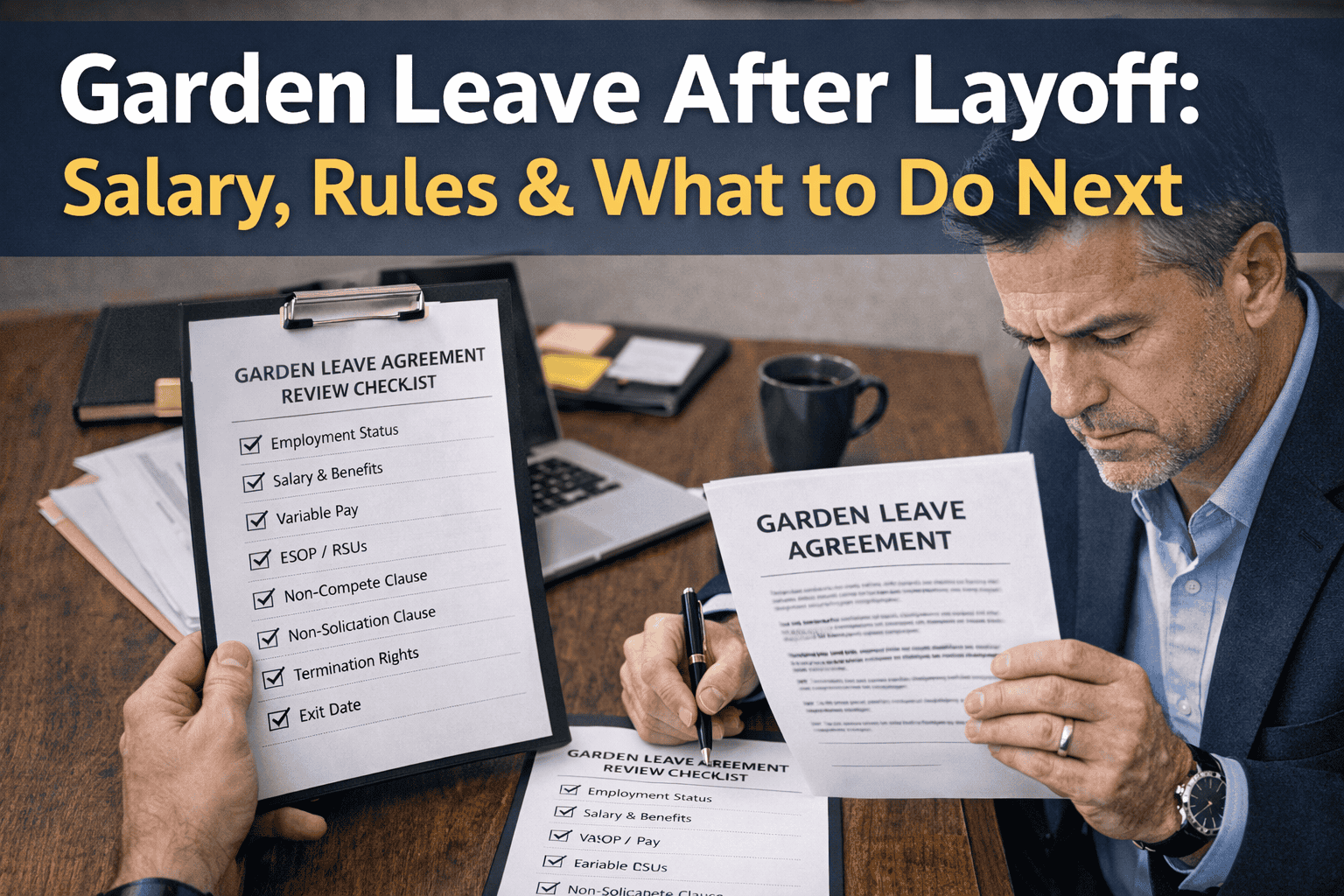
Garden Leave Checklist Before You Sign
Print this. Screenshot it. Tape it to your forehead. Whatever works. Just don’t sign your garden leave agreement without confirming every single item.
| # | Item | Confirmed? |
|---|---|---|
| 1 | Base salary continues at current rate through the entire garden leave period | ☐ |
| 2 | Bonus eligibility — are quarterly/annual bonuses included or excluded? | ☐ |
| 3 | RSU/stock option vesting — do shares continue to vest during garden leave? | ☐ |
| 4 | Health insurance and all benefits remain active | ☐ |
| 5 | 401(k)/PF matching — does employer contribution continue? | ☐ |
| 6 | Accrued PTO — is unused leave paid out, and when? | ☐ |
| 7 | Non-compete scope — which specific companies or industries are restricted? | ☐ |
| 8 | Non-solicitation clause — what’s the duration and scope? | ☐ |
| 9 | End date — exact date garden leave ends (not “approximately” or “around”) | ☐ |
| 10 | Reference letter — written commitment from a named individual | ☐ |
| 11 | Severance after garden leave — is there additional pay after garden leave ends? | ☐ |
| 12 | Equipment return — when and what do you need to return? | ☐ |
| 13 | Non-disparagement — is it mutual? (It should be.) | ☐ |
| 14 | Garden leave termination clause — can the company end garden leave early? If so, what happens to pay? | ☐ |
If any of these are vague, missing, or “to be discussed later” — that’s your signal to push back before you sign. You could lose lakhs in India or thousands of dollars in the US by skipping even one of these.
FAQ: Garden Leave After Layoff
Can my employer force garden leave during a layoff?
If your employment contract includes a garden leave clause, yes — the company can invoke it during a layoff. If there’s no such clause, you’d typically need to agree to it as part of a separation agreement. In either case, the employer must continue paying your full salary during the garden leave period.
Is garden leave pay taxable?
Yes. Garden leave pay is treated as regular employment income in the US, India, and the UK. Your employer will continue withholding income tax, Social Security (US), Provident Fund (India), or National Insurance (UK) just like normal. There’s no tax advantage — but there’s no extra burden either.
Can I start a new job while on garden leave?
Generally, no — not without your employer’s written permission. Garden leave is designed specifically to prevent you from working for competitors during the notice or cooling-off period. Starting a new role without permission can breach your contract and expose you to legal claims. However, you can actively interview, network, and accept offers with a future start date.
How long does garden leave typically last after a layoff?
In most cases, garden leave during layoffs ranges from 30 to 90 days. Senior executives and employees with significant client relationships or access to trade secrets may see garden leave periods of 3–6 months, especially in the UK and in financial services globally. The length is usually tied to your notice period or the duration of your non-compete clause.
Does garden leave count toward my employment tenure for future jobs?
Yes. Since you’re still technically employed during garden leave, this period counts as continuous employment. This matters for resume gaps, background checks, and tenure-based calculations at your next employer. Your official last day of employment is the day garden leave ends — not the day you stopped going to the office.
Can I negotiate out of garden leave and get severance instead?
Absolutely — and this is a smart move if you don’t have a binding non-compete or if you’re in a state like California where non-competes aren’t enforceable. You can ask the company to waive the garden leave and instead convert that period into a lump-sum severance payment. This frees you to start a new role immediately. The trade-off: you lose active benefits coverage sooner. Read our full guide on garden leave vs severance for a detailed comparison.
What happens if my company goes bankrupt during garden leave?
This is a real concern during mass layoffs. If the company enters bankruptcy, garden leave pay becomes an unsecured claim — meaning you’re essentially in line with other creditors. In the US, the WARN Act may provide some protection, requiring 60 days’ notice or pay in lieu for mass layoffs. Practically speaking, if you sense financial instability, it’s smarter to negotiate a lump-sum payout upfront rather than rely on continued garden leave payments.
Is garden leave common in India’s IT sector?
Increasingly, yes. Major IT services and product companies — particularly those with US or European parent entities — have adopted paid garden leave during layoffs as a standard part of separation packages since 2024. For employees at companies like Infosys, Wipro, TCS, and mid-size startups, a 30–60 day garden leave during layoffs has become fairly typical for roles at the senior engineer level and above.
Your Garden Leave, Your Move
Look, garden leave after a layoff isn’t inherently good or bad. It’s a tool — and like any tool, it works for whoever knows how to use it.
The professionals who come out ahead aren’t the ones who passively wait for the calendar to tick down. They’re the ones who negotiate the terms, protect their equity, use the runway to job search aggressively, and walk into their next role without a gap, without a legal headache, and often with a better title and salary than they had before.
If you’ve been placed on garden leave after a layoff, don’t just tend to the garden. Build the next chapter. And whatever you do — don’t sign until you’ve checked every line.
Before you sign anything → Read our complete guide on how to negotiate a better severance package. You could lose lakhs — or tens of thousands of dollars — if you skip this step.

Jonathan Reed: Executive Career Strategist & Leadership Advisor | Former Partner, McKinsey & Company | Executive Coach to Amazon & Unilever Leaders | 18+ Years in Career Strategy
Jonathan Reed spent nearly two decades as a Partner at McKinsey & Company, where he advised organisations on leadership development, talent strategy, and organisational design across the US, UK, and Asia. Since leaving consulting, he has worked as an executive coach to senior leaders at Amazon, Unilever, and a clutch of high-growth scale-ups — helping them navigate promotions, career pivots, and the unwritten rules of visibility and influence at the top. Based between London and New York, Jonathan writes for HRGet.com to give working professionals an honest look at how careers actually scale — and why so many talented people stall without ever knowing why.