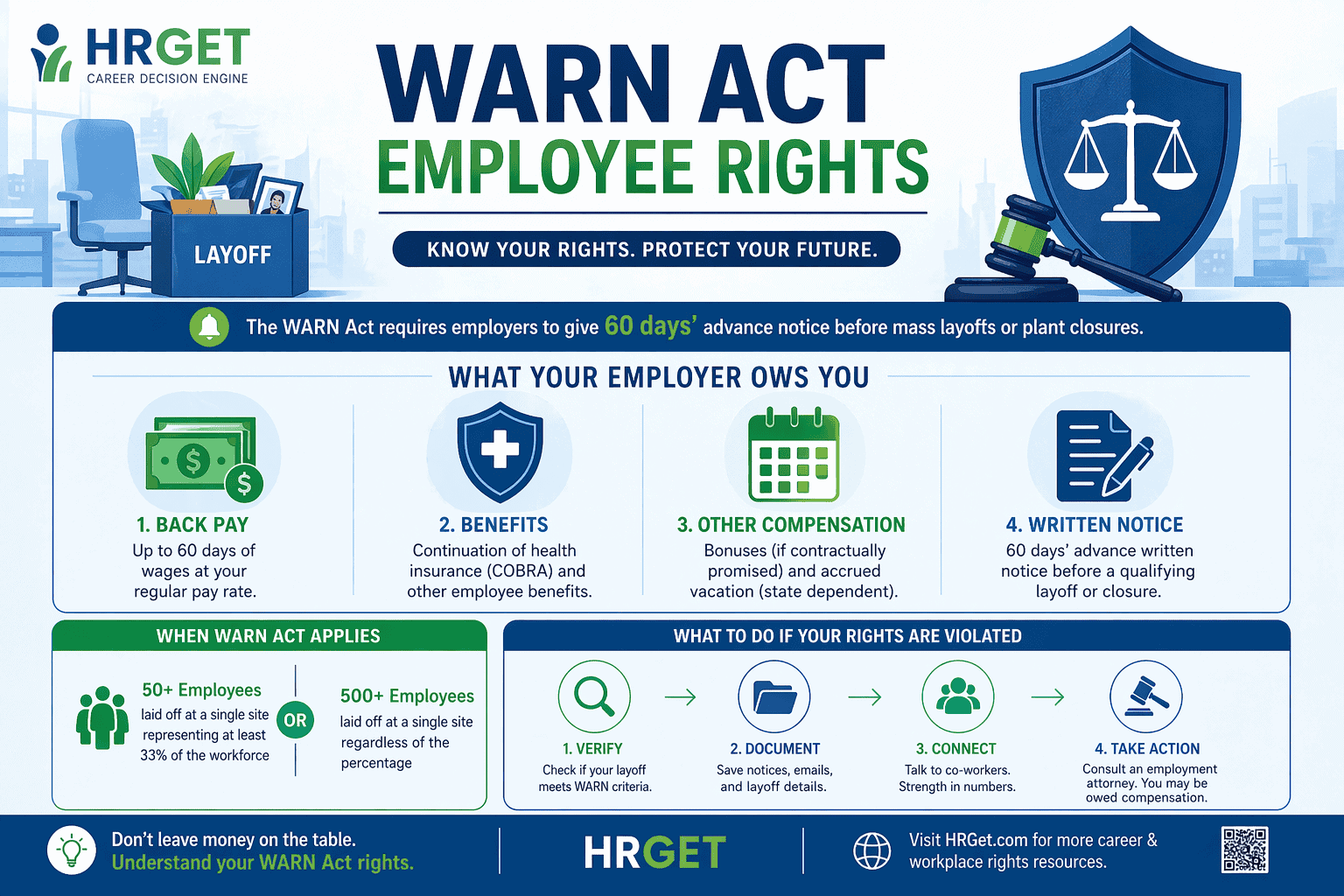
The WARN Act requires employers with 100+ employees to give 60 days’ advance notice before a mass layoff or plant closure. If they fall short, they may owe you up to 60 days of back pay plus benefits. This applies whether you were notified with two weeks, two days, or zero notice.
Most people only find out about their WARN Act employee rights after the layoff email has already landed. At that point they’re in shock, worried about their mortgage, and — honestly — not thinking about federal labor law.
That’s exactly what employers are counting on.
After 18 years handling workforce restructurings for Fortune 500 companies — first as Senior Counsel at Littler Mendelson, then as an independent severance advisor — I can tell you this without hesitation: a significant number of employees walk away from mass layoffs leaving thousands of dollars on the table. Not because they weren’t owed it. Because they didn’t know to ask.
This guide covers your WARN Act employee rights in plain English — what triggers them, what you’re owed, how employers try to sidestep them, and exactly what to do if yours has been violated.
What Is the WARN Act?
The Worker Adjustment and Retraining Notification (WARN) Act is a U.S. federal law passed in 1988. Its core requirement is simple: if you’re a covered employer planning a mass layoff or plant closure, you must give affected workers at least 60 calendar days of advance written notice.
If you skip that notice — or give less than 60 days — you don’t just get a fine. You owe each affected employee up to 60 days of back pay and benefits. That liability lands on the employer, not an insurance pool.
The law is enforced through federal civil lawsuits, not a government agency like the NLRB. Meaning: you or a class of employees typically have to file suit to collect. Which is another reason so many valid claims go unpursued.
Worth noting: many states have their own “mini-WARN” laws — New York, California, New Jersey, and Illinois among them — with lower thresholds and sometimes stricter notice periods than the federal standard. If you’re in one of those states, your rights may be even stronger than what’s described here.
Who Is Covered Under WARN Act Employee Rights?
Not every worker at every company qualifies. Here’s how to tell quickly whether you’re in scope.
You’re almost certainly covered if:
- Your employer has 100 or more full-time employees (part-timers working under 20 hours/week are excluded from the headcount)
- You’ve been employed for at least 6 months out of the past 12
- You work at least 20 hours per week
You’re not covered if:
- You’re an independent contractor or misclassified gig worker (though the “misclassified” part is worth scrutinizing)
- You work for a company with fewer than 100 full-time employees under federal law
- You’re a very recent hire who hasn’t crossed the 6-month threshold
Insider View
One tactic I’ve seen repeatedly in tech layoffs: companies reclassify certain roles as “contractors” right before a reduction. If your work arrangement changed in the months before a layoff, that reclassification could itself be legally vulnerable. Don’t accept contractor status at face value if it appeared suddenly.
What Counts as a “Mass Layoff”?
This is where employers get creative — and where many employees get confused. Under the federal WARN Act, a layoff qualifies as a “mass layoff” (and triggers the 60-day notice requirement) if it meets one of these tests at a single employment site:
| Trigger | Threshold | Notes |
|---|---|---|
| Mass layoff (size + share) | 50+ employees AND ≥33% of workforce | Both conditions must be met |
| Large mass layoff | 500+ employees at the site | Percentage doesn’t matter |
| Plant closure | 50+ employees affected | Applies to closures of an entire site |
Two things companies try that often don’t hold up in court:
Staggering layoffs across multiple weeks to stay under the 50-employee trigger at any one point. Courts look at the “rolling 90-day window” — if layoffs aggregate to WARN thresholds within that window, notice was required even if no single day hit the threshold.
Spreading layoffs across multiple sites when employees really worked at one location. If your company has a main HQ and a few satellite offices but everyone effectively reported to the same site, courts may aggregate those numbers.
What Employers Owe You Under the WARN Act
If a covered employer violates the WARN Act — meaning they didn’t give you 60 days’ notice — here’s what you’re legally entitled to recover for each day of shortfall (up to 60 days):
The WARN Act Damages Formula
- Back pay: Your regular wage rate × number of days of notice shortfall (max 60 days)
- Benefits: Employer’s cost of health insurance and any other employment benefits for the same period
- Bonuses: Contractually promised bonuses that would have been earned during the notice period
- Civil penalty: Up to $500/day for each day of violation (against the employer, paid to local government)
One critical clarification: WARN Act back pay is separate from severance. Severance is a contractual benefit your employer may or may not offer. WARN pay is a legal remedy for failing to give adequate notice. In the best-case scenario, you can receive both — though some severance agreements are written specifically to offset or eliminate WARN claims. More on that shortly.
Warning
The WARN Act does not automatically pay out. You — or a class of employees — must pursue the claim. If nobody acts, the employer keeps the money they should have paid you. That’s the uncomfortable reality.
Real Scenario: How Employees Lose $9,000+ Without Knowing
Real Scenario
A mid-size SaaS company lays off 130 employees across its Chicago office — about 38% of its workforce. Employees receive an email on a Tuesday and are told their last day is in two weeks.
The company offers a “generous” two-week severance package. Most employees sign it within a few days, grateful for anything at all.
Here’s what they didn’t know: the company had 58 days of WARN Act liability — the 60-day requirement minus the 2 days of actual notice.
An employee earning $6,000/month was owed approximately $11,600 in WARN back pay on top of whatever severance they accepted. By signing the standard severance agreement — which contained a broad release of all claims — they gave up that right entirely. For the price of two weeks’ pay.
I’ve seen this play out at companies of every size, from Series B startups to publicly traded corporations. The employees who fare best are the ones who pause before signing — even by just 48 hours — and get a quick attorney review.
Exceptions Employers Use — and Misuse
The WARN Act includes three recognized exceptions that allow employers to give less than 60 days’ notice. Here’s how they’re supposed to work, and how companies actually use them.
1. Unforeseeable Business Circumstances
The layoff was triggered by a sudden, dramatic business event that the employer couldn’t reasonably predict — like the overnight loss of a major contract that represented 40% of revenue. This is the most commonly invoked exception, and the most frequently abused. Courts have been clear that a general economic downturn, declining quarterly revenue, or known budget pressure does not qualify. The circumstances must be truly unforeseeable and sudden.
2. Faltering Company
The company was actively seeking capital or new business that, if obtained, would have allowed it to avoid the layoff — and notice would have undermined those efforts. This is a narrow exception and requires the employer to demonstrate a concrete, credible financing opportunity, not just general optimism about survival.
3. Natural Disaster
The layoff was a direct result of a flood, earthquake, drought, storm, or similar natural disaster. This one is legitimately narrow and rarely disputed.
Pro Tip
Even if an employer claims an exception, they must still give as much notice as practicable and explain in writing why the full 60 days wasn’t possible. If you never received that explanation, the exception claim gets a lot weaker in court.
The Insider View: How Companies Game the Threshold
Here’s what most WARN Act guides won’t tell you — because most are written by HR professionals whose job is to protect the company, not the employee.
Large employers with competent legal counsel don’t just ignore WARN. They engineer around it. Common methods I’ve seen across restructurings:
- Phased layoffs: Rolling out terminations in batches of 40–49 people every few weeks, trying to stay under the 50-employee single-event trigger
- Department shuffles: Moving workers to a different internal division before terminating them, so the headcount at the original “site” stays below threshold
- Performance exits as cover: Terminating a handful of employees “for cause” in the weeks before a mass layoff to reduce the official headcount
- Voluntary separation windows: Offering buyouts first, so the “involuntary” layoff count is lower
Some of these tactics are legally defensible. Others aren’t — particularly the 90-day aggregation rule, which is designed exactly to catch companies staggering their layoffs to game the numbers. If you were laid off in a series of rolling cuts, the total count across that 90-day window is what matters, not the count on any single day.
What to Do If Your Employer Violates the WARN Act
If you suspect a violation, the most important thing you can do is slow down. Don’t sign anything under time pressure until you’ve done these five steps.
Verify your actual notice period. What date did you receive written notice of the layoff? What is your last day of employment? The gap between those two dates is your notice period. If it’s under 60 days, the WARN Act may apply.
Determine the layoff size at your site. Talk to coworkers, check LinkedIn for announcements, and review any official company communications. You need to know whether 50+ employees were affected at your specific location. HR won’t volunteer this information.
Preserve all documentation immediately. Forward all relevant emails — layoff notice, severance offer, HR communications — to a personal email account before your company access is cut off. Save your offer letter and any bonus or equity agreements. You’ll need these.
Consult an employment attorney before signing severance. Many employment attorneys handle WARN Act cases on contingency — you owe them nothing unless you recover money. A one-hour consultation typically costs $150–$400 and can tell you whether you have a viable claim worth pursuing.
Check whether a class action has been filed. WARN violations are frequently litigated as group lawsuits because many employees are affected simultaneously. Search PACER (the federal courts database) for your employer’s name, or ask the attorney you consult.
Pro Tip
If you’re over 40, the Older Workers Benefit Protection Act (OWBPA) requires your employer to give you at least 21 days to review a severance agreement and 7 days to revoke after signing. If they pressured you to sign immediately, that may independently invalidate the release of claims.
Smart Strategy: How to Maximize Your Total Payout
Most people approach a layoff in damage-control mode. The ones who actually maximize their recovery approach it like a negotiation. Here’s the playbook.
Strategy 1: Don’t rush to sign severance — even if it feels awkward
Standard severance agreements almost always include a broad release of all claims, including WARN Act claims. The moment you sign, you’ve given up the right to sue. Take the full review period you’re legally entitled to. If you’re under 40, that’s whatever period they give you. If you’re over 40, it’s legally 21 days minimum.
Strategy 2: Know whether your employer can legally offset WARN pay against severance
Some employers structure severance payments as “pay in lieu of WARN notice” — which means they’re framing the severance as the WARN payment, not an additional benefit. Under the law, this is allowed, but only if the agreement explicitly states it. If your severance agreement doesn’t mention WARN, you may be entitled to both.
Strategy 3: Track the 90-day aggregation window
If your company did layoffs in waves — say, 30 people in January and 40 more in February — you want to verify whether the total within any 90-day window crossed the 50-employee threshold. If it did, WARN notice was required even if no individual batch triggered it.
Strategy 4: Leverage collective action
WARN violations are almost always group situations. The more employees involved, the stronger the legal pressure and the more likely an employer is to settle. Connecting with former colleagues who were also laid off can significantly strengthen a potential class action. One employee filing solo often gets ignored; 80 employees acting together gets the employer’s attention fast.
Decision Point: Should You Take Action?
| Your Situation | Recommended Action |
|---|---|
| Received full 60-day written notice | Likely compliant — review severance terms on their merits |
| Got less than 60 days notice | Investigate — calculate shortfall and verify employee count |
| 50+ employees affected at your site | High probability of valid WARN claim — consult attorney |
| Already signed severance quickly | Review the release language — may still have options if over 40 |
| Not sure of total employees affected | Talk to coworkers, check LinkedIn, consult attorney before signing |
Common Mistakes That Cost Employees Money
Mistake 1: Assuming a large company must be compliant. Big companies make WARN violations more often than small ones, not less — because they have the most restructurings and the highest headcounts. In 2024 and 2025 alone, multiple Fortune 500 tech companies faced WARN Act lawsuits over mass layoffs. Size is not a guarantee of compliance.
Mistake 2: Thinking severance covers everything you’re owed. Severance is what your employer chooses to give you. WARN back pay is what the law says you’re owed if they didn’t give proper notice. These are completely separate. One doesn’t satisfy the other unless the agreement explicitly says so.
Mistake 3: Deciding the claim isn’t worth pursuing. Run the math before you dismiss it. If you were earning $120,000/year ($10,000/month) and got only 5 days’ notice, your WARN claim is worth approximately $19,000 in back pay alone — before benefits continuation. That’s not a trivial number, and many attorneys take these cases for zero upfront cost.
Mistake 4: Expecting HR to tell you what you’re owed. I’ll be direct here: HR’s job is to manage the company’s exposure, not protect your rights. They are not your advocate in a layoff. That doesn’t mean every HR professional is acting in bad faith — but the structure of their role creates an inherent conflict of interest. Get your own counsel.
Mistake 5: Waiting too long to take action. The 90-day aggregation window runs backward from your termination. Evidence — internal communications, headcount data, contemporaneous records — becomes harder to obtain with every month that passes. If you suspect a violation, start gathering information now, not six months from now.
FAQ: WARN Act Employee Rights
Can I receive both WARN Act pay and severance at the same time?
Yes, in many cases. WARN back pay and severance are legally distinct — one is a statutory remedy, the other a contractual benefit. The catch is that many severance agreements include language that offsets or waives WARN claims. Always have an employment attorney review a severance agreement before signing, specifically for WARN-related waiver language.
What if I already signed a severance agreement?
It depends on the release language. A broad “release of all claims” likely waived your WARN rights. But if you’re over 40 and weren’t given the full 21-day review period required by the OWBPA, the waiver itself may be unenforceable. Consult an employment attorney — the window to challenge it may still be open.
Does the WARN Act apply to remote workers?
Yes. The DOL has clarified that remote employees count toward WARN Act thresholds and may be aggregated as a single “worksite” when they are geographically dispersed but report to the same operational location. The remote work arrangements that became standard post-2020 don’t exempt employers from WARN obligations.
How long do I have to file a WARN Act claim?
Federal courts have generally applied a 3-year limitations period, borrowing from the most analogous state statute. But don’t rely on that window. Evidence becomes harder to gather, class actions have separate filing deadlines, and the 90-day aggregation rule means you need contemporaneous evidence. Consult an attorney within 90 days of your layoff.
Can a startup with fewer than 100 employees avoid WARN?
Under federal WARN, yes — the 100-employee threshold is firm. But check your state. New York’s mini-WARN law covers employers with 50+ employees, and California’s WARN Act has similarly broad coverage. If you’re in a state with a mini-WARN law, your rights may be protected even if the federal law doesn’t apply.
What is the “unforeseeable business circumstances” exception?
This exception covers layoffs triggered by sudden, dramatic events the employer couldn’t have reasonably anticipated — like the overnight loss of a major contract. General economic conditions, declining revenue, or known budget pressure don’t qualify. Courts apply this standard narrowly, and employers must demonstrate they gave as much notice as was reasonably practicable under the circumstances.
Is WARN Act back pay taxable?
Yes. WARN Act back pay is treated as wages — it’s subject to federal and state income tax, Social Security, and Medicare withholding. Factor in a rough 22–32% tax haircut (depending on your bracket) when estimating your net recovery from a WARN claim.
Bottom Line
The WARN Act is one of the few employment laws that can directly put money back in your pocket after a layoff. But only if you know to claim it.
Companies move fast in a layoff for a reason. The faster you sign, the less leverage you have. Pause. Verify the headcount and notice period. Get a free or low-cost attorney consultation before you accept anything. Your WARN Act employee rights don’t enforce themselves — but when pursued, they can be worth tens of thousands of dollars.
Look, I understand the psychological pressure of a layoff. You want certainty. You want to move forward. And a severance check in hand feels a lot more real than a potential legal claim.
But here’s what I’ve seen repeatedly over 18 years: the employees who take 48 to 72 hours to understand their rights — and then decide — always fare better than the ones who sign immediately out of relief or fear.
Your WARN Act employee rights exist precisely because Congress recognized that workers are vulnerable at the moment of termination. Don’t hand that protection back to the employer by signing it away before you’ve read the fine print.
The next step is simple: if your layoff involved less than 60 days’ notice and 50 or more affected employees, spend $200 on an employment attorney consultation this week. It may be the best hourly rate you’ve ever paid.
Related Reading on HRGet.com
If you’re navigating a layoff, you’ll also want to understand your options around how to negotiate severance pay — especially how to push back on a standard offer before signing.

Michael Reeves | Former Senior Counsel, Littler Mendelson | Severance & Restructuring Specialist | 18+ Years in Employment Law
Author bio: Michael Reeves spent nearly two decades as Senior Counsel at Littler Mendelson — one of the world’s largest employment law firms — advising on mass layoffs, corporate restructurings, and severance negotiations for Fortune 500 companies across the US and Europe. He has worked both sides of the table: structuring cost-efficient separation packages for employers and, more recently, helping employees understand exactly where their leverage lies. Based between Chicago and London, Michael writes for HRGet.com to demystify the legal and financial dimensions of layoffs — so employees stop leaving money on the table.