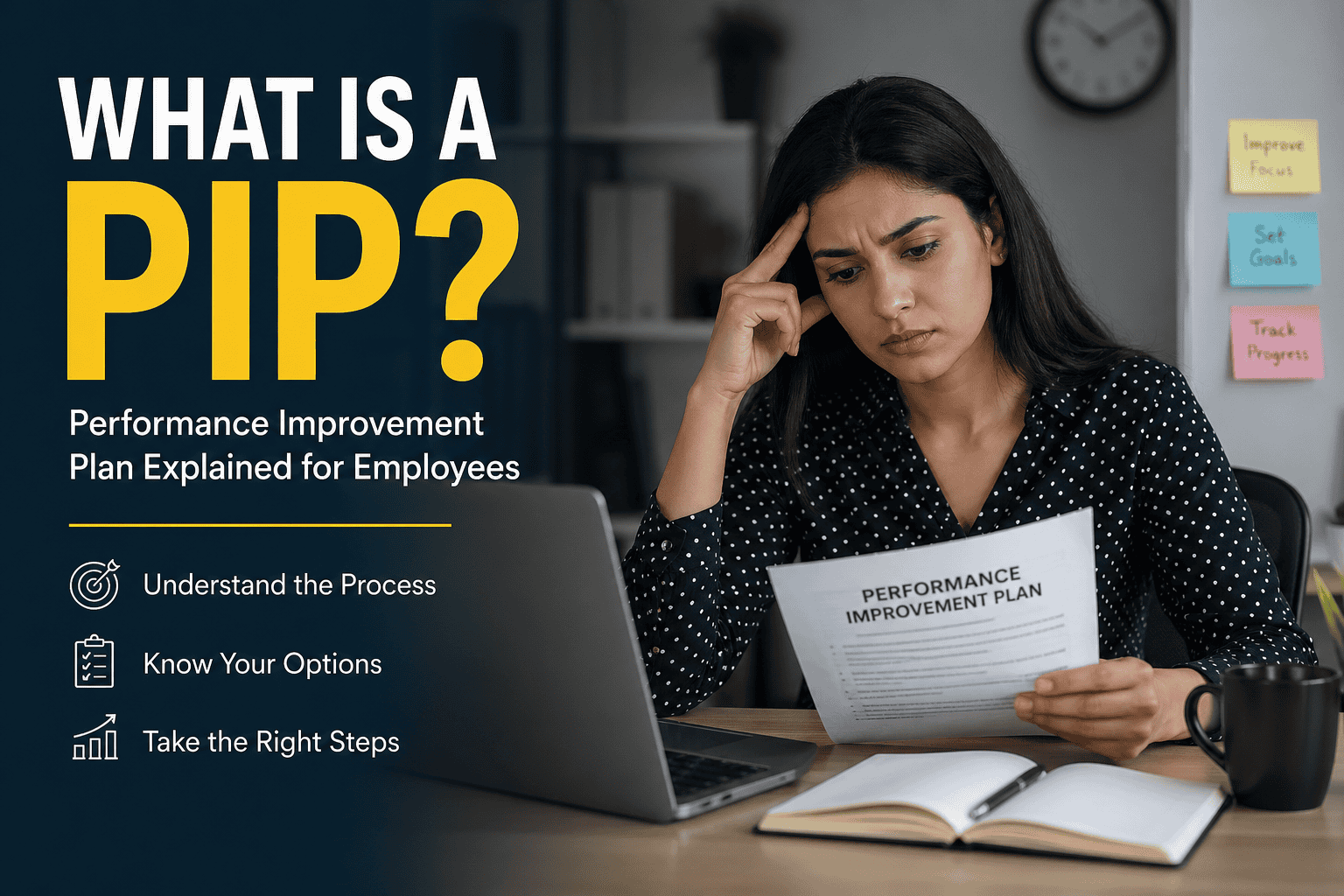
You open your inbox on a quiet Tuesday morning. There it is—a calendar invite from HR and your manager. Subject line: “Performance Improvement Plan Discussion.”
Your stomach drops. Your brain starts racing. Am I getting fired?
Here’s the honest answer: it depends. A PIP (Performance Improvement Plan) is one of the most misunderstood documents in corporate life. Some employees recover from one and go on to thrive. Others walk out the door within 60 days. The difference isn’t luck—it’s understanding what a PIP actually is and acting on that knowledge fast.
After 15 years working in HR across mid-size firms and large enterprises, I’ve seen PIPs used as genuine coaching tools and as polished exit strategies. This guide will tell you both truths—so you know exactly where you stand and what to do next.
What Is a PIP (Performance Improvement Plan)?
A Performance Improvement Plan (PIP) is a formal HR document issued when your employer believes your performance has fallen below an acceptable standard. It puts your situation in writing and creates a structured, time-bound path forward.
At its core, a PIP typically contains five elements:
- Specific performance issues — documented gaps with examples
- Clear expectations — what “acceptable” performance looks like going forward
- Measurable goals — targets with defined metrics, not vague instructions
- Timeline — usually 30, 60, or 90 days
- Consequences — explicitly stated: role change, demotion, or termination
In plain terms: A PIP is your employer saying, “Here’s what’s wrong, here’s what we need, and here’s how long you have to fix it—or we take action.” It’s formal. It’s documented. And it carries real stakes.
One critical thing most articles skip: the PIP process meaning is different in different companies. In well-run organizations, a PIP includes manager support, mentorship resources, and realistic timelines. In others, it’s a checkbox exercise before HR files the termination paperwork.
Why Companies Put Employees on a PIP
Let’s be direct—companies don’t always use PIPs purely for development. Here are the four actual reasons:
1. Genuine Performance Improvement
Yes, this happens. A manager notices a pattern—missed deadlines, communication breakdowns, quality issues—and wants to course-correct before it becomes permanent. In these situations, a PIP is structured coaching. Good managers deploy it for employees they genuinely want to retain.
2. Documentation for Termination
This is the part most people don’t want to hear. In many organizations, no one gets fired without a paper trail. HR requires documented warnings before approving a termination—especially in structured corporations or publicly listed companies. A PIP creates that paper trail efficiently and formally.
Red flag pattern: If you received a PIP with no prior verbal warnings, no previous feedback conversations, and your manager suddenly became distant—the PIP is almost certainly about documentation, not development.
3. Organizational Restructuring
During cost-cutting phases or quiet layoffs, PIPs become a filtering mechanism. Instead of announcing a reduction-in-force, companies use PIPs to let lower-rated performers “self-select out.” It’s cleaner legally and avoids WARN Act obligations in the US.
4. Managerial Misalignment
Sometimes a PIP has nothing to do with your actual performance. A new manager inherits a team, decides to rebuild it their way, and uses PIPs to remove people they didn’t hire. Or internal politics shift, and your work style clashes with where leadership is heading. I’ve seen strong performers get PIPs simply because a reorg changed who they reported to.
Is a PIP a Warning or a Termination Step?
The honest answer HR won’t usually say out loud: it can be both simultaneously. The document looks the same in either scenario. What’s different is the intent behind it—and you have to read that correctly.
| Situation | What It Likely Means | Your Risk Level |
|---|---|---|
| Supportive manager + specific, clear feedback | Genuine improvement opportunity | Low |
| Vague goals + no support resources offered | Exit process underway | High |
| Sudden PIP with zero prior feedback | Strong red flag — documentation play | Very High |
| Short 30-day window + unrealistic targets | Set up to fail | Very High |
| 60–90 days + coaching sessions scheduled | Company invested in outcome | Medium |
The document doesn’t tell you the intent. The context does. Read the room, not just the paper.
What a Typical PIP Looks Like
A standard PIP document—whether you’re in Mumbai, Chicago, or London—follows a recognizable structure. Here’s what each section means for you:
Problem Areas
Specific incidents with dates, impact descriptions, and prior feedback references. Example: “Missed sprint deadlines on three occasions in Q1 2026, impacting downstream delivery.” Pay close attention here—are these issues you caused, or were they systemic problems framed as individual failures?
Expected Improvements
Behavioral or output changes required. The quality of writing here is telling. Specific expectations (“complete all assigned tasks within agreed SLAs”) suggest genuine intent. Vague ones (“demonstrate ownership and accountability”) are hard to measure and easier to fail.
Measurable Goals
Numeric targets tied to a timeline: 95% on-time task completion, zero escalations, weekly status reports submitted by Friday. If the goals can’t be measured objectively, that’s a problem—it gives your manager subjective control over whether you “passed.”
Timeline
- 30 days — Extremely tight. Often signals low investment in the outcome.
- 60 days — Moderate. Possible to demonstrate real progress.
- 90 days — More realistic. Suggests the company wants to see sustained change.
Consequences
This section is always formal: role reassignment, demotion, or termination. Don’t skim it. The consequences section tells you exactly what’s at stake and what HR has already approved.
Real Scenario: How PIPs Actually Play Out
Scenario A — Genuine Recovery
Rahul, Software Engineer — Bengaluru
Rahul had been missing sprint deadlines for two months. The root cause was unclear task prioritization from his tech lead, but the impact was real. His manager flagged it and issued a 60-day PIP with a structured weekly check-in and a redesigned sprint board to reduce ambiguity.
Rahul treated the PIP like a project: he documented every completed task, flagged blockers early in writing, and asked for formal mid-PIP feedback in week four. He cleared it comfortably.
Outcome: PIP closed successfully. Rahul received a positive annual review six months later.
Scenario B — Silent Exit
Neha, Product Manager — Delhi NCR
Neha was put on a PIP with no prior verbal warning. Her manager had changed three months earlier. The goals were broadly written (“improve stakeholder management”) with no measurable benchmarks. No coaching or resources were offered. Her skip-level manager stopped responding to her emails.
Neha fought hard but had no way to objectively prove success because success wasn’t defined. She was let go on day 47.
Outcome: The PIP was a documentation exercise for a termination decision already made.
Scenario C — Strategic Exit
Arjun, Senior Financial Analyst — Mumbai
Arjun recognized within the first week that his 30-day PIP had unrealistic targets. His manager had been given a headcount reduction mandate. Rather than exhaust himself trying to survive an unfair process, Arjun immediately activated his network, updated his resume, and had two interviews lined up by week two. He resigned on day 21 with an offer in hand.
Outcome: Controlled exit. No termination record. Joined a competitor at a ₹4 LPA increment.
Can You Survive a PIP?
Yes—but survival rates depend heavily on the environment and intent, not just your effort. Based on patterns I’ve observed across organizations, here’s a rough reality check:
| Environment | Estimated Survival Rate | Key Factor |
|---|---|---|
| Supportive manager, clear goals, genuine intent | 55–70% | Manager committed to coaching |
| Mixed intent — some support, some politics | 30–50% | Your ability to document and over-deliver |
| Toxic environment or pre-decided outcome | <20% | Exit strategy more important than performance |
Here’s the counterintuitive truth: surviving a PIP is sometimes the wrong goal. If the environment is toxic or the company has already decided, staying and fighting burns time and energy you could spend landing a better role elsewhere.
Smart Strategy: What to Do Immediately After Getting a PIP
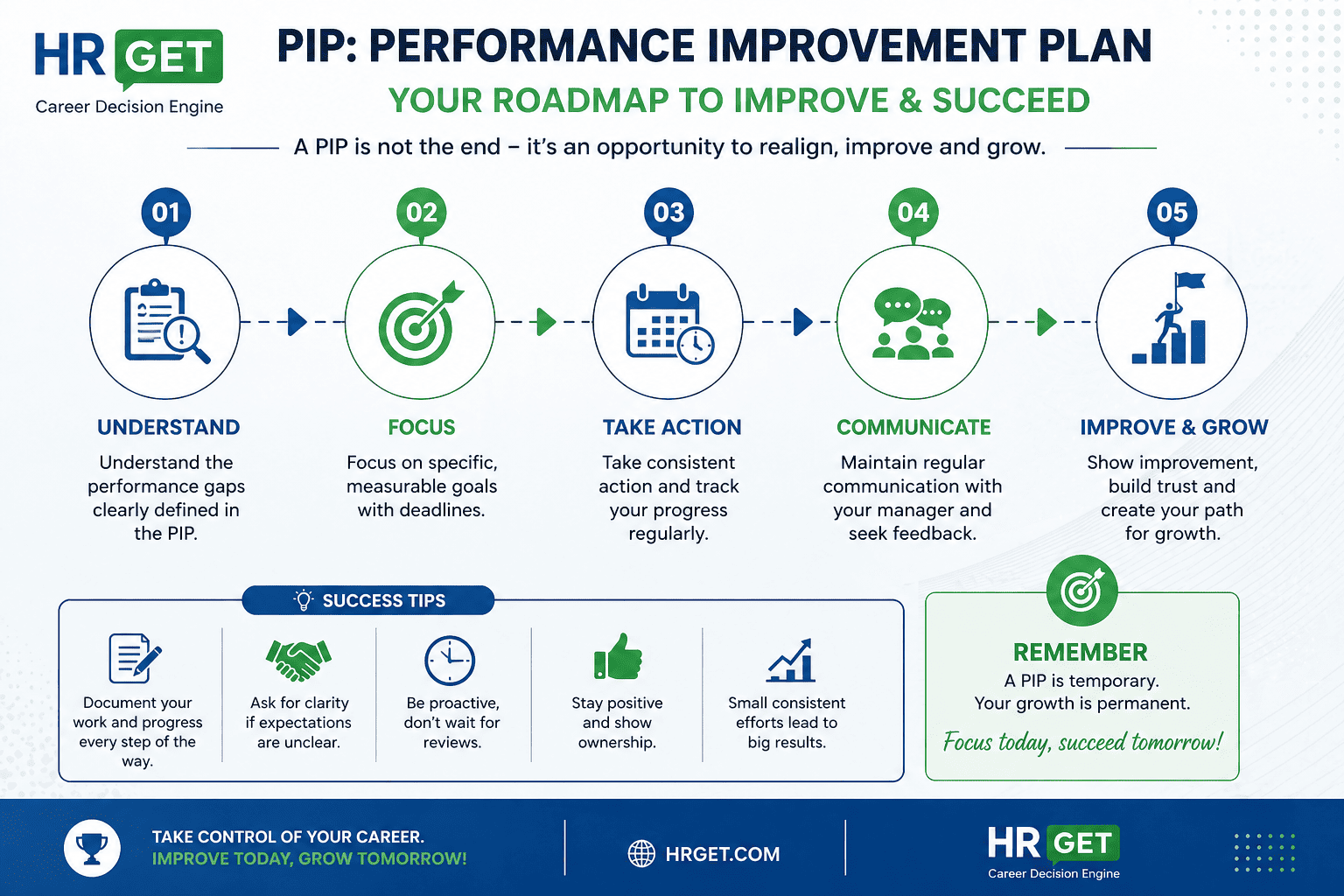
The first 72 hours after a PIP meeting are the most important. Most employees either freeze up or react emotionally—both are costly mistakes.
-
1
Don’t React — Absorb
Thank your manager calmly, take the document, and ask for 24 hours to review it. Don’t sign anything immediately. Don’t argue, don’t cry, don’t apologize excessively. Neutral professionalism buys you time and preserves your options.
-
2
Decode the Intent
Ask yourself: Was I warned before this? Are the goals specific and measurable? Is support being offered? Has my manager’s behavior toward me changed recently? Your answers determine whether you fight to stay or plan to exit gracefully.
-
3
Clarify Everything in Writing
Send an email to your manager asking: What does a successful outcome look like? How will progress be assessed? What happens if I meet all targets? Getting these answers in writing creates accountability—and protects you if the goalposts shift.
-
4
Over-Communicate Visibly
Weekly progress summaries. Completed tasks documented in writing. Blockers flagged proactively via email. During a PIP, visibility matters more than effort—because effort you don’t document effectively doesn’t exist in the record.
-
5
Start Your Job Search Immediately
This is not pessimism. This is risk management. Even if you plan to pass the PIP and stay, a parallel job search gives you leverage, reduces anxiety, and ensures you’re not starting from zero if things go badly. In India and the US alike, a quiet job search costs you nothing while you’re still employed.
Pro Tip — From HR Insider Perspective
Build allies outside your immediate reporting line. Your skip-level manager, key stakeholders, and cross-functional partners can validate your performance independently. If they’re willing to vouch for your work quality, that social proof matters—especially if your direct manager’s assessment is the only negative voice in the room.
Common Mistakes That Kill Your Chances
Mistake 1 — Treating it as “just feedback”A PIP is a formal legal-grade HR document. It triggers HR review processes and is filed in your employment record. The moment you sign it, you’ve acknowledged the performance concerns as real. Take it with the seriousness it deserves.
Mistake 2 — Getting defensive or emotionalArguing in the PIP meeting, sending frustrated emails, or venting to colleagues all damage your credibility and give HR more documentation to work with. Neutral, professional, and focused is your only mode during this period.
Mistake 3 — Working hard but invisiblyEffort that isn’t documented doesn’t count. Your manager is building a file either way. Make sure your completed work, communications, and improvements are timestamped and visible. Effort ≠ documented results.
Mistake 4 — Not preparing a backup planEmployees who assume they’ll clear the PIP and do nothing else often end up scrambling for a job after termination—a much weaker negotiating position than searching quietly while employed. Start the backup plan on day one.
Mistake 5 — Signing without readingRead every word before signing. You can acknowledge receipt without accepting every claim. Ask HR if you can sign a note that says “Received and reviewed” rather than “Agreed.” Many employees don’t realize this is an option.
Should You Quit During a PIP?
This is the most personal decision in the whole process—and the answer depends on your read of the situation.
| Consider Quitting If… | Consider Staying If… |
|---|---|
| Goals are vague or objectively unreachable | Goals are specific, fair, and achievable |
| No support, no coaching, no resources offered | Manager is actively coaching and checking in |
| You already have a competing offer | You genuinely want to repair the relationship |
| Culture is toxic and affecting your health | One strong reference from this role is valuable |
| Timeline is 30 days — clearly set up to fail | You have financial commitments that need runway |
The best move in most situations: Stay and job-hunt quietly. You keep your income, you avoid a gap on your resume, and if you land an offer, you exit on your own terms—not theirs.
Legal & HR Perspective — India vs US
The mechanics of a PIP differ meaningfully depending on where you work.
In India
PIPs are primarily internal HR processes. Indian labor law — the Industrial Disputes Act for blue-collar workers and the new Labour Codes (effective 2025–26) for formal sector employees — provides stronger protection for workers in manufacturing and organized sectors, but most IT, BFSI, and services sector employees have limited formal recourse against a PIP-driven termination.
In practice, employers in India’s private sector have significant flexibility to issue PIPs and exit employees — especially in Tier 1 cities. Your strongest protection is your employment contract’s notice period clause, which must be honored regardless of a PIP outcome.
In the US
In the US, PIPs serve a dual function: performance management and legal protection for the employer. Under at-will employment law (applicable in most states), companies can terminate employees for almost any reason — but documented cause reduces the risk of wrongful termination lawsuits. A PIP creates that documentation.
If your PIP coincides with a protected status event — you recently reported harassment, disclosed a disability, or took FMLA leave — consult an employment attorney. A PIP issued suspiciously close to a protected action can be relevant in a retaliation claim.
Bottom line in both jurisdictions: PIPs are designed primarily to protect the company’s ability to terminate — not to protect your job. Knowing this shifts how you should respond.
PIP vs Warning vs Termination
| Aspect | Verbal / Written Warning | PIP | Termination |
|---|---|---|---|
| Formality | Low to medium | High — HR-approved document | Final — legally binding |
| Documentation | Minimal (email or meeting note) | Detailed with timelines and targets | Full file, exit paperwork |
| Recovery chance | High — early-stage signal | Medium — depends on intent | None at this role |
| HR involvement | Often informal | Always formal — HR signs off | HR and Legal both involved |
| Intent | Alert and course-correct | Improve or exit | Exit only |
The Insider Truth Most People Miss About PIPs
Here’s what most articles on this topic won’t say clearly: a PIP isn’t primarily about your performance. It’s about perception and company protection.
Even if you execute flawlessly during the PIP period, if leadership has already decided you’re not the right fit for where they’re heading, perfect execution may not be enough. I’ve seen employees genuinely outperform their PIP targets and still lose their roles — because the decision was made before the document was ever drafted.
That’s not cynicism. That’s the reality of how performance management works in organizations where the PIP is used as a legal formality. Knowing this doesn’t mean you should give up — it means you should hedge simultaneously: fight to stay and build your exit strategy.
Frequently Asked Questions
What is a PIP in simple terms?
A Performance Improvement Plan (PIP) is a formal HR document that identifies performance gaps and sets specific, measurable goals the employee must meet within a defined time — typically 30 to 90 days — or face consequences including termination. It’s both a structured improvement tool and a legal record for the company.
Is a PIP always a sign I’m about to be fired?
Not always, but it’s a serious warning that shouldn’t be minimized. Whether it leads to termination depends on the intent behind it. A sudden PIP with vague goals and no support is a much stronger exit signal than one with a supportive manager, clear targets, and a 90-day runway. Read the context, not just the document.
How long does a PIP typically last?
Most PIPs run for 30, 60, or 90 days. A 30-day PIP is unusually short and often signals the company isn’t genuinely invested in the outcome. A 60–90 day window gives you more realistic time to demonstrate sustained improvement and document your progress effectively.
Can you refuse to sign a PIP?
You can refuse, but it rarely helps. Refusing to sign often accelerates the exit timeline and eliminates any goodwill you might have had. A better approach: ask to add a note that you are “acknowledging receipt” rather than “agreeing with all stated concerns.” Many HR teams will accept this. Consult an employment attorney if the stakes are high.
Should I start job hunting while on a PIP?
Yes — always. Even if you plan to fight hard and pass the PIP, a parallel job search is straightforward risk management. You lose nothing by interviewing quietly. You lose significant leverage if you’re terminated and then begin searching from a position of unemployment.
What happens in India if you fail a PIP?
In India’s private sector — especially IT, BFSI, and services — failing a PIP typically leads to termination with the notice period specified in your employment contract. Employees are generally entitled to their full notice period pay (or payment in lieu) and provident fund settlement. Formal legal recourse under labor law is limited for most white-collar private-sector employees.
Is a PIP legally binding?
A PIP itself is an internal HR document, not a contract. However, it becomes legally significant once signed by both parties and can be used as evidence in wrongful termination proceedings or employment disputes. In the US, it helps employers demonstrate “documented cause.” In India, it supports the company’s narrative in any severance or dispute process.
Can you negotiate the terms of a PIP?
Yes — and more employees should try this. You can request clearer metrics, a longer timeline, specific resources or training, or a mid-point review. Frame it professionally: “I want to set myself up to succeed — can we ensure these targets are measurable and achievable?” A manager who wants you to succeed will work with you. One who doesn’t will reveal that quickly.
Final Takeaway: What a PIP Really Means for Your Career
A Performance Improvement Plan is a career inflection point — not just a performance tool. How you respond in the first week often determines the outcome more than anything you do in the remaining 29 to 89 days.
You have three realistic paths when you receive a PIP:
- Recover and stay — clear the PIP, rebuild trust, reclaim your standing
- Exit on your terms — recognize an unfair process, job-hunt immediately, resign with an offer
- Get pushed out — react emotionally, miss the signals, and get terminated without a plan
The first two outcomes are entirely within your control. The third only happens when you treat a PIP casually or let panic drive your decisions.
What is a PIP, ultimately? It’s a document. But how you treat it — as a wake-up call, a battle worth fighting, or a signal to move on — that’s what actually shapes what comes next.
🔍Wondering if your company is trying to manage you out without a formal PIP? Read our guide on Quiet Firing: Signs Your Employer Wants You to Leave Without Saying It — and how to protect yourself.

Emily Carter is a career coach and former McKinsey talent advisor with 15+ years of experience helping professionals navigate career transitions, promotions, and high-stakes job decisions. She has advised professionals across consulting, technology, finance, and corporate leadership roles on offer negotiations, career positioning, and long-term growth strategy.
Role: Career Coach & Ex-McKinsey Talent Advisor: Focuses on helping professionals make smarter career moves—switching jobs, negotiating offers, and long-term career growth. She blends structured thinking with real-world coaching insights.